


Compare
The short answer
Most people searching for a Drata alternative want one of three things: a lower or more predictable price, coverage of regimes outside the US audit set, or control over where evidence is stored. Vanta and Secureframe are the closest like-for-like swaps. Sprinto is the lighter, cheaper option for small teams. Venvera is the different-shaped answer if your obligations are European or Gulf and you need to file with a regulator rather than only satisfy an auditor. If you are a US company that needs SOC 2 and nothing else, Drata is a genuinely good product and switching may buy you very little.
Disclosure: Venvera is one of the products compared here, so treat the Venvera rows as an interested party's account. Everything said about other vendors is drawn from their own public documentation and pricing pages, checked in August 2026. Vendors change their products; verify anything that matters to your decision before you sign.
On this page
Why people look for a Drata alternative
The reasons cluster tightly, and knowing which one is yours removes most of the shortlist immediately. Two head-to-head views sit alongside this one: Drata vs Vanta and Secureframe vs Drata.
- Renewal pricing. Drata does not publish prices. Foundation, Advanced and Enterprise all route to a sales conversation, so the number you pay is negotiated and the number you pay next year is negotiated again. Teams often start looking at renewal rather than at first purchase.
- Regimes beyond the US audit set. Drata covers a broad framework catalogue, but organisations facing European or Gulf regulation frequently find the depth is elsewhere.
- Data residency. Where evidence physically sits becomes a contractual question for European buyers and for anyone answering a regulator about outsourcing.
- Weight. Some small teams want less product than the category leaders build, at a price that reflects that.
What Drata is genuinely good at
Worth stating plainly, because a comparison that only lists the other side's weaknesses is not useful to a buyer.
Drata is one of the two most complete compliance automation platforms in the market. Its integration library is large, its continuous control monitoring is mature, and its audit workflow is built around how US audit firms actually run engagements. It has invested heavily in trust centers and security questionnaire automation, including through acquisition. For a US software company whose compliance problem is SOC 2 followed by ISO 27001, it is a strong default and the burden of proof sits with anything trying to displace it.
Nothing below argues that Drata is a poor product. The argument is that "best product" and "best fit" are different questions, and fit is decided by which regimes you answer to.
The shortlist, and who each one suits
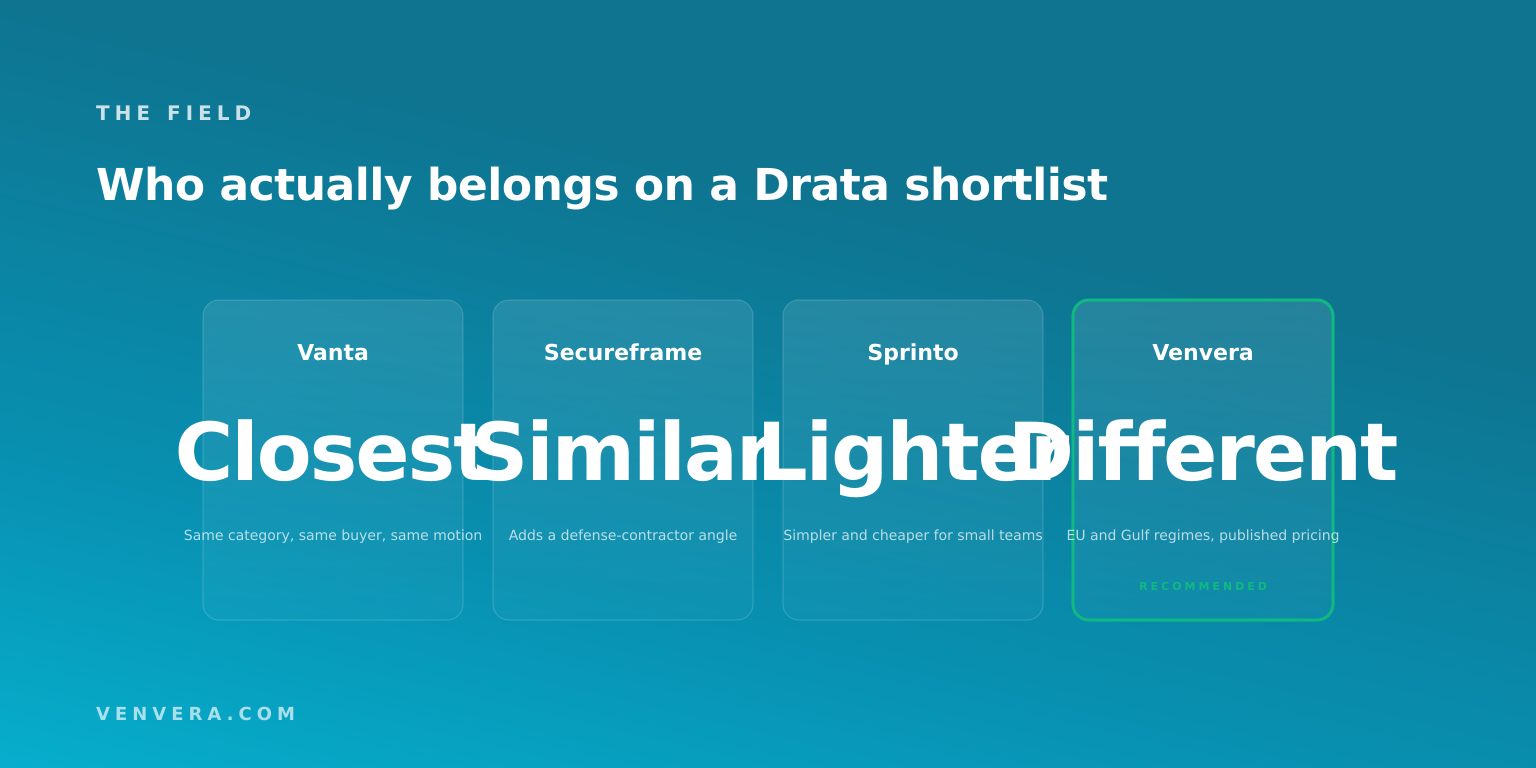
Vanta. The closest comparison and the other market leader. Same buyer, same motion, comparable automation and integration depth. Switching between the two is largely a commercial decision rather than a capability one, which is why so much of the category's content is Vanta and Drata comparing themselves to each other.
Secureframe. Similar positioning with a notable focus on defense-sector work, which matters if CMMC is on your roadmap.
Sprinto. Lighter and generally cheaper. A reasonable answer for a small team whose honest requirement is one or two frameworks and a clean audit, rather than a GRC platform.
Scrut and Apptega. Both appear consistently on this query. Apptega is built around managing many client programmes from one place, which makes it interesting to service providers rather than to end users.
Venvera. A different shape. Built for organisations whose obligations are European, Middle Eastern or African as well as the familiar audit standards, where the deliverable is often a regulatory submission rather than an auditor's evidence pack. Published flat pricing from EUR 399 per month, and data held in the EU.
Comparison table
| Drata | Vanta | Sprinto | Venvera | |
|---|---|---|---|---|
| Published pricing | No, contact sales | No, contact sales | No, contact sales | Yes, from EUR 399 per month |
| Best fit | US SOC 2 and ISO 27001 at scale | Same category, same buyer | Small teams, one or two frameworks | EU, Gulf and Africa regimes alongside the audit set |
| Integration library | Large and mature | Large and mature | Good, narrower | Smaller, focused on posture and evidence |
| Trust center | Mature, including acquired capability | Mature | Available | Included |
| Regulatory filing | Audit evidence focus | Audit evidence focus | Audit evidence focus | DORA Register of Information in xBRL-CSV |
| Data residency | US-headquartered platform | US-headquartered platform | US-headquartered platform | EU, Amsterdam |
| Track record | Long, large customer base | Long, large customer base | Established | New product, no customer references yet |
Read the last row carefully. Drata and Vanta have years of deployments behind them and Venvera does not. If a long reference list is part of your evaluation criteria, that is a real and current point against us, and you should weigh it.
Four questions that decide your answer

| Question | If the answer is... | Then look at |
|---|---|---|
| Which regimes must you satisfy? | US audit standards only | Drata, Vanta or Secureframe. Little reason to move |
| EU or Gulf regulation as well | A platform that maintains those control sets natively | |
| Do you submit anything to a regulator? | No, auditors only | Any of the category leaders |
| Yes, filings and returns | Check the submission format is produced, not just the evidence | |
| Does data residency appear in your contracts? | No | Not a differentiator for you |
| Yes, EU residency is required | Confirm where evidence is stored, contractually | |
| How do you want to be priced? | Comfortable negotiating annually | The incumbents are fine |
| You want a published number | Venvera publishes; most of the category does not |
Where Drata and Venvera stop overlapping
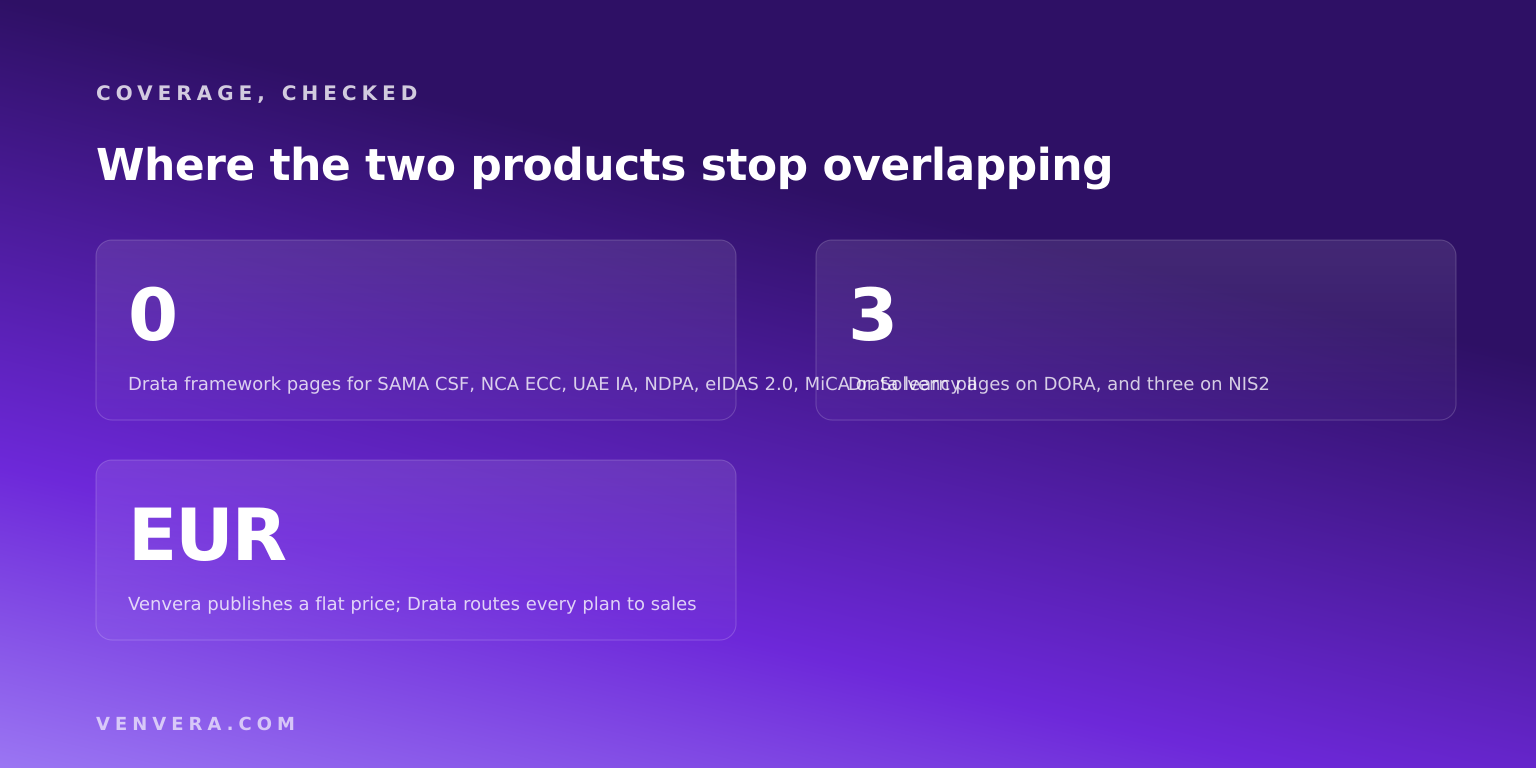
Drata's published framework pages cover a broad set: SOC 2, the ISO 27000 family, ISO 42001, HIPAA, GDPR, PCI DSS, CMMC, FedRAMP, the NIST family, HITRUST, NYDFS, TISAX, CIS, CCM, CCPA, Cyber Essentials, Essential Eight, Microsoft SSPA, NIS2, DORA, CPS 230 and custom frameworks. That is a serious catalogue and it covers most US and Commonwealth buyers completely.
They list no framework page for SAMA CSF, Saudi NCA ECC, UAE Information Assurance, Nigeria's NDPA, eIDAS 2.0, MiCA, Solvency II or the Cyber Resilience Act. Those are the regimes Venvera was built around, alongside the audit standards everyone supports.
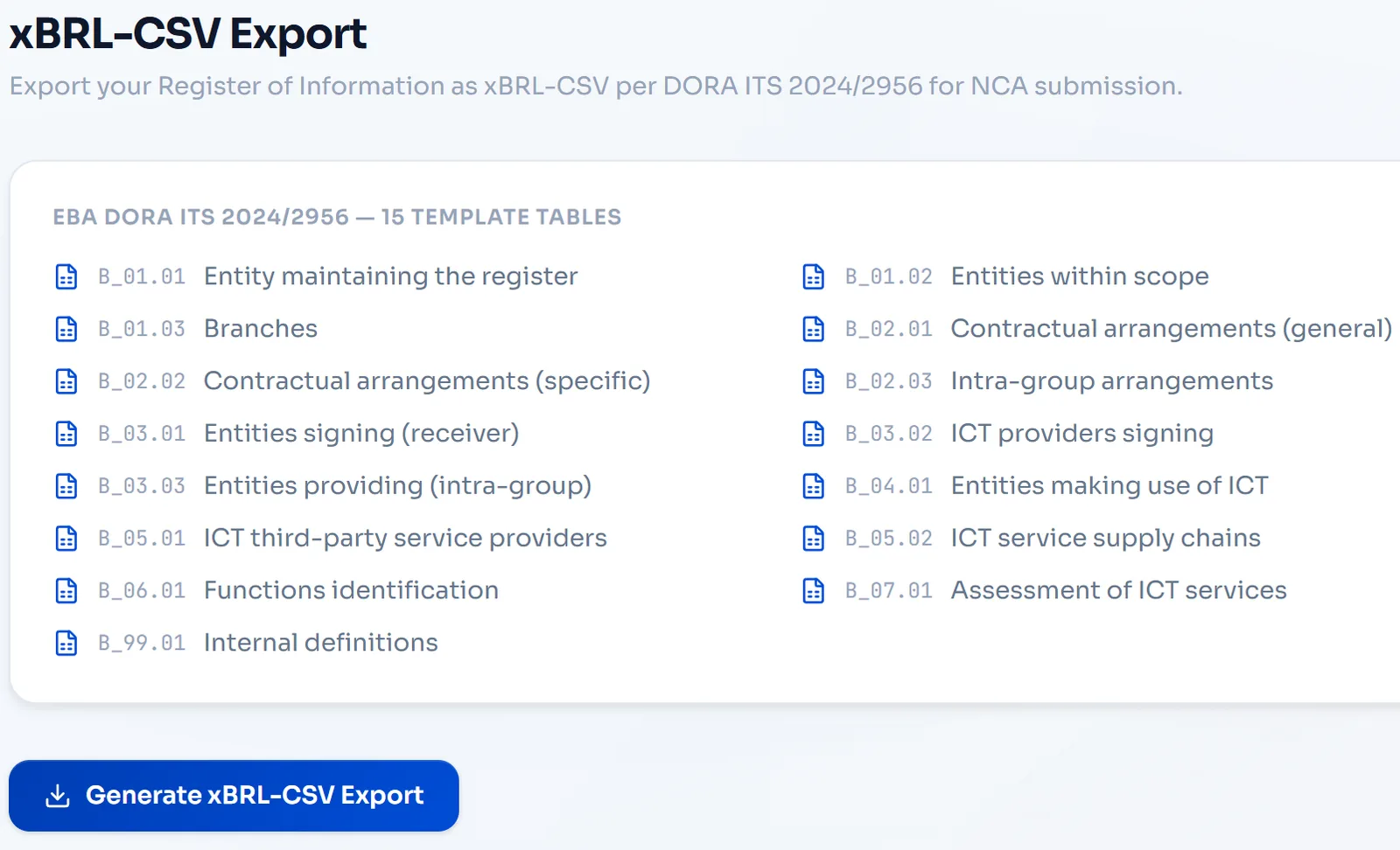
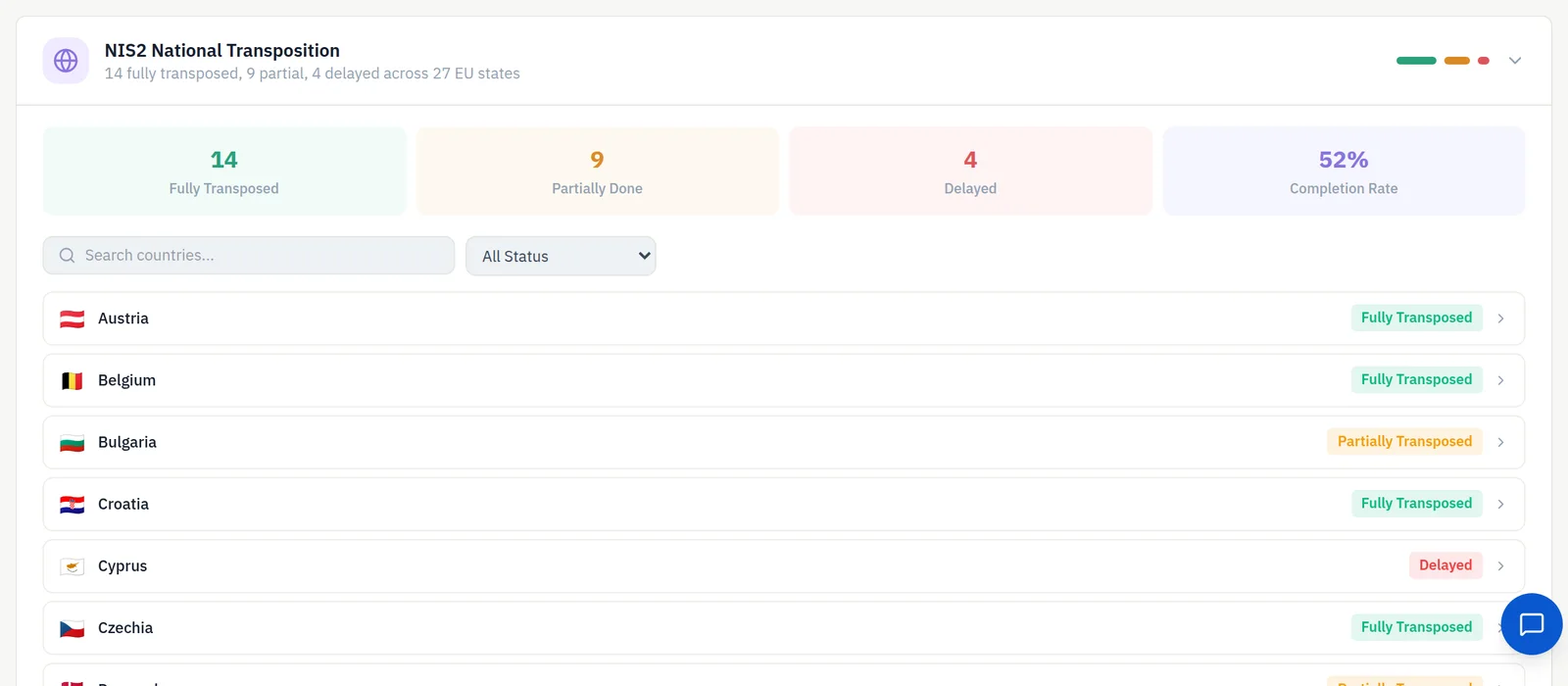
The depth question matters more than the list. DORA appears in both catalogues, but the work differs: producing a Register of Information across fifteen linked EBA templates and exporting it as xBRL-CSV for submission is a different deliverable from evidencing controls for an auditor. Same with NIS2, where what binds you is your national transposition rather than the directive text, so per-country differences have to be modelled.
When you should stay on Drata
Several situations where switching is the wrong call, stated plainly.
- Your compliance surface is SOC 2, or SOC 2 and ISO 27001, and you are US-based. This is what Drata is built for and it does it well.
- You are mid-audit. Changing platforms during an active engagement adds risk for no compliance benefit. Move afterwards if you still want to.
- Your evaluation weights customer references heavily. Venvera has none yet, and no amount of product argument changes that.
- You depend on a specific integration. Check it exists before anything else. A missing connector is a daily cost that no roadmap promise offsets.
What switching actually costs
The honest accounting has four lines, and only one of them is the subscription.
Evidence migration. Your existing evidence has to move or be re-collected. Ask any vendor exactly what they migrate and what they expect you to re-gather; the answer varies more than the marketing suggests.
Control mapping. Your controls are mapped to your current platform's model. Re-mapping is real work, and it is the step most likely to be underestimated.
Auditor familiarity. Your audit firm has a workflow with your current tool. A change is usually fine, but it is worth a conversation before rather than after.
Timing. The cheapest moment to move is immediately after an audit completes and well before a renewal date, which means the decision has to be made months before the renewal that prompted it.
If Venvera looks like the fit
Venvera holds each framework as a maintained control set, with evidence entered once counting toward every framework that asks for the same control. Pricing is published and flat from EUR 399 per month, data is held in Amsterdam, and there is a free readiness check that scores your position without an email gate. If you are looking because of a renewal quote, renewal rescue covers migration specifically. And if after reading this you conclude Drata fits you better, that is a legitimate outcome of an honest comparison.
Frequently asked questions
What is the best Drata alternative?
It depends on why you are looking. Vanta and Secureframe are the closest like-for-like swaps. Sprinto suits small teams wanting less product for less money. Venvera suits organisations with European or Gulf regulatory obligations that need filings rather than only audit evidence, and it publishes its pricing.
How much does Drata cost?
Drata does not publish prices. Its Foundation, Advanced and Enterprise plans all route to a sales conversation, so pricing is negotiated per customer and per renewal. This is normal for the category; Venvera publishing a flat figure from EUR 399 per month is the exception rather than the rule.
Is Drata better than Vanta?
They are close enough that most buyers decide on commercial terms, integration fit and which sales process they preferred, rather than on a capability gap. Both are mature and both are well suited to US audit standards.
Does Drata support DORA and NIS2?
Yes, both appear in Drata's published framework catalogue. The question worth asking any vendor is what depth means in practice: whether the platform produces the Register of Information in the submission format, and whether NIS2 is modelled per Member State transposition rather than against the directive alone.
Should we switch platforms mid-audit?
Generally no. Complete the audit, then move in the window after it closes and before your renewal date. Migrating during an active engagement adds risk without any compliance benefit.
If you are still mapping the category rather than choosing a replacement, our map of Drata competitors by group is the better starting point.