

Learn
Let me save you three months of vendor calls.
If you run compliance at a bank, you do not have a DORA problem. You have a cost-of-proof problem. The regulation is written. The deadlines passed. Your NCA can ask for your Register of Information tomorrow morning, and the only question that matters is: how expensive is it for you to prove, on demand, that your house is in order?
Right now most banks are paying that cost in the most expensive currency that exists: senior people's hours, spread across spreadsheets, consultants, and tools that were built for a different job.
I build compliance software for a living. Venvera is my product, so yes, I am biased, and I will put it first in this comparison. But I am going to do something most vendors will not: I am going to tell you exactly who should buy each of the alternatives instead, including when you should not buy mine. Because a customer who buys the wrong tool churns in a year and tells everyone. A customer who buys the right tool stays for a decade. I want the second one.

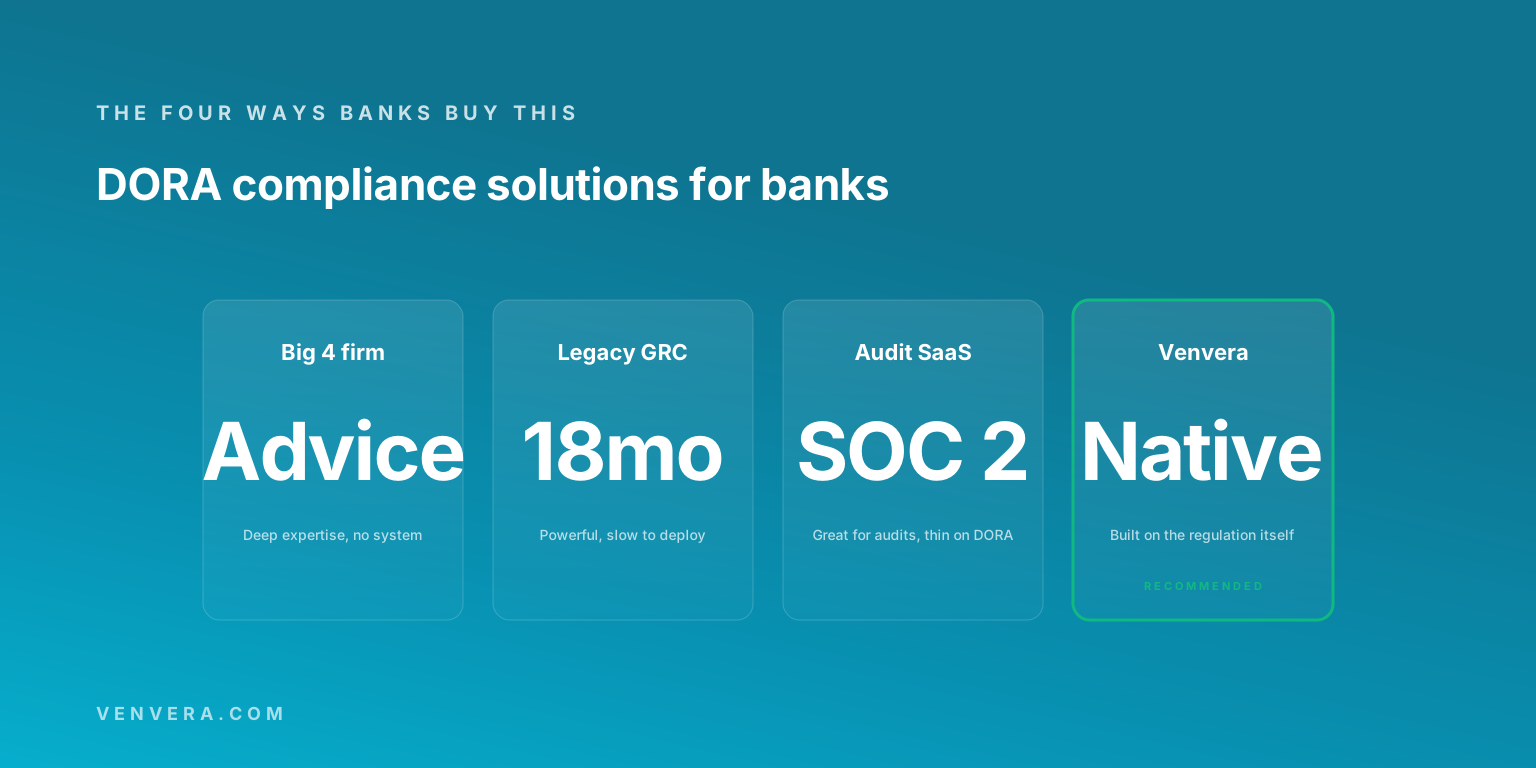
The four ways banks buy DORA compliance solutions
Strip away the marketing and every DORA compliance solution for banks falls into one of four buckets:
- Regulation-native platforms. Software built on the text of DORA itself: the five pillars, the incident clocks, the Register of Information templates. Venvera is in this bucket.
- Consultants. Big 4 and specialist firms who interpret the regulation, run gap assessments, and prepare you for supervisory dialogue.
- Legacy enterprise GRC suites. The big configurable platforms your parent company may already own. Immensely capable, famously slow to deploy.
- Audit-automation SaaS. The SOC 2 and ISO 27001 evidence-collection platforms that added a DORA checklist. Excellent at what they were built for, which was not this.
There is a fifth option nobody admits to: spreadsheets and SharePoint. Roughly half the mid-size banks I talk to are still there. We will do the math on that one too.
First, be honest about what DORA actually demands
Before comparing tools, look at the shape of the work, because the shape of the work decides the tool.
DORA is not an annual audit. It is a permanent supervisory regime with five pillars that never stop running:
- ICT risk management (Articles 5 to 16). A living risk framework, approved by the management body, with controls you can evidence at any moment.
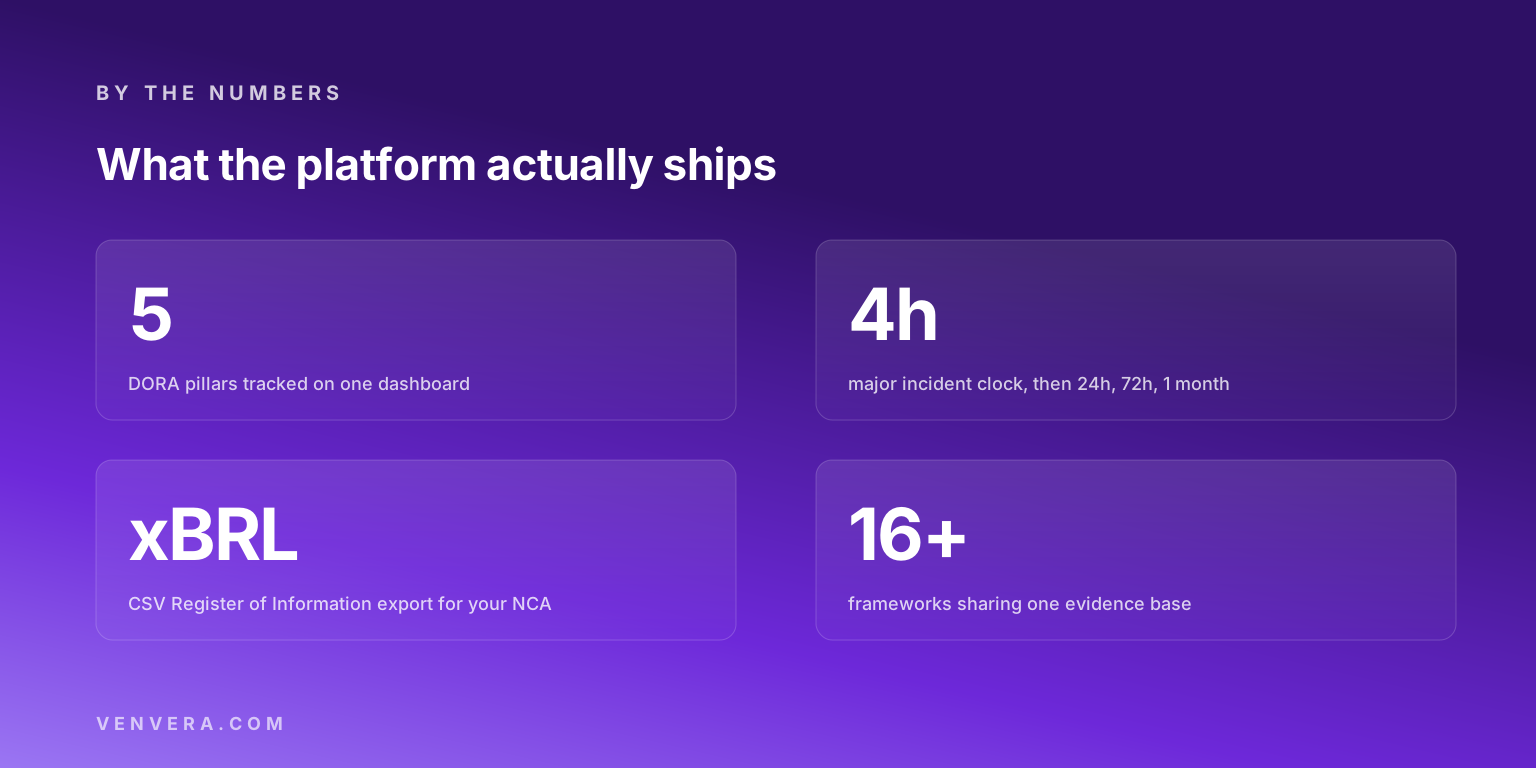
- Incident management and reporting (Articles 17 to 23). Classification criteria and reporting clocks that start the moment an incident is classified as major: initial notification within 4 hours, intermediate report within 72 hours, final report within a month. Miss a clock and it is not a finding, it is a reportable failure.
- Resilience testing (Articles 24 to 27). A testing programme, up to and including TLPT for significant institutions, planned, executed and documented.
- Third-party risk (Articles 28 to 30). Every ICT contract assessed, exit strategies documented, concentration risk reviewed.
- The Register of Information. The ITS templates: linked registers covering providers, contracts, functions and dependencies, submitted to your NCA in xBRL-CSV format. Hundreds of fields that must reconcile with each other, or the submission bounces.
Whatever you buy has to carry all five, forever, with evidence. Keep that picture in your head as we go through the options.
Option 1: Venvera. Why I built it and why it goes first
Here is the value equation I judge every purchase by, including my own product: how likely is the outcome, how fast do I get it, and how much of my team's effort does it consume. A DORA solution wins or loses on those three, because the price tag is never the real cost. The real cost is your Head of Operational Resilience spending every Friday rebuilding a spreadsheet.
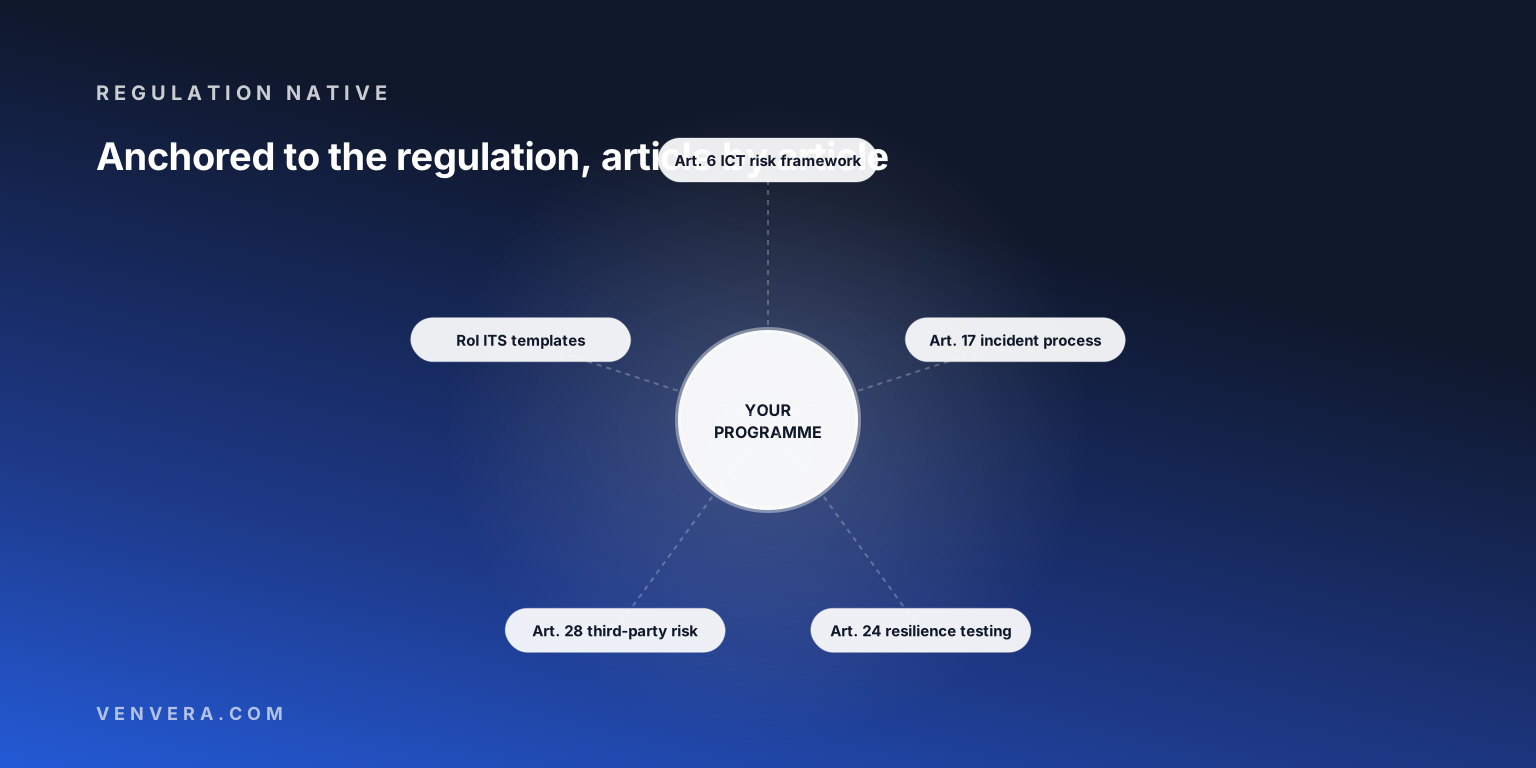
Likelihood of outcome: the platform is anchored to the regulation, article by article
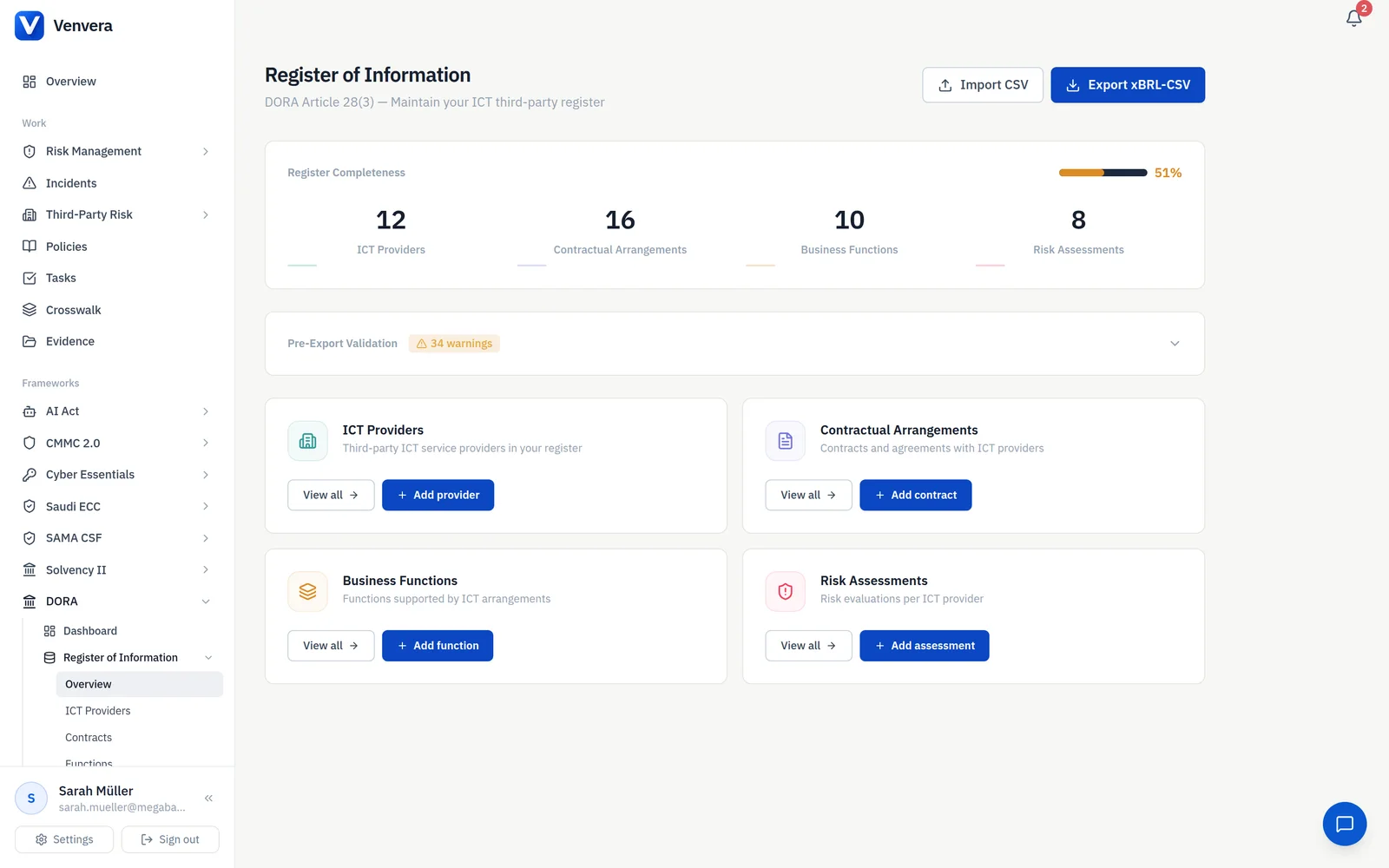
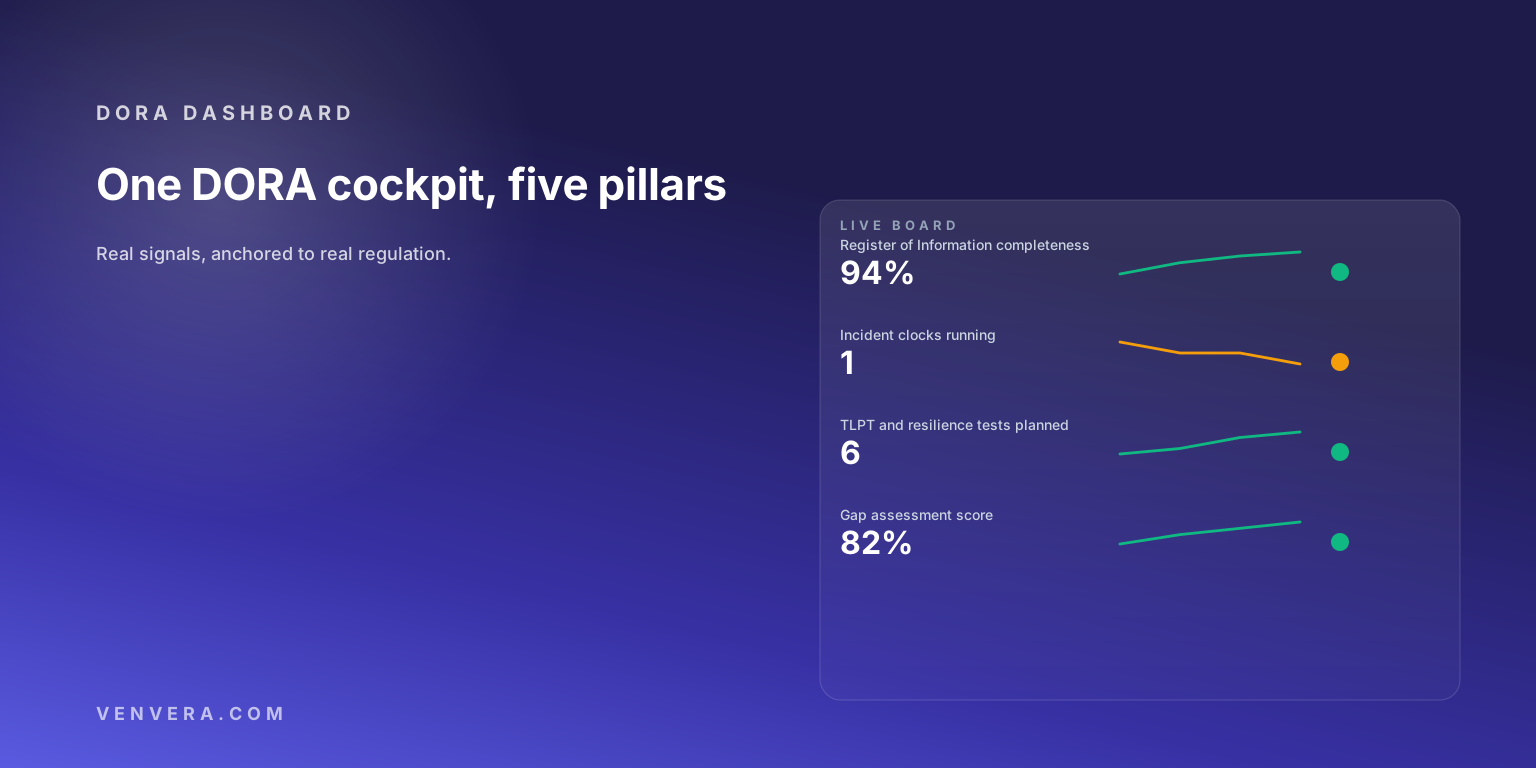
Venvera does not have a "DORA module" bolted onto an audit tool. The DORA workspace is built from the regulation itself. The gap assessment walks the actual requirements across all five pillars and scores you against them. Every control maps to its article. The incident workflow carries the classification criteria and starts the 4 hour, 72 hour and one month clocks for you, with the deadlines visible on the incident record, not in someone's calendar. The resilience testing module holds your TLPT and scenario test plan with results and remediation. And the Register of Information is not a template pack, it is a live register: providers, contracts, functions and their links, validated against the ITS rules, exported in xBRL-CSV for your NCA at the press of a button.
Speed: days, not quarters
You do not implement Venvera, you log into it. The DORA workspace is live on day one. Most teams run the gap assessment in their first week and walk out with a scored baseline and a generated remediation plan. Compare that with a GRC suite deployment measured in quarters, or a consulting engagement that produces its first deliverable after six weeks of interviews.
Effort: evidence once, compliant everywhere
This is the part I am proudest of, and the reason banks specifically should care. DORA is never your only framework. You are also carrying NIS2, GDPR, ISO 27001, maybe SOC 2 for your fintech arm, the EU AI Act for your models. Venvera runs 16+ frameworks on one platform, and its crosswalk links equivalent controls across them. Upload the evidence for your access-control process once, and it closes the matching controls in DORA, NIS2, ISO 27001 and the rest simultaneously. Your team stops proving the same fact five times to five different question sets.
A few more things that remove effort rather than add features:
- Company groups. A banking group writes a policy once in the parent entity and every subsidiary inherits it as a read-only source of truth, while each keeps its own evidence. Built for holding structures.
- A board pack that writes itself. The board dashboard rolls the five pillars, incidents and testing posture into the report your management body needs under Article 5, because DORA makes them personally accountable.
- Your language, your keys. The interface runs in English, German, Spanish, Bulgarian, Arabic and Chinese, switchable per organisation and per user, so the compliance officer in Frankfurt and the risk analyst in Sofia work the same system in their own language. AI assistance runs on your own API key, and your data is hosted in the EU.
- Integrations that fetch evidence. Azure and Microsoft 365, Google Workspace and Jira connect so posture evidence arrives on its own instead of being screenshotted every quarter.
The honest limitation
Venvera will not interpret the regulation for you and it will not negotiate with your supervisor. It is the system of record and the workflow engine. If your situation needs bespoke legal interpretation, you still want a human expert, which brings us to option two.
Option 2: consultants. Buy the advice, not the operating model
The Big 4 and the specialist resilience boutiques are genuinely good at things software cannot do: interpreting grey areas of the regulation, preparing you for supervisory dialogue, and running an actual TLPT engagement with a red team. If you are a significant institution heading into your first threat-led penetration test, or a group with a gnarly cross-border structure, buy that expertise. Seriously.
Just be clear about what you get. A consulting engagement ends. The binder it produces starts aging the day it lands, and the retainer it takes to keep it alive runs into six figures a year. Consultants produce advice. They do not produce a permanently current Register of Information at 9am on the day your NCA asks for it.
The pattern that works: bring consultants in for interpretation and TLPT, and run the day-to-day regime on a platform. The combination costs less than the consulting-only model and leaves you owning your own compliance instead of renting it.
Option 3: legacy enterprise GRC suites. Right tool for a different weight class
The big GRC platforms are extraordinarily capable. They will model your entire enterprise, integrate with everything, and survive any audit. If you are a tier-one bank with a dedicated GRC operations team, an existing licence, and an eighteen month change budget, they are a defensible choice, and no SaaS vendor should pretend otherwise.
The math changes below that weight class. These suites are toolkits, not products: DORA arrives as content packs and configuration workshops, which means implementation partners, which means the project plan is measured in quarters and the total cost lands at a multiple of the licence. Mid-size banks routinely spend more configuring the suite than running the compliance function it was meant to support. If that is the road you are on and it works, finish the road. If you have not started it, check whether you need the weight.
Option 4: audit-automation SaaS. Superb for audits, thin where DORA is thick
The SOC 2 and ISO automation platforms deserve their success. For getting a US-style attestation done fast with automated evidence collection, they are the best money can buy, and if your primary need this year is SOC 2 for enterprise sales, buy one and do not look back.
But notice the center of gravity. Those products organise everything around an audit: a point-in-time exercise with an auditor as the customer. DORA has no auditor. It has a supervisor, no end date, and deliverables that audit tools were never shaped for: the ITS register templates with xBRL-CSV submission, incident clocks measured in hours, a TLPT programme, exit strategies per critical provider. On those, checklist coverage is not the same as native support. If DORA is the job, buy something whose center of gravity is the regulation itself.
Option 5: the spreadsheet. Let us do the math you have been avoiding
The spreadsheet feels free. Here is what it actually costs.
The Register of Information alone is a set of linked templates with hundreds of interdependent fields per provider relationship. Say you have 40 ICT providers and it takes ninety minutes per relationship to compile, reconcile and re-verify each reporting cycle. That is 60 hours per cycle of someone senior enough to get it right. Add incident reporting drills, evidence chasing before every board meeting, and version-controlling policies across entities by email, and you are consuming weeks of expert time per quarter to maintain something that is out of date the moment anyone ships a change.
And the failure mode is silent: nothing tells you the register stopped reconciling until the submission bounces or the supervisor asks a question the spreadsheet cannot answer. You are not saving money. You are converting a subscription into unpriced senior headcount and regulatory risk.
DORA compliance solutions for banks, side by side
| Venvera | Consultants | Legacy GRC | Audit SaaS | Spreadsheets | |
|---|---|---|---|---|---|
| Register of Information with xBRL-CSV export | Native, validated | Compiled for you, ages fast | Configurable | Rare or manual | Manual, fragile |
| Incident clocks (4h / 72h / 1 month) | Built into the workflow | Playbook on paper | Configurable | Generic ticketing | Calendar reminders |
| Resilience testing and TLPT tracking | Native module | They run the test itself | Configurable | Thin | Documents folder |
| Cross-framework reuse (NIS2, ISO 27001, GDPR...) | Crosswalk, evidence once | Per engagement | Possible, heavy config | Audit frameworks only | None |
| Time to first scored gap assessment | First week | After interviews | After implementation | Fast, audit-shaped | Never truly scored |
| Regulatory interpretation and TLPT execution | No, pair with experts | Yes, their core strength | No | No | No |
| Cost shape | Subscription | Six-figure engagements | Licence plus implementation | Subscription | Hidden senior hours |
Who should buy what
- Mid-size bank, insurer or payment institution carrying DORA plus NIS2 plus ISO: buy the regulation-native platform. This is the exact customer Venvera was built for.
- Banking group with subsidiaries across countries: same answer, and use company groups so policy flows down once instead of being forwarded around. The multilingual interface stops being a nice-to-have the day your Spanish subsidiary onboards.
- Significant institution facing its first TLPT or a genuinely novel structure: hire the specialists for the test and the interpretation, run the regime on the platform.
- Tier-one bank with an established GRC suite and the team to feed it: stay the course, and be honest about the total cost when renewal comes.
- SaaS or fintech whose burning need is SOC 2 for the sales pipeline: buy the audit-automation tool for that. When DORA becomes your problem, you know where the door is.
- Anyone still on the spreadsheet: count the hours from the section above, multiply by the loaded cost of the people spending them, and make the decision with a real number instead of a feeling.
Frequently asked questions
What is the best DORA compliance solution for a mid-size bank?
A regulation-native platform that carries all five pillars with evidence: gap assessment scored against the articles, incident workflow with the 4 hour, 72 hour and one month reporting clocks, a resilience testing programme, third-party registers, and a Register of Information that exports to xBRL-CSV. Consultants complement it for interpretation; they do not replace the system of record.
Does a bank still need consultants if it uses DORA software?
Sometimes, and for specific jobs: TLPT execution, supervisory dialogue, bespoke legal interpretation. The software carries the permanent regime so the consulting budget shrinks to the moments that genuinely need judgment.
Can SOC 2 automation platforms handle DORA?
They can host a DORA checklist, and they are excellent for audit-shaped frameworks. But the Register of Information, xBRL-CSV submission, hour-denominated incident clocks and TLPT programmes sit outside the audit model they are built on. For banks, regulation-native support is the safer bet.
How fast can a bank get DORA-ready on Venvera?
The workspace is live on day one. Most teams complete the scored gap assessment in the first week, and the remediation plan it generates becomes the backlog. From there it is execution, with the register, clocks and testing programme filling in as you work.
See your own Register of Information in it
Here is my offer, and it is the same one I would want as a buyer. Bring your provider list to a demo. We will load a slice of your real world into the Register of Information, run the gap assessment against your actual posture, and you can watch the crosswalk close ISO and NIS2 controls off the back of your DORA evidence. If it does not obviously beat the way you work today, you have lost forty five minutes and gained a benchmark.
Book the demo, and bring the person who maintains the spreadsheet. They will have the strongest opinion in the room.