NEWVenvera speaks your language: the full platform, in English, German, Spanish, Bulgarian and Arabic.See what’s new
Control crosswalk

Prove a control once. Watch every framework turn green.

Encryption at rest is not five separate controls - it is one control that ISO 27001, SOC 2, GDPR, NIS2 and DORA all ask for in different words. Venvera maps them for you, so the evidence you enter once closes that control across every framework it satisfies. Stop re-proving the same thing in a dozen spreadsheets.

ISO 27001SOC 2NIST CSFDORANIS2GDPR

Try it on your own frameworks.

The same curated mapping the product runs on, open to anyone. Pick the framework you already run and the one you have been asked to add, and see which requirements are the same requirement.

You already run
You have been asked to add
21 of the 43 domains in this crosswalk appear in both ISO 27001 and DORA.
DomainISO 27001DORA
Encryption
A.8.24Use of cryptography
Art. 9(4)(d)Is data encrypted at rest and in transit using industry-standard cryptographic techniques, with documented key management procedures?
Access Control
A.5.15Access control
Art. 9(4)(c)Is there a formal identity and access management policy enforcing least privilege, multi-factor authentication for critical systems, and regular access recertification?
Identity Management
A.5.16Identity management
Art. 9(4)(c)Is there a formal identity and access management policy enforcing least privilege, multi-factor authentication for critical systems, and regular access recertification?
Authentication & MFA
A.5.17Authentication information
A.8.5Secure authentication
Art. 9(4)(c)Is there a formal identity and access management policy enforcing least privilege, multi-factor authentication for critical systems, and regular access recertification?
Network Security
A.8.20Networks security
A.8.21Security of network services
A.8.22Segregation of networks
Art. 9(4)(b)Are network security controls (segmentation, firewalls, intrusion prevention) implemented to protect ICT systems, with regular review and hardening?
Vulnerability Management
A.8.8Management of technical vulnerabilities
Art. 9(4)(a)Is there a formal patch and vulnerability management process that ensures timely remediation of identified vulnerabilities in all ICT systems?
Logging & Monitoring
A.8.15Logging
A.8.16Monitoring activities
Art. 10(1)–(4)Do you operate continuous monitoring and detection capabilities (SIEM, IDS/IPS, anomaly detection) to promptly identify ICT-related incidents and anomalous activities?
Incident Management
A.5.24Information security incident management planning
A.5.25Assessment and decision on information security events
A.5.26Response to information security incidents
Art. 17(1)–(2)Do you have a documented ICT incident management process covering detection, recording, classification, escalation, response, and closure?
Post-Incident Review
A.5.27Learning from information security incidents
Art. 17(3)Do you perform formal post-incident reviews with root cause analysis for all major ICT incidents, with findings fed back into the risk management framework?
Business Continuity
A.5.29Information security during disruption
A.5.30ICT readiness for business continuity
Art. 11(1)–(11)Are ICT business continuity and disaster recovery plans documented, tested at least annually, approved by management, and covering all critical business functions?
Backup & Restoration
A.8.13Information backup
Art. 12(1)–(7)Do you maintain backup and restoration policies specifying scope, frequency, and secure storage locations, with regular restoration testing?
Third-Party Risk Management
A.5.19Information security in supplier relationships
A.5.20Addressing information security within supplier agreements
Art. 28(2)Has the management body approved an ICT third-party risk strategy that is aligned with the overall ICT risk management framework and reviewed at least annually?
Supplier Due Diligence
A.5.21Managing information security in the ICT supply chain
Art. 28(4)Is thorough due diligence and risk assessment performed before entering into new ICT third-party arrangements, particularly for critical or important functions?
Supplier Contracts
A.5.20Addressing information security within supplier agreements
Art. 30(2)(a)Do ICT third-party contracts include clear service level agreements (SLAs) with quantitative performance targets, monitoring measures, and consequences for non-compliance?
Art. 30(3)(e)Do contracts for critical or important ICT services include unrestricted rights of audit and inspection, including on-site access and use of pooled audits?
Supplier Monitoring
A.5.22Monitoring, review and change management of supplier services
Art. 28(5)Are critical or important ICT third-party providers subject to continuous monitoring and formal performance reviews at least annually?
Risk Assessment
A.5.7Threat intelligence
Art. 8(2)–(6)Is there a formal ICT risk identification and assessment process performed at least annually, after significant changes, and after major ICT incidents?
Information Security Policy
A.5.1Policies for information security
Art. 9(1)–(2)Are comprehensive ICT security policies and standards documented, approved by management, communicated to all staff, and reviewed regularly?
Security Awareness Training
A.6.3Information security awareness, education and training
Art. 13(6)Is there an ICT security awareness and training programme covering all staff (including management) that is updated regularly and includes DORA-specific obligations?
Change Management
A.8.32Change management
Art. 9(4)(e)Are ICT change management procedures in place to ensure controlled, tested, and approved modifications to ICT systems and applications?
Security Testing
A.5.35Independent review of information security
Art. 24(1)–(2)Have you established a digital operational resilience testing programme that is risk-based, covers critical ICT systems, and is reviewed at least annually?
Configuration Management
A.8.9Configuration management
Art. 7(1)–(2)Are ICT systems, protocols, and tools maintained to be adequate, continuously updated, reliable, and designed with sufficient capacity to support operations?

A row means the two requirements cover the same ground, so one implementation and one set of evidence can usually serve both. It does not mean satisfying one certifies the other: each framework keeps its own scope, wording and assessment, and some requirements have no counterpart at all. Treat this as a starting map for planning, then confirm each row against the requirement text.

The work is not the controls. It is proving each one, over and over.

Most teams do not have a controls problem - they have a duplication problem. The same access-control policy re-evidenced for ISO, then again for SOC 2, then again for the DORA audit, each in its own spreadsheet, each drifting out of date at its own pace. The crosswalk is the connective tissue: a curated map of which control satisfies which requirement across every framework you run, so one piece of evidence spreads to every equivalent control automatically and your coverage reflects reality instead of effort.
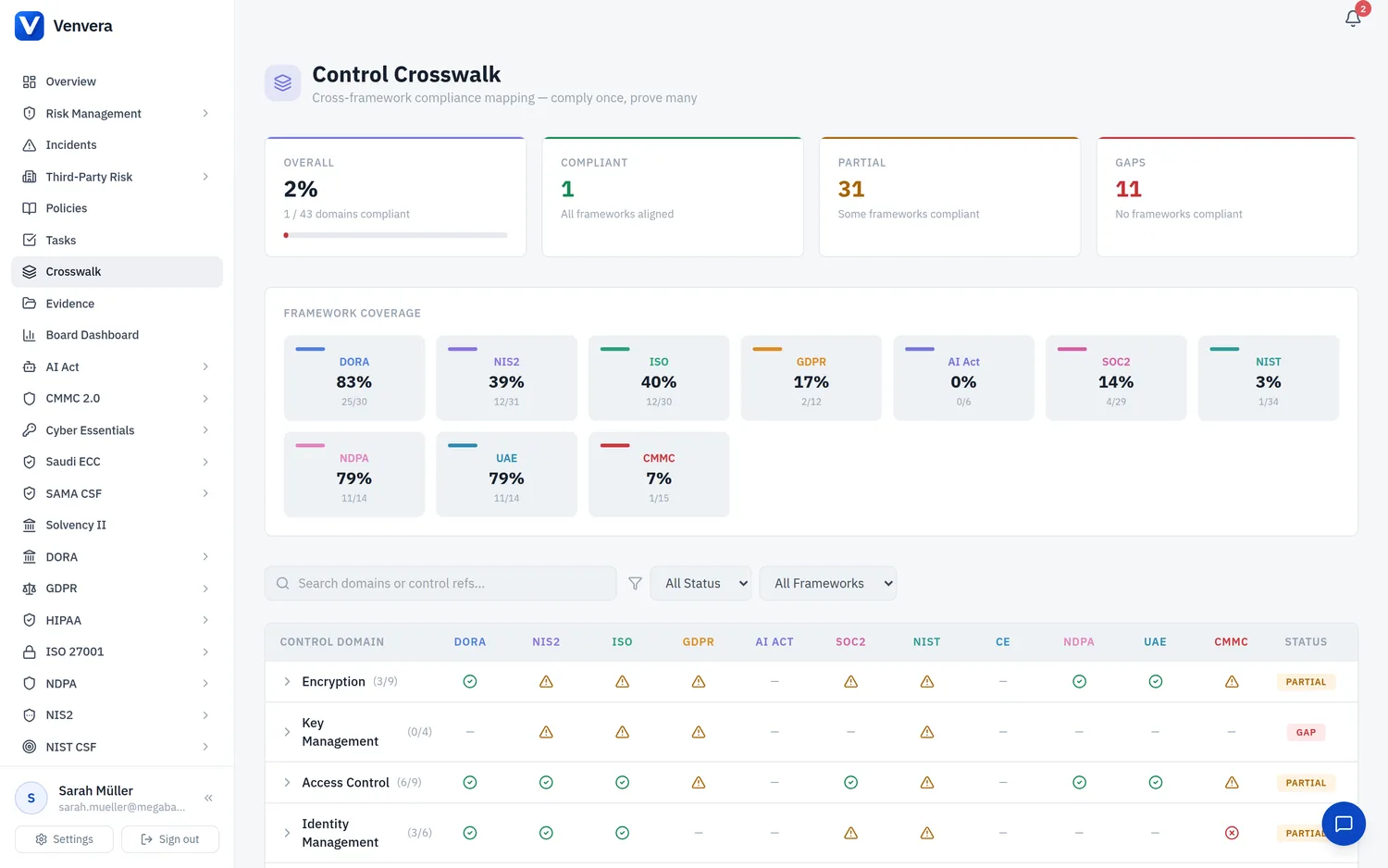
 app.venvera.com
/ CROSSWALK · one control, every framework it satisfies
1
Control set, every framework mapped
Once
Evidence entered, spread everywhere
150+
Controls pre-mapped
43
Crosswalk domains
Core library

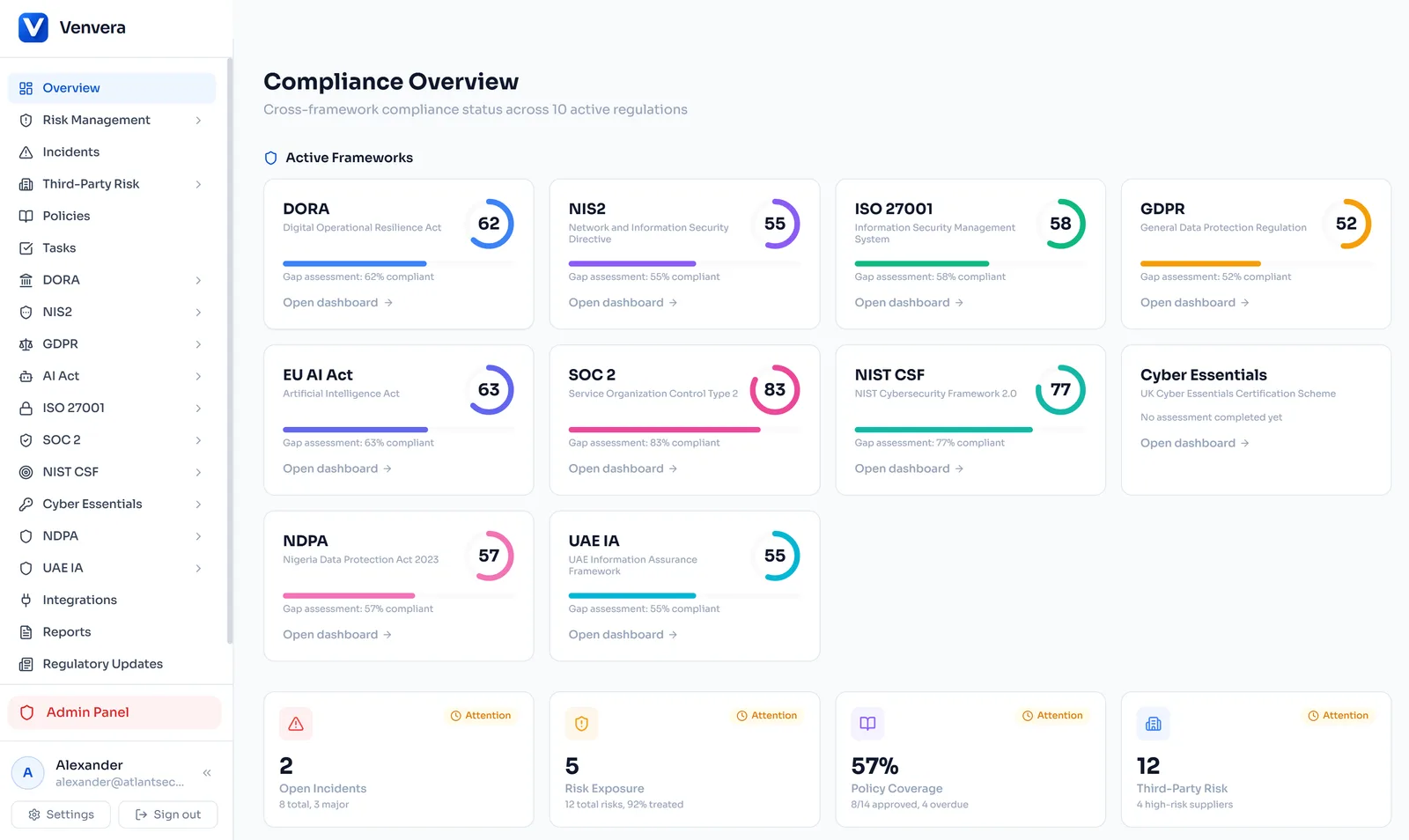
One library holds every control, mapped to every framework it answers.

A single library of controls, each linked to every applicable framework requirement, so implementation status is set once and reflected everywhere. 150+ controls come pre-mapped out of the box across all supported frameworks, each with its control type and evidence tracking.

  • 150+ pre-mapped controls across ISO 27001, SOC 2, NIST CSF, GDPR, NIS2 and DORA
  • One implementation status applies to every mapped framework
  • Control type classification: preventive, detective, corrective
  • Framework-specific requirement references down to article and clause
 app.venvera.com
/ LIBRARY · one control set, every framework mapped
Propagation

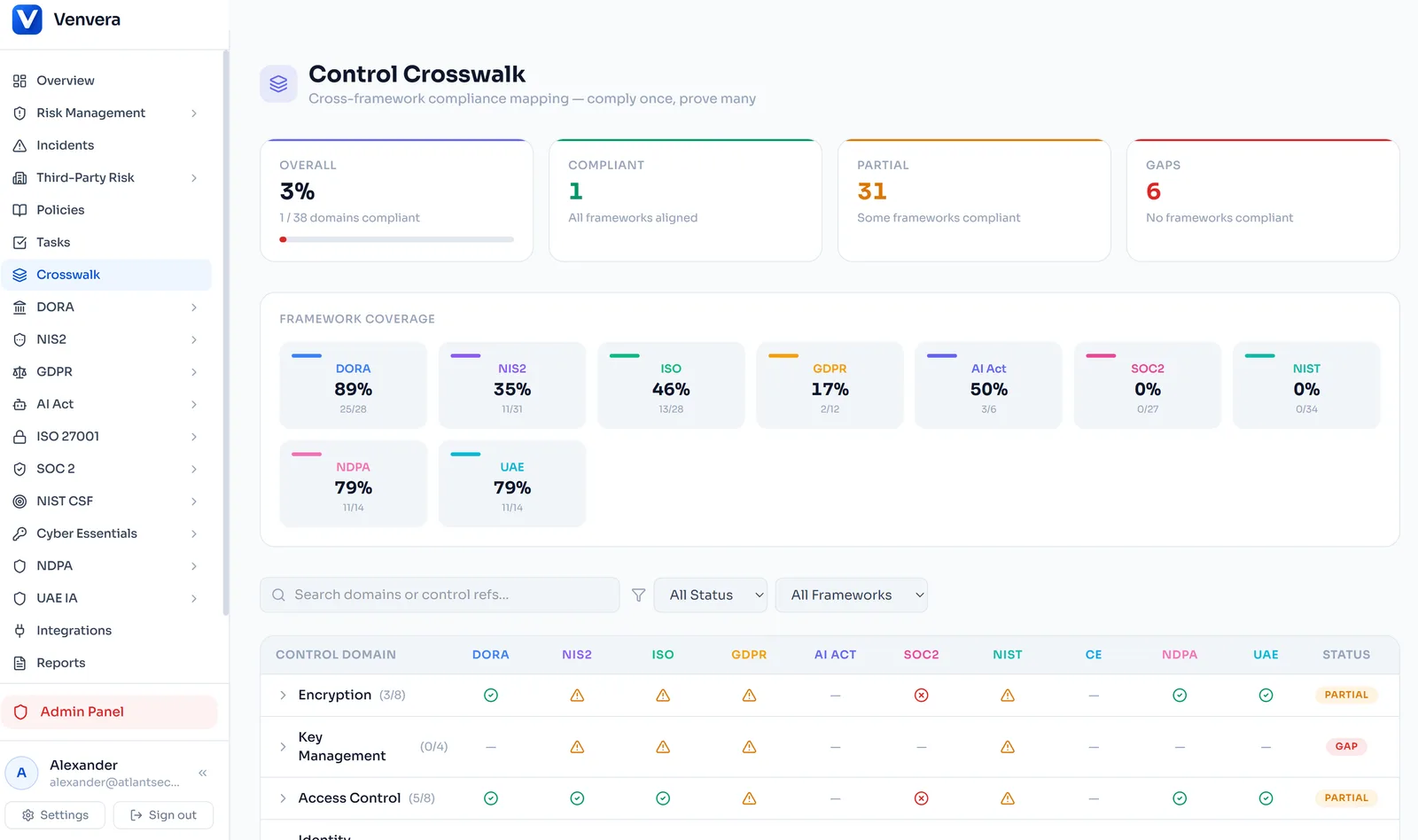
Mark a control done once, and every mapped framework updates itself.

Mark encryption at rest as implemented for ISO 27001 A.8.24, and Venvera marks it implemented for SOC 2 CC6.1, NIST CSF PR.DS-01, GDPR Art. 32, NIS2 Art. 21(h) and DORA Art. 9.2. One action, six frameworks updated, in real time.

  • Real-time propagation the moment any control status changes
  • A visual auto-mapped badge on every propagated status
  • Only propagates when mapping confidence is high
  • Manual override for genuine framework-specific exceptions
 app.venvera.com
/ PROPAGATION · one update, every mapped framework
Coverage matrix

See exactly where you are covered, and where you are not.

A single view of which compliance areas are covered across all your active frameworks, so gaps surface instantly. If encryption is implemented for ISO 27001 but not mapped to your SOC 2 programme, the matrix shows it before an auditor does.

  • Visual matrix of compliance areas against frameworks
  • Green, amber and red status per intersection
  • Instant gap identification across every active framework
  • Filter by compliance area or framework, export as a board-ready table

 app.venvera.com
/ COVERAGE · every gap, across every framework
Gap analysis

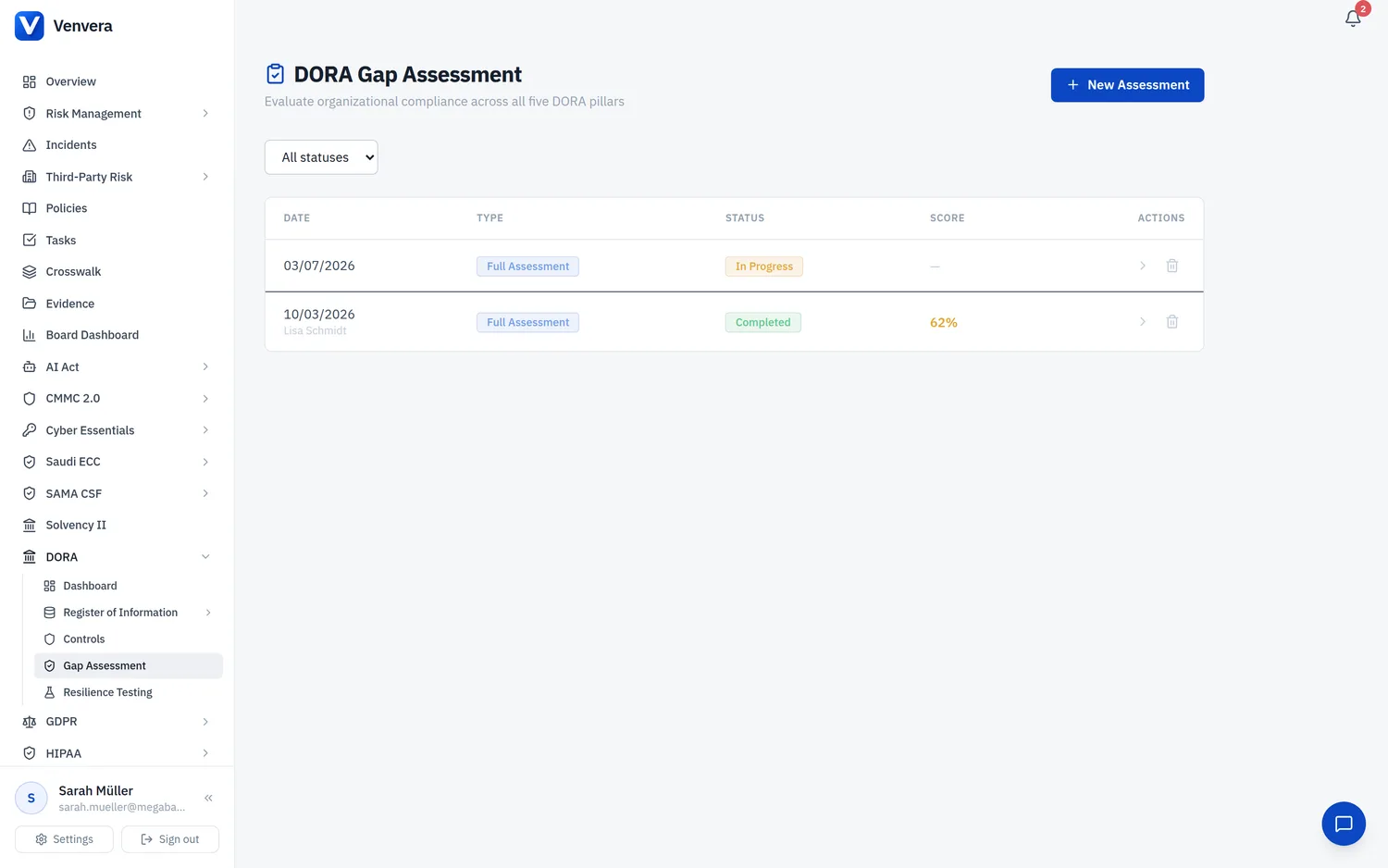
Fix one gap, and close it across every framework it touches.

Run a gap assessment in one framework and instantly see the impact on the others. A gap in access control affects ISO A.5.15, SOC 2 CC6.1, NIST CSF PR.AC-01, NIS2 Art. 21 and DORA Art. 9 at the same time, so the fixes that close the most frameworks rank highest.

  • Gap propagation shows cascading impact across frameworks
  • Gaps that affect more frameworks are ranked higher
  • Fix once, close the matching gap in every mapped framework
  • Impact score weighs framework count and regulatory weight
 app.venvera.com
/ GAPS · one fix, ranked by frameworks closed
Evidence

Attach evidence once, and it counts everywhere the control is mapped.

Upload a penetration test report for your ISO 27001 programme and it automatically serves as evidence for SOC 2 CC7.1, NIS2 Art. 21 and DORA Art. 24. Evidence is entered once per control and applies to every framework the control satisfies.

  • Upload evidence once per control, not once per framework
  • Evidence becomes available in every mapped framework automatically
  • Supports PDF, DOCX, XLSX, images and more
  • Review dates and expiry tracking on every evidence item
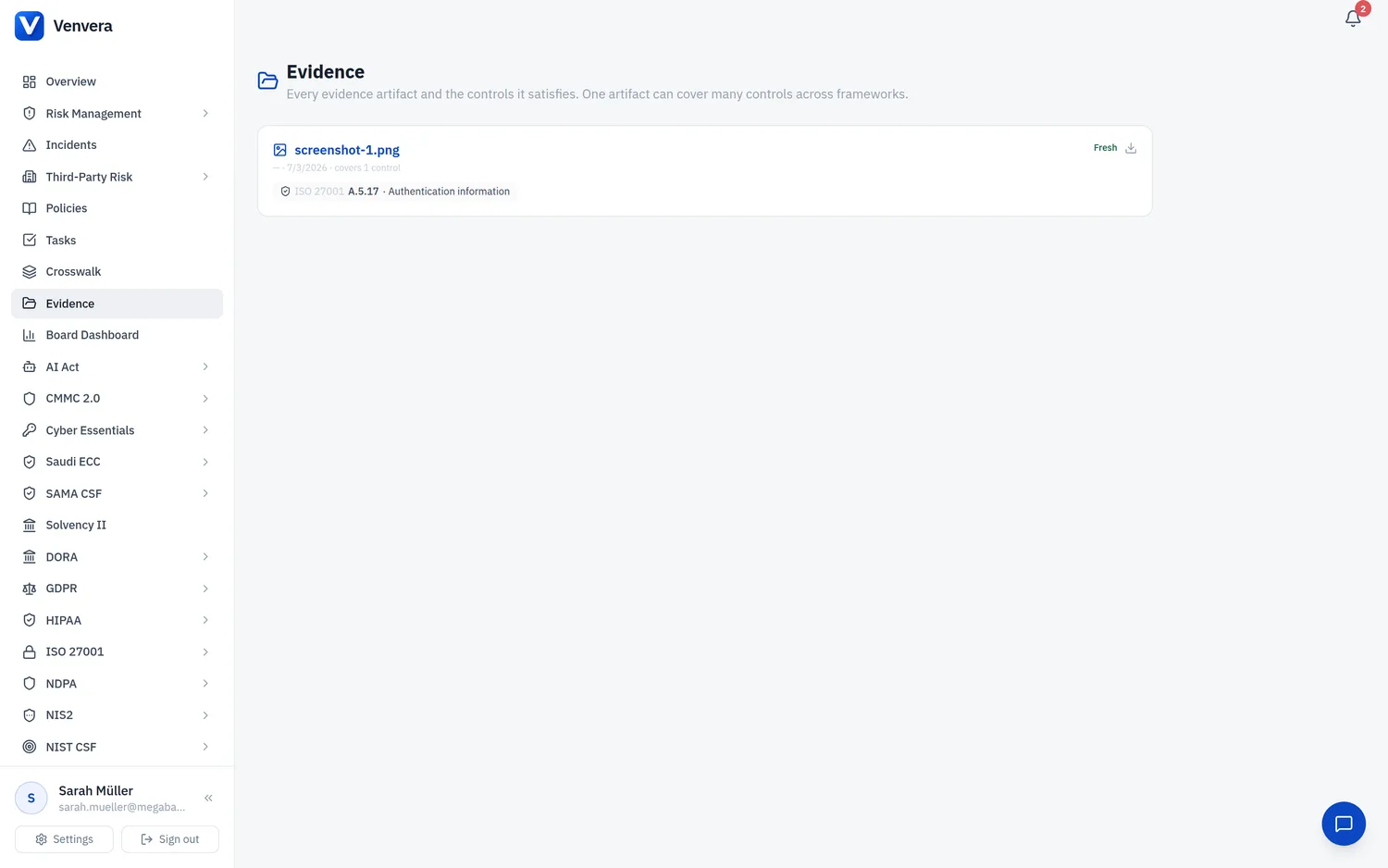
 app.venvera.com
/ EVIDENCE · entered once, applied everywhere
Why switch

The spreadsheet or Venvera.

A spreadsheet per framework
Venvera
Duplicate effort
Same control documented separately for each framework
One control mapped to every requirement it satisfies
Framework overlap
Up to 70% of requirements overlap, but you implement each independently
Overlaps mapped once, so evidence spreads automatically
Audit consistency
Different status for the same control, auditors find contradictions
One status, consistent across every framework
Evidence
Re-attached to each framework by hand
Attached once, available in every mapped framework
Gap visibility
Found late, one framework at a time
Coverage matrix surfaces gaps across all frameworks at once

Control crosswalk questions, answered.

Related: Compliance software for groups of companies

Prove it once, satisfy every framework.

Start with a free compliance check - see how much of your coverage one evidence library unlocks across frameworks.

Every paid plan: audit-ready in 90 days, or your money back*

10 minutes · no email to start · no credit card · yours to keep