DORA is law. And the fine has your name on it.
The Register of Information, ICT risk, self-starting incident clocks and resilience testing - the whole Digital Operational Resilience Act kept permanently audit-ready. Your NCA submission and your board’s personal liability under Article 5, covered before anyone asks.
How much of DORA do you already have?
Pick the framework you already run. Every control domain that appears in both is listed with the requirement reference on each side, so you can see the reusable part of your existing programme before you scope any new work.
A row means the two requirements cover the same ground, so one implementation and one set of evidence can usually serve both. It does not mean satisfying one certifies the other: each framework keeps its own scope, wording and assessment, and some requirements have no counterpart at all. Treat this as a starting map for planning, then confirm each row against the requirement text.
DORA compliance software, from ICT risk to the Register of Information
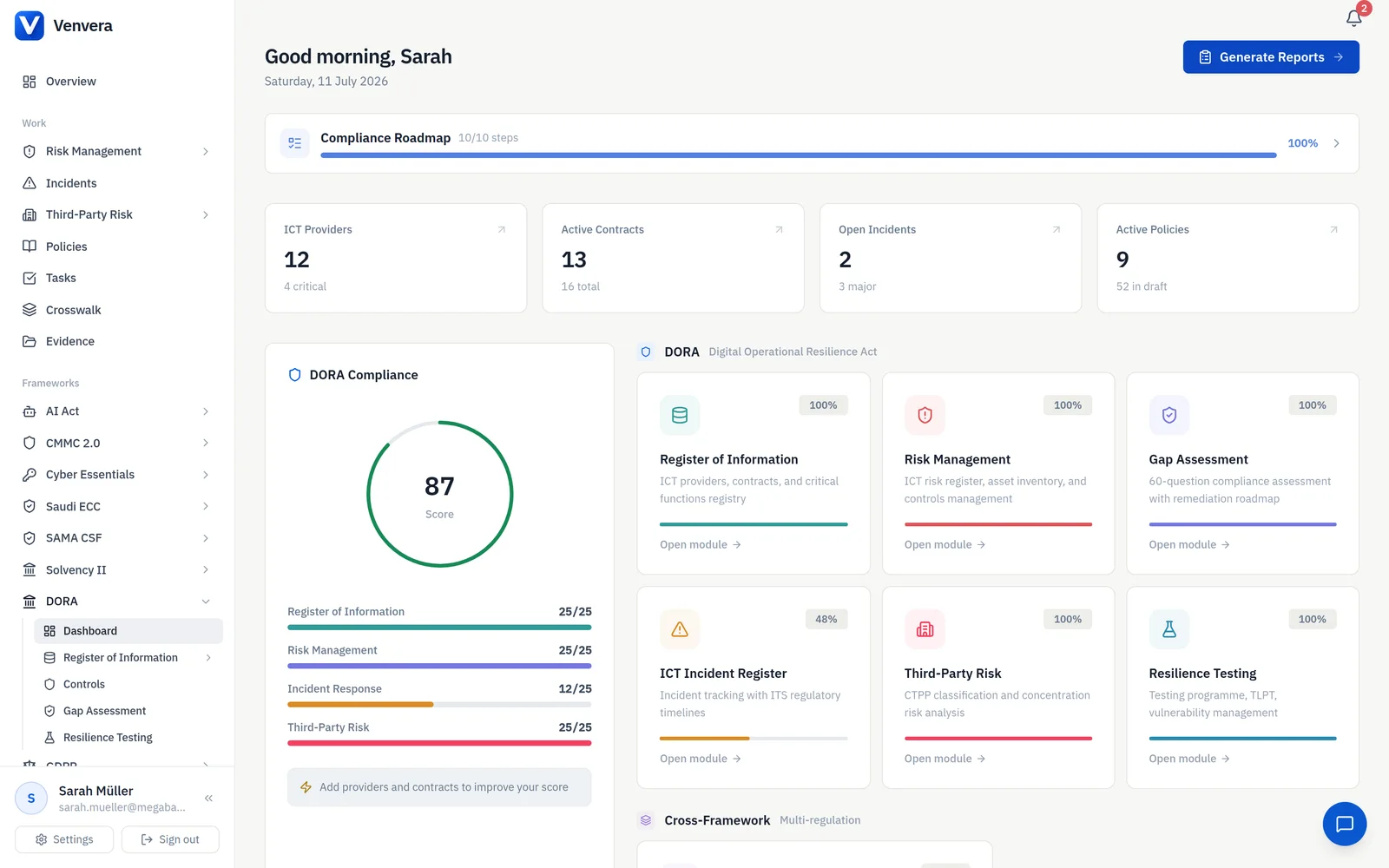
Venvera is DORA compliance software for the financial entities in scope of Regulation (EU) 2022/2554: banks, insurers, investment firms, payment institutions, crypto-asset service providers and the ICT third-party providers they rely on. It holds 21 tracked controls across ICT risk management, incident reporting, resilience testing and third-party risk, keeps the Register of Information in the ESA xBRL-CSV shape your National Competent Authority asks for, starts the incident clocks on classification, and names the evidence each control needs. Board oversight under Article 5 is evidenced in the same place.
What is DORA, and why can you not ignore it?
The Digital Operational Resilience Act (Regulation 2022/2554) is EU law, in force since 17 January 2025, binding over 22,000 financial entities: banks, insurers, investment firms, payment institutions and crypto-asset service providers. It is not a certificate you choose to pursue - your National Competent Authority expects your Register of Information submitted in the ESA xBRL-CSV format, and under Article 5 your management body is personally accountable for the ICT risk framework. Miss a filing or an incident deadline and the exposure lands on named individuals, not just the company.
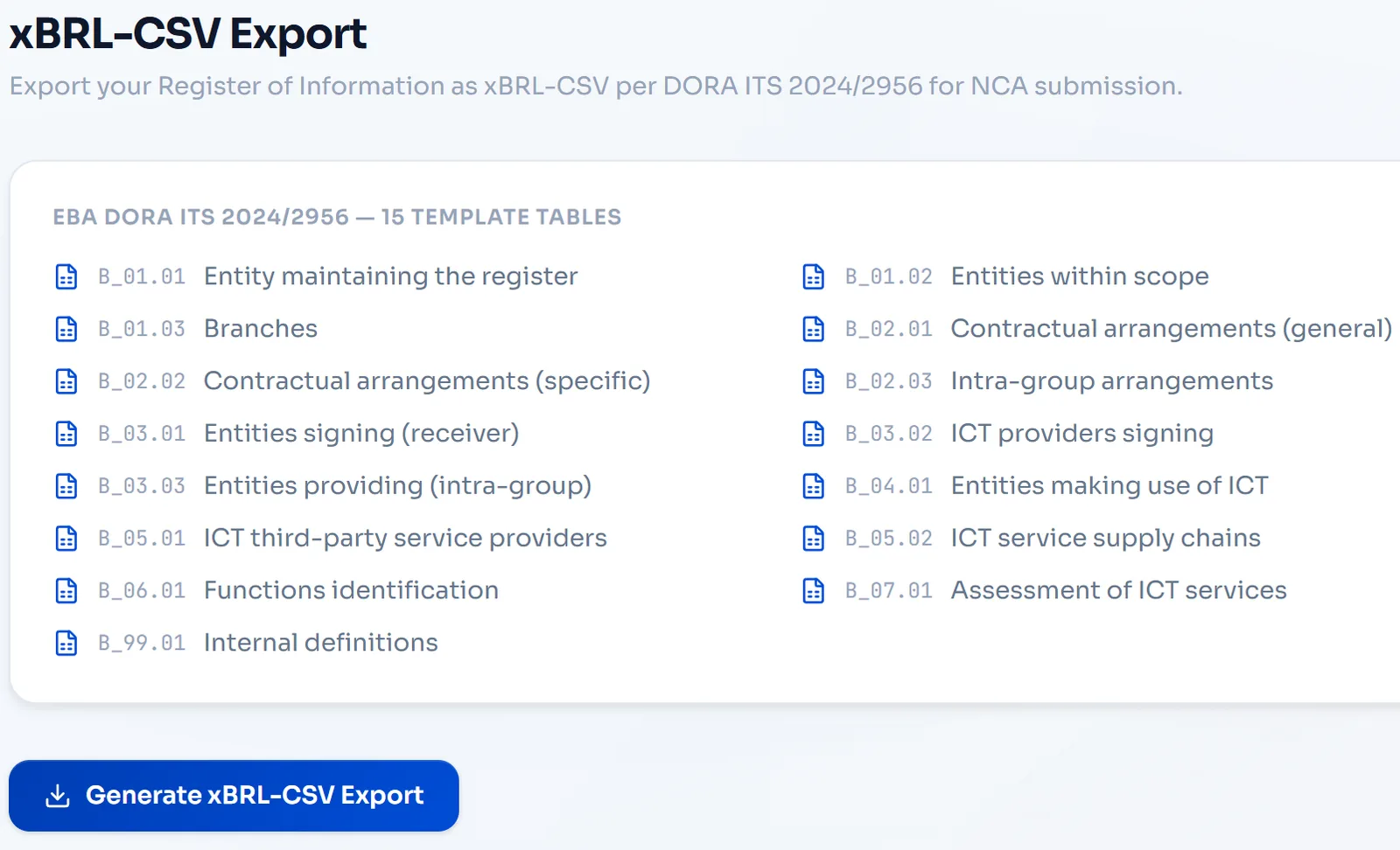
One-click xBRL-CSV export. No other platform has it.
This is the piece the US-built compliance platforms simply do not have. They map DORA onto their existing control library and stop there - none of them generate the EBA xBRL-CSV file your National Competent Authority actually requires. Venvera does. Your register is built from the providers and contracts you already track - every ICT third-party provider, contractual arrangement, supporting function and subcontracting chain, held as structured fields that map straight onto the EBA’s 15 tables. When the submission window opens, export all 15 tables, cross-references validated, in seconds - in the exact format your regulator ingests. No manual CSV assembly, no broken foreign keys, no last-minute scramble.
- Native xBRL-CSV export in the EBA format - unique to Venvera, not offered by US-built tools
- All 15 EBA tables generated automatically from your platform data
- Cross-table validation catches errors before you submit
- Entity, sub-consolidated and consolidated level registers
- Subcontracting chain tracking with n-th party visibility
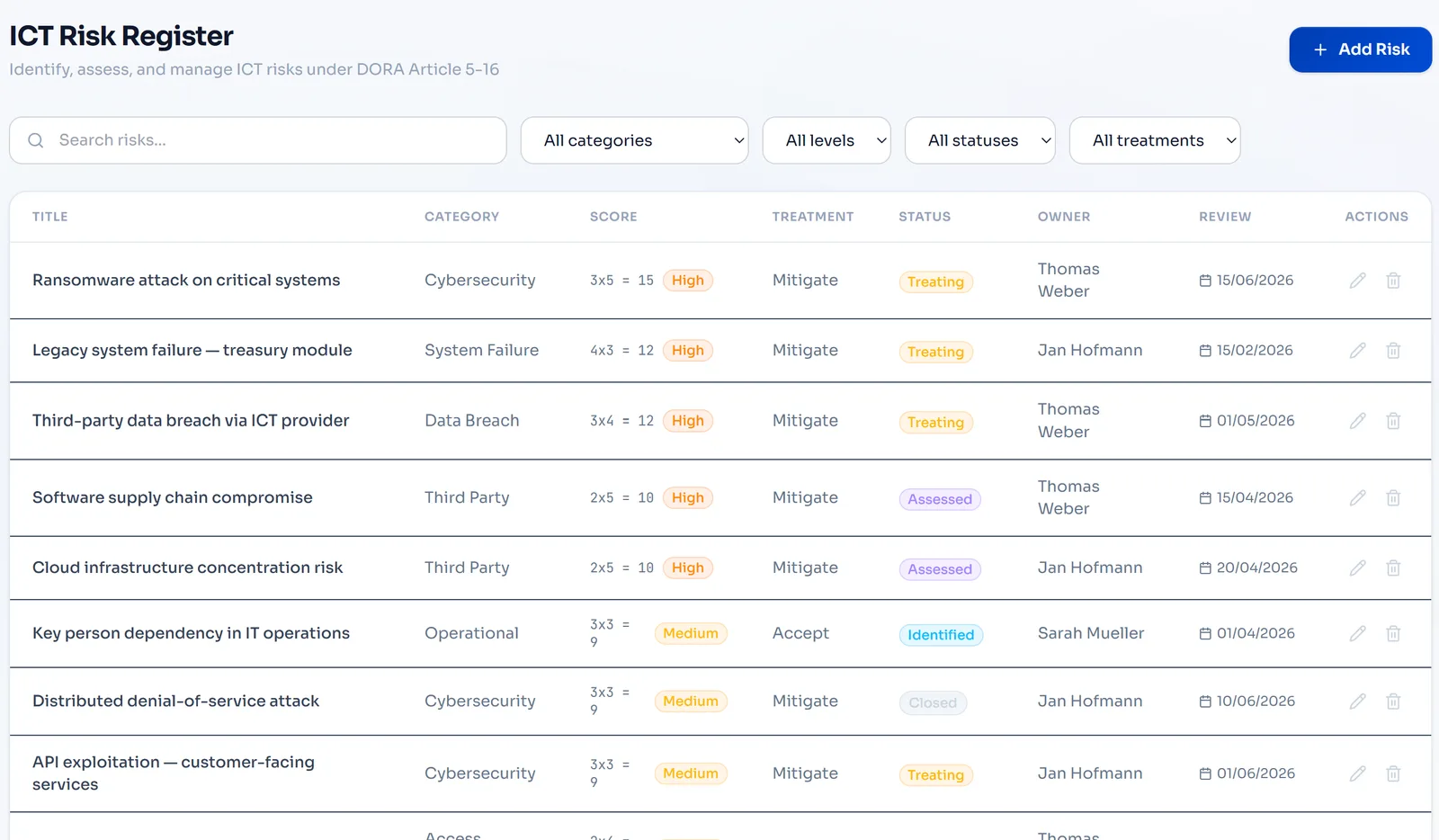
An ICT risk register that runs Article 6 for you.
A centralised risk register purpose-built for DORA Article 6. Every ICT risk scored on a 5x5 likelihood-by-impact matrix with automatic classification from Low through Critical. Assign ownership, set review dates, track treatment decisions and generate board-ready reports in one click - with a full audit trail on every change to satisfy supervisory evidence requirements.
- Automated 5x5 risk scoring with inherent and residual risk tracking
- 9 ICT risk categories aligned to the DORA taxonomy
- Risk appetite thresholds with automatic escalation triggers
- Cross-framework control mapping to NIS2, ISO 27001 and GDPR
- Quarterly risk snapshots for trend analysis and audit evidence
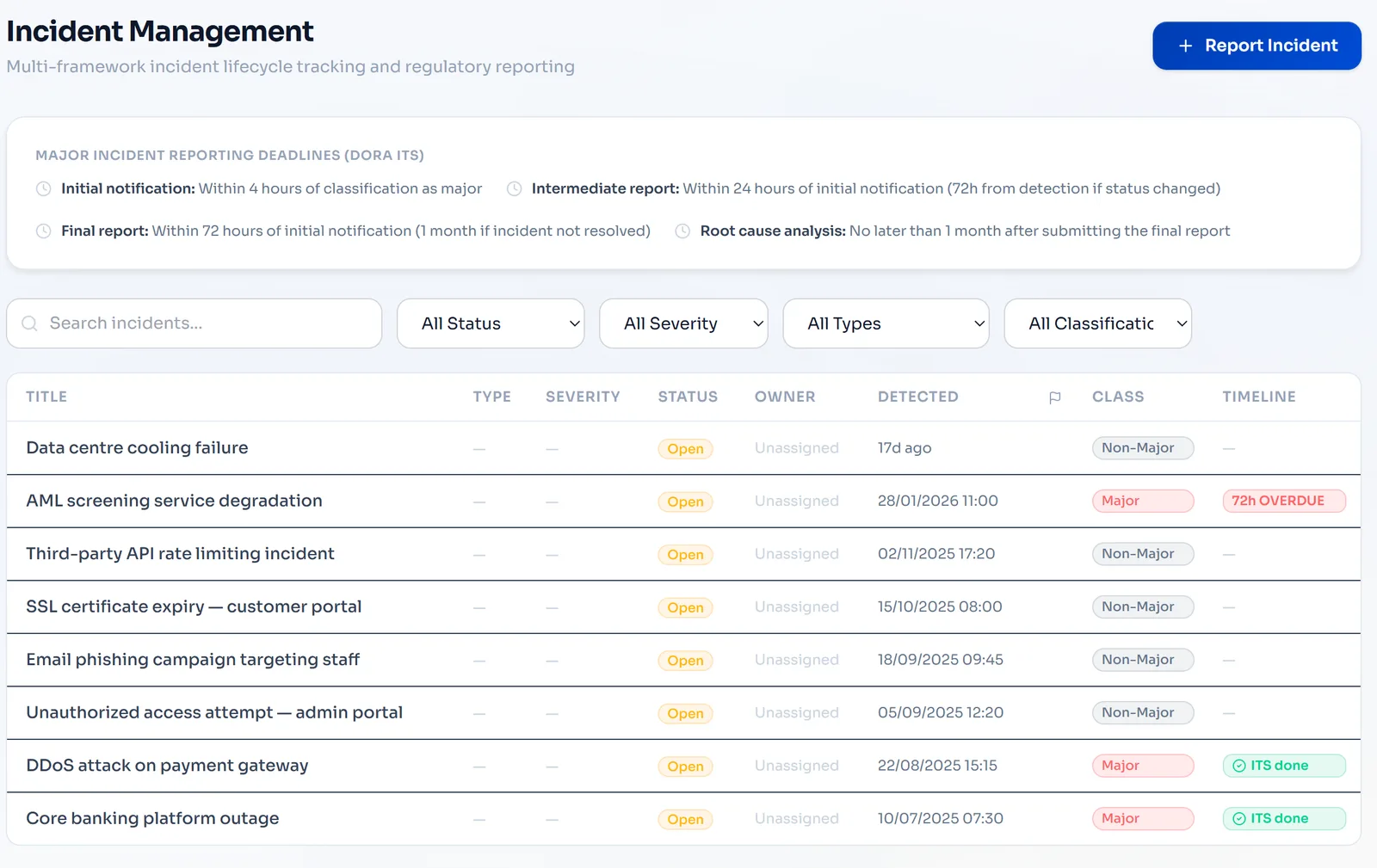
Incident clocks that start themselves.
DORA gives you 4 hours to classify a major ICT incident and start reporting. Venvera enforces the timeline with built-in classification criteria, automatic deadline tracking and pre-formatted templates for all three reporting stages - initial notification, intermediate report and final report. The clock starts the moment the incident does, so a regulatory deadline is never something someone had to remember.
- Automatic incident classification against DORA severity criteria
- Countdown timers for the 4-hour, 72-hour and 1-month deadlines
- Pre-formatted templates for initial, intermediate and final reports
- Escalation workflows when deadlines approach
- Complete incident timeline with audit trail for supervisory review
Find your concentration risk before your regulator does.
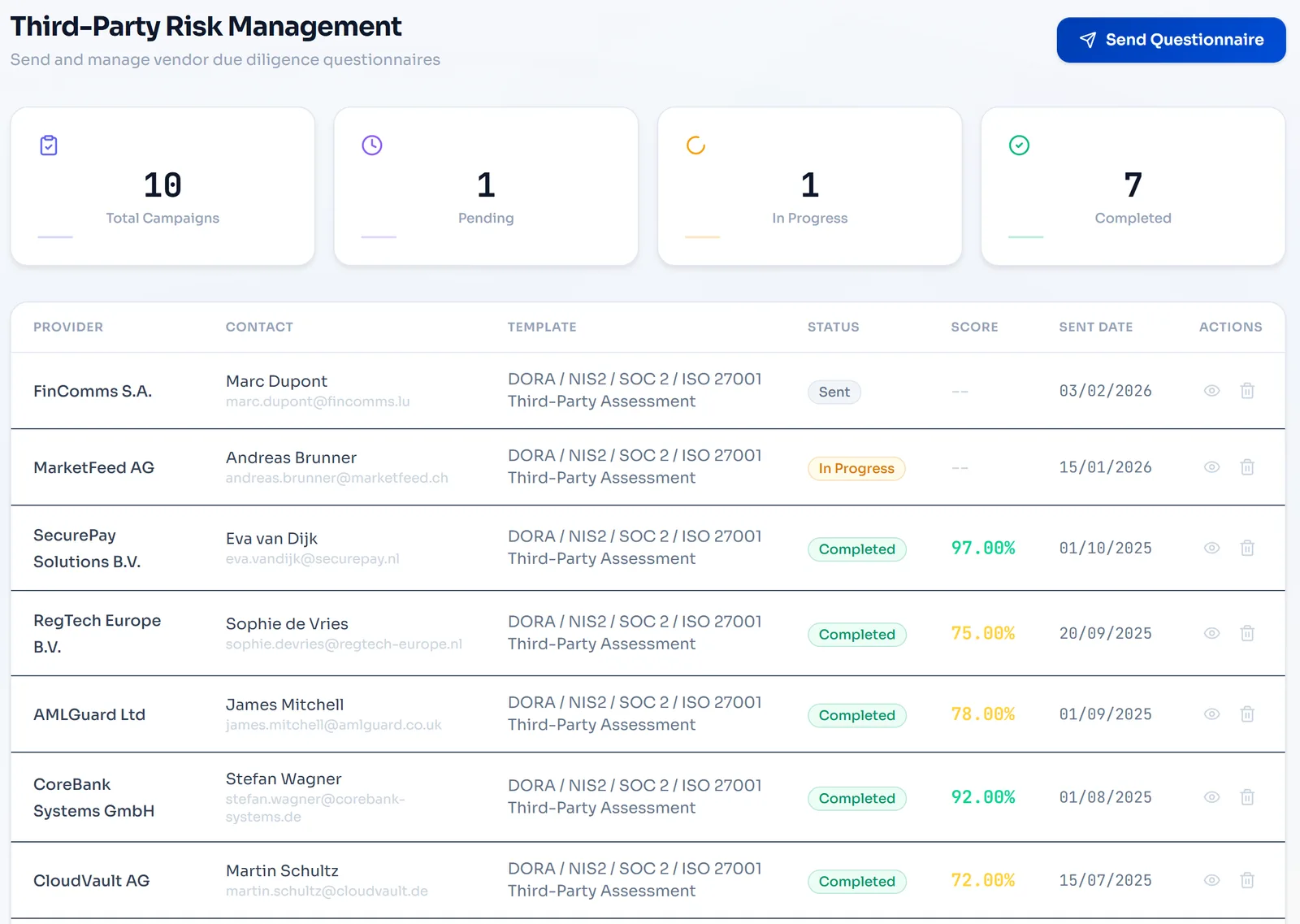
Article 28 makes you manage ICT third-party risk across the whole provider relationship. Venvera scores each provider on five weighted dimensions - criticality, geographic risk, concentration, contract health and data sensitivity - and flags single points of failure before a supervisor asks about them. Exit strategies, substitutability assessments and subcontracting chains all live in one place.
- Five-dimension automated risk scoring per provider
- Concentration risk alerts at country and provider level
- Exit strategy documentation with substitutability scoring
- Sub-outsourcing chain mapping with n-th party tracking
- Contract lifecycle monitoring: expiry, SLAs, audit rights
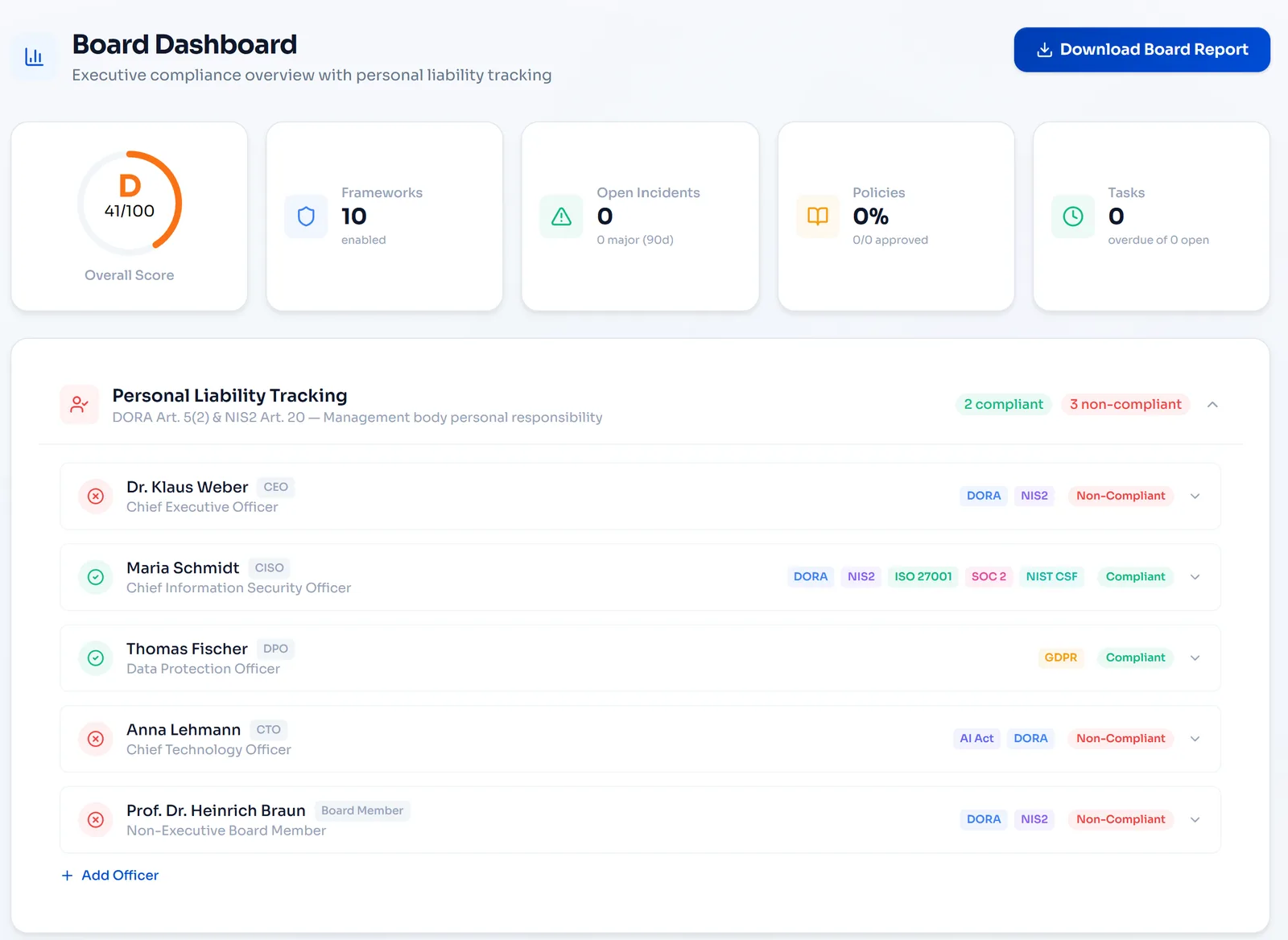
The evidence file that protects your board.
Article 5(2) makes board members personally accountable for the ICT risk management framework - so the question is not whether they governed, but whether you can prove it. Venvera tracks every element of board oversight: policy approvals, risk report reviews, resource allocation decisions, training completion and meeting attendance, all in one dashboard with a liability evidence package exportable per board member.
- Policy approval tracking with digital sign-off records
- Board meeting attendance and agenda item logging
- Resource allocation documentation for ICT risk budgets
- Training completion records for management body members
- Personal liability evidence package exportable per board member
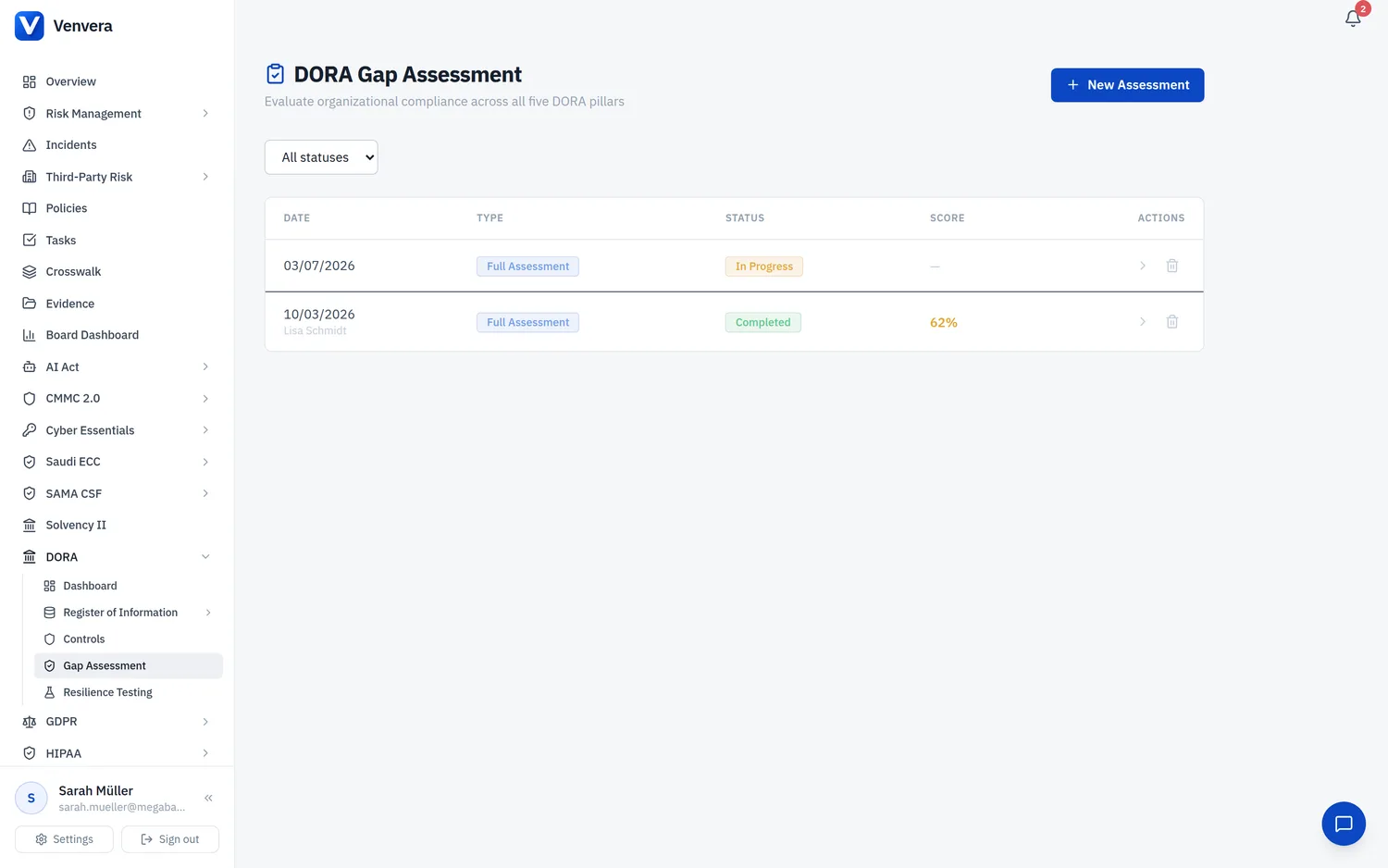
Know exactly where you stand in five minutes.
A gap assessment that evaluates your organisation against all five DORA pillars - ICT risk management, incident reporting, resilience testing, third-party risk and information sharing - and hands back a scored maturity assessment with a prioritised remediation roadmap, effort estimates and owners. Track progress from first assessment through full compliance instead of guessing.
- Five-pillar assessment covering all DORA requirements
- Maturity scoring: Not Started, Partial, Implemented, Effective
- Auto-generated remediation roadmap with priority and effort estimates
- Ownership assignment and deadline tracking per remediation item
- Progress dashboard showing compliance trajectory over time
The spreadsheet or Venvera.
DORA, answered.
DORA guides
- DORA requirements explainedThe five sets of duties in Articles 5 to 45, who carries which version of them, and the four-hour clock that starts at classification.
- Third-party risk management solutions: the 2026 guideFour kinds of TPRM platform, what Articles 28 to 30 and the register of information require of each, and a ten-criteria scoring table.
- DORA for insurersWho is in and out under Article 2(3), what DORA changed in Solvency II Article 41(4), and the TLPT thresholds for insurers.
- DORA for payment institutionsWhich payment and e-money firms get Article 16, what PSD2 Article 96(7) switched off, and the EUR 150 billion TLPT default.
- How long does DORA compliance take?Four to six months from a mature programme, nine to twelve from spreadsheets, and why.
- DORA fines and penaltiesWhy DORA sets no EU fine for financial entities, what Article 50 requires, national amounts, and the 1% CTPP penalty.
- DORA compliance cost: a line-by-line modelThe eight work items every DORA programme pays for, and what multiplies each one.
- The complete guide to the DORA Register of InformationAll 15 templates from Implementing Regulation 2024/2956 and how they connect.
- DORA major incident classification: the 7 criteriaThe exact test in Delegated Regulation 2024/1772 and the 4h, 72h and 1-month clocks.
- DORA ICT third-party risk: building a compliant vendor registerThe contract clauses, the sub-outsourcing RTS and the exit tests.
- DORA TLPT: threat-led penetration testingWho gets designated, the TIBER-EU phases, and how to plan the engagement.
- Why your Register of Information keeps getting rejectedThe seven ESA rule codes that actually reject a submission, and how to clear them.
- Incident reporting deadlines by regulationThe DORA 4h clock next to the GDPR, NIS2, AI Act and CRA ones, and which binds first.
- ISO 27001 vs DORADORA never mentions ISO 27001: where an ISMS answers Articles 5 to 16, and what a certificate leaves open.
- Cyber Resilience Act vs NIS2 vs DORAWhy DORA replaces NIS2 for financial entities under Article 1(2), and where the CRA still applies.
- DORA audit: what to expectThe Article 50 powers, the internal audit Article 6(6) makes you run, and the yearly cycles a supervisor can check.
- How to collect audit evidenceRelevant, reliable, sufficient and verifiable: the five-step method and who can demand it under DORA Article 50(2)(a).
Know where you stand on DORA before your NCA does.
Start with a free gap report across all DORA domains - 10 minutes, no email to start.
✓ Every paid plan: audit-ready in 90 days, or your money back*
10 minutes · no email to start · no credit card · yours to keep