
Best
Let me tell you what nobody selling NIS2 compliance solutions will say out loud: most of the money spent on NIS2 this year will buy activity, not compliance.
Workshops. Gap reports. A binder with a maturity heatmap on page four. Meanwhile the actual obligations, the ten risk-management measures of Article 21, the 24 hour early warning clock, the training your management body is personally on the hook for, sit exactly where they were: undone, or done once and quietly rotting.
I build compliance software for a living. Venvera is mine, so I am biased and I will put it first. In exchange for that bias, I will do the thing vendors avoid: tell you honestly who should buy each of the alternatives, including when you should not buy my product. The wrong buyer churns in a year. The right buyer stays a decade. I am optimising for decade.

What makes NIS2 compliance solutions different from every other compliance purchase
Three things about NIS2 change the buying decision, and most vendors gloss over all three.
- It is a directive, not a regulation. NIS2 (Directive (EU) 2022/2555) was transposed into 27 different national laws, on 27 different timelines, with 27 flavours of scope, registration duties and penalties. Your obligations in Germany are not your obligations in Ireland. Any solution that treats NIS2 as one uniform rulebook is selling you a simplification you will pay for later.
- Management is personally accountable. Article 20 puts approval of the cybersecurity measures, and training, on the management body itself. Your board members can be held liable. That turns "the security team's project" into "the board's standing agenda item," and your solution has to produce something a board can actually read.
- The clocks are brutal. Article 23 gives you 24 hours for the early warning, 72 hours for the incident notification, one month for the final report. Fines reach 10 million euros or 2 percent of worldwide turnover for essential entities, 7 million or 1.4 percent for important ones. You do not meet a 24 hour clock with a process someone has to remember. You meet it with a system that starts counting for you.
Hold those three against every option below.
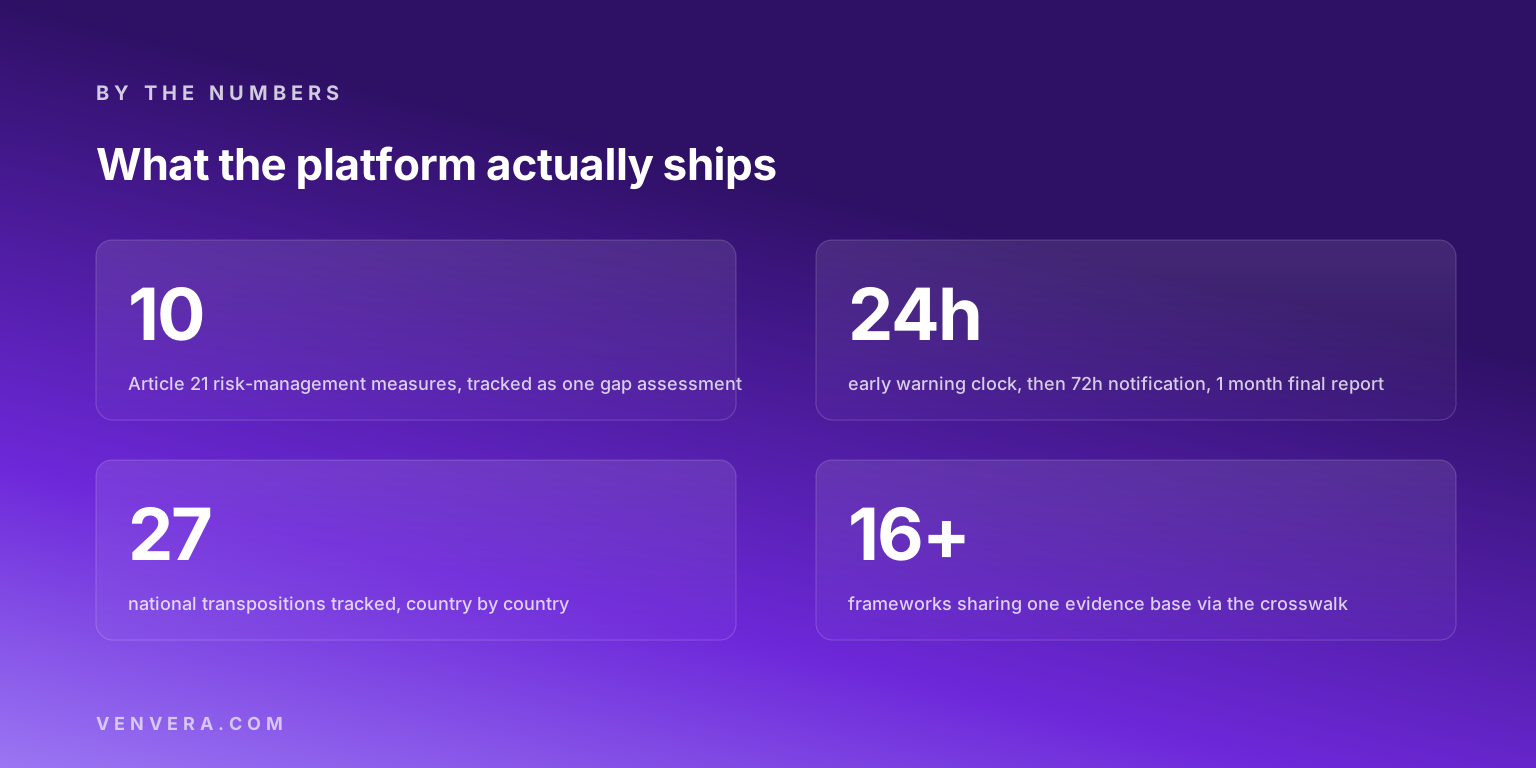
The four ways companies buy NIS2 compliance solutions
- Regulation-native platforms. Software built from the directive itself: the ten measures, the reporting clocks, the training register, the national transposition differences. Venvera is here.
- Consultants. Big 4 and boutique firms who interpret your national transposition, classify you as essential or important, and prepare you for the supervisor.
- Legacy enterprise GRC suites. The big configurable platforms. Immensely capable, famously slow, priced for the largest operators.
- Audit-automation SaaS. SOC 2 and ISO evidence-collection tools that added a NIS2 checklist to the framework menu.
And the unspoken fifth: a spreadsheet named NIS2_final_v7_REAL.xlsx. We will price that one too.
Option 1: Venvera. Why I built it and why it goes first
I judge every purchase, including my own product, on three axes: how likely is the outcome, how fast does it arrive, and how much of my team's life does it consume. Price is fourth, because the real cost of compliance tooling is never the invoice. It is your security lead spending every Friday rebuilding evidence someone already collected.
Likelihood of outcome: built on Article 21, not adapted to it
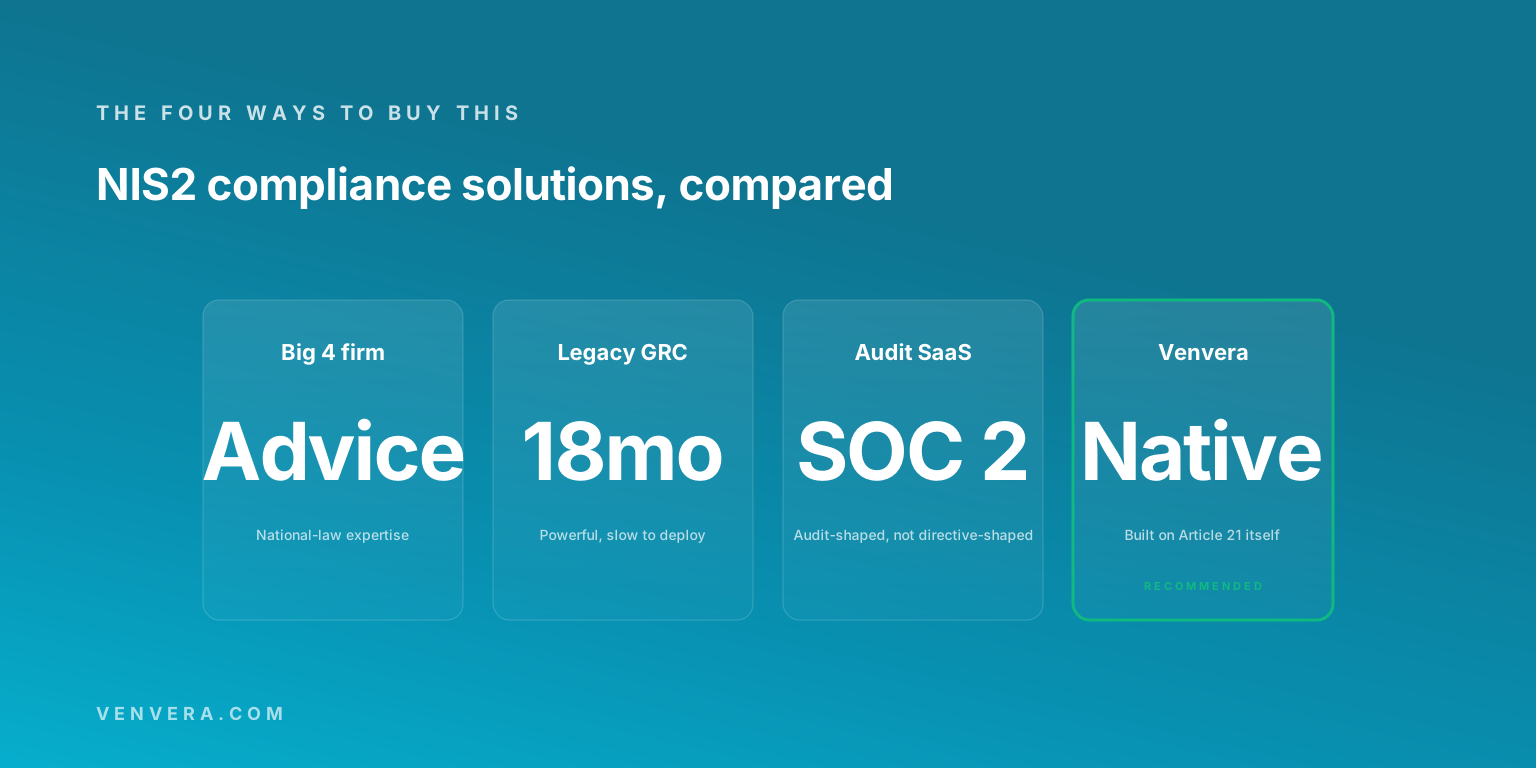
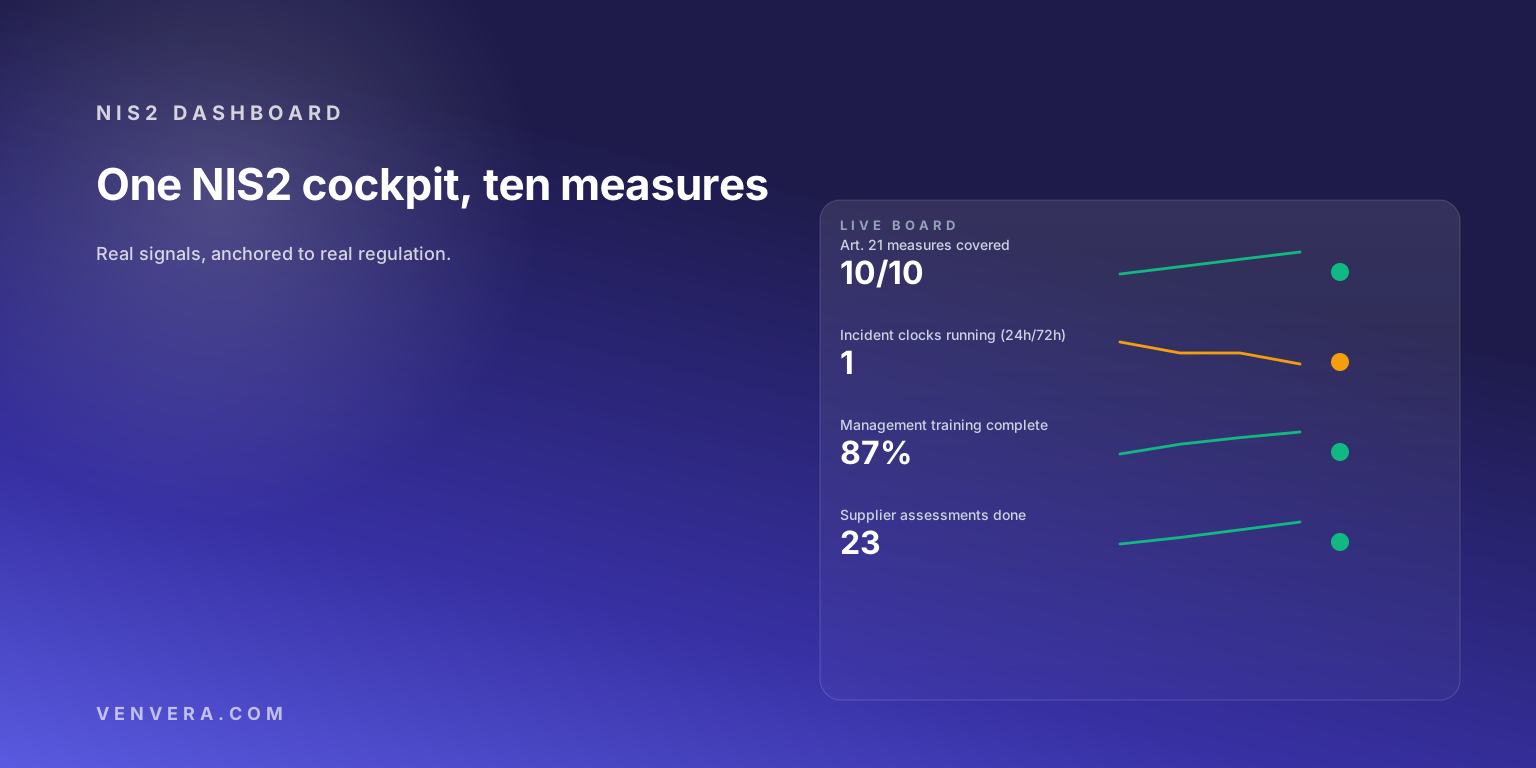
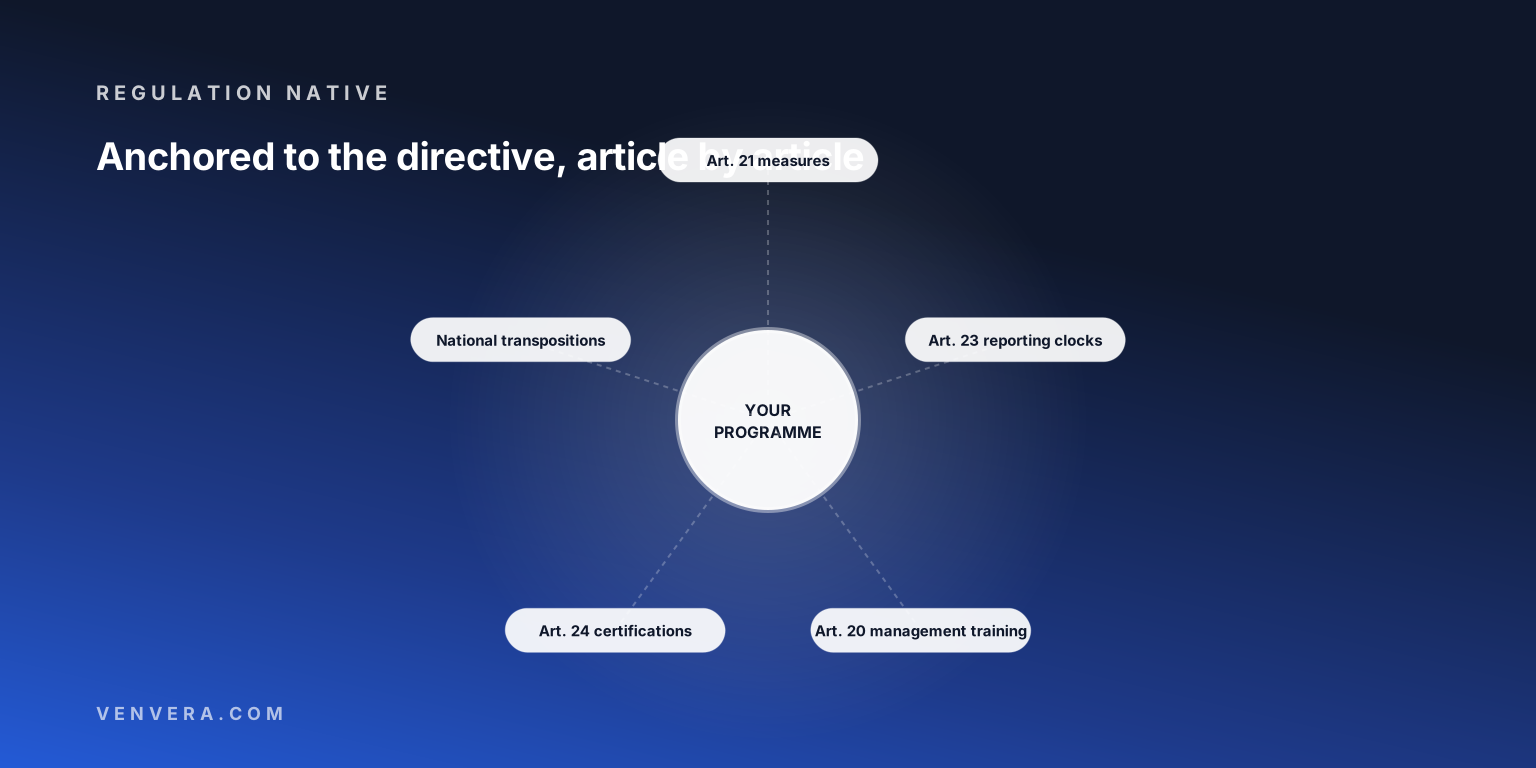
Venvera's NIS2 workspace starts from the directive's own structure. The gap assessment walks all ten Article 21 risk-management measures, from risk analysis and incident handling to supply chain security, cryptography policy and MFA, scores you against them, and generates the remediation plan. Incident handling carries the Article 23 clocks natively: classify an incident and the 24 hour early warning, 72 hour notification and one month final report deadlines appear on the record and count down. The Article 20 obligation gets its own register: management training, tracked per person, because "the board approved the measures" needs a paper trail with names on it.
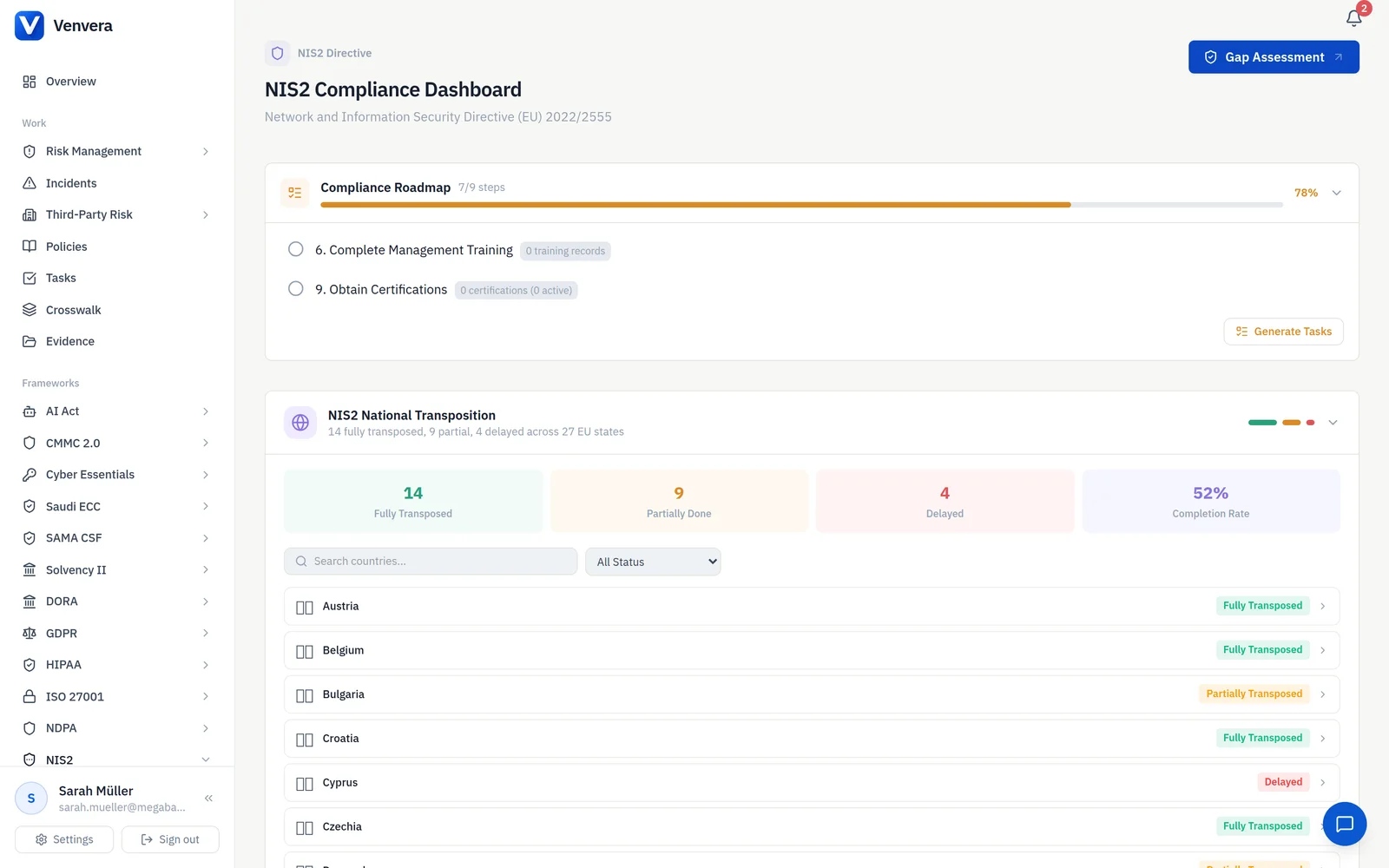
And because NIS2 is 27 laws wearing one name, the workspace includes a transposition tracker: country by country, which national law implements the directive, who the authority is, and how the local flavour differs. Your subsidiary in Prague and your headquarters in Munich are not guessing from the same PDF.
Speed: a scored baseline in your first week
There is no implementation project. You log in, run the ten-measure gap assessment, and finish the week with a score, a prioritised remediation backlog, and a board view that shows both. The typical alternative timelines: consultants deliver a first draft after the interview rounds; a GRC suite delivers after the implementation partner does.
Effort: evidence once, compliant everywhere
Here is the part that changes the annual math. Nobody carries NIS2 alone. You are also holding ISO 27001, GDPR, maybe DORA if you serve financial entities, maybe the AI Act. Venvera runs 16+ frameworks on one platform and its crosswalk links equivalent controls across them: evidence your access-control process once and it closes the matching controls in NIS2, ISO 27001, DORA and the rest at the same time. The second framework stops costing what the first one did. That is the whole trick, and audit-season stops being a season.
The supporting cast, chosen to remove work rather than add features:
- A board pack that writes itself. Article 20 makes the management body approve and oversee the measures. The board dashboard rolls posture, incidents and training into the report they need, in language a non-engineer can defend.
- Company groups. Write the security policy once in the parent entity; every subsidiary inherits it read-only while keeping its own evidence. Built for exactly the multi-country operators NIS2 catches.
- Your language, your keys, your region. The interface runs in English, German, Spanish and Bulgarian, switchable per organisation and per user. AI assistance runs on your own API key. Data is hosted in the EU.
- Integrations that fetch evidence. Azure and Microsoft 365, Google Workspace and Jira feed posture evidence automatically instead of by quarterly screenshot.
The honest limitation
Venvera will not tell you whether your national authority will classify you as essential or important in an edge case, and it will not argue with a supervisor on your behalf. That is judgment work, and judgment is bought from humans. Which brings us to option two.
Option 2: consultants. Buy the judgment, not the operating model
The genuinely valuable things consultants do for NIS2 are the things software cannot: read your national transposition against your corporate structure, argue an entity-classification edge case, prepare you for a supervisory inspection under local law. If your scope question is genuinely ambiguous, or you operate in a member state whose transposition took creative liberties, pay for that judgment. It is worth it.
Just do not confuse the deliverable with the regime. An engagement produces a report; NIS2 demands a permanently running system with clocks measured in hours. The report starts aging on delivery day, and keeping a firm on retainer to re-produce it is the most expensive way to store a spreadsheet that exists. The pattern that works: consultants for interpretation at the start and for the occasional hard question, a platform for the permanent regime. Both together usually cost less than the consulting-only model, and you own the result.
Option 3: legacy enterprise GRC suites. Right weight class, wrong default
If you are a national grid operator with a dedicated GRC operations team and an existing enterprise licence, the big suites are defensible and battle-tested, and this section is not for you. For everyone else, the arithmetic is the problem: the suite arrives as a toolkit, NIS2 arrives as content packs and configuration workshops, and the distance between contract and go-live is measured in quarters and implementation-partner invoices. Mid-size essential entities routinely spend more configuring the platform than operating the security programme it exists to document. Capability is not the question. Time-to-value is.
Option 4: audit-automation SaaS. Excellent product, different shape
The SOC 2 and ISO automation platforms are genuinely excellent at their job: automated evidence collection against audit frameworks, point-in-time attestation, auditor happy, sales team unblocked. If your burning need this quarter is SOC 2 for the pipeline, buy one and enjoy it.
NIS2 is a different shape. There is no auditor and no end date; there is a supervisor and a set of duties that never close: hour-denominated incident clocks, a personally accountable management body with a training obligation, supply chain assessments, and 27 national variations. A checklist named NIS2 inside an audit tool covers the letterhead, not the regime. Buy the audit tool for audits. Buy directive-shaped software for a directive.
Option 5: the spreadsheet. The price tag you refuse to read
The spreadsheet is not free. It is prepaid with senior hours.
Run the numbers you already know: ten measures, each with controls and evidence that expires. Say 60 suppliers who each need a security assessment under Article 21(2)(d), an hour each, twice a year. Training records for every management body member. An incident drill that must prove you can produce an early warning in 24 hours from a standing start. Version-controlling all of it across two or five legal entities by email. That is weeks of expert time per quarter, spent maintaining a file that cannot start a clock, cannot remind anyone, and cannot survive the person who built it changing jobs.
The failure mode is silent until it is public: nothing in a spreadsheet tells you the register is stale until the 24 hour clock is already running and everyone is looking for the current version. You are not saving a subscription. You are self-insuring a regulatory deadline with unpriced labour.
NIS2 compliance solutions, side by side
| Venvera | Consultants | Legacy GRC | Audit SaaS | Spreadsheets | |
|---|---|---|---|---|---|
| Article 21 ten-measure coverage, scored | Native gap assessment | Point-in-time report | Configurable | Checklist add-on | Self-graded |
| Incident clocks (24h / 72h / 1 month) | Built into the workflow | Playbook on paper | Configurable | Generic ticketing | Calendar reminders |
| Management accountability and training (Art. 20) | Named training register + board pack | Briefing deck | Configurable | Thin | Attendance list |
| 27 national transpositions | Country tracker built in | Their core strength | Per-project content | Rare | A tab named "Countries" |
| Cross-framework reuse (ISO 27001, DORA, GDPR...) | Crosswalk, evidence once | Per engagement | Possible, heavy config | Audit frameworks only | None |
| Time to scored baseline | First week | After interviews | After implementation | Fast, audit-shaped | Never truly scored |
| Entity classification and supervisory dialogue | No, pair with experts | Yes, buy this from them | No | No | No |
| Cost shape | Subscription | Six-figure engagements | Licence plus implementation | Subscription | Hidden senior hours |
Who should buy what
- Mid-size essential or important entity (energy, transport, health, water, digital infrastructure, manufacturing) carrying NIS2 plus ISO plus GDPR: regulation-native platform. This is the exact buyer Venvera was built for.
- Group operating across member states: same answer, plus company groups for one policy source of truth and the transposition tracker for the 27-flavours problem. The multilingual interface earns its keep the day your Sofia and Madrid teams onboard.
- Genuinely ambiguous scope or a hostile classification question: buy consultant judgment for that question, run the regime on the platform.
- Tier-one operator with an entrenched GRC suite and the team to feed it: stay, and re-read the total cost at renewal.
- SaaS company whose real deadline is SOC 2: buy the audit-automation tool. Revisit when a customer contract makes NIS2 your problem.
- Still on the spreadsheet: multiply the hours above by your security lead's loaded cost. Decide with a number, not a feeling.
Frequently asked questions
What is the best NIS2 compliance solution for a mid-size company?
A directive-native platform that carries all ten Article 21 measures with scored gap assessment and evidence, starts the Article 23 clocks (24 hours, 72 hours, one month) automatically, tracks Article 20 management training by name, and understands that NIS2 is 27 national laws rather than one rulebook. Consultants complement it for classification and supervisory questions.
Does NIS2 apply to my company, and does software decide that?
Scope comes from the directive's annexes and your national transposition: essential and important entities across sectors like energy, transport, banking infrastructure, health, water, digital infrastructure and manufacturing, generally from 50 employees or 10 million euros turnover, with exceptions in both directions. Software helps you operate the obligations; a genuinely ambiguous classification is a question for counsel or your authority.
Can we cover NIS2 with our existing ISO 27001 programme?
ISO 27001 gives you a running start, and a good crosswalk makes it concrete: in Venvera, evidence attached to ISO controls closes the equivalent NIS2 controls automatically. But ISO does not give you the 24 hour early warning duty, the named management-training obligation, or the national registration duties. Reuse the overlap, then close the directive-specific gap deliberately.
How fast can we get NIS2-ready on Venvera?
The workspace is live on day one. Most teams complete the ten-measure gap assessment in the first week and leave with a scored baseline, a generated remediation backlog, and a board view. From there it is execution, with the clocks, training register and supplier assessments filling in as you work.
Watch your own gap assessment score itself
Same offer I made the DORA buyers, because it is the offer I would want: bring your reality to a demo. We will run the ten-measure gap assessment against your actual posture, put your countries into the transposition tracker, and you can watch ISO evidence close NIS2 controls through the crosswalk in real time. If it does not obviously beat your current setup, you spent forty five minutes and got a free benchmark.
Book the demo, and bring whoever owns the spreadsheet. They will ask the hardest questions, which is exactly why they should be there.