
Best

Unmetered on Professional
Vendor questionnaire campaigns are unmetered on Venvera.
Templates, secure vendor links, auto-scoring and a full audit trail are included in Professional and Enterprise at no extra cost, and they are unmetered: send as many as you need, all year. Vanta charges extra to send vendor questionnaires (an arm-and-a-leg add-on, at the time of writing, 29 July 2026) - confirm current pricing with their sales team before you budget.
Short answer: if SOC 2 or ISO 27001 audit automation is the main job, Vanta is a strong fit, with automated evidence collection, integration monitoring and a large integrations library. If you need to run risk management as an ongoing discipline, with residual scoring, a heatmap, an enforceable risk appetite and key risk indicators, Venvera is built around exactly that. This article compares the two on risk capability and classifies every claim by how it was verified.
Most teams meet Vanta through SOC 2. It automates evidence collection, watches your integrations, and gets you to an audit faster than a spreadsheet could. That is genuinely useful, and for a startup chasing its first SOC 2 report it can be the right tool. The mistake comes later, when the same team assumes the tool that carried them through an audit will also carry a risk programme. Those are different jobs with different rhythms: one ends on a report date, the other never ends.
A different question needs different tooling: not “are we audit ready,” but “what are our top risks, how bad could they get, and what are we doing about them.” That is risk management, a separate discipline from audit readiness. Vanta documents a risk register and risk assessment feature; the depth that dedicated risk management calls for, such as residual scoring, a heatmap, an enforceable risk appetite and key risk indicators trending over time, was not confirmed from the public documentation reviewed in July 2026, so verify the current feature set with Vanta. Venvera was built the other way around: risk is the core, and the frameworks hang off it.
Methodology
Compiled in July 2026 from Vanta’s public documentation and hands-on use of the Venvera product. Venvera capabilities described here are verified in the product. Vanta was not hands-on tested by us; every Vanta line is classified as either described in Vanta’s public documentation or not confirmed from the public documentation reviewed in July 2026. Vendor features change, so verify current details with Vanta before deciding.
🔍
The gap
This comparison focuses on risk management. For the full multi-framework picture see our Vanta alternative for EU compliance, or the DORA-specific comparison.
Audit readiness and risk management are different jobs
Audit-first platforms tend to treat risk as an input to a report: a register exists so an auditor can confirm you have one. That is fine until a regulator, a board or a large customer wants to see how you identify, score, treat and monitor risk on an ongoing basis. At that point a static list does less of the work, and the depth of a dedicated risk module matters. If you want a blunt test of which camp your current tool sits in, ask it which of your risks are outside appetite right now. A register that cannot answer that in one screen is a filing cabinet with a login.
📊
The register
A risk register that scores risk properly
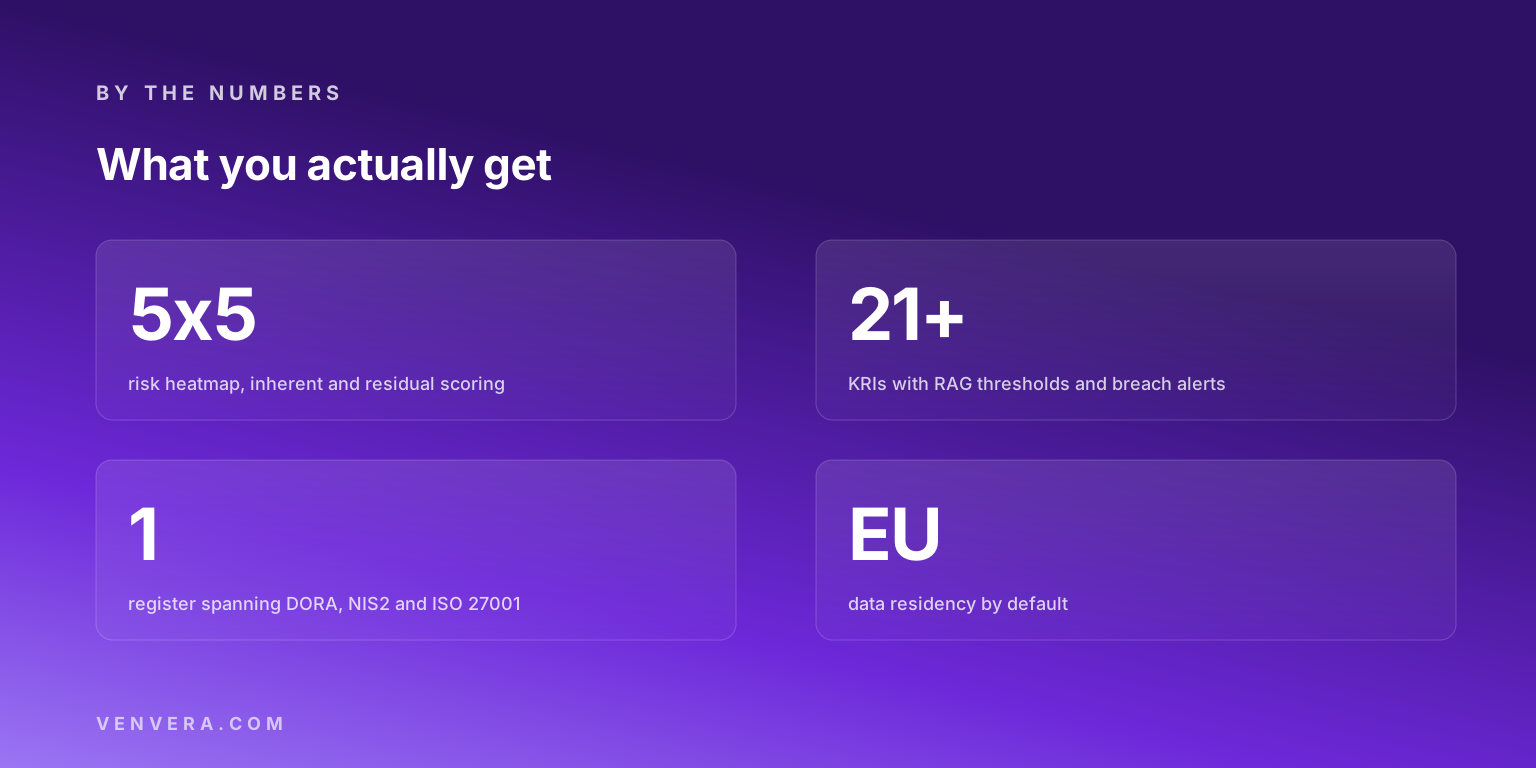
In Venvera every risk carries both an inherent score (before controls) and a residual score (after the controls you have in place), each derived from a likelihood and impact rating on a 5x5 scale (verified in product). That distinction is what lets you show a regulator your controls are actually reducing exposure rather than merely existing. Each risk also links to the controls that treat it, so the register and your control library stay connected. Scoring both numbers is more work at the outset and it is worth it. Registers that only carry one score age badly: years of control investment leave no trace in the figures, and you end up arguing your progress from memory in front of a board that wanted a trend line.
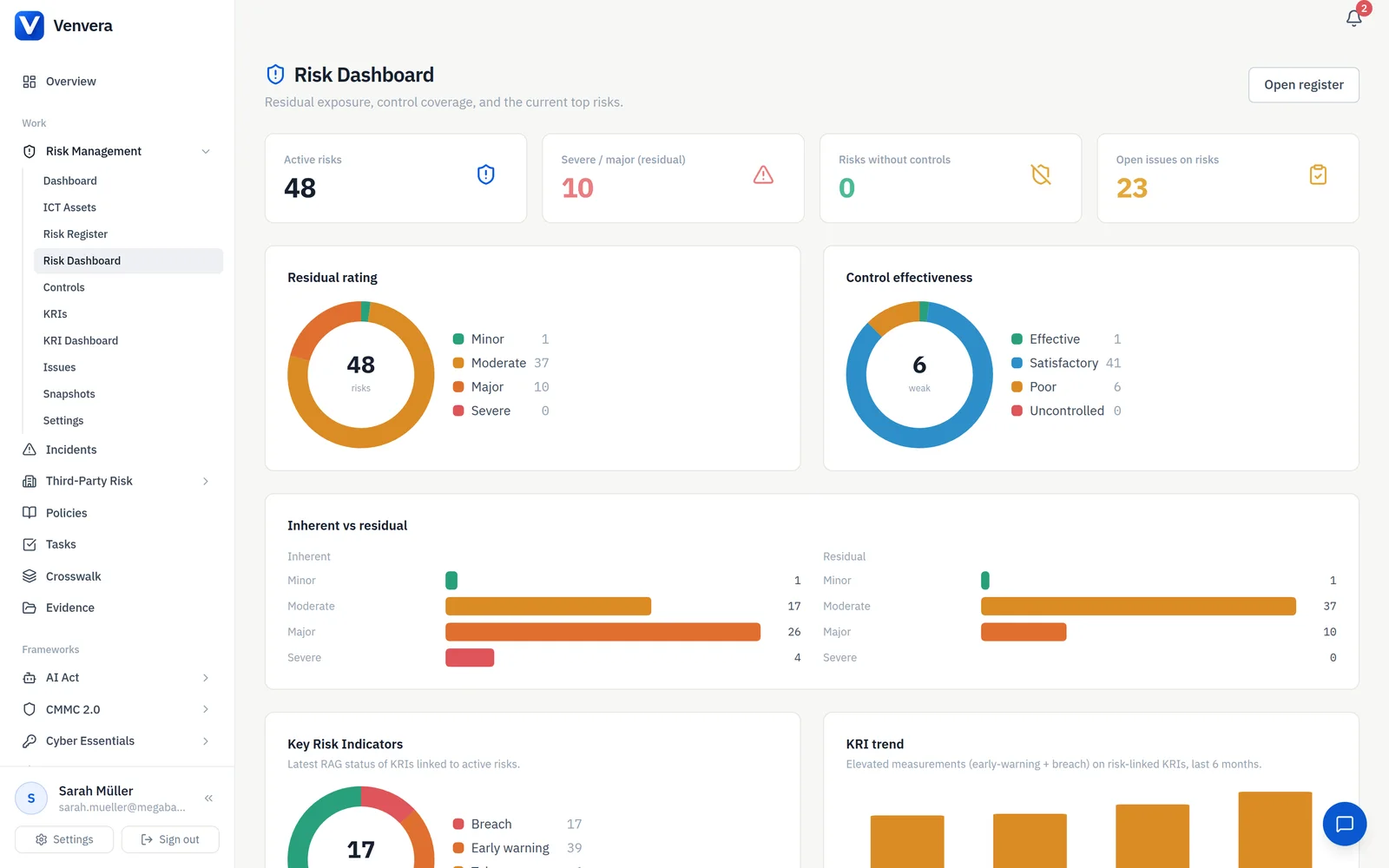
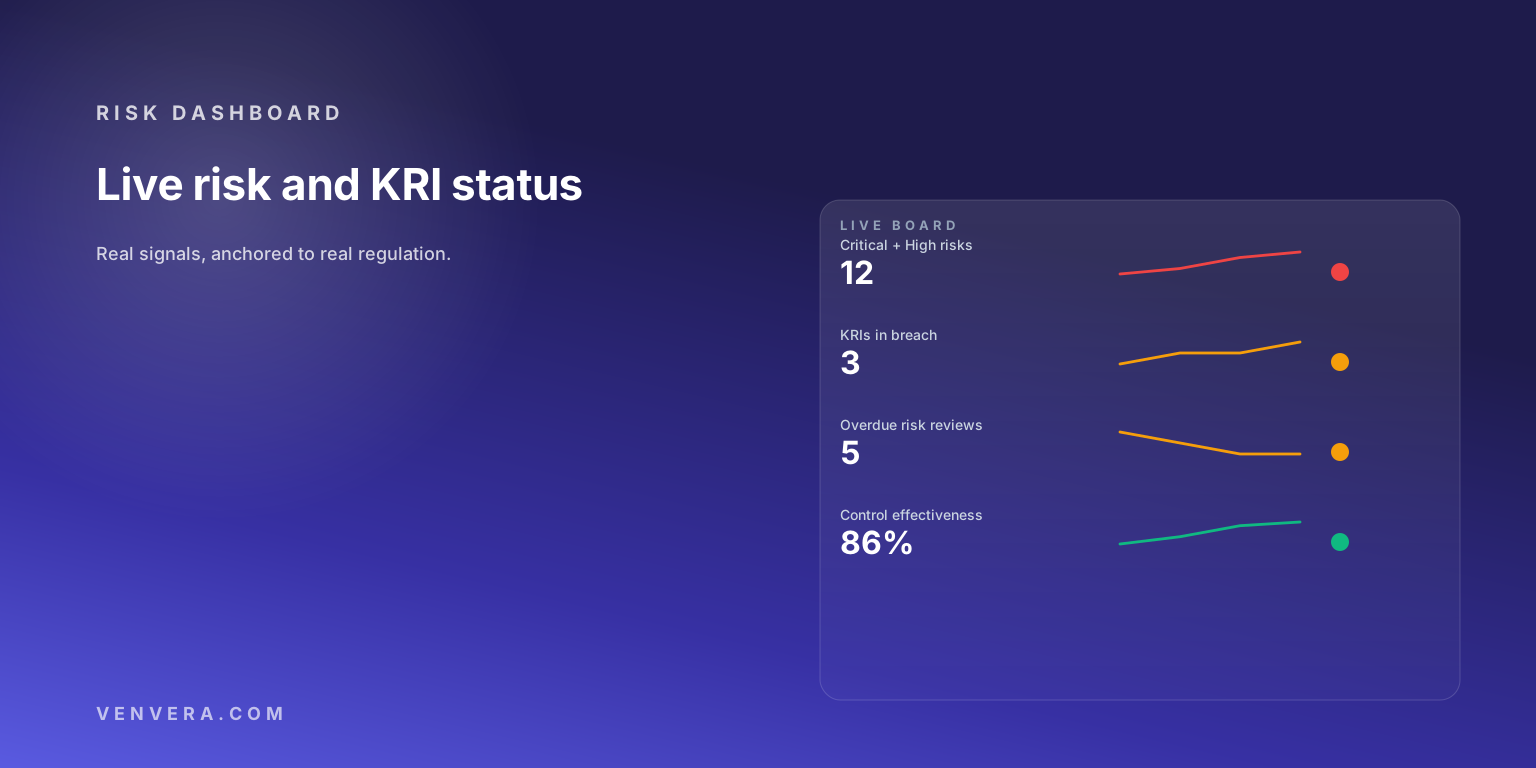
The Risk Dashboard turns the register into a 5x5 heatmap so the picture is immediate: critical and high risks sit in the red corner, the count in each cell is one click from the underlying records, and overdue reviews are surfaced so nothing quietly goes stale.
🎯
Risk appetite
Risk appetite you can actually enforce
A risk appetite statement that lives in a slide deck changes no behaviour. Venvera lets you set per-level thresholds, preview them across the full 25-cell matrix, and route them through review and approval (verified in product). From then on the platform knows which risks fall inside appetite, which need treatment, and which must be escalated, and it colours the register accordingly. Expect the thresholds themselves to be the argument. Deciding where amber becomes red is a board conversation about how much loss the business will tolerate, and configuring it afterwards takes minutes by comparison. An equivalent risk-appetite workflow was not confirmed from Vanta’s public documentation reviewed in July 2026 (verify with Vanta).
📈
KRIs
Key risk indicators that get reported every month
Risk is not static, so monitoring it cannot be either. Venvera ships a library of Key Risk Indicators tied to specific regulatory clauses, each with red, amber and green thresholds (verified in product). Many compute themselves from your live data; the rest are owned by a person. When a value breaches appetite, Venvera opens a breach record automatically. Start with fewer indicators than you think you need. A handful that get a real number every month beat a long list that gets an estimate every quarter, because the reporting habit is far harder to build than the library.
Collection is the part teams tend to value most. Instead of chasing owners by email, you send a single-use magic link for the period and they submit their number without ever logging in. The KRI Dashboard then shows the whole portfolio at a glance: latest RAG status, elevated measurements, reporting health, and exactly which update requests are still outstanding.
🛠
Issues
Issues and remediation, tracked to closure
Findings are only useful if they get fixed. The Issues register records each weakness with a rating, an owner and a reviewer, and hangs remediation actions off it: due dates that can be retargeted, the action to be taken, a rolling status, and an auditor assurance review for independent sign-off (verified in product). That is the audit trail from weakness found to remediated and assured that reviewers expect, and it is richer than a flat findings list.
🌍
One register
One register across every framework, hosted in the EU
If the register has to be readable by an Arabic-speaking board as well as an English-speaking security team, risk management software in Arabic covers bilingual registers, Arabic sorting and what SAMA and the Saudi NCA expect to see.
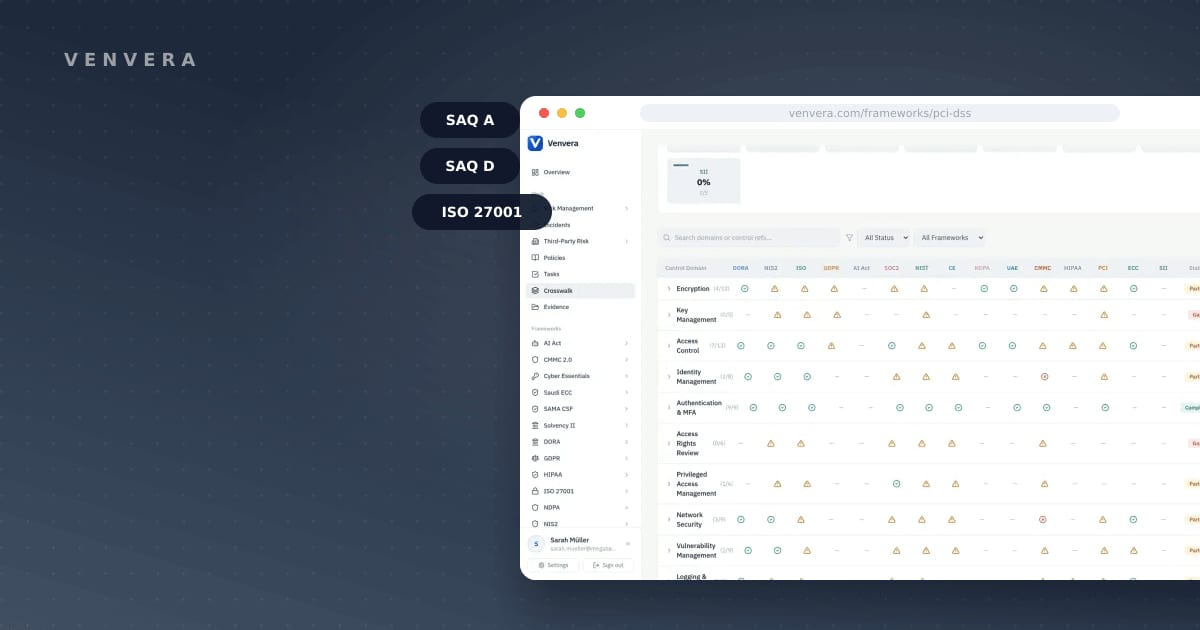
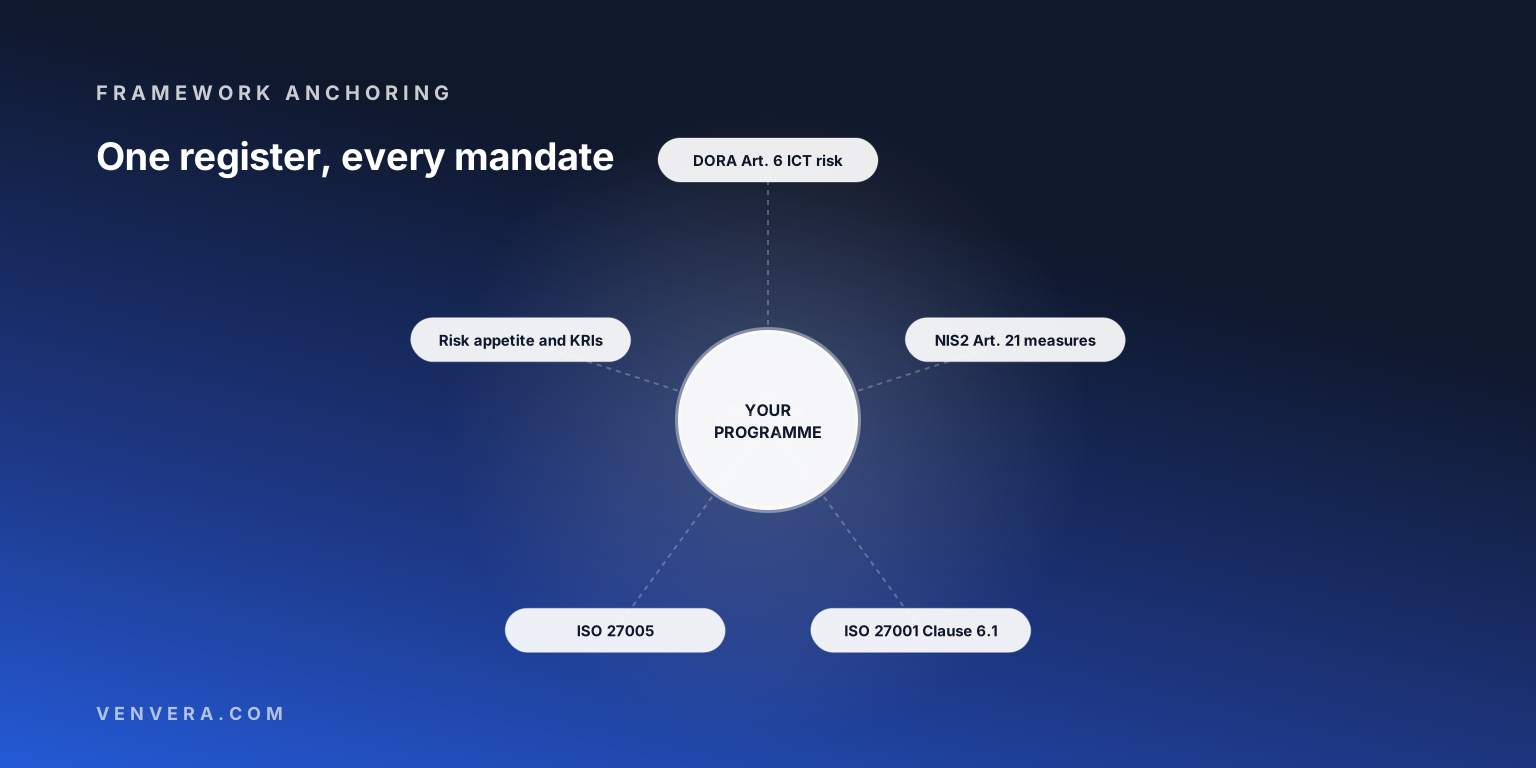
Because risk is the core, a single register feeds ISO 27001, NIS2 and DORA at once, rather than maintaining a separate list per standard (verified in product). Venvera also runs on EU infrastructure by default, which matters when the risks you are tracking concern EU data and regulators. For Vanta, a unified cross-standard register and EU data residency were not confirmed from the public documentation reviewed in July 2026 (verify with Vanta).
Vanta vs Venvera for risk management
Venvera lines are verified in the product. Vanta lines are marked either as documented in Vanta’s public materials (verify) or as not confirmed from the documentation reviewed in July 2026. Not confirmed means we did not find it, not that it is absent.
| Risk capability | Venvera | Vanta |
|---|---|---|
| Dedicated risk register | Core module (verified) | Risk feature documented (verify) |
| Inherent and residual scoring | Yes, 5x5 matrix (verified) | Not confirmed (Jul 2026) |
| Visual risk heatmap | Yes (verified) | Not confirmed (Jul 2026) |
| Risk appetite with per-level thresholds | Yes, approval workflow (verified) | Not confirmed (Jul 2026) |
| Key Risk Indicators with RAG bands | 21+ KRIs, breach alerts (verified) | Not confirmed (Jul 2026) |
| Request measurements from owners | Magic-link requests (verified) | Not confirmed (Jul 2026) |
| Risk-to-control linkage | Controls linked to risks (verified) | Not confirmed (Jul 2026) |
| Issues and remediation tracking | Full remediation actions (verified) | Findings documented (verify) |
| Board and risk reporting pack | Yes (verified) | Reporting per Vanta docs (verify) |
| One register across ISO 27001, NIS2, DORA | Unified (verified) | Not confirmed (Jul 2026) |
| EU data residency by default | Yes (verified) | Not confirmed (Jul 2026) |
Which tool fits which buyer
If SOC 2 or ISO 27001 audit automation is your main need, Vanta is a reasonable choice and its integrations library is a documented strength. Consider Venvera when:
- A regulator or board wants ongoing risk reporting.
- You report under NIS2, DORA or ISO 27001 and want one risk register, not several.
- You need KRIs, an enforceable risk appetite and a heatmap rather than a single likelihood and impact field.
- EU data residency is a requirement rather than a nice to have.
Neither is a universal winner. The right choice depends on whether your priority is audit automation or running risk as a continuous discipline. On cost, Venvera publishes its plans on the pricing page, while Vanta’s pricing is quote-based and not publicly listed, so confirm current figures with Vanta. Verify the current feature set of each with the vendor before deciding.
See risk management built for risk teams, not just auditors
Book a 30 minute walkthrough of the Venvera risk register, KRIs, risk appetite and board pack, mapped to the frameworks you already report on.
Book a demo Explore the module