
Best
If you run more than one legal entity, you already know the problem. A holding company with five subsidiaries. A multinational with a bank in Germany, an insurer in France, and a fintech in the UAE. A private equity firm with a dozen portfolio companies. A franchise network. Each entity has its own regulators, its own frameworks, its own auditors, and its own evidence, yet the group is expected to run to one standard and report up to one board. Most compliance tools were built for a single company. They break the moment you have a group of them.
This guide is for anyone searching for compliance software for groups of companies, and for the many phrases that mean the same thing: multi-entity compliance software, group compliance management, holding company GRC, subsidiary compliance management, corporate group compliance, or a multi-tenant compliance platform. We will cover what makes group compliance genuinely different, what to look for, and how Venvera solves it with a feature called Company Groups: author your policies and controls once in a parent tenant and have them flow down to every subsidiary, while each entity keeps its own evidence.
What "compliance software for groups of companies" actually means
People search this in a few different ways depending on their structure, but the intent is the same: one place to run compliance across many related legal entities without doing the work N times. Common variants include:
- Multi-entity compliance software and multi-tenant compliance platform - for organisations that operate several distinct legal entities.
- Holding company compliance software and parent company compliance management - where a parent sets the standard and subsidiaries execute it.
- Subsidiary compliance management and group GRC software - keeping every subsidiary aligned to one governance framework.
- Per-entity reporting - each entity able to show its own posture to its own board and auditors, drawn from a shared group standard.
Whatever you call it, the requirement is consistent: define the group standard once, apply it everywhere, and let each entity prove it locally. The hard part is rarely the software. It is agreeing, at group level, which decisions the parent gets to make and which stay with the subsidiary managing director who has a local regulator to answer to. Settle that first, because no platform will settle it for you.
Why a group of companies is harder to keep compliant
Compliance for a single company is already a lot of work. A group multiplies it, and not linearly:
- The same policy, rewritten five times. The parent's information security policy gets copied into each subsidiary, then edited locally, then drifts. Six months later no two entities have the same version and nobody can say which is authoritative.
- Different frameworks per entity. A German bank answers to NIS2 and DORA. A UK entity runs Cyber Essentials and ISO 27001. A US subsidiary needs SOC 2 and HIPAA. A Saudi arm faces SAMA and the NCA ECC. One group, many rulebooks.
- Evidence lives locally, but the standard lives centrally. Group compliance says "everyone must enforce MFA." Whether MFA is actually enforced is a fact about each subsidiary, evidenced in that subsidiary. The tool has to hold both truths without mixing them.
- Data isolation is not optional. One subsidiary's incident log, vendor list, and evidence must never be visible to another. A shared spreadsheet or a single-tenant tool cannot guarantee that.
What to look for in multi-entity compliance software
If you only stress-test two of these in a demo, make them data isolation and author-once distribution. Those two are architectural: a vendor either built for them or did not, and retrofitting either one is a rewrite. The rest can be worked around. A tool that genuinely handles groups of companies should give you:
- A parent-to-child structure: a way to unite tenants under one group and designate a parent that sets the standard.
- Author-once distribution: policies and their mapped controls defined at the parent and pushed to every member entity as a read-only source of truth.
- Per-entity evidence and isolation: each subsidiary keeps its own evidence, its own data, fully walled off from the others.
- Per-entity framework selection: enable the frameworks each entity actually needs based on its jurisdiction.
- Cross-framework mapping: so a control evidenced once in a subsidiary counts across every framework that subsidiary runs.
- Per-entity board-ready reporting: each entity able to produce reports for its own board and auditors against the shared standard.
How Venvera does it: Company Groups
Venvera was built as a multi-tenant platform from day one, and Company Groups is the feature that turns that into real group compliance. The model is simple to describe and strict about isolation.
A platform administrator creates a Company Group, adds the member organisations, and designates one of them as the parent (the Admin Tenant). From that point on, the parent becomes the group's source of truth for policies, and the subsidiaries inherit from it without being able to change it.
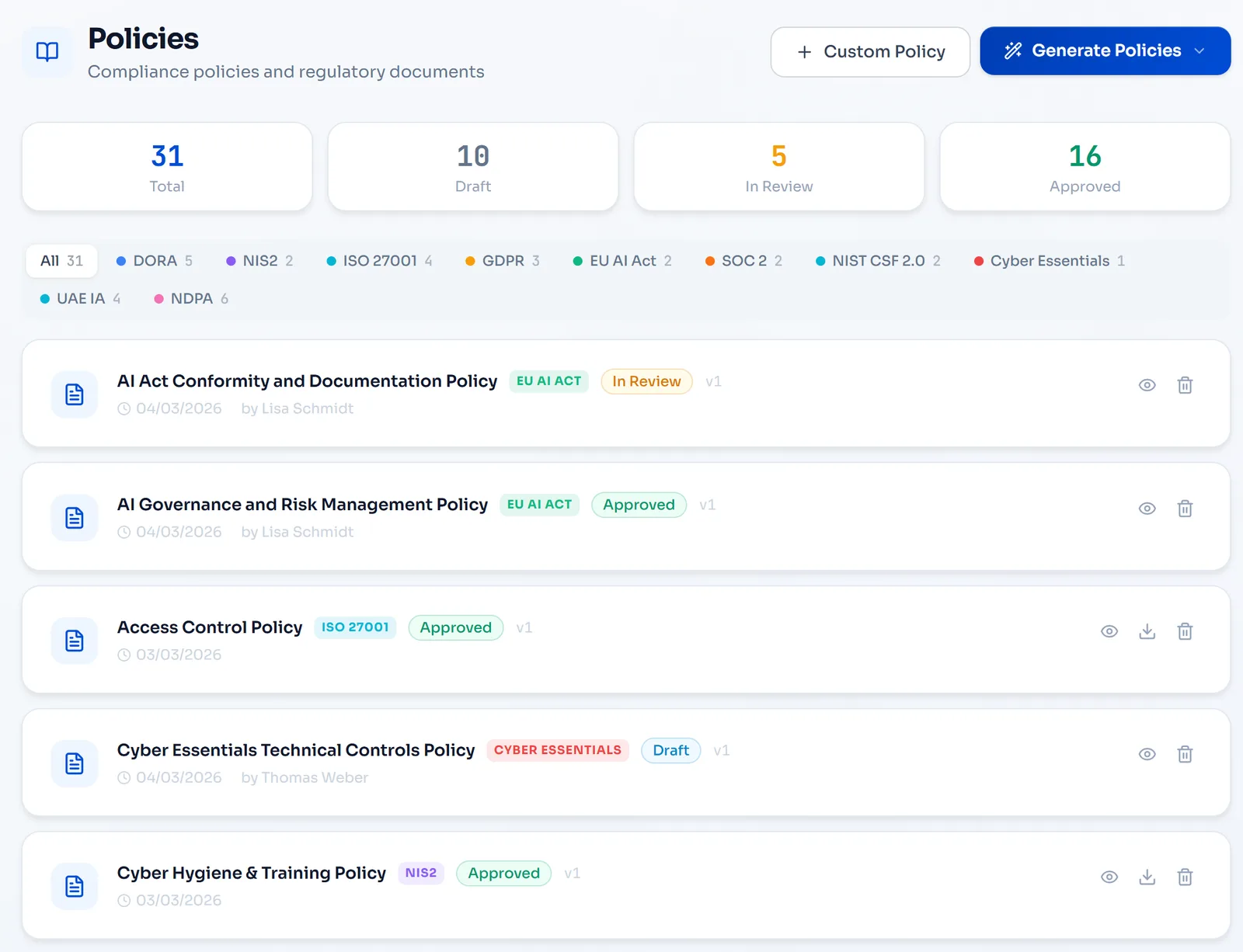
1. Author your policies and controls once, at the parent
You write the group's policies in the parent tenant: the information security policy, the acceptable use policy, the third-party risk policy, and so on. Venvera maps each policy to the specific controls it satisfies. That mapping is the important part: a policy is a set of control requirements the group commits to.
2. Every subsidiary inherits the group standard
Those policies and their mapped controls flow down to every member entity as a read-only standard. Subsidiaries can read the group policy and its control map but cannot edit either, so there is exactly one authoritative version at all times. Update the policy at the parent and members read the new version, because they read the parent's copy directly rather than holding a stale duplicate. No more copy-paste, no more drift, no more "which version is current?".
3. Each entity proves it with its own evidence
Here is the crucial distinction. The standard is shared, but the evidence is local. Each subsidiary attaches its own evidence to the mapped controls inside its own tenant: its MFA configuration export, its access review, its penetration test report. One subsidiary's evidence is never visible to another. The group defines a control as required; each entity is responsible for showing it is actually met. Be honest with yourself about where the time goes here. Publishing the group standard at the parent is an afternoon of work. Getting every local team to attach its own access reviews and configuration exports against that standard is a quarter of patient chasing, and that is the part worth resourcing properly.
Comply once, prove across every framework - for each entity
Most subsidiaries do not run just one framework. Venvera's cross-framework Crosswalk means that when a subsidiary evidences a control once, it satisfies the equivalent control across every framework that entity runs. Evidence MFA enforcement in your UK subsidiary and it can satisfy ISO 27001, SOC 2, Cyber Essentials and more at the same time. Do it in your German bank and it satisfies NIS2, DORA and the others it is subject to. The group standard is proven once per entity, not once per framework per entity.
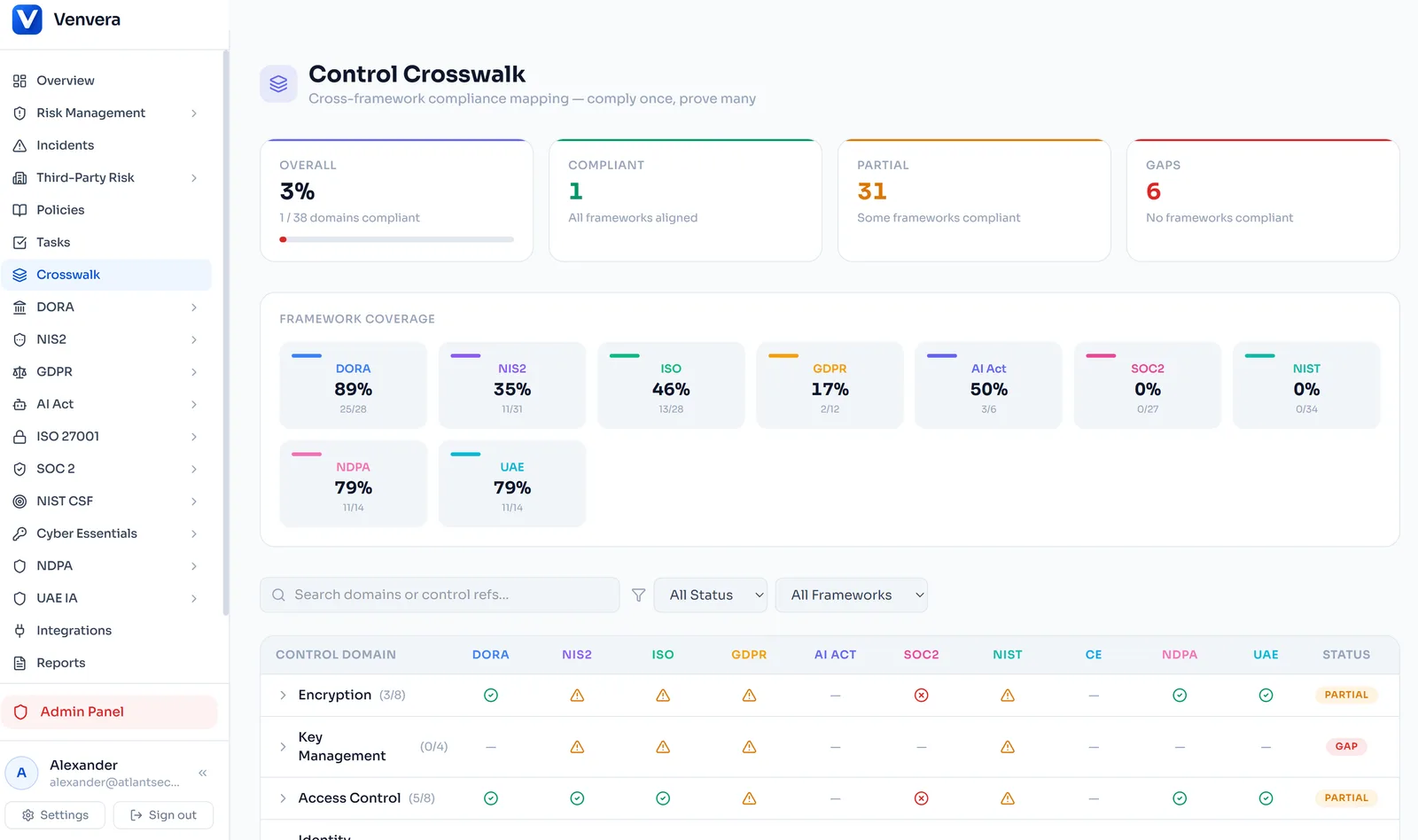
This is what makes group compliance tractable instead of exponential. Without cross-framework mapping, a group with five subsidiaries each running four frameworks faces twenty separate evidence programmes. With it, each subsidiary evidences its controls once and the platform propagates the result across its frameworks.
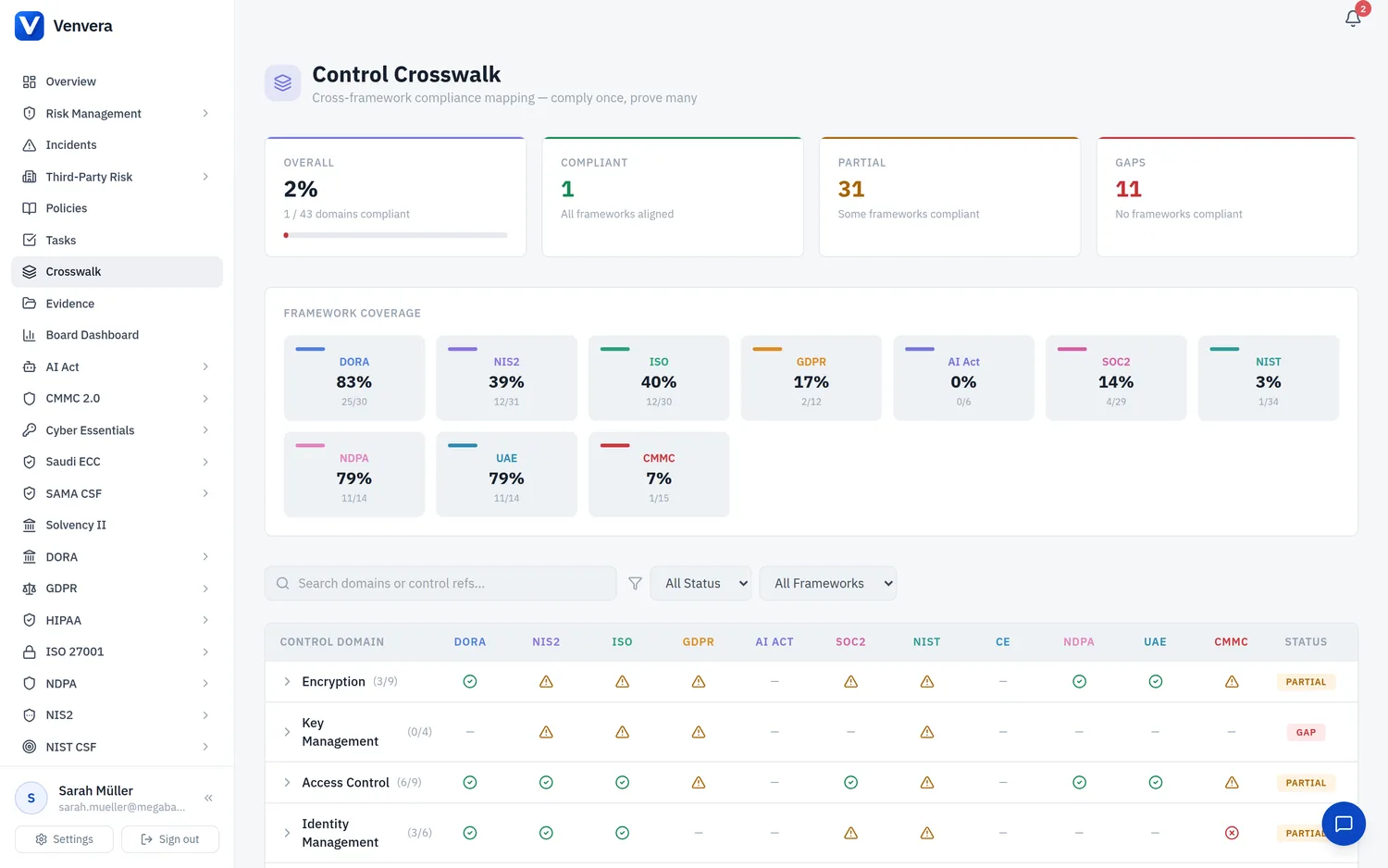
Different entities, different frameworks, different jurisdictions
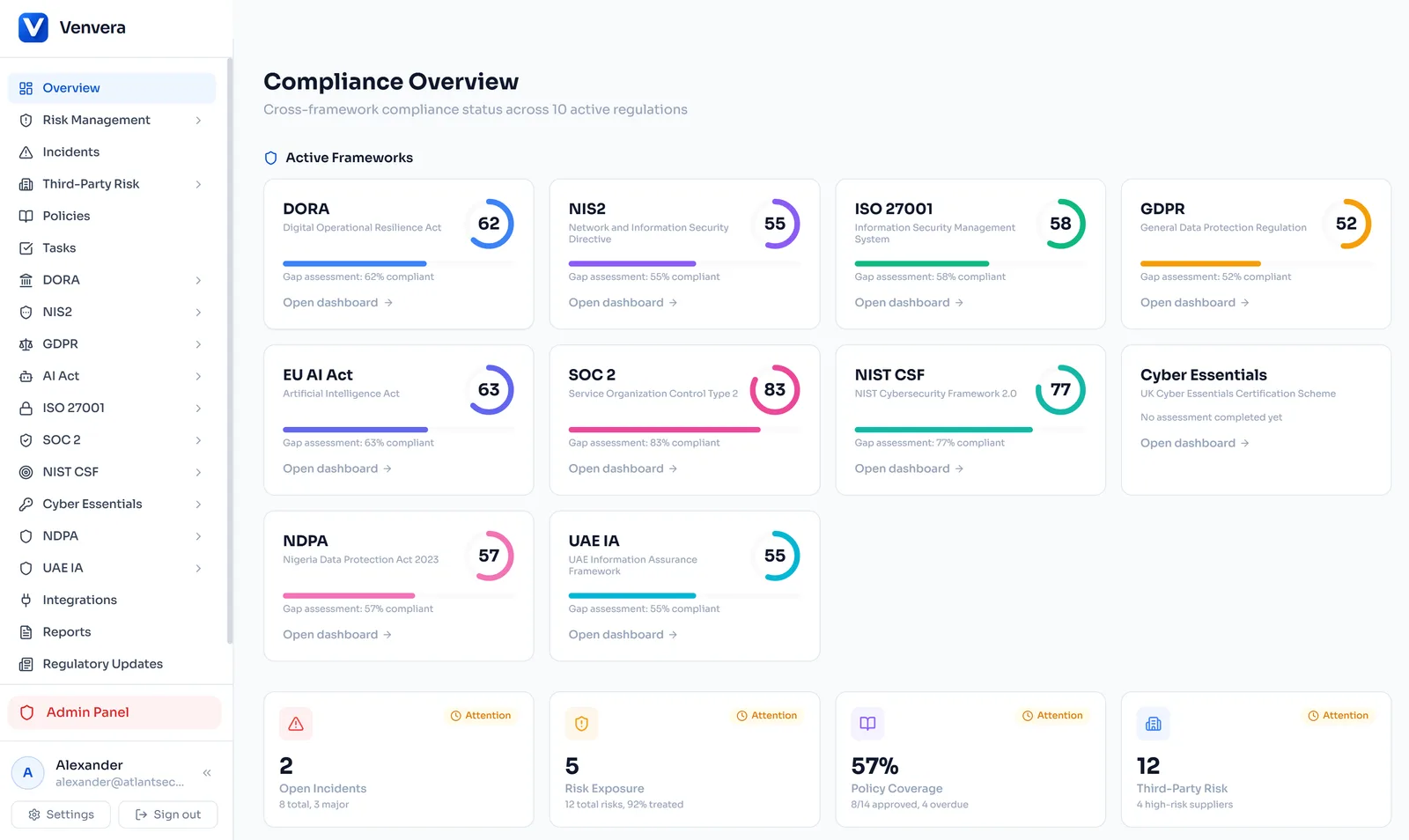
A real group is rarely uniform, and the temptation is to flatten it anyway: switch every framework on everywhere so the group looks tidy from the top. Resist that. A subsidiary confronted with controls it will never be assessed against quietly stops trusting the list, and a list nobody trusts is a list nobody maintains. Venvera lets you enable the frameworks each entity actually needs, based on where it operates and what it does. An EU bank might run NIS2 and DORA; a UK entity ISO 27001 and Cyber Essentials; a US subsidiary SOC 2 and HIPAA; a Saudi arm SAMA and the NCA ECC. Your parent sets the common policy standard once; each subsidiary maps it onto the specific frameworks it answers to, and only those frameworks appear in that entity's workspace.
Board-ready reporting, per entity
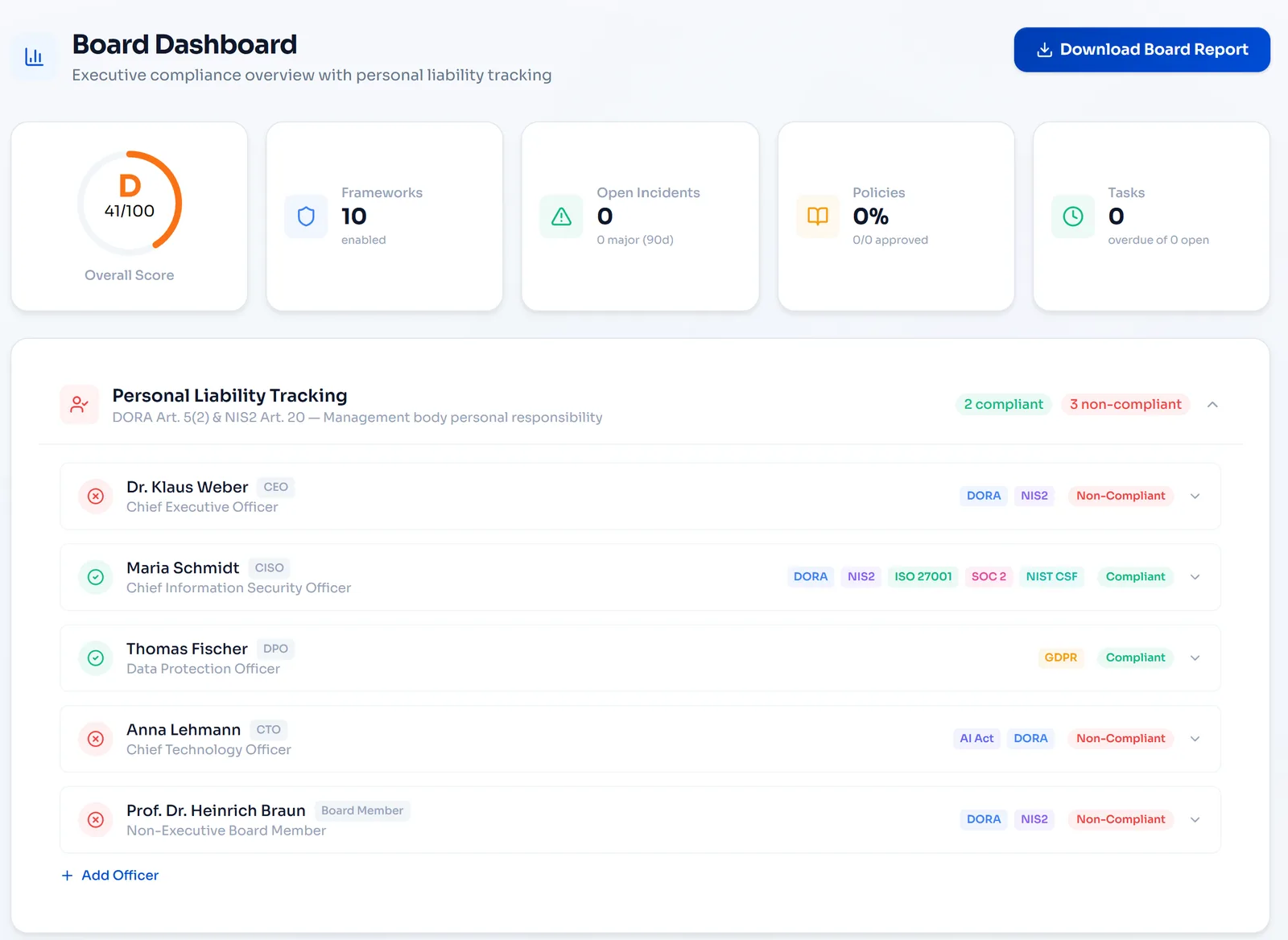
Every subsidiary runs against the same inherited standard, so each one can produce board-ready and auditor-ready reports on its own posture without rebuilding the baseline first. The parent owns and maintains the standard; each entity reports against it in its own workspace, on its own frameworks, with its own evidence. That keeps each entity's reporting self-contained and its data isolated, while the story every entity tells traces back to one group policy set.
Security and data isolation for groups
Isolation is the requirement groups underestimate most, because a leak between two entities is invisible right up to the moment it becomes a regulatory problem. Grouping entities must never mean leaking data between them. In Venvera, the cross-entity relationship is deliberately one-directional and read-only: member entities can read the shared group policies and their control map, but each entity's own operational data, its evidence, incidents, vendors and risk register, stays strictly isolated to that tenant and is enforced at the database level with row-level security. Membership is managed by platform administrators, not by the tenants themselves, so no entity can pull another into a group or read across the boundary. A group gets a shared standard without a shared data pool.
Who this is for
- Holding companies that need every subsidiary to run to the parent's governance standard.
- Multinational groups with entities under different regulators who still report to one board.
- Private equity and portfolio operators standardising compliance across acquired companies while keeping each one's data separate.
- Franchise and multi-brand groups pushing one policy set to many operating entities.
- Shared-services and group compliance functions that own the standard centrally but need local teams to evidence it.
Related reading: the Venvera platform, DORA Register of Information and NIS2 for banking groups, Policy Library, Control Crosswalk.
Groups usually span regulators as well as entities. How Venvera runs multi-jurisdictional compliance covers the other half of that problem: one control set across twenty frameworks, and the artefact each regulator collects.
Compliance software for groups of companies: the bottom line
The right tool for a group of companies does three things at once: it lets the parent author the standard once, it distributes that standard to every subsidiary as a single read-only source of truth, and it lets each entity prove it locally without any data crossing the boundary. Add cross-framework mapping, and a group's compliance stops being N separate programmes and becomes one standard, set at the top and evidenced at the edges.
That is exactly how Venvera's Company Groups works. If you manage compliance across more than one entity, book a short demo or run a free compliance check to see it applied to your own group structure.