

Compare
The short answer
These two overlap almost completely on SOC 2, ISO 27001, HIPAA, GDPR and PCI DSS. Secureframe is worth a closer look if CMMC and defense-sector work are on your roadmap. Drata's audit workflow is built tightly around US audit firm engagements. Neither publishes a price, so both decisions end in a negotiation. If your obligations are European or Gulf, the comparison is between the wrong two products.
Disclosure: Venvera is one of the products compared here, so treat the Venvera rows as an interested party's account. Statements about other vendors come from their own public pages, loaded and checked on 10 August 2026, and the screenshots below are those checks. Products change; verify anything that matters before you sign.
On this page
The overlap, which is most of the product
Continuous control monitoring, evidence collection, policy management, personnel and device tracking, vendor risk, risk registers and an audit workflow. Both cover the audit standards a US or UK software company needs, both integrate with the usual cloud and identity providers, and both are mature enough that the core job gets done.
Anyone claiming a decisive capability gap between them at core compliance automation is selling something. The category converged years ago.
Where they actually diverge
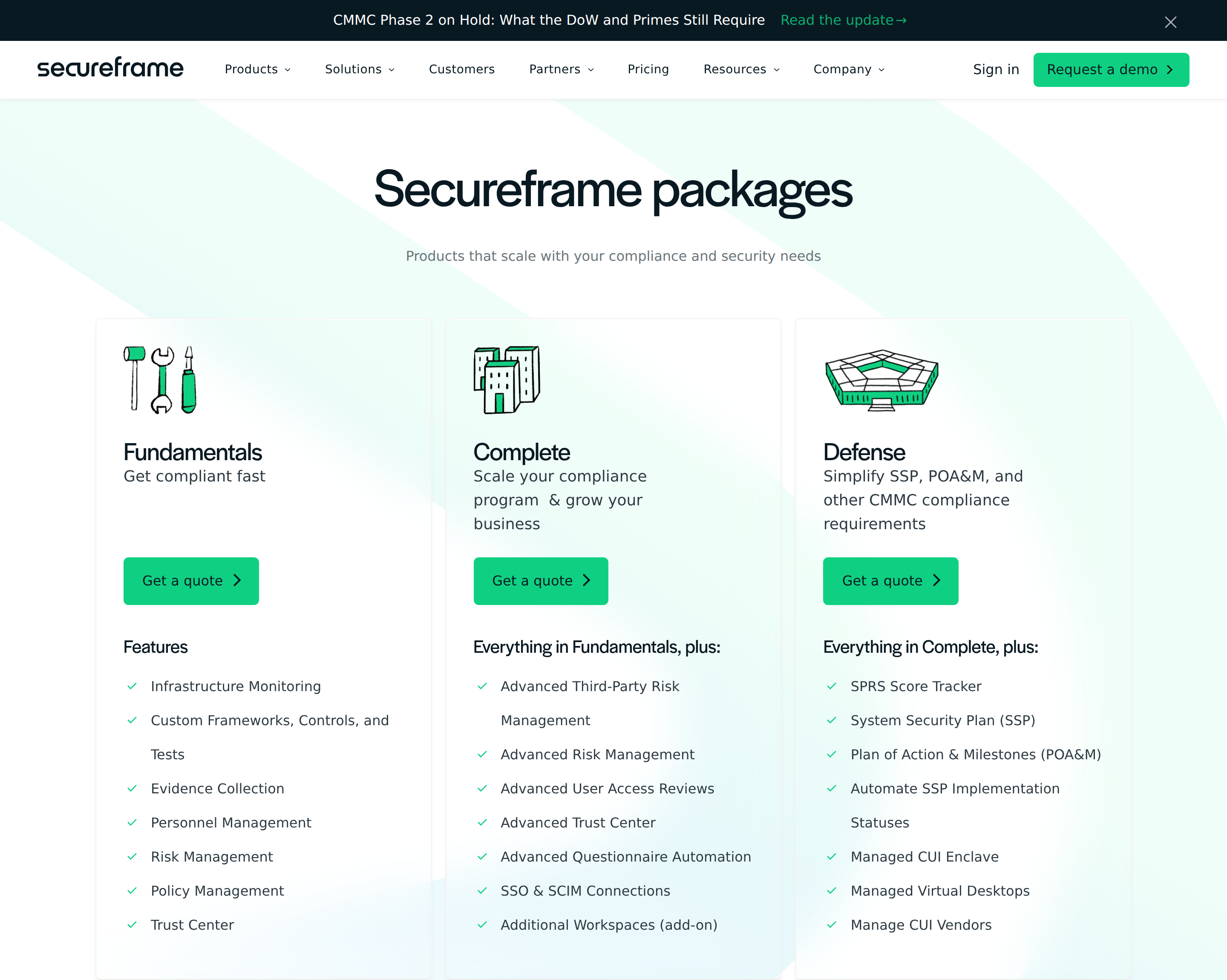
Defense and CMMC. Secureframe has leaned into defense-sector compliance more visibly. If CMMC is on your roadmap, that focus is worth weighing.
Audit engagement fit. Drata's audit hub is shaped around how US audit firms run engagements, and firms working in it regularly tend to move quickly through it.
Scale of catalogue. Both publish broad framework catalogues covering the ISO family, the NIST family, HITRUST, FedRAMP, TISAX and more.
Localisation. Secureframe publishes German, Spanish and French versions of parts of its site, which is unusual in this category and may matter if your team reads in those languages.
Neither publishes a price
We checked this rather than assuming it. On 10 August 2026 each vendor's public pricing page was loaded and inspected for a price figure. None of Drata, Vanta, Secureframe or Sprinto displays one. Drata, Vanta and Secureframe route you to a sales conversation to find out. Venvera publishes a flat figure, from EUR 399 per month, which is the exception in this category rather than the norm.

Coverage table
| Secureframe | Drata | Venvera | |
|---|---|---|---|
| SOC 2, ISO 27001, HIPAA, GDPR, PCI DSS | Yes | Yes | Yes |
| CMMC | Yes, with visible defense focus | Yes | Yes |
| FedRAMP, HITRUST, TISAX | Yes | Yes | No |
| DORA, NIS2 | Listed | Listed | Yes, with filing and per-country modelling |
| eIDAS 2.0, MiCA, Solvency II, CRA | Not listed | Not listed | Yes |
| SAMA CSF, NCA ECC, UAE IA, NDPA | Not listed | Not listed | Yes |
| Published pricing | No | No | Yes, from EUR 399 per month |
| Site localisation | de, es, fr | None | bg, de, ar |
| Customer references | Extensive | Extensive | None yet |

Who should pick which
- CMMC or defense contracts on the roadmap: weigh Secureframe first.
- Your audit firm has a strong preference: follow it. This is cheap information and it removes friction for a year.
- You need FedRAMP, HITRUST or TISAX: either of these two. Venvera does not cover them.
- Your obligations end in a European filing: neither is built for that, and this comparison covers why.
Venvera's gaps, plainly:
- No customer references yet. Venvera is a new product. If a long reference list is part of your evaluation, that counts against us and no argument changes it.
- A smaller integration library. The incumbents have spent years on connectors. Check the specific integration you depend on before anything else.
- No FedRAMP, HITRUST or TISAX. If any of those are on your roadmap, look elsewhere.
The third option
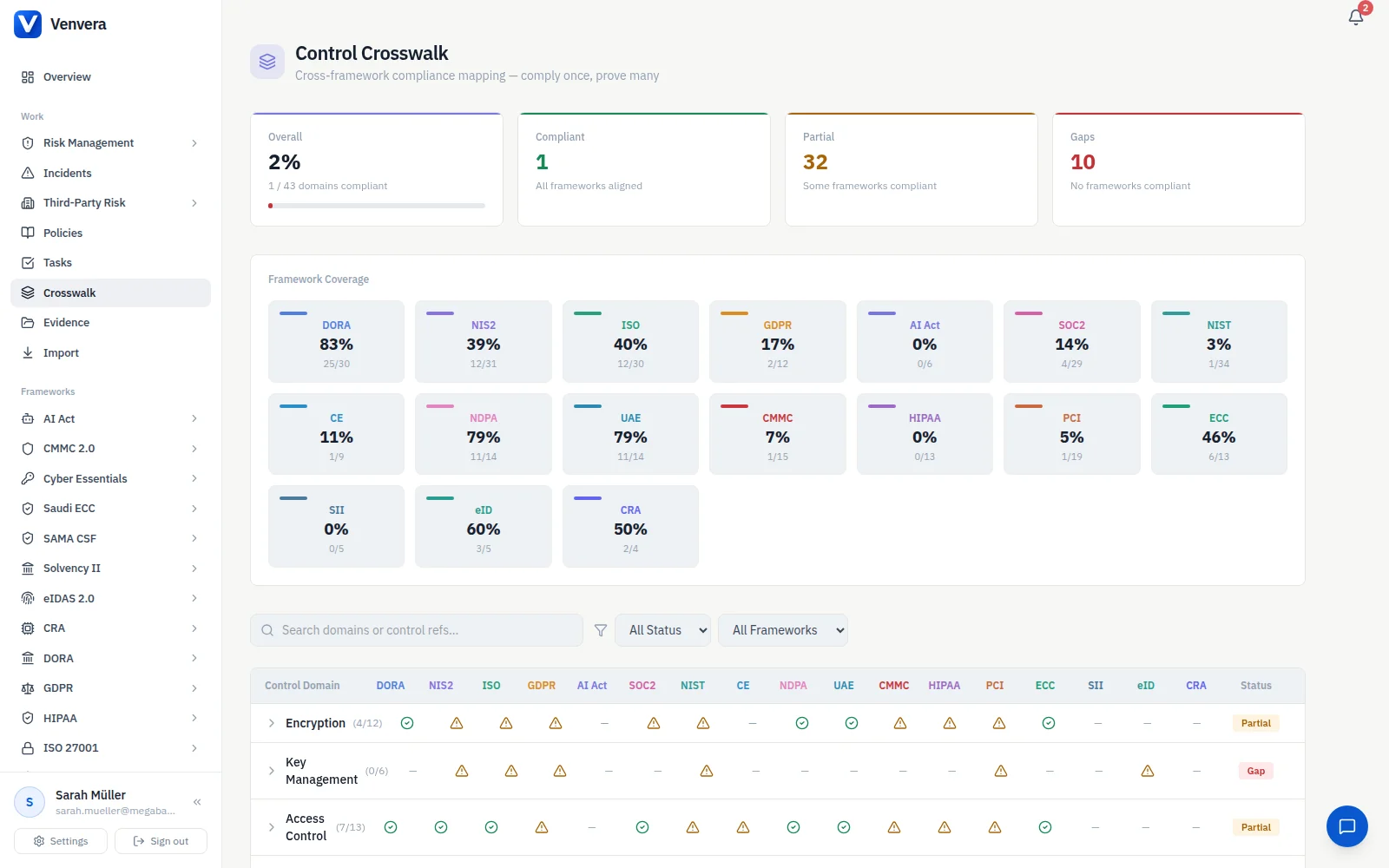
If you run EU or Gulf regimes alongside the audit standards, Venvera holds them as maintained control sets with shared evidence, publishes a flat price from EUR 399 per month and stores data in Amsterdam. Start with the free readiness check, or see Drata alternatives for the wider field and Secureframe competitors for the group around Secureframe.
Frequently asked questions
Is Secureframe or Drata better?
They overlap almost completely on the audit standards. Secureframe is worth weighing for CMMC and defense work; Drata's audit workflow suits US audit firms. Most decisions come down to commercial terms and your auditor's preference.
Do Secureframe and Drata publish pricing?
Neither does. Both route you to a sales conversation, checked on 10 August 2026, so the price is negotiated per customer and again at renewal.
Which is better for CMMC?
Secureframe has the more visible defense-sector focus. Both list CMMC in their catalogues, so ask each to demonstrate the SSP and POA&M workflow against your actual scope.
Do either handle DORA filings?
Both list DORA. Ask to see the Register of Information exported as xBRL-CSV across the fifteen EBA templates, because listing the framework and producing the submission are different capabilities.