


Compare
The short answer
If your compliance surface is SOC 2 and ISO 27001, Drata handles it well and this page will not change your mind. The reason European buyers look elsewhere is narrower than "Drata is US-first": EU regimes frequently end in a submission to a regulator, in a prescribed format, on a statutory clock. That is a different deliverable from an evidence pack an auditor reads, and platforms built for the second do not automatically produce the first.
Disclosure: Venvera is one of the products compared here, so treat the Venvera rows as an interested party's account. Everything said about other vendors is drawn from their own public documentation and pricing pages, checked in August 2026. Vendors change their products; verify anything that matters to your decision before you sign.
On this page
The difference that actually matters
Compliance automation grew up solving one problem: proving to an auditor that controls operated over a period. Evidence collection, continuous monitoring and an audit workflow all serve that. It is a real problem, well solved, and it is most of what a US software company needs. For the head-to-head framing instead, see Drata vs Vanta, Vanta alternatives and Sprinto vs Vanta.
European regulation frequently asks for something else. Under DORA you file a Register of Information with your national competent authority. Under NIS2 you register with a national authority and report incidents into a national route on a statutory clock. Under the CRA you report to ENISA. These are submissions with prescribed formats, validation rules and deadlines, and no auditor is involved.
A platform that produces excellent audit evidence has not necessarily produced a filing. The two artefacts are built from overlapping data and they are not the same output.
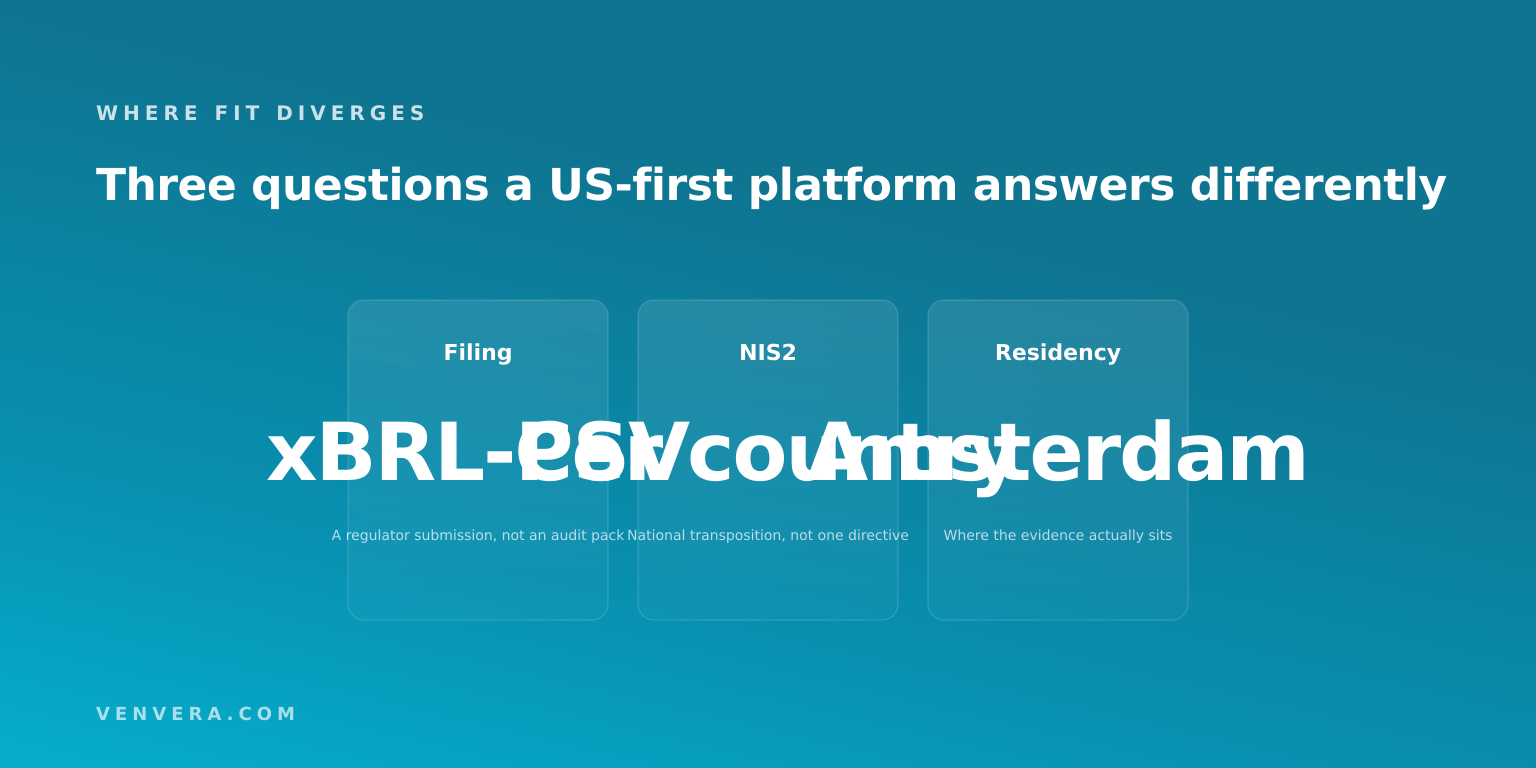
Three places the gap shows up
1. The DORA Register of Information. It is fifteen linked templates defined by Implementing Regulation (EU) 2024/2956, filed as xBRL-CSV, and rejected on structural validation rules rather than returned with comments. Producing it needs the data model, the cross-references between tables and the export. We wrote up the failure modes in why your Register of Information keeps getting rejected.
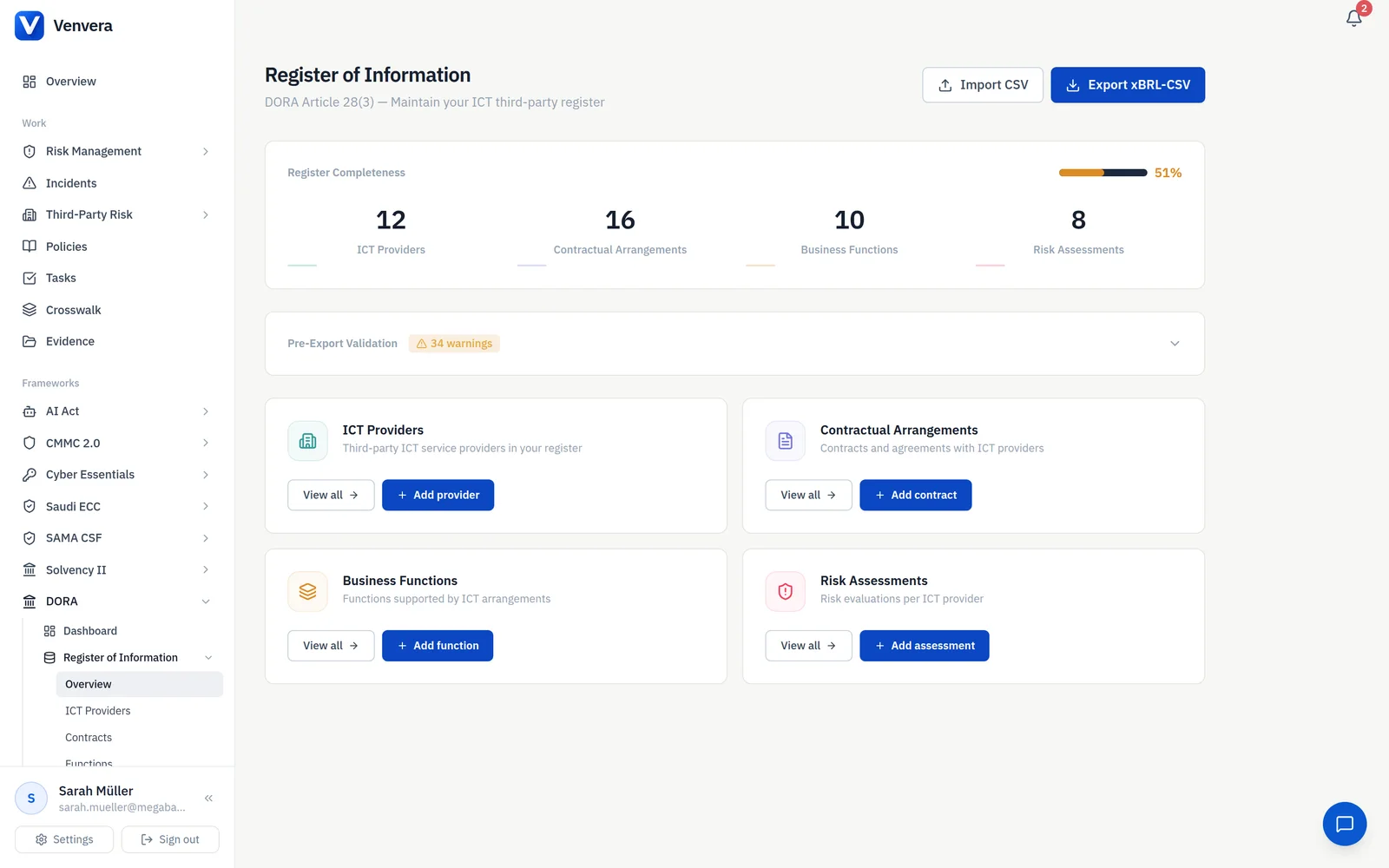
2. NIS2 is twenty-seven regimes wearing one name. It is a Directive, so what binds you is your national transposition. Scope thresholds, registration duties, reporting portals and penalty maxima all vary. A group operating in five Member States needs the differences modelled, not a single directive-level checklist. We cover the mechanics in NIS2 fines and penalties and the budget consequences in NIS2 compliance cost.
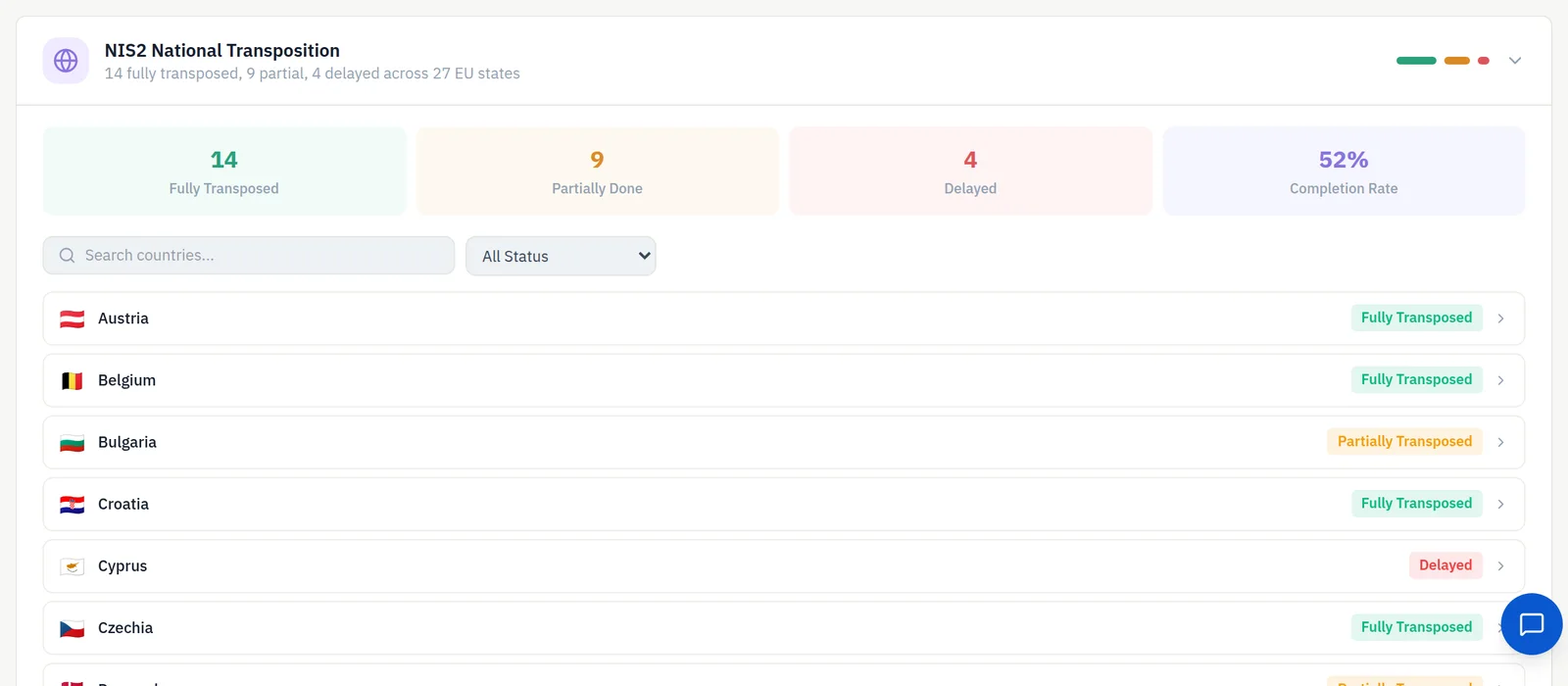
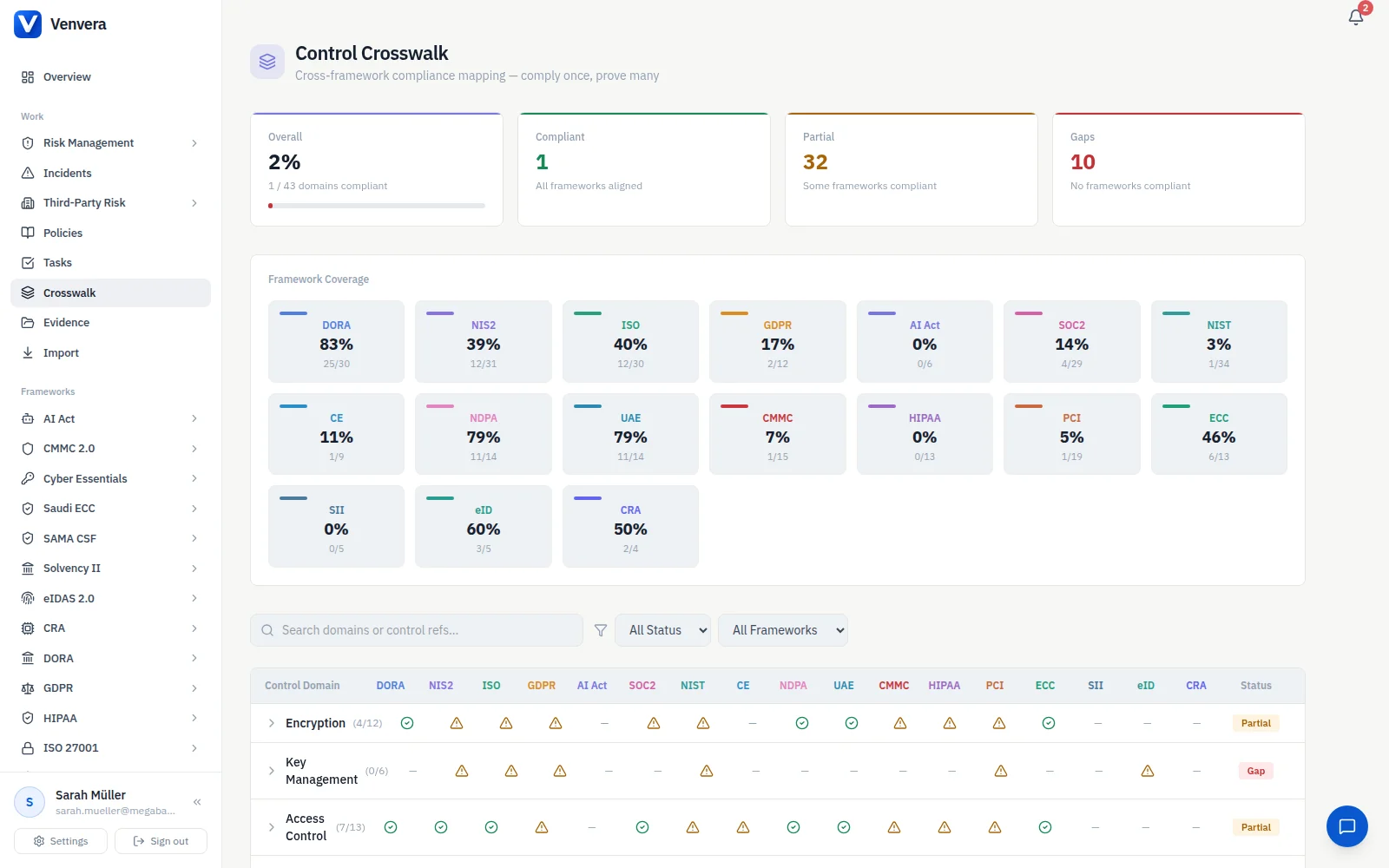
3. The regimes that are not in the US catalogue at all. For organisations operating across Europe, the Gulf and Africa, the working set includes eIDAS 2.0, MiCA, Solvency II, the CRA, SAMA CSF, Saudi NCA ECC, UAE Information Assurance and Nigeria's NDPA. None of those appear as framework pages in Drata's published catalogue, which is a reasonable product decision for their market rather than an oversight.
Which EU and Gulf regimes are in each catalogue
| Regime | In Drata's published framework catalogue | In Venvera |
|---|---|---|
| SOC 2, ISO 27001, HIPAA, PCI DSS, GDPR | Yes | Yes |
| NIS2 | Yes | Yes, modelled per Member State transposition |
| DORA | Yes | Yes, including Register of Information filing in xBRL-CSV |
| EU AI Act | ISO 42001 and NIST AI RMF listed | Yes, as the regulation |
| Cyber Resilience Act | Not listed | Yes |
| eIDAS 2.0 | Not listed | Yes |
| MiCA | Not listed | Yes |
| Solvency II Pillar 2 | Not listed | Yes |
| SAMA CSF, Saudi NCA ECC | Not listed | Yes |
| UAE Information Assurance | Not listed | Yes |
| Nigeria NDPA | Not listed | Yes |
| FedRAMP, CMMC, NYDFS, TISAX, HITRUST | Yes | CMMC yes, others not |
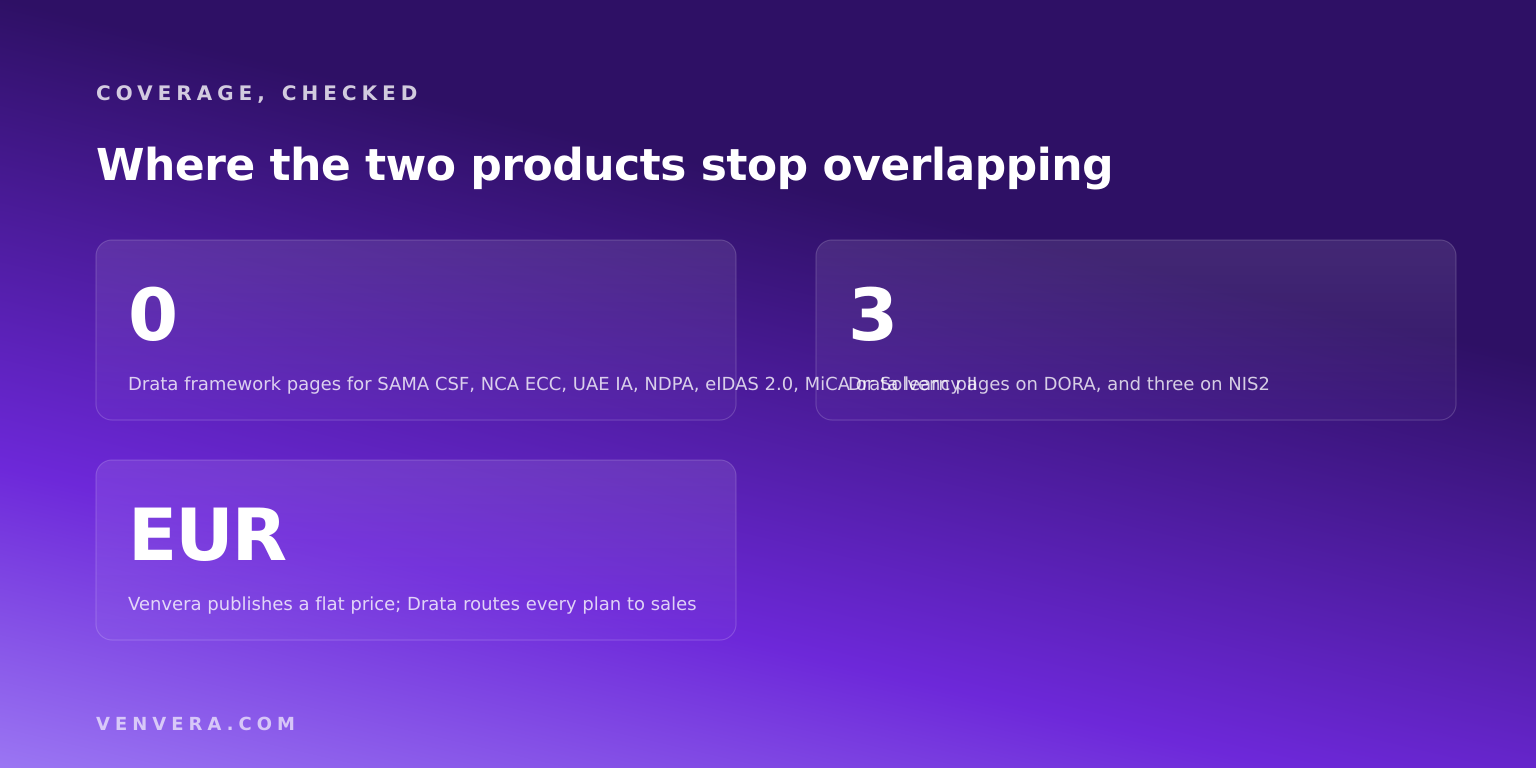
Note the last row. Drata covers US federal and defense regimes that Venvera does not, and that asymmetry runs both ways. If FedRAMP or HITRUST is on your roadmap, that is a straightforward reason to prefer them.
Does data residency matter, or is it a talking point?
It depends entirely on whether anyone can make it contractual for you. For most companies it is a preference. It becomes concrete when a regulator or a large customer asks where evidence about your controls is processed, which happens in financial services outsourcing reviews and in public sector procurement.
The honest framing: EU hosting is a feature that matters to some buyers and not to others. It is not a statement about who a product is for, and it does not make a platform better. Venvera holds data in Amsterdam because a share of its buyers need to answer that question with a contract rather than a preference.
The honest case for staying with a US-first platform
- Your obligations really are SOC 2 and ISO 27001. Then most of this page is irrelevant and the mature platform with the bigger integration library is the better buy.
- You need FedRAMP, HITRUST or TISAX. Venvera does not cover those.
- Integration breadth is your binding constraint. Drata and Vanta have invested years in connectors and it shows.
- You want a long reference list. Venvera is new and has no customer references to offer, which is a fair objection and not one we can argue away.
A comparison page that concluded "always switch" would not be worth reading. The genuine claim is narrower: if your compliance year ends in a filing to a European supervisor, check that whatever you buy actually produces that filing.
How to test any vendor on this in one call
Four questions, none of which can be answered with a slide.
- "Show me the Register of Information export." Ask to see the xBRL-CSV file, not a dashboard that says the register is complete.
- "Show me two Member States' NIS2 requirements side by side." If the product only models the directive, the differences are your problem to track.
- "Where is our evidence stored, and will that be in the contract?" A location in a slide and a location in a DPA are different commitments.
- "What is the price, and what is it at renewal?" Ask both. The second number is the one that brings people to pages like this one.
Ask Venvera the same four. If the answers do not hold up, the comparison has done its job either way.
See it against your own obligations
The free readiness check scores your position across the regimes that actually apply to you, without an email gate, and the DORA and NIS2 workspaces show the filing and per-country handling described above. Pricing is published from EUR 399 per month. If you are here because of a renewal quote, renewal rescue covers the migration path, and the broader field is compared in Drata alternatives.
Frequently asked questions
Is Drata a good choice for EU companies?
For EU companies whose requirements are SOC 2, ISO 27001 and GDPR, yes. The question sharpens when obligations include filing a DORA Register of Information, registering and reporting under national NIS2 law, or regimes such as eIDAS 2.0, MiCA or Solvency II that do not appear in its published catalogue.
Does Drata support DORA?
DORA appears in Drata's published framework catalogue. What varies across vendors is whether the platform produces the Register of Information in the xBRL-CSV submission format across the fifteen EBA templates, so ask to see the exported file rather than a completeness score.
Why does NIS2 need per-country support?
NIS2 is a Directive, so it binds you through your national transposition. Scope thresholds, registration duties, reporting routes and penalty maxima differ by Member State, so a group operating in several countries needs those differences modelled rather than a single directive-level checklist.
Does EU data residency actually matter?
It matters when someone can require it of you contractually, which is common in financial services outsourcing reviews and public sector procurement, and it is a preference otherwise. It is a feature for buyers who need it rather than a measure of product quality.
What does Drata do that Venvera does not?
FedRAMP, HITRUST, TISAX and NYDFS appear in Drata's catalogue and not in Venvera's. Drata also has a larger integration library and years of deployments behind it, while Venvera is a new product without customer references. Those are real considerations and they should be weighed.