Security reviews should not be the slowest part of your sales cycle.
The questions a prospect asks about your security are nearly always the same questions, and answering them by hand each time is what turns a two-week close into a two-month one. A trust page publishes the answers once, releases the sensitive documents under your control, and logs who asked for what.
The deal is not stuck on your security. It is stuck on retrieval.
A buyer asks for your certification status, your policies, your sub-processor list and answers to sixty standard questions. None of that is hard. It is slow, because someone has to find each item, decide what is safe to share, and send it. Doing that per deal is a tax on every sale. A trust page turns it into a link, with the sensitive material released deliberately rather than emailed ad hoc.
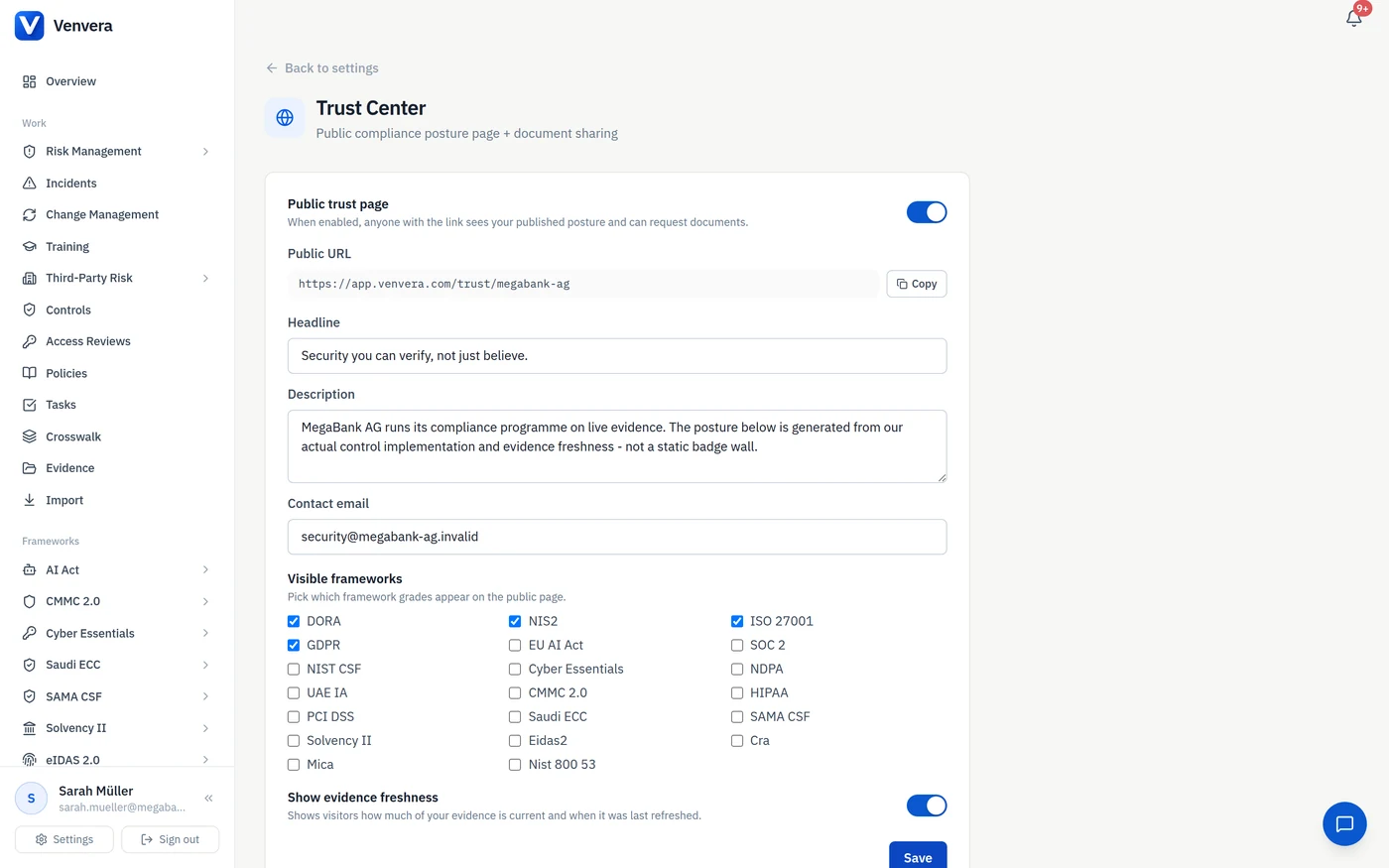
Your posture, stated once, in public.
Show the frameworks you run and where you stand on them, drawn from the same data as the rest of your compliance programme rather than retyped into a marketing page that goes stale.
- Framework status reflecting your live compliance data
- Public documents available without a request
- Your own branding and domain presentation
- A single link your sales team can send on first contact
Release the sensitive material deliberately.
A certification badge can be public while the report behind it is not. Documents held behind an access request are released to a named requester through a token link, with no account for them to create and no permanent copy floating in an inbox thread.
- Per-document choice between public and request-gated
- Token links rather than accounts for requesters
- Requests recorded with who asked and what was released
- Access that can be granted for a defined window
Stop rewriting the same questionnaire.
The overlap between one buyer questionnaire and the next is large. Publishing the standard answers and the supporting documents means most reviews resolve against the page, and the ones that do not arrive with a much shorter list of genuinely specific questions.
- Standard answers published rather than rewritten per deal
- Supporting evidence drawn from your compliance programme
- Fewer round trips between sales, security and the buyer
- A record of what was shared, per requester
Trust centers, answered.
Related: Third-party risk management, SOC 2, ISO 27001, Access reviews
Take security reviews off your sales team.
See the trust page set up against your own frameworks in a 30 minute walkthrough.
✓ Every paid plan: audit-ready in 90 days, or your money back*
10 minutes · no email to start · no credit card · yours to keep