

Compare
The short answer
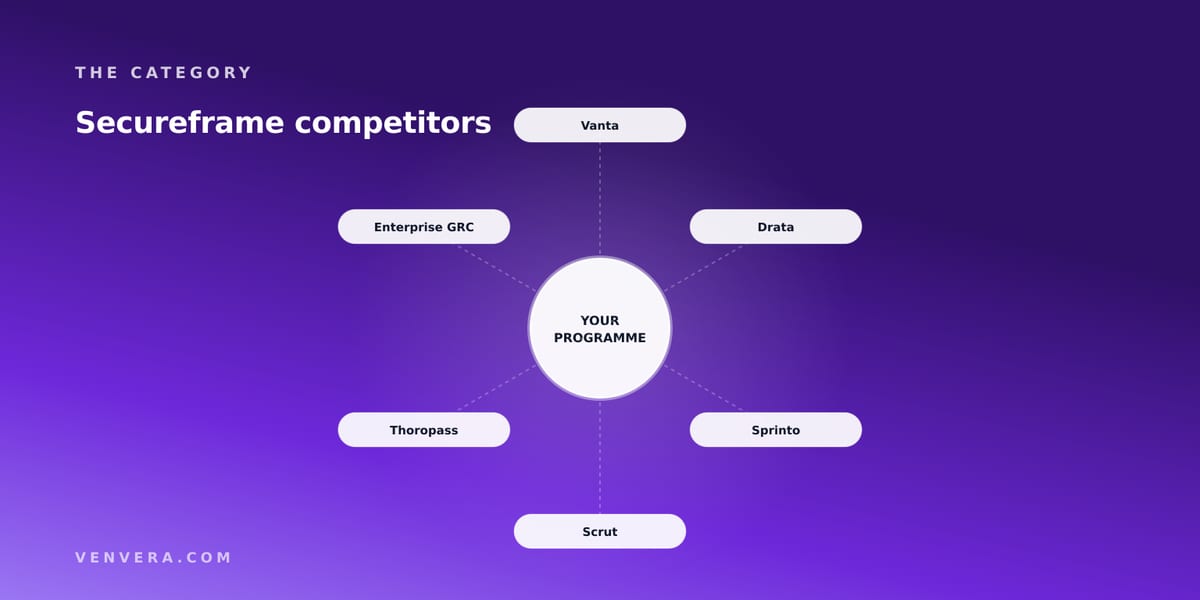
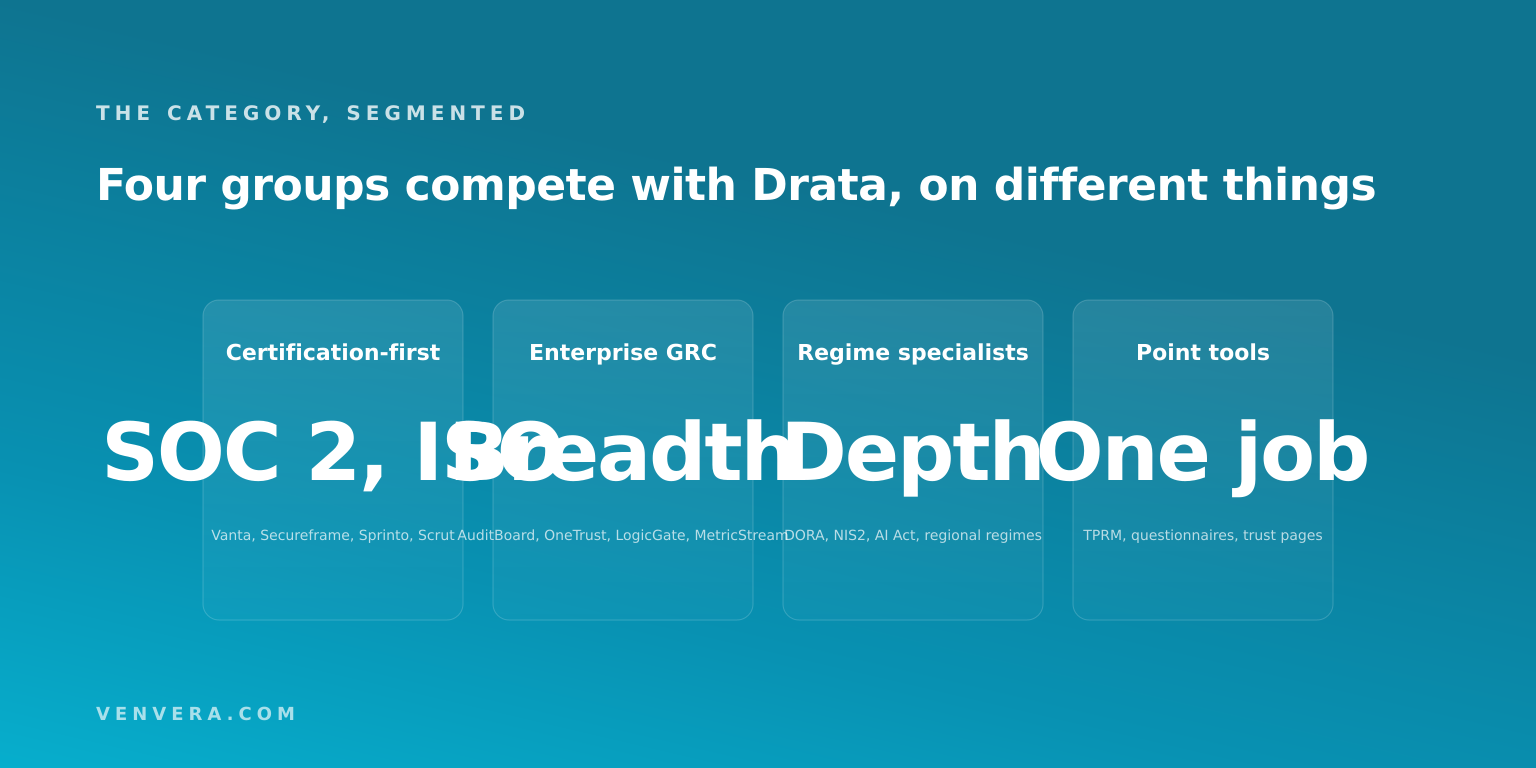
Drata's competitors fall into four groups that compete on completely different things: certification-first platforms (Vanta, Secureframe, Sprinto, Scrut), enterprise GRC suites (AuditBoard, OneTrust, LogicGate, MetricStream), regime specialists built around a particular rulebook, and point tools that do one job well. Asking which is "best" produces a useless answer, because a company chasing its first SOC 2 and a bank scoping DORA are not shopping in the same group. Work out which group you are in first, then compare within it.
On this page
The four groups that compete with Drata
Search "Drata competitors" and you get ranked lists. The ranking is nearly always by review count, which measures how long a vendor has been selling and how hard they push for reviews, and tells you nothing about whether a product fits your problem. The more useful cut is by what a vendor is built to do.
Certification-first platforms
Vanta, Secureframe, Sprinto and Scrut sit closest to Drata and compete with it head-on. All of them are built around the same core job: get a company to a SOC 2 or ISO 27001 certificate, and keep it there, by connecting to your cloud and collecting evidence continuously. They differ on integration count, price, how much service comes with the licence and how much of the audit they will project-manage for you. If your problem is a certificate a customer is asking for, this is your group and the choice inside it is genuinely close. If Secureframe is the one you are actually weighing, we map that field separately in Secureframe competitors.
Enterprise GRC suites
AuditBoard, OneTrust, LogicGate, MetricStream and ServiceNow's GRC module come from the other direction. They were built for large organisations with internal audit functions, risk committees and a board that wants reporting. They cover far more ground than a certification platform, and they cost and weigh accordingly. They compete with Drata mostly at the top end, where a company has outgrown certificate-chasing and wants one system for enterprise risk, audit, policy and regulatory change.
Regime specialists
The third group organises around a particular rulebook rather than around certification. This is where DORA, NIS2, the EU AI Act, the Cyber Resilience Act, SAMA CSF and similar regimes live. The distinction that matters is depth: a certification-first platform will often list DORA on its site, which is true in the sense that it can hold evidence against DORA controls, and incomplete in the sense that it may not produce a Register of Information in the format the supervisor expects. Venvera is in this group. So are several regional and sector vendors you will not find on a G2 list, because they sell to too few buyers to accumulate reviews.
Point tools
The fourth group does one job. Whistic and Conveyor answer inbound security questionnaires. SafeBase and Trust pages publish a trust centre. Panorays and Prevalent do third-party risk. They compete with Drata only on the specific module you were going to use, and they usually beat it on that module while leaving you to run the rest somewhere else.
How to read any vendor's competitor list
Most pages ranking for this query were written by one of the competitors. That is not a scandal, it is how the category markets itself, but it does mean the ordering carries information about the author rather than about the products.
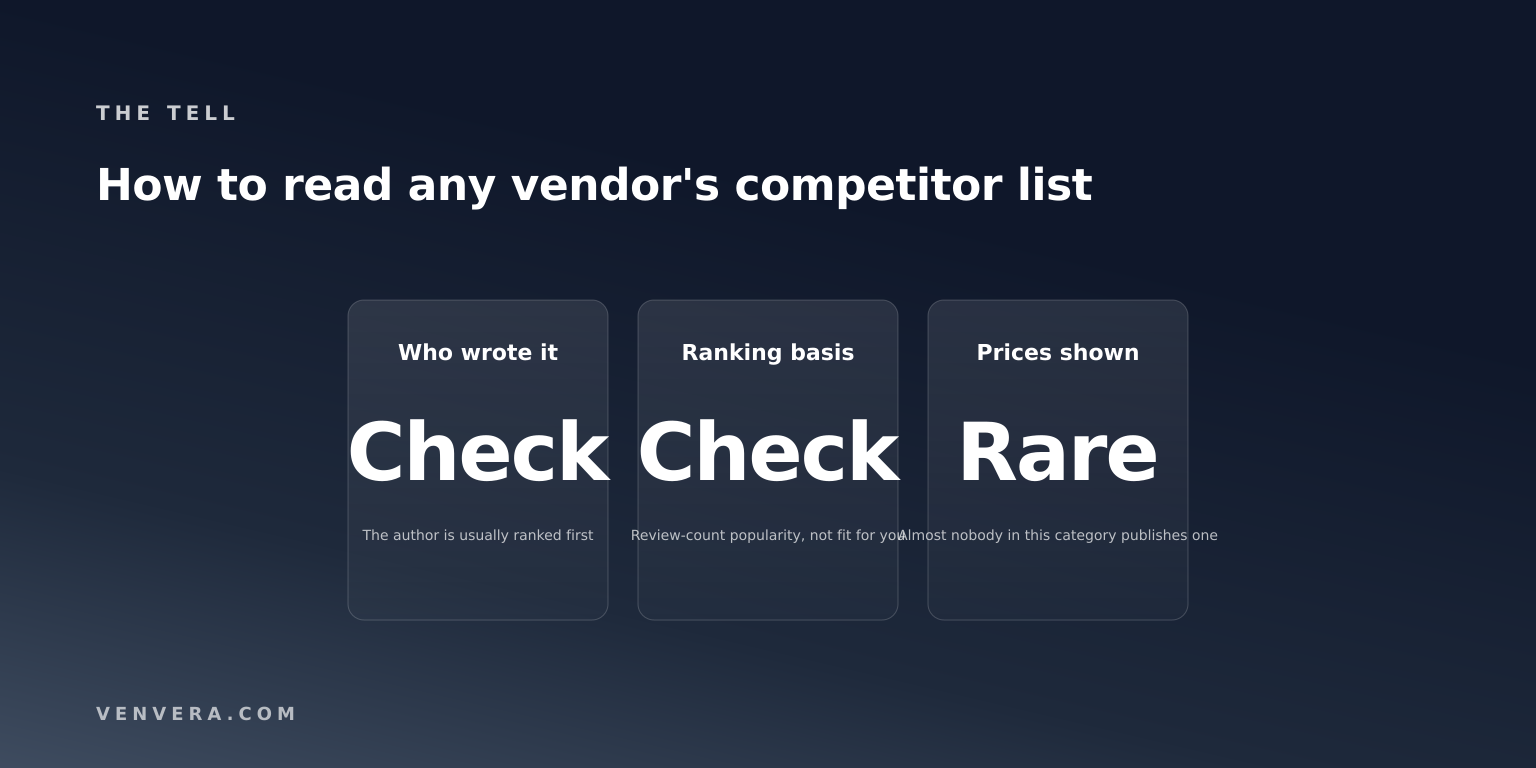
Three things worth checking on any list, including this one. Who published it, and where do they place themselves. What the ranking is based on, because "top 10" almost always means review volume rather than fit. And whether any prices appear, because in this category almost nobody publishes one, which makes every cost comparison in every listicle an estimate presented as a fact.
Review aggregators have the opposite problem. G2 and Gartner ratings are real signal about satisfaction among people who bothered to review, and no signal at all about whether a platform covers the regime you are actually subject to. A 4.7 average tells you customers are happy. It does not tell you they were solving your problem.
The four axes that actually decide it
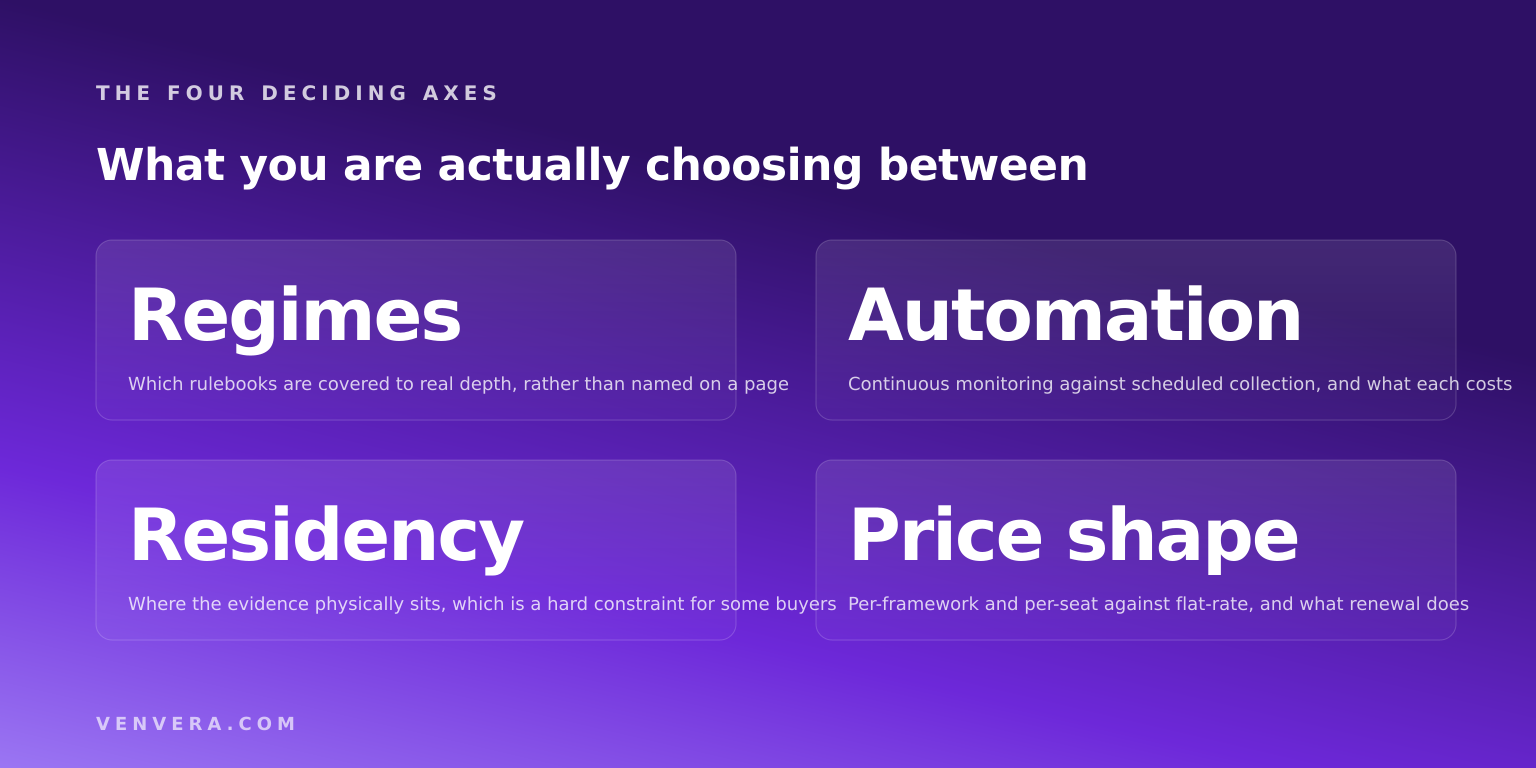
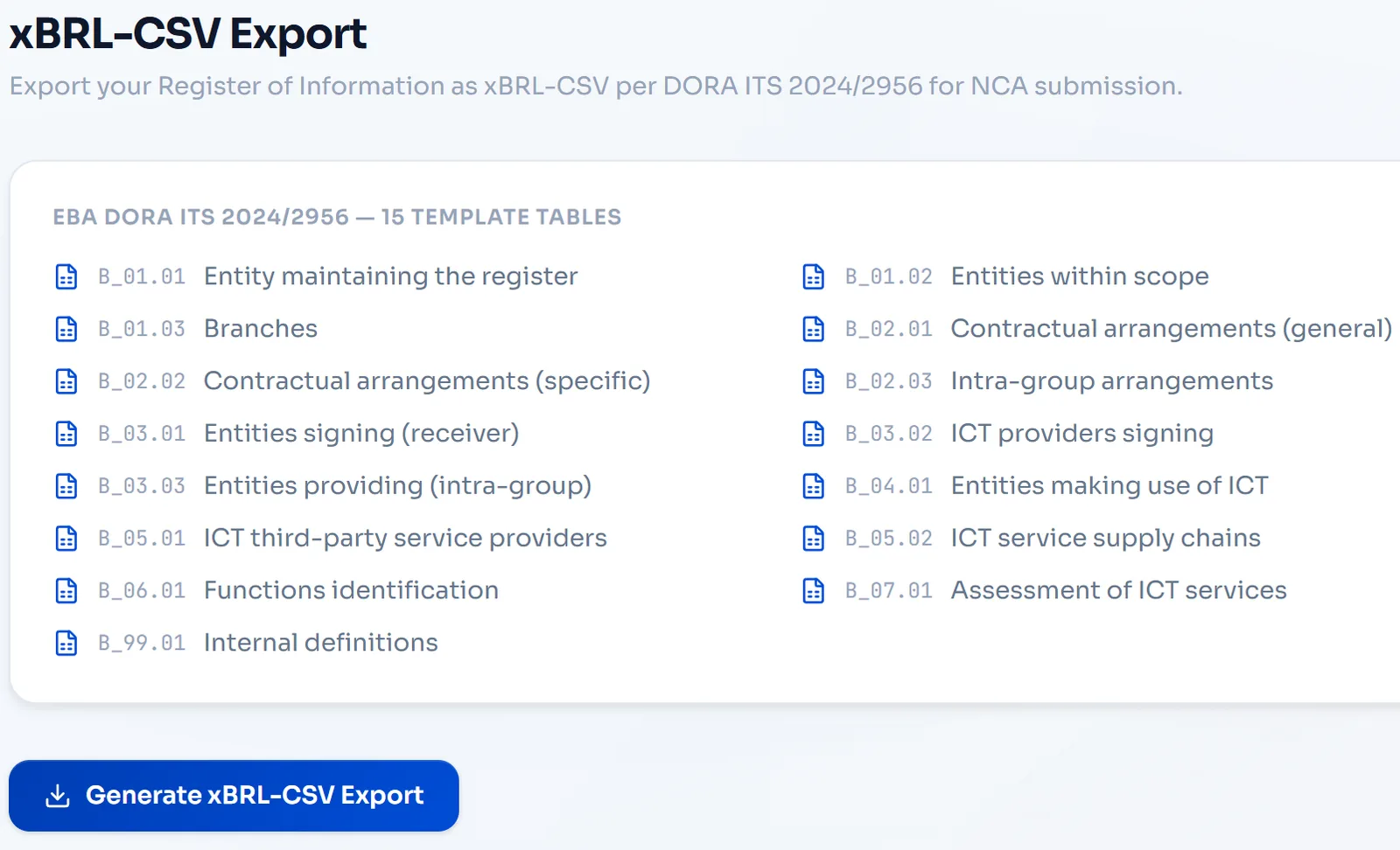
Regime coverage, to depth. Every platform lists frameworks. The question is what "supports" means for the one you care about. For SOC 2 it usually means a full control set, evidence mapping and auditor-ready export. For a regulation like DORA it should mean the Register of Information in the filing format, incident notification clocks anchored on the right trigger, and a resilience testing programme. Ask for a screenshot of the specific artefact your regulator will ask for, not a logo grid.
Automation depth. Continuous control monitoring, where the platform checks your cloud configuration on a schedule and opens a finding when it drifts, is the thing certification-first platforms genuinely do well and the thing most other groups do not. If your compliance burden is largely technical controls on cloud infrastructure, that automation is worth a great deal. If it is largely governance, documentation and supervisory reporting, it is worth much less than the demo suggests.
Data residency. For a lot of buyers this is not a preference, it is a hard filter that eliminates most of the market before features are discussed. If your evidence cannot leave a jurisdiction, ask where the database physically sits, not where the company has an office.
Price shape. The category prices in three different ways: per framework, per seat, or flat. Which one you are quoted matters more than the headline number, because it decides what happens when you add a regulation or a team. Renewal behaviour matters too, and it is the most common complaint in public reviews across every vendor in the category.
Who competes with Drata on what
This table is about which axis each group competes on, rather than a ranking. Naming a group's strength is not a claim that any individual product in it is weak elsewhere.
| Group | Competes on | Typical buyer | Where it struggles |
|---|---|---|---|
| Certification-first Vanta, Secureframe, Sprinto, Scrut | Speed to a certificate, integration breadth, continuous monitoring | SaaS company whose customer is asking for SOC 2 or ISO 27001 | Regimes that need a filing artefact or a supervisory format rather than a control set |
| Enterprise GRC AuditBoard, OneTrust, LogicGate, MetricStream | Breadth across risk, audit, policy and regulatory change | Large organisation with an internal audit function and a risk committee | Time to value and cost for a company that wanted one certificate |
| Regime specialists including Venvera | Depth in a specific rulebook, the artefacts a supervisor asks for | Regulated company whose obligation is named in law rather than requested by a customer | Continuous technical monitoring and integration breadth |
| Point tools Whistic, Conveyor, SafeBase, Panorays | Doing one job better than a suite does it | Company with one acute problem, often inbound questionnaires | Everything outside that one job, which you then run elsewhere |
What Drata is genuinely good at
Any competitor page that cannot answer this is worth closing. Drata is strong at the thing it was built for: taking a company with cloud infrastructure from nothing to a SOC 2 or ISO 27001 certificate, quickly, with a large integration library doing the evidence collection and continuous monitoring keeping it collected. The auditor workflow is mature. The product is well documented. For a SaaS company whose blocker is a customer security review, it is a straightforwardly good answer and has been for years.
It is also worth saying plainly that most of the reasons people go looking for competitors are not product defects. They are fit problems: a regime the platform was not designed around, a residency constraint, a price shape that stops working at a certain size, or a team that needs less automation and more hand-holding than the licence includes.
Working out which group you are in
One question usually settles it. Is your compliance obligation something a customer asks for, or something a law imposes?
If a customer is asking, you want a certificate, and the certification-first group exists for exactly that. Speed and integration breadth are the right things to optimise, and Drata is a reasonable default in that group rather than an underdog.
If a law imposes it, the artefact matters more than the certificate. A supervisor asking for a Register of Information, an incident notification within a statutory window, or evidence of a resilience testing programme is not satisfied by a control set with evidence attached to it. That is the regime-specialist group, and it is where a platform that lists your regulation and a platform that implements it look identical on a feature grid and completely different in an inspection.
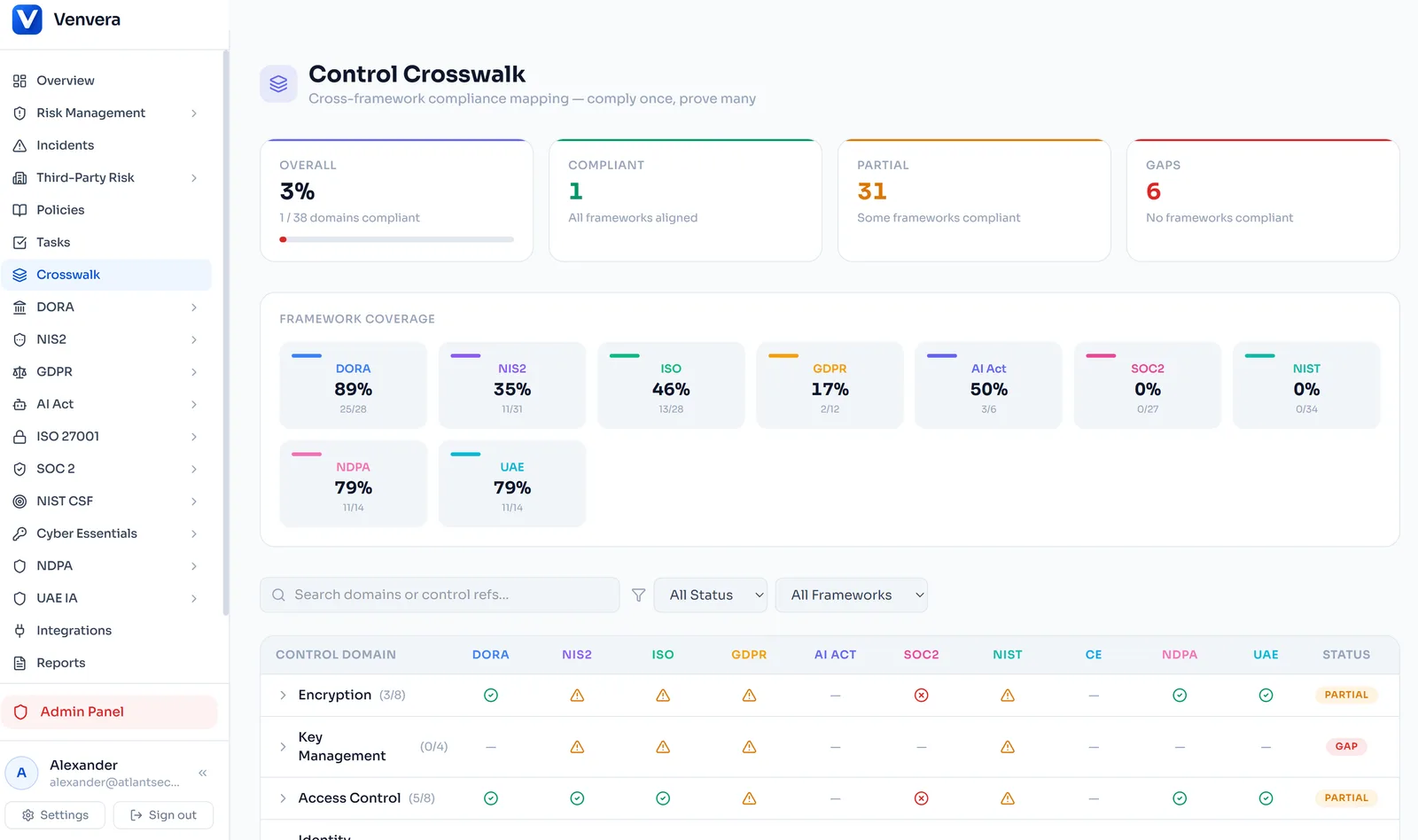
If you have both, and plenty of regulated companies do, the practical answer is usually one platform that handles the regime work and covers the certification alongside it, rather than two subscriptions and two evidence libraries. Cross-framework control mapping is what makes that viable: prove a control once and it counts everywhere the equivalent applies.
Where Venvera sits, and where it does not
Venvera is in the regime-specialist group. It is built for companies whose obligations are named in legislation rather than requested by a buyer, and it treats every framework as a peer instead of building around one and adding the rest: DORA, NIS2, GDPR, the EU AI Act, eIDAS 2.0, the Cyber Resilience Act, MiCA and Solvency II governance in Europe, SOC 2, NIST CSF, NIST SP 800-53, HIPAA, PCI DSS and CMMC in North America, SAMA CSF, Saudi NCA ECC, UAE IA and Nigeria's NDPA across the Middle East and Africa, ISO 27001 throughout. Evidence is held in the EU, pricing is flat-rate per organisation with unlimited users, and the price is locked at renewal.
The honest limits, because a competitor page without them is marketing rather than analysis. Venvera does not do continuous automated control monitoring, which is the certification-first group's core strength. Its integration library is deliberately narrow. It does not answer inbound security questionnaires with AI, though it sends them to your own vendors. There is no auditor partner marketplace. If your problem is a fast SOC 2 on AWS infrastructure and nothing else, one of the certification-first platforms is a better fit and you should buy one.
Bring your shortlist to a 30 minute call
Tell us which group you are in and which regimes you answer to, and we will tell you honestly whether we are the right group for you. If we are not, we will say which one is.
Pick a timeFrequently asked questions
Who are Drata's biggest competitors?
Vanta is the closest and largest, followed by Secureframe, Sprinto and Scrut in the certification-first group. At the enterprise end Drata runs into AuditBoard, OneTrust and LogicGate. In regulated sectors it meets vendors built around a specific rulebook rather than around certification. Which of those is "biggest" depends entirely on which of those markets you are in.
What is the difference between Drata competitors and Drata alternatives?
In practice, intent. People searching for competitors are usually mapping the category, often before they own anything. People searching for alternatives usually have Drata and are considering leaving. If you are in the second group, our Drata alternatives comparison is the more directly useful page.
How much does Drata cost compared with its competitors?
Nobody in the certification-first group publishes list pricing, so every figure you will read is either a leaked quote or an estimate. What you can compare is price shape: whether you are charged per framework, per seat or a flat rate, and what the contract says about renewal increases. Ask for that in writing during the evaluation, because it is the part that changes what you pay in year three.
Is Vanta or Drata better?
They are close enough that the answer comes down to your specifics rather than a verdict. Both are mature certification-first platforms with large integration libraries. Differences show up in service model, pricing structure and how each handles frameworks outside the SOC 2 and ISO 27001 core. If you are choosing between them, run both trials against your own cloud rather than reading comparisons, including this one.
Does Drata support DORA and NIS2?
Drata lists both. What that means in practice is a control set you can attach evidence to, which is genuinely useful and is not the same as producing a DORA Register of Information in the format the European Supervisory Authorities expect, or running notification clocks against statutory deadlines. If you are subject to either regulation, ask for a demonstration of the specific artefact you will have to file rather than the framework name on a page.
Which Drata competitor is best for a startup?
If you are chasing a first SOC 2 with a small team and cloud infrastructure, stay in the certification-first group and choose on price and service rather than features, because at that stage the products are more alike than the marketing suggests. Regime specialists and enterprise GRC suites are both the wrong shape for that problem.
Can one platform cover both certification and regulation?
Yes, and it is usually cheaper than two, but only where the control sets genuinely overlap and the platform maps them to each other. The mechanism to ask about is cross-framework control mapping: whether evidencing an access control once satisfies the equivalent requirement in every other framework you run, or whether you will be uploading the same document into several places.