

Resources
This vendor risk assessment template is a free Excel workbook for evaluating any supplier that touches your data, before you sign and every year after. If you are a compliance lead, CISO, or security manager who has been asked to prove supplier due diligence, this vendor risk assessment template gives you a structured questionnaire and a scoring model you can put to work today. It covers the questions that actually matter: what data a vendor processes and where, who their subprocessors are, which certifications they hold, how they control access and encrypt data, how they handle vulnerabilities and breaches, and what happens to your data when the relationship ends. Download it below, adapt the criticality tiers to your business, and start assessing vendors this week.
Free download
Get the Vendor Risk Assessment Template
A third-party security questionnaire covering data, subprocessors, certifications, access, encryption, incidents and exit, with a criticality-based rating.
What the Vendor Risk Assessment Template covers
The workbook is a third-party security questionnaire, organised so you can send it to a supplier and score what comes back. Each row is a question, each answer is scored, and every vendor rolls up to a criticality tier. The vendor risk assessment template covers the areas that decide whether a supplier is safe to trust with your data. If you only ever get straight answers to three of them, make them subprocessors, breach notification and exit: certifications tell you a supplier was in reasonable shape on the date of a report, subprocessors tell you where your data actually goes today, and exit terms are the only leverage you hold on the day you decide to leave. The full set:
- Data processed and location. What personal or sensitive data the vendor handles on your behalf, and the countries or regions where it is stored and processed.
- Subprocessors. The fourth parties the vendor relies on, so your supply chain has no blind spots one layer down.
- Certifications. Whether the vendor holds ISO/IEC 27001, SOC 2 Type 2, or equivalent independent assurance, and when it was last renewed.
- Access control and MFA. How the vendor restricts access to your data and whether multi-factor authentication is enforced for privileged accounts.
- Encryption. Whether data is encrypted in transit and at rest.
- Vulnerability and patch management. How quickly the vendor finds, tests, and applies fixes to known weaknesses.
- Breach notification and incidents. The vendor's commitment on how fast it will tell you about a breach, plus any recent security incidents.
- Business continuity and disaster recovery. Whether the vendor can keep running, and recover, when something goes wrong.
- Contracts. Whether a Data Processing Agreement is in place, and a Business Associate Agreement where protected health information is involved.
- Exit. How your data is returned or destroyed when the contract ends.
third-party risk the honest way: what actually matters
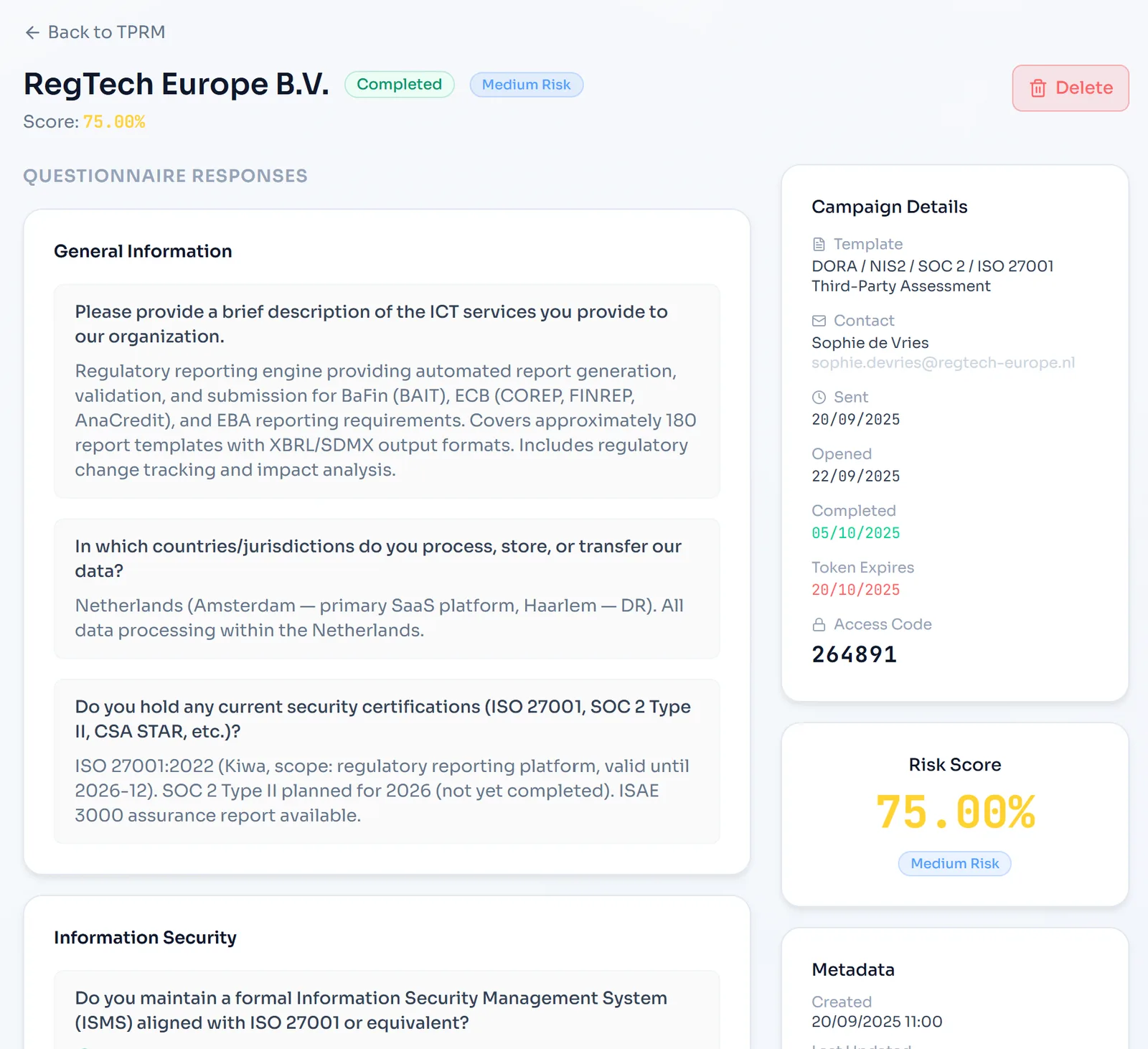
A vendor security risk assessment exists to evidence due diligence over the suppliers that touch your data. That is the whole point. Be clear-eyed about what a questionnaire proves, which is a vendor's own account of itself. That is still worth having, because the answers are dated, attributable and comparable, and because the act of asking changes how a supplier treats you. For the handful of vendors who could genuinely hurt you, back the answers with something independent. If a vendor is breached and your customers' data is exposed, you need to show that you checked, before you signed and on a schedule after, that the vendor could protect it. A signed order form is not due diligence. A scored questionnaire, kept current, is.
Third-party risk is not the concern of one regulation. It runs through NIS2, ISO 27001, DORA, and GDPR alike. Under GDPR you need a Data Processing Agreement with any processor and you stay accountable for what your processors and their subprocessors do. NIS2 raises supply chain security to a management responsibility for essential and important entities. DORA holds financial entities accountable for the ICT third parties they depend on. ISO 27001 expects supplier relationships to be governed and monitored. Different words, same obligation: know your suppliers, and prove it.
Two details separate a real assessment from a checkbox. First, scoring. An answer you do not score is an answer you cannot compare or track, so score each response so a weak control stands out and so you can watch it improve or decay. Second, criticality tiering. A vendor that stores your entire customer database is not the same risk as a vendor that prints your office lanyards. Tier vendors by how much damage they could do, concentrate your effort on the critical ones, and reassess critical vendors at least annually so an assessment from three years ago does not stand in for the truth today.
A third detail bites later, in the contract. Security questions get answered politely enough. Then you ask for audit rights, a breach notification timescale in writing, or the right to object to a new subprocessor, and the conversation slows right down. Ask for those terms while you still have leverage, which means before signature, and decide in advance which ones you would genuinely walk away over. Sub-processing is where this gets hardest: your leverage runs out one layer down, and the vendor's contract with its own suppliers is rarely yours to shape.
How to use the Vendor Risk Assessment Template
- Inventory your vendors. List every supplier that processes, stores, or can access your data. You cannot assess what you have not written down.
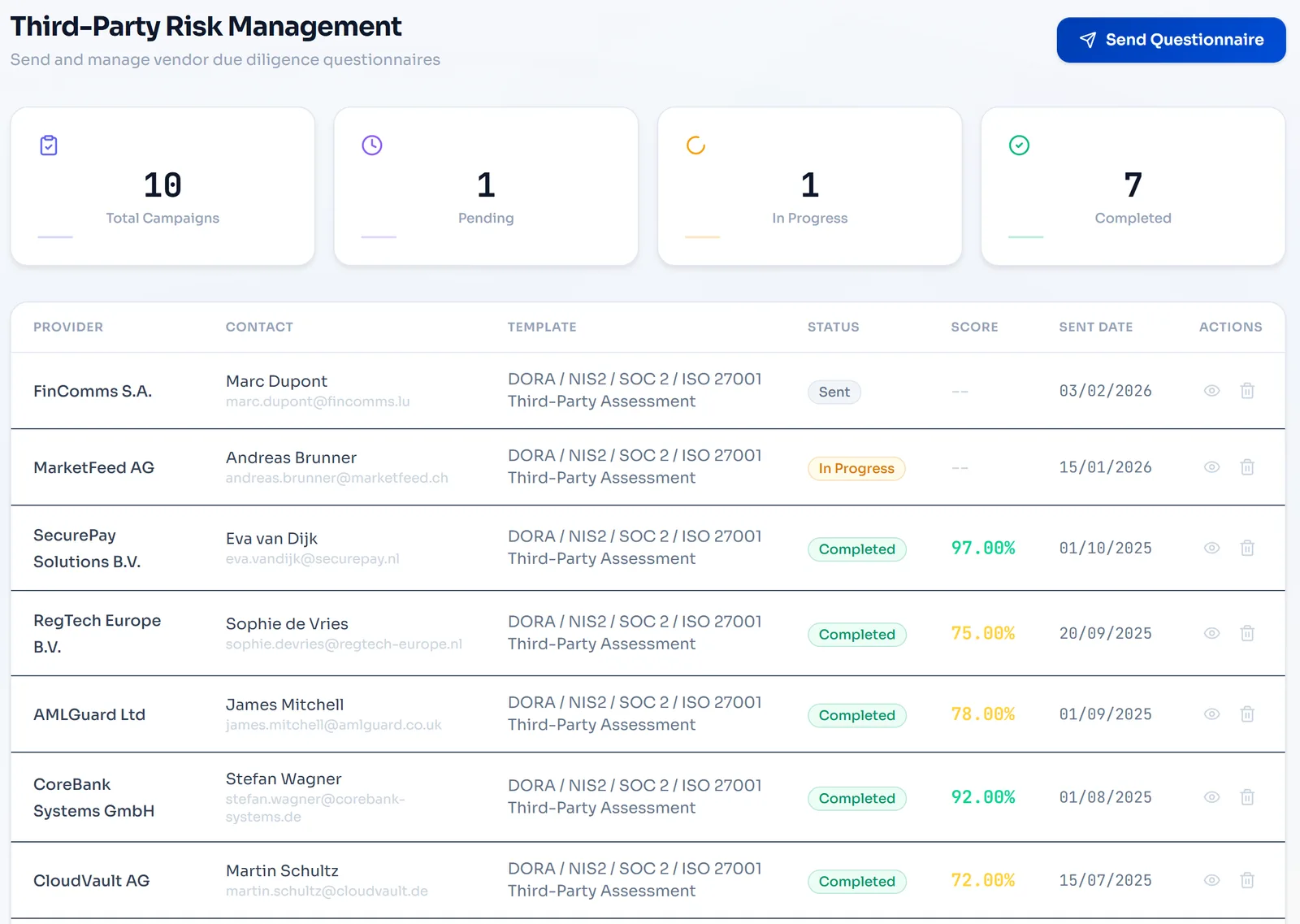
- Tier by criticality. Rank each vendor by the data it touches and the harm a failure would cause. Critical, important, and low is enough to start. Do this before you send anything out. Tiering a whole vendor list takes an afternoon and it is the highest-return work in the process, because it tells you which few suppliers deserve a real conversation and which simply need a record that you looked.
- Send the questionnaire. Share the relevant tab with the vendor's security contact, or complete it yourself from their trust page and existing reports. Expect a split response. Large vendors will send you a trust portal link and decline your form outright, and for most of them you should accept that and do the mapping yourself. Smaller vendors will answer, slowly, and their answers will need a follow-up question. Chasing this is the bulk of the work and it is measured in weeks, so start it before the procurement deadline rather than alongside it.
- Score the answers. Use the scoring column to rate each response, and flag any gap in encryption, MFA, subprocessor disclosure, or breach commitment for follow-up.
- Decide and record. Approve, approve with conditions, or reject, and keep the completed sheet as your evidence of due diligence.
- Reassess on a schedule. Diarise critical vendors for at least an annual review, and repeat sooner if the vendor has an incident or changes subprocessors.
Do this automatically in Venvera
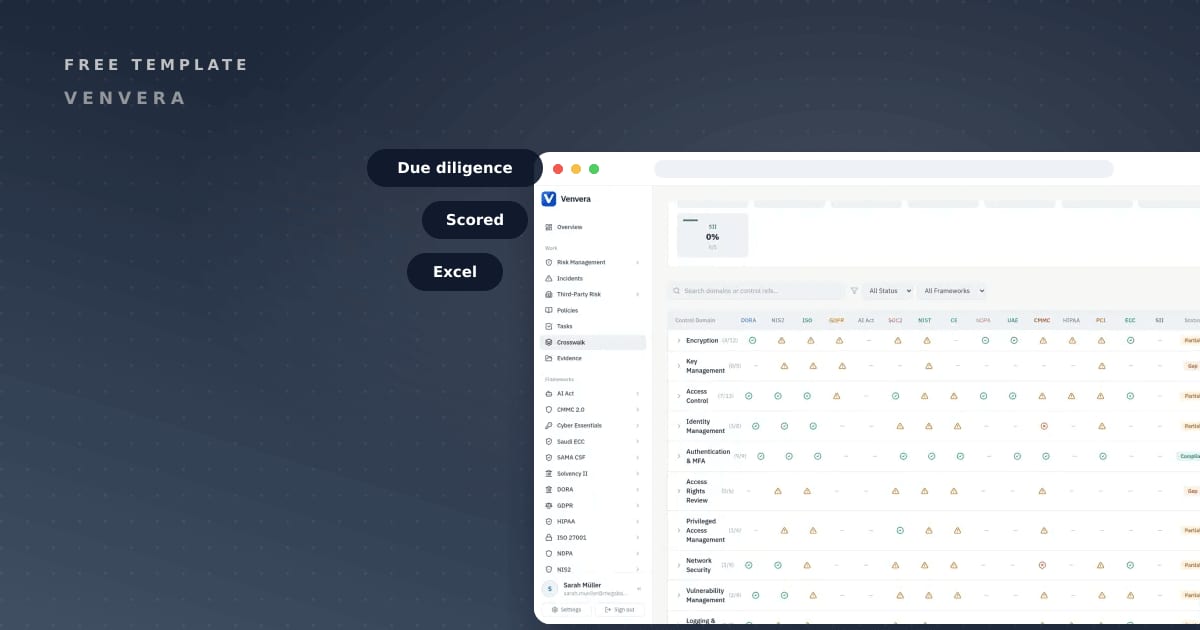
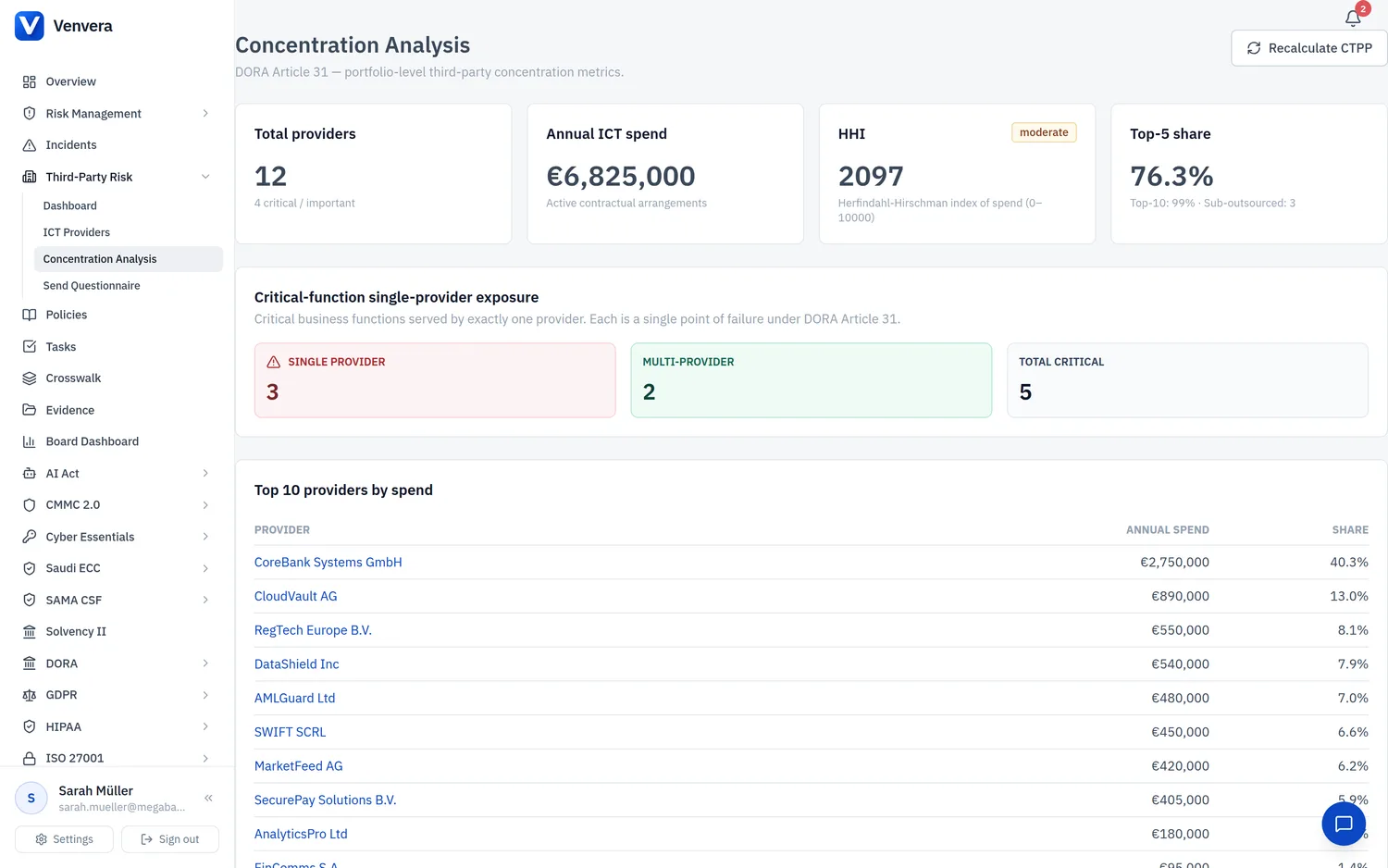
The template is a solid starting point, and for a handful of vendors a spreadsheet is genuinely fine. It stops scaling the moment you have dozens of suppliers, renewal dates, and evidence that goes stale between reviews. Venvera keeps the same work current: vendors, questionnaires, scores, and reassessment dates live in one place, and the evidence you collect once reuses across your obligations under NIS2, ISO 27001, DORA, and GDPR instead of being re-gathered for every audit. If you are weighing tools, our TPRM and vendor risk comparison lays out what to look for. Venvera starts from EUR 399/month.
Frequently Asked Questions
What is a vendor risk assessment template?
It is a structured questionnaire, usually a spreadsheet, that you use to evaluate the security and data-handling practices of a supplier before you engage them and on a regular basis afterwards. A good vendor risk assessment template covers data, subprocessors, certifications, access, encryption, incidents, continuity, contracts, and exit, and it scores each answer so you can compare vendors and track risk over time.
What should a vendor risk assessment include?
At minimum: what data the vendor processes and where, its subprocessors, its certifications such as ISO/IEC 27001 and SOC 2 Type 2, access control and MFA, encryption in transit and at rest, vulnerability and patch management, its breach-notification commitment and recent incidents, business continuity and disaster recovery, whether a Data Processing Agreement and, where health data is involved, a Business Associate Agreement are in place, and how data is returned or destroyed on exit.
How often should you reassess vendors?
Reassess critical vendors at least once a year. Tier your suppliers by criticality first, then focus the frequent, deeper reviews on the vendors that hold the most sensitive data or would cause the most damage if they failed. Trigger an off-cycle review whenever a vendor has a security incident or changes its subprocessors.
Is the template really free?
Yes. Download the Excel file above at no cost and adapt it to your own criticality tiers and scoring. If you later want the same process to stay current across many vendors and frameworks without manual upkeep, that is exactly what Venvera automates.