
Best
The short answer. Vendor risk management as a service is a subscription that runs your vendor programme for you: intake and triage of new suppliers, tiering by criticality, due diligence and evidence, contract clause tracking, monitoring, renewals and offboarding, and the reporting a regulator or customer asks for. It is sold under two names, vendor risk management as a service and third-party risk management as a service, and the difference is scope rather than substance. Four delivery models exist, they price very differently, and none of them can take the accountability off your management body.
You get four things from this guide. A definition that separates the service from the software. A straight answer on whether vendor risk management as a service and third-party risk management as a service are the same thing. The list of jobs a provider should be doing every month, with the regulatory clauses that force each one. And a scoring table to fill in while you are talking to providers, including what stays your responsibility whichever one you sign.

What is vendor risk management as a service?
Vendor risk management as a service, usually shortened to VRMaaS, is an ongoing subscription in which someone other than your own staff operates the vendor risk programme. The provider maintains the vendor inventory, decides which suppliers matter, runs the due diligence, collects and stores the evidence, watches the contracts and produces the reports. You keep the decisions: who gets approved, which risks are accepted, when a contract is signed or ended.
The service is not the same as the software. A platform gives your team the register, the workflow and the evidence vault, and your team does the work in it. A service adds people, or automation, or both, so the work happens without your team driving it. The distinction matters when you compare prices: a EUR 899 platform subscription and a EUR 4,000 monthly managed service are not competing offers, they are different amounts of labour. If what you actually need is the tooling, the guide to third-party risk management solutions compares the four kinds of platform instead.
Is vendor risk management as a service the same as third-party risk management as a service?
In the market, the two phrases are sold as synonyms and most providers use them interchangeably. In a regulated programme they are not identical, and the difference is worth ten minutes before you sign anything. Vendor risk usually means the suppliers you buy from. Third-party risk covers everyone outside your legal entity who can hurt you, which includes suppliers, but also partners, intra-group service companies, agents, outsourced processes and the subcontractors of all of them.
| Term | What it usually covers | Where it matters |
|---|---|---|
| Vendor risk management | Companies you buy goods and services from, managed through procurement and security review. | Purchasing, SaaS sprawl, security questionnaires, renewals. |
| Third-party risk management | Every external party that can affect your operations, data or customers, whether or not you pay them. | Regulatory scope: partners, intra-group entities, agents and outsourced processes are in scope even when no invoice exists. |
| ICT third-party service provider | A defined category under DORA: providers of digital and data services, on an ongoing basis. | The DORA register of information and the contract terms in Regulation (EU) 2022/2554 Article 30 apply to these, and to the arrangements that support critical or important functions in particular. |
| Subcontractor, or nth party | The providers your providers rely on, to any depth. | DORA expects the subcontracting chain to be documented; a customer breach at a fourth party is still your incident. |
The practical test: if a provider quotes for vendor risk management as a service and your obligations sit under DORA, NIS2 or an ISO 27001 certificate, ask explicitly whether intra-group arrangements, non-paid partners and subcontracting chains are in the scope of the engagement. If they are not, you have bought procurement support and you still owe the regulator a third-party programme.
What does vendor risk management as a service actually include?
Eight jobs make up the service. A serious provider does all eight and can show you the artefact each one produces; a thin one does the questionnaires and calls it a programme.
1. Intake and triage
Every new supplier is captured before the contract is signed, not after, with the business owner, the data involved and the process it touches recorded at intake. Triage decides which suppliers need a full review and which need a light one. Without intake, the register is always three months behind procurement.
2. Tiering by criticality
Each supplier is classified by what its failure would do, not by what it costs. Under DORA the specific question is whether the arrangement supports a critical or important function, and that classification drives the contract terms, the exit plan and the register entry.
3. Due diligence and evidence
Certificates, penetration test summaries, SOC 2 reports, insurance, financial checks and the answers to your questionnaire, collected before signature and refreshed on a schedule. The evidence has to be stored with a date and a source, because an auditor will ask when you last saw it. The method is set out in the guide to performing a third-party risk assessment.
4. Contract clause tracking
DORA Article 30 lists the provisions every ICT contract must contain, with a longer list for arrangements supporting critical or important functions: service descriptions, data locations, access and audit rights, exit strategies, subcontracting conditions and termination grounds. A service that does not track which clauses are missing from which contract leaves the gap that the supervisor will find.
5. Monitoring between reviews
Annual reviews miss the year. Monitoring means watching for breaches, rating changes, financial distress, ownership changes and certificate expiry, and turning any of them into a task with an owner rather than an email.
6. Concentration and chain analysis
The risk nobody sees on a per-vendor form is the one where nine critical services sit behind the same cloud region, or three suppliers subcontract to the same processor. DORA Article 29 asks financial entities to assess concentration at entity level before entering an arrangement, and the analysis has to look through the chain, not just at the counterparty.
7. Renewals and offboarding
Notice periods, exit plans, data return and deletion, and access removal on the day the contract ends. Offboarding is the step almost every programme skips, and it is where orphaned accounts and undeleted data come from.
8. Reporting
Per-vendor status for the business owner, a portfolio view for the risk committee, and the regulator's artefact on demand: the register of information for DORA, the supplier-security section of an ISO 27001 audit, the vendor evidence set for a SOC 2 examination.

Who answers the security questionnaires your customers send?
Vendor risk runs in two directions, and buyers forget the second one until it costs them a deal. You send questionnaires to your suppliers, and your regulated customers send questionnaires to you. Ask any provider whether the engagement covers inbound questionnaires as well as outbound, because the inbound ones arrive with a sales deadline attached.
The efficient answer to both directions is the same: one evidence library, answered once, reused. A control you have already proven for ISO 27001 answers the same question in a customer's SOC 2 questionnaire and in your own supplier review. The practice is covered in the guide to vendor security questionnaires, and the free vendor risk assessment template is a reasonable starting point if you want to run the first pass yourself.
What must the service produce for a regulator?
Regulators do not ask whether you outsourced the work. They ask for records. These are the ones a vendor risk service is judged on.

| Requirement | Source | What the service has to produce |
|---|---|---|
| Register of information on all ICT third-party arrangements | DORA Article 28(3), templates in Implementing Regulation (EU) 2024/2956 | A complete register per legal entity, in the ESA templates, exportable as xBRL-CSV, covering every contractual arrangement and its subcontracting chain. |
| Pre-contract due diligence and criticality classification | DORA Article 28(4) | A dated assessment made before signature, with the critical or important function decision and its rationale kept on the provider record. |
| Concentration assessment before entering an arrangement | DORA Article 29 | An entity-level view of where a single provider, region or subcontractor carries several critical services. |
| Mandatory contract provisions | DORA Article 30 | A clause-by-clause status per contract, showing which required terms are present and which are missing. |
| Security in supplier relationships | NIS2 Article 21(2)(d), as transposed nationally | Evidence that supply chain security measures exist and are proportionate, plus management body oversight under Article 20. |
| Supplier relationship controls | ISO 27001:2022 Annex A 5.19 to 5.23 | Policies, agreed requirements, monitoring of supplier service delivery and controls for cloud services, each with evidence. |
| Processor contracts and sub-processors | GDPR Article 28 | A written processor contract with the required terms, and a record of authorised sub-processors. |
| Vendor and business partner risk | SOC 2 CC9.2 | A repeatable assessment process and the evidence an auditor can sample across the period. |
What can you not outsource?
This is the section most service pages leave out. Four things stay with you no matter who runs the programme.
- Accountability. DORA Article 5 puts the ICT risk management framework, including third-party arrangements, in the hands of the management body. NIS2 Article 20 requires management bodies to approve and oversee the risk measures and makes them liable for infringements. A provider can prepare the pack; a director signs it.
- Risk acceptance. Somebody inside your company has to accept a supplier's residual risk, in writing, with a name attached. No service can hold that decision for you.
- The controller duty. Under GDPR Article 28 the controller must use only processors that give sufficient guarantees. Outsourcing the assessment does not move that duty to the assessor.
- Knowing your own business. Which functions are critical, which data actually flows to which supplier, and which outages the business could survive are answers only your people have. A provider who does not ask these questions in the first fortnight is building a register that will not survive contact with an audit.
How is the service delivered, and what does it cost?
Four delivery models sit behind the same phrase. They differ in who does the work, how fast it scales and how the bill behaves when your vendor count doubles.

| Model | Who does the work | Cost basis | Fits when |
|---|---|---|---|
| Consultancy managed service | The provider's analysts, on a retainer, usually in their own tooling. | Monthly retainer, often banded by vendor count; the tooling may be included or billed separately. | You have critical suppliers, no internal team, and you need judgment as well as administration. |
| Fractional or staff augmentation | A named part-time analyst working inside your systems. | Day rate or a fixed number of days a month. | You have the platform and the process, and you are short of hands. |
| Platform delivered | The platform does the standing work: register, scoring, clause tracking, reminders, reports. Your team reviews and decides. | Flat subscription, unlimited users on sensible plans. | You want the programme to run continuously without adding headcount, and your people can make the decisions. |
| Hybrid: platform plus partner | The platform carries the standing work; a consultancy or vCISO provides the judgment and the board-facing role. | Subscription plus a smaller advisory retainer. | Regulated scope with a lean team. Usually the cheapest route to a defensible programme. |
Price the models on the same sheet, including the pieces that hide outside the quote: the platform if the retainer excludes it, the translation of evidence if a regulator reads another language, and the internal hours your team still spends on decisions. On Venvera the platform-delivered route is flat: Basic at EUR 399 a month and Professional at EUR 899, per organisation, unlimited users, with the provider register and questionnaires on both paid plans.

How do you choose a vendor risk management service?
Take this table into the first call and fill it in as they answer. The Venvera column states what the platform does today, so you have a baseline to compare against.
| Question to ask | Why it matters | Vendor A | Venvera |
|---|---|---|---|
| Is the scope vendors only, or every third party including intra-group and unpaid partners? | Decides whether the engagement satisfies a regulator or only procurement. | Every third party, with the ICT provider register modelled on the DORA categories. | |
| Who owns the register when the engagement ends? | A register you cannot export is a hostage. | Yours. Excel and xBRL-CSV export, plus a read API. | |
| Do you track contract clauses per contract, or just store the PDF? | Article 30 gaps are found clause by clause. | Clause tracking with a dashboard of what is missing. | |
| Do you analyse concentration and subcontracting chains? | The failure that takes out three services at once is never on a single vendor form. | Concentration across three dimensions and sub-outsourcing chains to nth party. | |
| Do you handle inbound customer questionnaires as well as outbound? | Inbound ones carry sales deadlines. | Both directions from one evidence library. | |
| Which artefacts do you produce, and how fast? | The register of information has a deadline; a spreadsheet export is not the template. | One-click register of information in xBRL-CSV, board reports as PDF and DOCX. | |
| Where is the data hosted, and in which languages do you work? | Gulf and EU regulators ask both questions. | Amsterdam hosting with per-tenant encryption; English, German, Spanish, Bulgarian, Arabic and Chinese. | |
| What does it cost when our vendor count doubles? | Per-vendor pricing punishes growth. | Flat per organisation, unlimited users, vendor count not a price lever. |
What do the other results for this query get wrong?
Read the current page one for vendor risk management as a service and the same four gaps repeat.
- They never separate the service from the software. Pages price a platform against a managed service as if they were alternatives, which makes the cheaper one look like the better deal when it contains a fraction of the labour.
- They stop at questionnaires. Intake, clause tracking, concentration, offboarding and the regulator's artefact are the hard parts, and they are missing from most service descriptions.
- They ignore what cannot be outsourced. No page in the top results tells a buyer that DORA Article 5 and NIS2 Article 20 leave accountability with the management body. That omission is the one that hurts during an inspection.
- They are written for one jurisdiction. Almost every result assumes a US buyer with SOC 2 and state privacy law. For a company under DORA, NIS2, SAMA CSF or NDPA, the artefacts are different; the multi-jurisdictional guide covers that case.
How Venvera delivers vendor risk management as a service
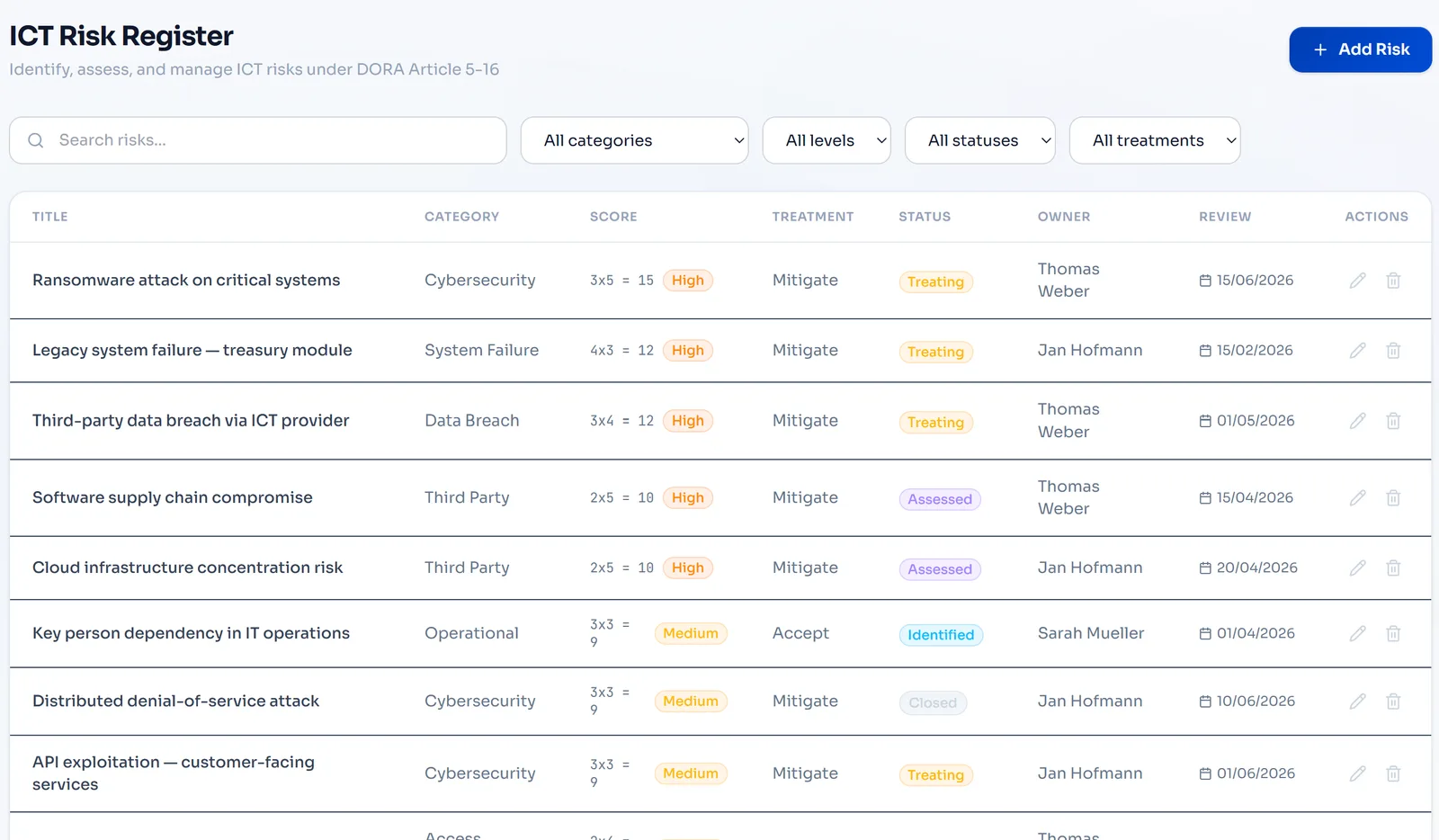
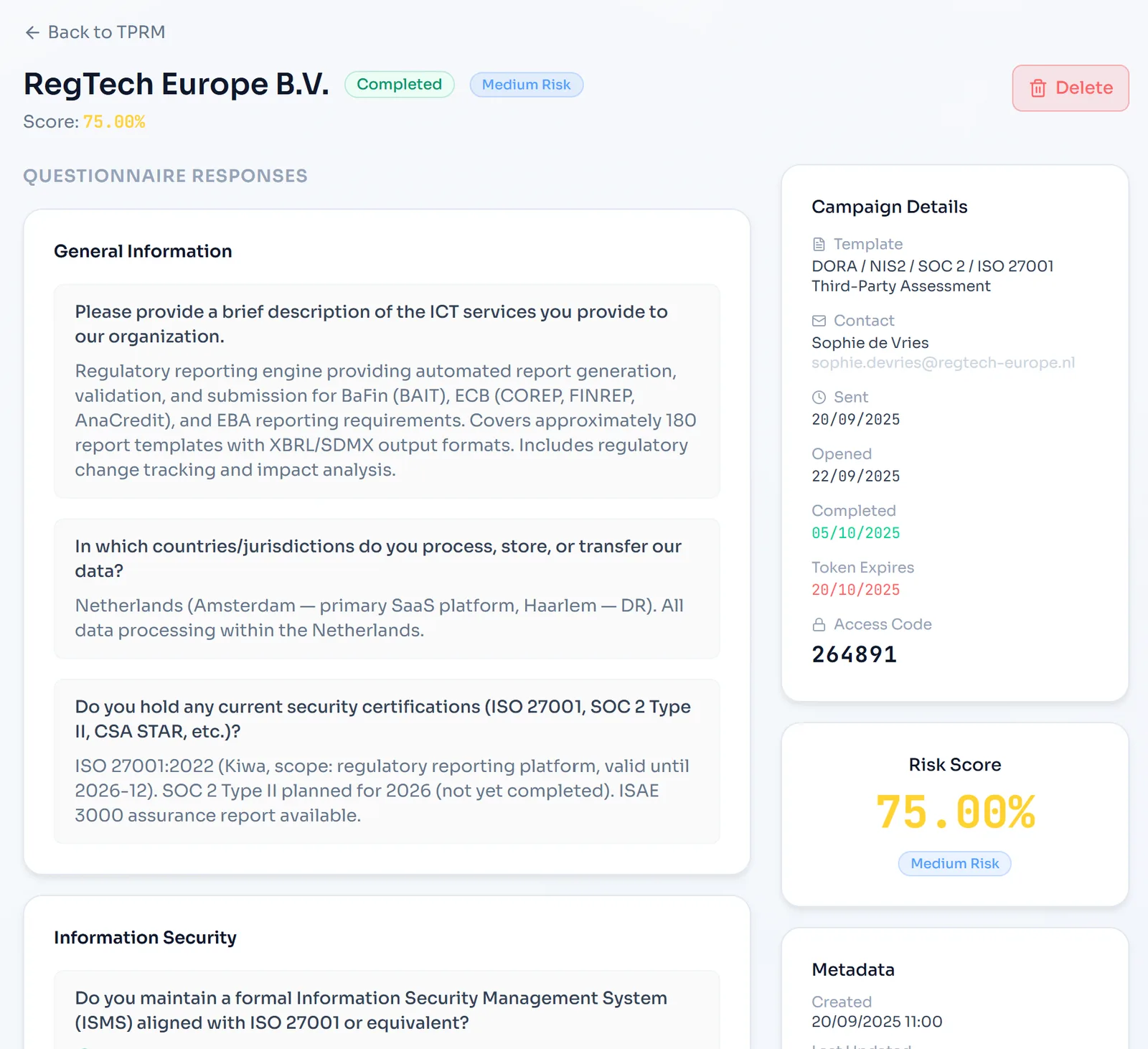
Venvera is the platform-delivered model, and it is the layer the hybrid model runs on. Third-party risk management in the platform keeps the provider register with five-signal risk scoring, tracks the DORA Article 30 clauses per contract, maps sub-outsourcing chains, raises concentration alerts and exports the register of information as xBRL-CSV in one click. Questionnaires run in both directions against one evidence library, and the same controls answer several frameworks at once through the control crosswalk.
The register does not have to start empty. The setup wizard behind risk management as a service drafts your third parties, ICT assets, risks and first actions from ten questions about the business, ready for your team to review and apply. For the hybrid model, consultancies and vCISO providers run client programmes on the platform through the partner programme, which is the usual answer when a lean team needs the judgment as well as the tooling. If your obligations start with the DORA register specifically, the walkthrough for building a compliant vendor register from scratch is the place to begin.

Frequently asked questions
Is vendor risk management as a service the same as TPRM as a service?
Providers use the phrases interchangeably. The honest difference is scope: vendor risk usually means the suppliers you pay, and third-party risk covers every external party that can affect your operations, including partners, intra-group entities and subcontractors. Check which one the statement of work describes before you sign.
How much does vendor risk management as a service cost?
Consultancy retainers are usually banded by vendor count and start in the low thousands per month. Fractional analysts are billed by the day. Platform-delivered is a flat subscription: on Venvera, EUR 399 or EUR 899 a month per organisation with unlimited users. Compare them on total labour, not on the headline number.
Can a small company do this without a service?
Yes, up to a point. With a platform that carries intake, reminders, clause tracking and reporting, one part-time owner can run a programme of thirty or forty suppliers. The service becomes worth paying for when the supplier count grows, when a regulator is watching, or when nobody internally has the time to chase evidence.
Does using a service satisfy DORA or NIS2?
Using a service can produce the records both regimes require, but neither transfers responsibility. DORA Article 5 keeps the framework with the management body and NIS2 Article 20 requires management bodies to approve and oversee the measures. The service prepares; your directors approve.
How long does it take to get a vendor programme running?
Two to four weeks for the inventory and tiering if procurement data is available, and a quarter before the evidence and contract clauses are complete for the critical suppliers. Anyone promising a finished register in a week has not seen your contracts.
What happens to our data if we stop the service?
Ask before you start. The register, the evidence and the assessment history should be exportable in a usable format on the day you leave. On Venvera every register exports to Excel, the DORA register comes out as xBRL-CSV, and a read API serves the same data to your own systems.
Sources
- Regulation (EU) 2022/2554 (DORA), Articles 5, 28, 29 and 30.
- Implementing Regulation (EU) 2024/2956, templates for the register of information.
- Directive (EU) 2022/2555 (NIS2), Articles 20 and 21(2)(d).
- Regulation (EU) 2016/679 (GDPR), Article 28.
- ISO/IEC 27001:2022, Annex A controls 5.19 to 5.23.
- AICPA, SOC 2 trust services criteria, CC9.2.