

Features
The short answer. Multi-jurisdictional compliance software keeps one control set, one evidence library and one register per legal entity, then maps them to every regulation the company answers to and produces what each regulator wants in its own language and template. Three product categories share the name; only regulatory GRC platforms do this job. Buy for the crosswalk, the legal-entity model, the language coverage and the data residency, in that order.
You get three things from this guide. A definition sharp enough to exclude the entity-management and workforce tools that rank for the same phrase. The seven capabilities a regulatory programme spread over several countries actually needs, with the article numbers that force each one. And a scoring table you can hand to two vendors and fill in during the demo.

What is multi-jurisdictional compliance software?
Multi-jurisdictional compliance software is a platform that lets one organisation meet the regulatory obligations of several countries or regulators from a single set of controls, evidence and registers. The distinguishing features are a crosswalk that maps one control to the requirements of many frameworks, a legal-entity model that keeps each subsidiary's scope, registers and audit trail separate while the parent sees the whole, and outputs shaped to each regulator: the DORA register of information for the European supervisor, the maturity self-assessment for a Gulf central bank, the audit return for a Nigerian data protection commission, the SOC 2 evidence set for a North American customer.
The phrase is used for three unrelated product categories, which is why search results for it are confusing. Entity-management software tracks corporate registrations, directors and annual filings across states or countries. Workforce compliance software applies labour and scheduling law by state. Regulatory GRC software does what this guide describes. If your problem is that the Bulgarian entity answers to DORA, the German clients ask for NIS2 evidence and the Riyadh office answers to SAMA, you are shopping in the third category.
Who needs multi-jurisdictional compliance software?
Any company whose regulators do not share a rulebook. Four patterns account for most of them:
- A financial entity with clients across borders. A payment institution licensed in one EU member state serving customers in three others answers to DORA once, to NIS2 as transposed by each member state where it is an important entity, and to GDPR under a lead supervisory authority plus every local authority that receives a complaint.
- A Gulf institution with a European footprint. A Saudi bank or fintech runs SAMA CSF and the NCA Essential Cybersecurity Controls at home, DORA and GDPR for the Dublin or Amsterdam subsidiary, and produces evidence in Arabic and English.
- A service provider whose customers are regulated. A SaaS or managed service company selling into banks, hospitals and public bodies in several countries is asked for SOC 2, ISO 27001, HIPAA and DORA Article 30 contract terms by different customers in the same quarter.
- A group of companies. A holding with entities in four countries needs each entity's register, evidence and audit trail kept apart for the local regulator, and one consolidated view for the board.

What must multi-jurisdictional compliance software do?
Seven capabilities, each forced by a specific obligation. A vendor that lacks one of them pushes the work back onto your team, usually as a second tenant, a second spreadsheet or a translation agency.
1. Crosswalk one control set across every framework
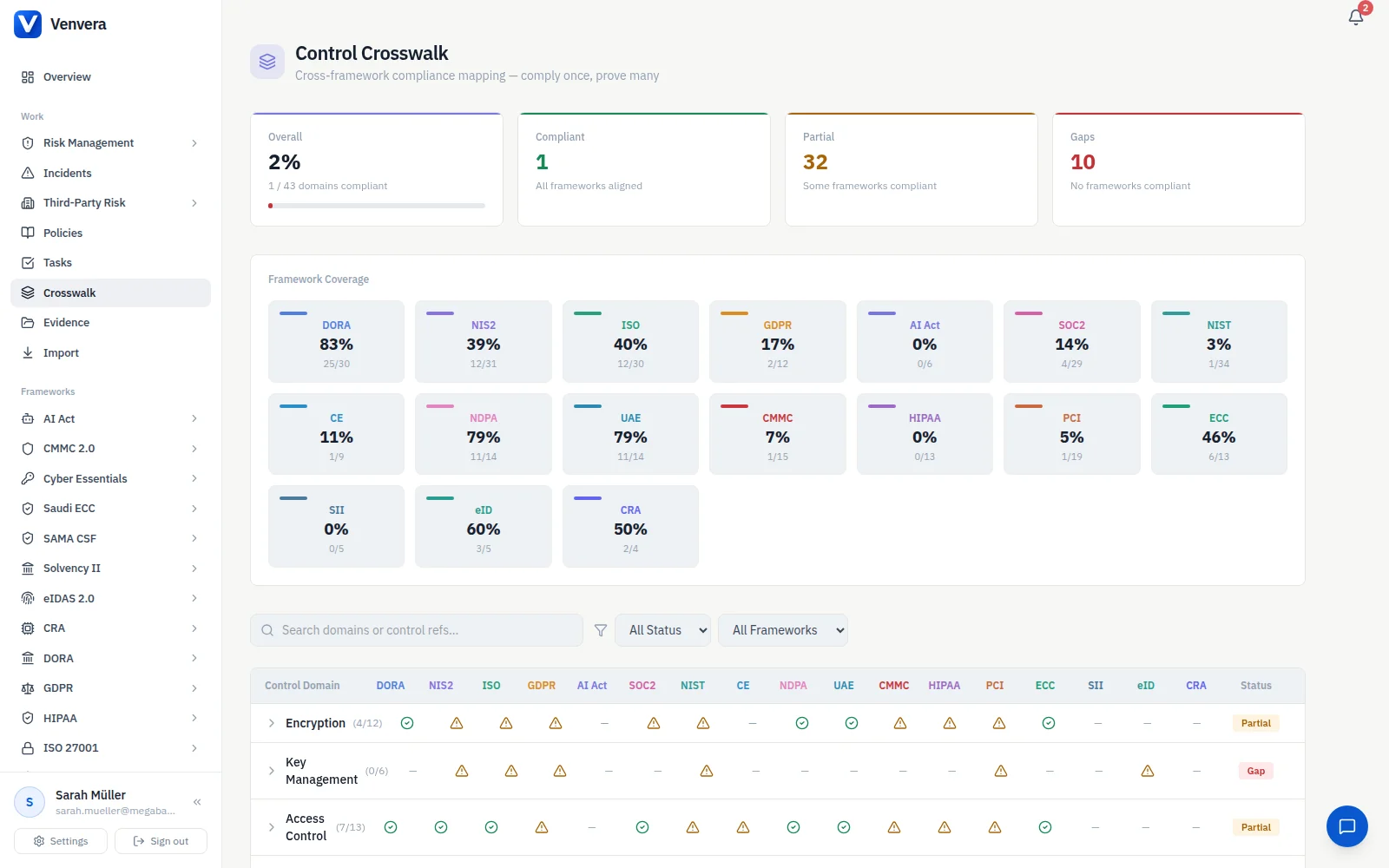
The same access-control procedure satisfies ISO 27001 Annex A 5.15, DORA Article 9, NIS2 Article 21(2)(i), SOC 2 CC6.1 and the NCA ECC access-management controls. Software that stores the control once and maps it to each framework lets you prove it once. Software that stores a copy per framework makes you prove it five times and keep five copies in step. Venvera's control crosswalk is the mechanism for this across the 27 frameworks the platform covers.
2. Model legal entities, not just frameworks
Regulators supervise legal entities. The Dutch subsidiary's register of information, the Saudi branch's SAMA self-assessment and the parent's consolidated risk view are three different documents about three different scopes, even when the controls behind them are shared. Look for a group structure where each entity has its own registers, evidence and audit trail and the parent gets consolidated scoring. In Venvera this is Company Groups on the Enterprise plan.
3. Track how directives were transposed
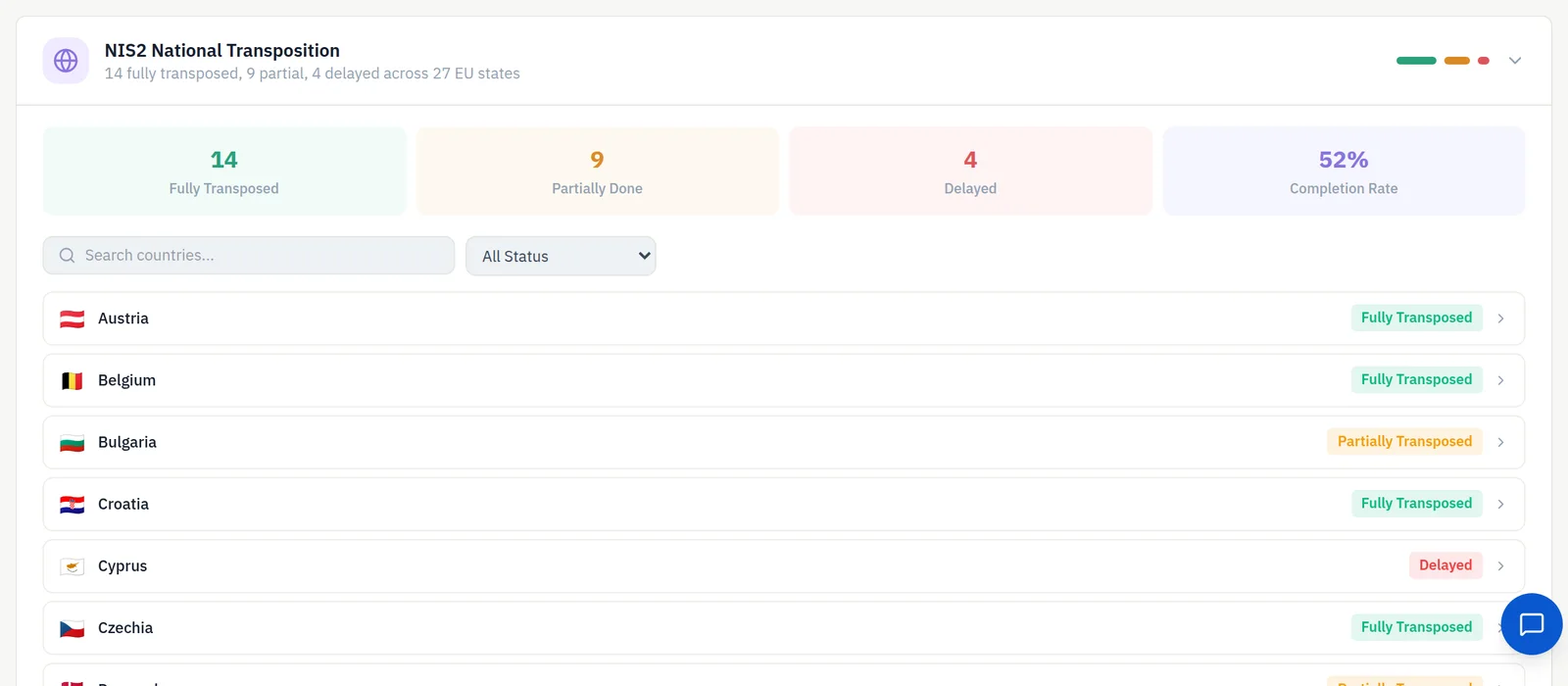
NIS2 is a directive, so it binds companies only through each member state's own law, and those laws differ in scope thresholds, registration duties, competent authorities and penalties. The transposition deadline was 17 October 2024 and several member states finished late, which means the rules a company follows depend on where each entity sits and when. Software that treats NIS2 as one framework hides the differences your lawyers will be asked about; software that records the national transposition shows them.
4. Work in the regulator's language
A Gulf central bank reads Arabic, a German data protection authority reads German, an American customer's auditor reads English. Policies, evidence descriptions and reports have to exist in the language of the regulator who receives them, and the interface has to work for the staff who produce them. Venvera runs the full platform in English, German, Spanish, Bulgarian, Arabic and Chinese; the note on bilingual policies and evidence for Gulf regulators explains why the evidence language matters as much as the interface.
5. Produce each regulator's output, not a generic export
Each regime asks for a specific artefact. DORA asks for the register of information in the Implementing Regulation (EU) 2024/2956 templates, delivered as xBRL-CSV; NIS2 asks for incident notifications on a 24-hour, 72-hour and one-month clock under Article 23; GDPR asks for a record of processing activities under Article 30; SAMA asks for a maturity self-assessment; the Nigerian Data Protection Commission asks controllers of major importance to register and file annual audit returns. A multi-jurisdictional tool generates these from the same records rather than asking you to rebuild them in Excel.
6. Know where the data is, and say so
Every one of these regulators can ask where the compliance records themselves are hosted and who can reach them. Buy a tenant whose hosting region you can name in the answer. Venvera tenants are hosted in Amsterdam, with per-tenant encryption, which satisfies EU data-residency questions and is a documented fact you can put in front of a Gulf or Nigerian regulator rather than a vague statement about the cloud.
7. Follow regulatory change per jurisdiction
PCI DSS v4.0.1 made its future-dated requirements mandatory on 31 March 2025. CMMC 2.0 entered defence contracts on 10 November 2025 under the DFARS rule. The Cyber Resilience Act's reporting obligations start on 11 September 2026. Saudi Arabia's NCA replaced its ECC with ECC-2:2024. Each change lands on a different entity in your group. A regulatory updates feed that tells you which entity and which controls a change touches turns that into a task list instead of a surprise.
Where do single-jurisdiction tools break?
Most compliance platforms were built for one market. They are good at it. The trouble starts when the second regulator arrives, and it shows up in five predictable places.

- One framework per tenant. The vendor's answer to a second regulator is a second workspace. Evidence is uploaded twice and drifts apart within a quarter.
- Controls copied per regime. Without a crosswalk, the same procedure becomes five controls with five owners and five review dates. When it changes, four copies are wrong.
- English-only evidence. Policies and reports exist in one language, so every regulator submission in another language goes through a translation step outside the system and out of the audit trail.
- No legal-entity separation. One flat tenant means the Saudi regulator's request exposes the Dutch entity's records, or the parent cannot consolidate without exports.
- No transposition tracking. NIS2 appears as one checklist, and nobody can say which member state's thresholds, authorities and deadlines apply to which entity.
Which regulations does a multi-jurisdictional programme have to cover?
The table lists the regimes that most often meet in one company, who each one binds, and the trap that catches teams running them together. Dates are from the primary texts.
| Regime | Who it binds | The multi-jurisdiction trap |
|---|---|---|
| DORA | EU financial entities and their critical ICT third-party providers; applies since 17 January 2025. | The register of information is per entity and per contractual arrangement, in the ESA templates, delivered as xBRL-CSV. |
| NIS2 | Essential and important entities in 18 sectors, through each member state's transposing law; deadline 17 October 2024. | Scope, registration, authority and penalties differ by member state. Incident clocks of 24 hours, 72 hours and one month run from the national law. |
| GDPR | Controllers and processors handling EU personal data, wherever established. | One lead supervisory authority under Article 56, but any local authority can receive a complaint. The UK runs its own GDPR. |
| SAMA CSF | Financial institutions supervised by the Saudi Central Bank. | A maturity self-assessment on a 0 to 5 scale, evidence expected in Arabic, and overlap with NCA ECC for the same bank. |
| Saudi NCA ECC | National organisations and critical infrastructure in Saudi Arabia; ECC-2:2024 replaced the 2018 edition. | Control numbering unlike ISO 27001; a bank maps it to SAMA CSF and ISO 27001 at once. |
| UAE IA | UAE government entities and critical sectors under the TDRA Information Assurance Regulation. | A management and technical control split that does not follow ISO numbering; evidence in Arabic and English. |
| Nigeria NDPA | Controllers and processors handling Nigerian personal data; Act of 2023, supervised by the NDPC. | Controllers of major importance register with the NDPC and file annual compliance audit returns; a second set of duties alongside GDPR. |
| SOC 2 | Service organisations whose customers ask for it, mostly North American. | An attestation over a period, not a certificate; the evidence set has to be reproducible for the auditor every year. |
| NIST CSF 2.0 and SP 800-53 | Voluntary in the private sector, contractual for US federal supply chains; CSF 2.0 released February 2024. | Profile-based, no certificate; customers ask for a mapping, not a badge. |
| HIPAA | US covered entities and business associates. | A documented risk analysis under 45 CFR 164.308(a)(1)(ii)(A) that regulators ask to see first. |
| PCI DSS v4.0.1 | Anyone storing, processing or transmitting cardholder data. | Future-dated requirements became mandatory on 31 March 2025; the self-assessment questionnaire type depends on the payment channel. |
| CMMC 2.0 | US Department of Defense contractors and subcontractors; rules effective 16 December 2024 and 10 November 2025. | The required level is set per contract; Level 2 needs a third-party assessment. |
What do the other results for this query get wrong?
Read the current page one for this phrase and four problems repeat.
- They answer a different question. Entity-management and workforce-scheduling tools rank for the phrase because they use it. They track filings and shift rules, not controls and evidence. A compliance officer who buys one has solved corporate housekeeping and still has no register.
- They stop at the US border. The lists cover SOC 2, HIPAA and state privacy laws and treat GDPR as the one foreign regime. DORA, NIS2, SAMA, NCA ECC, UAE IA and NDPA do not appear, which is exactly where multi-jurisdictional programmes fail.
- They sell the size of the catalogue. A library of ten thousand harmonised controls sounds like coverage. Without a legal-entity model and a crosswalk you can read, it is scoping work for consultants.
- They never mention language. Not one result discusses evidence in the regulator's language. For any programme that includes a Gulf, African or non-English European regulator, that omission decides the purchase.
How do you score multi-jurisdictional compliance software?
Weight the rows for your own regulators, then fill in each vendor during the demo, not from the brochure. The Venvera column states what the platform does today.
| Requirement | Weight (1 to 5) | Vendor A | Vendor B | Venvera |
|---|---|---|---|---|
| One control crosswalked across every framework you run | Yes. 27 frameworks on one control library. | |||
| Legal-entity model with consolidated group view | Yes. Company Groups on the Enterprise plan. | |||
| National transposition recorded for directives | Yes, for NIS2. | |||
| Interface and evidence in the regulator's language | Yes. English, German, Spanish, Bulgarian, Arabic and Chinese. | |||
| Regulator-specific outputs (DORA RoI in xBRL-CSV, GDPR RoPA, board reports) | Yes. One-click xBRL-CSV register of information, RoPA, board reports as PDF and DOCX. | |||
| Named hosting region and per-tenant encryption | Yes. Amsterdam, AES-256 per tenant. | |||
| Regulatory change feed mapped to entities and controls | Yes. Regulatory updates with impact assessment. | |||
| Flat pricing you can quote to the board | Yes. Basic EUR 399 a month for 2 frameworks, Professional EUR 899 for 5, Enterprise for groups. |
What does multi-jurisdictional compliance software cost?
Three pricing models meet in this category. Enterprise GRC suites quote per module and per user, and the multi-entity and multi-language pieces are usually separate line items. North American compliance automation platforms price per framework, so the fifth regulator costs as much as the first. Venvera prices per organisation with unlimited users: Basic at EUR 399 a month covers 2 frameworks of your choice, Professional at EUR 899 covers 5, and Enterprise adds Company Groups with unlimited frameworks per entity. Whichever model you buy, put the translation, the second tenant and the consultant hours for scoping on the same sheet; they are the real multi-jurisdiction cost.

If you want to see the model rather than the criteria, how Venvera runs multi-jurisdictional compliance walks through the control set, the per-entity separation and the artefact each regulator collects.
Frequently asked questions
Is multi-framework compliance the same as multi-jurisdictional compliance?
No. Multi-framework means several standards in one country, for example ISO 27001 and SOC 2 for a British software company. Multi-jurisdictional adds different regulators, languages, legal entities and, for EU directives, different national laws. The five features that make multi-framework compliance work are necessary but not sufficient; you also need the entity model, the languages and the transposition tracking described above.
Do we need a separate tenant per country?
Not if the software has a legal-entity model. One tenant with an entity per subsidiary keeps each regulator's scope separate and gives the parent the consolidated view. Separate tenants are the workaround vendors offer when the entity model is missing, and they double the evidence work.
How can one control count for several regulators?
Because regulators describe the same practice in different words. Access reviews, backup testing, incident response and supplier due diligence appear in every regime in this guide. The crosswalk stores the control and its evidence once and shows each regulator's view of it; the evidence is attached once and read many times.
Where should the compliance records themselves be hosted?
Somewhere you can name. EU regulators expect EU residency or documented transfer safeguards; Gulf and Nigerian regulators expect a clear answer on location and access. Venvera hosts every tenant in Amsterdam with per-tenant encryption, and states so in writing.
How long does it take to stand up a programme across several jurisdictions?
The first register takes an afternoon. Venvera's risk management as a service approach drafts the risk register, indicators, third parties and first actions from ten questions about the business, mapped to the frameworks you enable; your team reviews and applies. Evidence collection and the first regulator-specific outputs follow over the first quarter.
Sources
- Regulation (EU) 2022/2554 (DORA) and Implementing Regulation (EU) 2024/2956 on the register of information.
- Directive (EU) 2022/2555 (NIS2), Articles 21 and 23, and the transposition deadline in Article 41.
- Regulation (EU) 2016/679 (GDPR), Articles 30 and 56.
- Saudi National Cybersecurity Authority, Essential Cybersecurity Controls (ECC-2:2024).
- Saudi Central Bank, Cyber Security Framework.
- Nigeria Data Protection Commission, Nigeria Data Protection Act 2023.
- NIST Cybersecurity Framework 2.0.
- PCI Security Standards Council, PCI DSS v4.0.1.
- US Department of Defense, CMMC programme.
- Regulation (EU) 2024/2847 (Cyber Resilience Act), Article 71 on application dates.


