
Best
The best risk management software for an enterprise is the one that keeps a scored, owned, current register without a project to keep it that way, and that turns it into a board report and a regulator export without anyone assembling slides. Which product that is depends on four things before it depends on any feature list: how many risk teams and legal entities you run, whether you already live on ServiceNow or SAP, whether the programme is run by audit and the board or by a risk function, and whether you are a regulated company of up to a few hundred people or a group of them. Those four questions sort the market into four segments, and picking the segment does more for the outcome than picking the vendor inside it.
This page is written by a vendor, so read it knowing that. Venvera sells risk management software and sits in the fourth segment below, with the other compliance-automation platforms, and this guide says so wherever it matters. What it also does, which the pages ranking above it do not, is define what enterprise means, weight the evaluation criteria, put a three-year number on cost, show the ninety days after signature and give you fifteen questions that separate a demo from a product. Every vendor fact carries its source; every price is labelled as a published range or a list price.
| Your situation | Segment to shortlist | Names to start with |
|---|---|---|
| Several risk teams, several entities, a services budget | Platform suite | Archer, MetricStream, IBM OpenPages |
| Standardised on ServiceNow or SAP | Your platform's risk module | ServiceNow IRM, SAP GRC |
| Programme run from internal audit, SOX or the board | Audit and board led | Diligent, Optro (was AuditBoard), Workiva |
| One risk team, 500 to 5,000 staff, workflows you want to own | Configurable mid-market | LogicGate, LogicManager, Resolver, SAI360, Riskonnect |
| Regulated company to about 250 staff, or a group of them, certifications in play | Compliance automation with risk | Venvera, Vanta, Drata |
| Under DORA or Solvency II, any size | Any segment with the register of information and incident clocks in the product | Check the regulatory fit section before the demo |
What enterprise risk management software actually does
Strip the category names away and every product on this page does three jobs, or fails at one of them. It records the facts about each risk: what it is, how likely and how bad, who owns it, what controls mitigate it, what incidents have evidenced it. It helps people decide: where the appetite line sits, which risks cross it, what treatment is planned and whether the indicators say it is working. And it reports, to a board that will act on it and a regulator that will test it. The twelve capabilities below are the three jobs broken into the things a demo can show.

The failure pattern is consistent across segments. Most tools record well; recording is what a database does. Fewer decide: appetite is a paragraph in a policy rather than a threshold the system enforces, and key risk indicators are a dashboard of numbers someone types in. Fewer still report from live data; the board pack is still assembled by a person the week before the meeting, which means the register was true on the day of the meeting and nobody knows about the other eighty-nine. The risk management frameworks guide covers what the register should contain under COSO, ISO 31000 or NIST; this page is about the software that keeps it true.
ERM, GRC, IRM, TPRM and compliance automation: which category are you buying?
Five labels sit on the same shelf and the vendors use them interchangeably, which is why a buyer can spend a quarter comparing products that were never built for the same job.

Enterprise risk management software centres on the register, the appetite, the indicators and the board: the whole organisation's risks, strategic and financial as much as cyber. GRC adds the obligations and the controls: a control library, policy management, audit and issue tracking, with risk as one of the objects. Integrated risk management is the analyst umbrella for suites that put ERM, IT risk, vendor risk and resilience on one data model, and it is where the platform suites sell. Third-party risk management is a specialism with its own tools, reviewed separately, that most enterprise buyers need as a module rather than a product. And compliance automation platforms grew up collecting evidence for SOC 2 and ISO 27001 and added a risk register because the auditors asked for one; some of those registers are now serious, some are a table.
The practical rule: an enterprise needs ERM with GRC controls underneath it, whatever the box says. The test is whether one record serves all three views. If the risk, the control that mitigates it and the audit finding that proved the control failed are three objects in three modules that a report joins together, you will spend the second year reconciling them.
How to evaluate: a weighted scorecard
Every ranking page gives you ten criteria in a row, all equal. They are not equal, and they are not equal in the same way for a bank and a manufacturer. Weight them before the first demo, write the weights down, and score every vendor against the same proof of concept on your own data. This is the scorecard we use with buyers; the weights are a starting point.

| Criterion | Weight | What a full score looks like | What a demo hides |
|---|---|---|---|
| Risk depth | 25% | One taxonomy across domains; inherent and residual on one numeric scale; appetite as thresholds; KRIs with sources and bands; controls and incidents linked many to many; quantification where money matters | Scoring in words; appetite as a PDF; KRIs typed by hand |
| Reporting | 20% | The board pack generated from live data in one action; heatmap cells drill to the record; quarterly snapshots for trend; exports the supervisor accepts | A pretty dashboard with no export; the pack built in PowerPoint |
| Regulatory fit | 15% | DORA, NIS2, Solvency II, OCC and COSO mapped to records and exports, not to a logo wall | A framework list on the pricing page |
| Integration | 15% | Identity, ITSM, SIEM, ERP, vendor data and cloud posture in; API and exports out; KRIs computed from the feeds | Native for one system, partner-built for the rest, CSV forever |
| Adoption | 15% | A first-line owner updates a risk from an email link without training; the review cycle runs itself | Training days; the risk team doing everyone's updates |
| Total cost | 10% | Licence, implementation, integration and internal hours as one three-year number, with the renewal capped in writing | The licence quoted alone |
Two adjustments come up often enough to state. A financial entity under DORA or Solvency II moves regulatory fit to 25 percent, because the register of information, the incident clocks and the management body's approval trail are legal artefacts the product must produce. A group with several ERPs and identity systems moves integration to 25, because a register nobody feeds is a register nobody trusts.
Anatomy of a risk record the software must hold

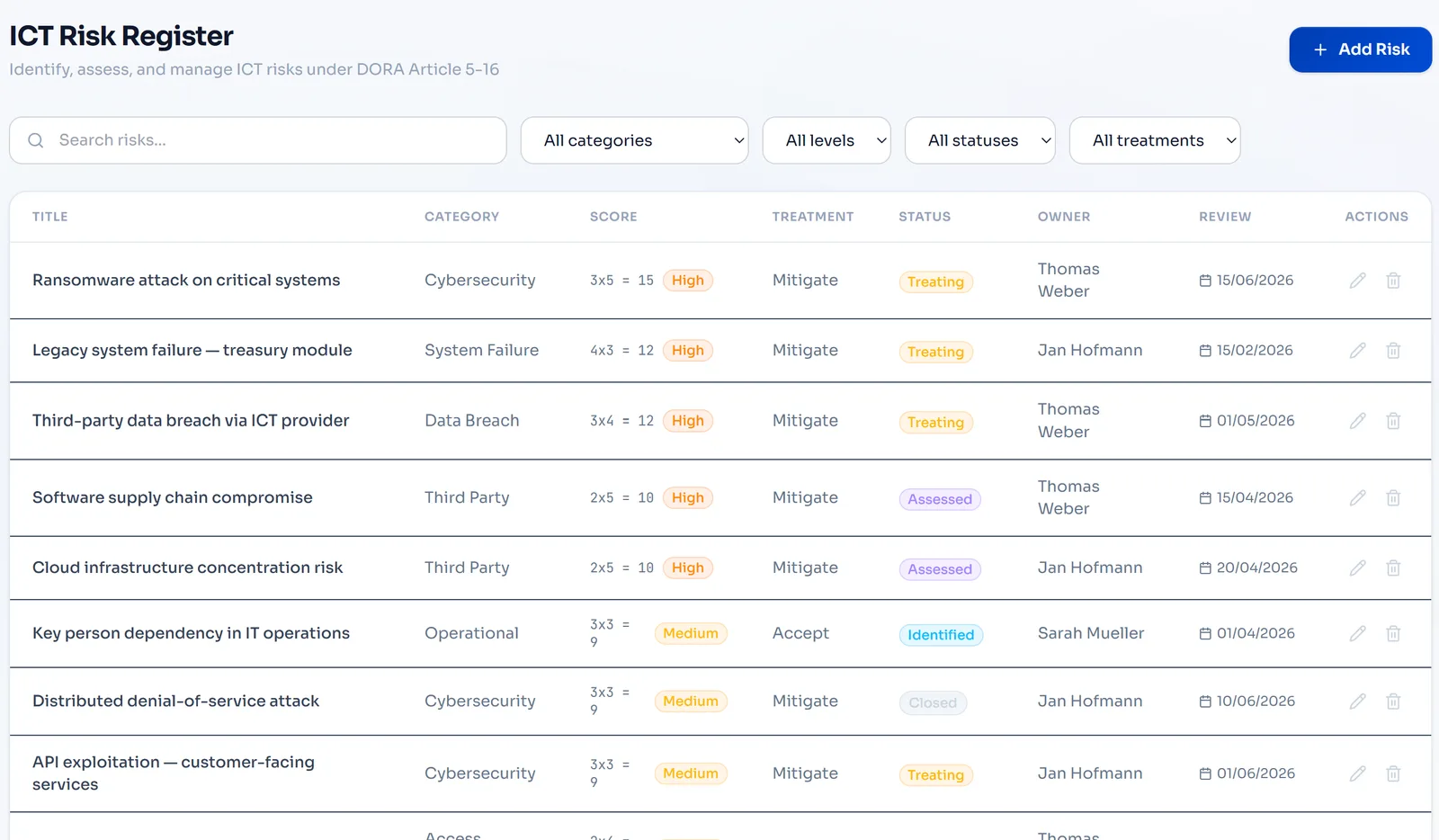
The unit of work is the risk record, and the fields on it decide what the tool can ever report. Category on a shared taxonomy is what lets an enterprise heatmap roll ICT, conduct, fraud and ESG onto one picture. Inherent and residual scores on the same numeric scale are what let the board judge whether treatment spend is working. Owner and review date are what keep the register true without a quarterly project. Linked controls are what let one control tested once cover every risk it mitigates, and linked incidents are what correct a likelihood that was a guess. Evidence on the record is what the auditor reads instead of an email thread, and the change log is what the supervisor reads when the score moved the week before the inspection.
Appetite, scoring and the heatmap
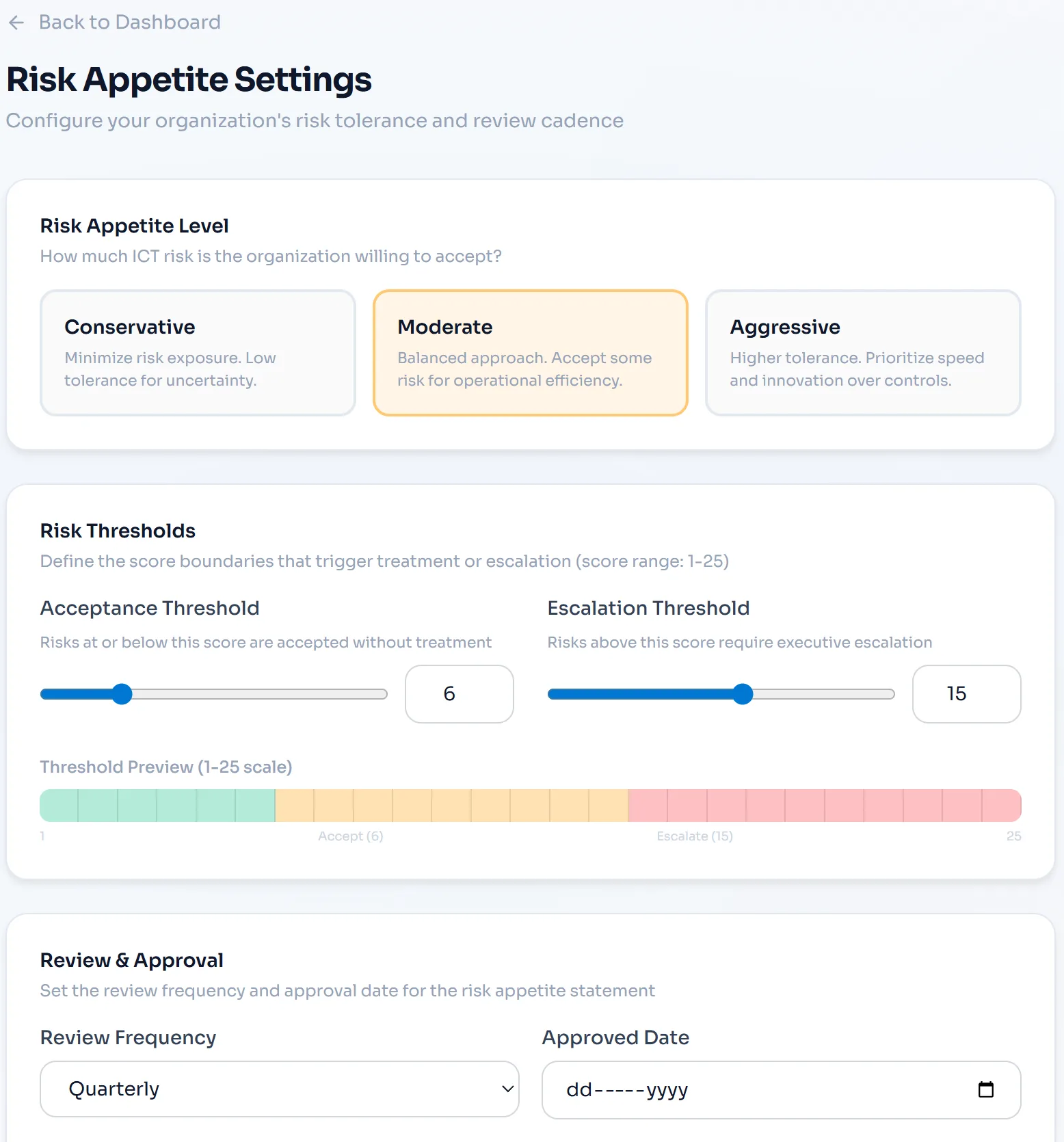
A risk appetite statement that lives in a policy document cannot escalate anything. The software has to hold it as thresholds on the same scale the risks are scored on, so that a risk crossing the line triggers a review without a person noticing. On a 5 by 5 matrix that is a line across the grid and three zones: accept below it, treat on it, escalate above it. Residual and inherent on the same map, with the line drawn, is the single most useful picture a risk committee sees.

Watch for three things in the demo. Whether the scale is numeric; a tool that scores Low, Medium and High cannot draw the line, cannot aggregate across business units and cannot show a trend. Whether the thresholds are configurable per entity and approved with an audit trail, because a subsidiary's appetite is not the group's. And whether crossing the line does something on its own: an escalation to the committee agenda, a task to the owner, a flag on the board pack. Venvera's register draws the line as three zones with conservative, moderate and aggressive presets and escalates automatically; the suites do the same with more configuration; several mid-market tools draw the heatmap and leave the escalation to a workflow you build.
Key risk indicators: the feature most tools ship half-built
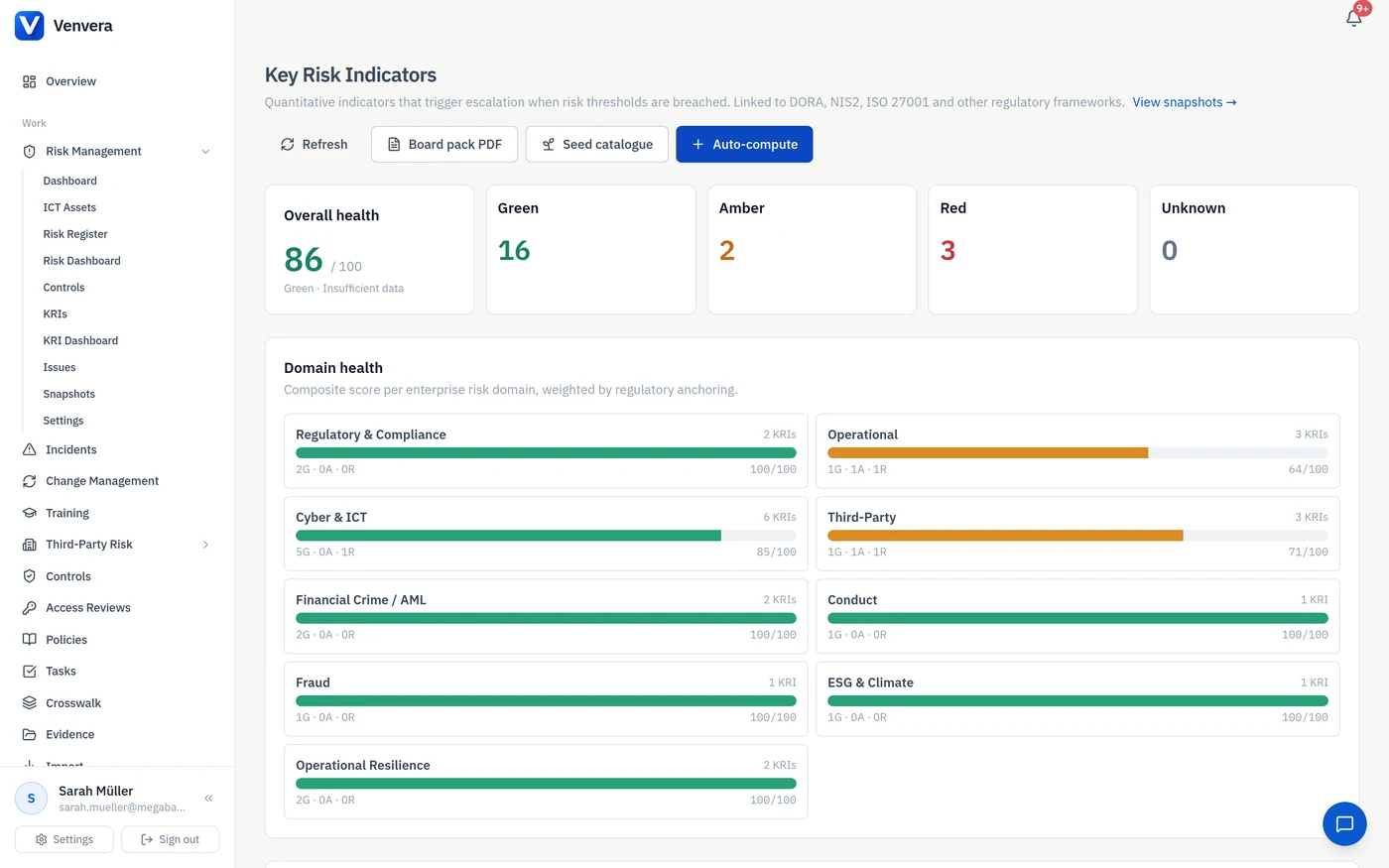
A key risk indicator is a loop, not a chart. Define the metric, its direction and its source; collect the value from a system or from the owner; compare it with two to four threshold bands; alert the owner and subscribers on a breach; re-score the linked risk when the breach persists; and put the trend on the board pack. Most products ship the first step and the last, and leave the collection to a person with a spreadsheet, which is how KRIs become a quarterly ritual instead of an early warning.

The two steps to test are collection and escalation. Collection means the tool computes the value from data it already has, such as privileged accounts without a review in ninety days from the access module, critical vendors with an expired assessment from the vendor register, or controls tested ineffective this quarter from control testing, or that it asks the owner for a reading through a link that needs no login. Escalation means a breach changes the score of the risk the indicator belongs to, so the heatmap moves without a meeting. Venvera's KRIs do both on the Professional plan, with auto-computed indicators from control effectiveness, policy review dates and vendor concentration; the suites do it with connectors and a services engagement; most mid-market tools do the bands and the alert and leave collection manual.
The market in 2026: four segments and who is in each
The names below are the ones a buyer meets in the first week of looking. They are grouped by who buys them and how they are deployed, not by quality, and the notes are what the published reviews and buyer guides agree on, with the source in brackets. Prices are the ranges one 2026 buyer's guide publishes or a vendor's own list price; almost every vendor quotes custom, so treat the ranges as the order of magnitude, not a quote.

| Vendor | Segment | Best for | Implementation | Pricing signal | Watch for |
|---|---|---|---|---|---|
| Archer | Platform suite | Large, highly regulated, mature programmes; deepest framework library | 4 to 12 months (Risk Publishing) | USD 100k to 400k+ a year (Risk Publishing); custom | Interface and reporting date from an earlier era; GRC expertise needed to deploy (Mitratech, G2 3.6) |
| MetricStream | Platform suite | Large multi-entity groups; federated data model; quantitative tooling | 6 to 12 months | USD 150k to 500k+ a year; custom | Significant implementation commitment; complexity |
| IBM OpenPages | Platform suite | Banking, insurance, pharma; watsonx classification and analytics | 6 to 18 months | SaaS from about USD 3,300 a month list (G2); enterprise custom | Heavy for occasional users; AI features priced as add-ons |
| ServiceNow IRM | Platform module | Enterprises standardised on ServiceNow; risk on the ITSM and CMDB data model | 3 to 6 months | USD 100k to 350k a year on top of the platform; custom | Value compounds only inside the ServiceNow stack |
| SAP GRC | Platform module | SAP shops tracking risk ownership inside S/4HANA | Custom | Custom; described as high in reviews (G2) | Non-SAP integration is hard; SAP skills required |
| LogicGate Risk Cloud | Configurable mid-market | Teams that want to own their workflows without code; graph data model | 8 to 16 weeks | USD 50k to 200k a year; custom | Advanced reporting needs configuration or third-party tools; modules add up (G2 4.6) |
| LogicManager | Configurable mid-market | Mid-market ERM with taxonomy-driven linking | Custom | Fixed fee, unlimited users; custom quote | Mid-market focus may lack suite depth |
| Resolver | Configurable mid-market | Operational and incident-linked risk; ISO 31000 alignment | 4 to 8 weeks | USD 40k to 150k a year; custom | Advanced analytics on an upgrade tier; training needed |
| SAI360 | Configurable mid-market | ERM, compliance, EHS and training in one; regulated industries | Fast initial deployment (Mitratech) | USD 60k to 200k a year; custom | Reporting gaps and two UIs noted in reviews (G2 4.2) |
| Riskonnect | Configurable mid-market | Broadest domain coverage: ERM, TPRM, claims, insurance, resilience; 2,700+ customers | 3 to 9 months | USD 75k to 300k a year; custom | Vertical modules priced separately; significant configuration |
| Diligent (HighBond) | Audit and board led | Boards: risk reporting through the board portal; NIST CSF and ISO 27001 alignment | Cloud | USD 75k to 250k a year; custom | Feature access depends on modules bought |
| Optro (was AuditBoard) | Audit and board led | Audit-led programmes, SOX and controls; rebranded under Hg in March 2026 | 4 to 8 weeks | USD 50k to 150k a year; custom | Full ERM needs several modules; strongest for mature audit functions |
| Workiva | Audit and board led | Reporting-grade risk tied to SEC and SOX filings | Custom | Premium; custom | Finance-first; risk is a use case, not the centre |
| Venvera | Compliance automation with risk | Regulated companies to about 250 staff and groups of them: register, appetite, KRIs and board pack beside the evidence engine; DORA register of information | Days; 14-day trial, no card | EUR 359 or 799 a month list, unlimited users (published) | Not built for a 20,000-person bank with five risk teams; see the honesty note below |
| Vanta, Drata | Compliance automation with risk | Certification-driven companies that want a register beside SOC 2 and ISO 27001 automation | Days to weeks | Custom | Risk depth varies by module; check appetite and KRI collection in the demo |
Platform suites
Archer, MetricStream and IBM OpenPages are what a group with several risk teams, several jurisdictions and a change budget buys, and ServiceNow IRM and SAP GRC are what the same group buys when it already runs the platform. The strength is real: any taxonomy, any workflow, any report, and a data model that carries operational, IT, vendor and resilience risk at once. So is the cost: implementations run two to four quarters with a services partner, licences are six figures before the partner, and the reviews are consistent that the products are heavy for people who touch them once a quarter. Buy a suite for the organisation you are, not the one on the vendor's reference slide; a suite deployed to one entity with a spreadsheet feeding it is the most expensive spreadsheet on the market.
Configurable mid-market
LogicGate, LogicManager, Resolver, SAI360 and Riskonnect are where most buyers between five hundred and five thousand staff should spend their demo time. The common shape is no-code configuration a risk team can own, two to four month implementations and modules priced separately, which is where the total cost hides. LogicGate's graph model and workflow builder get the highest marks for flexibility and the most consistent complaint about reporting; Resolver links incidents to risks well and sells fast; Riskonnect is the widest, reaching claims and insurance, and the most configuration-hungry; LogicManager prices flat with unlimited users, which changes the adoption maths; SAI360 pairs risk with compliance training. Run the scorecard on three, not five.
Audit and board led
Diligent, Optro and Workiva sell to a different sponsor: the audit committee, the SOX programme, the company secretary. Their centre of gravity is controls, testing and the board portal, and ERM is a module that inherits that discipline. If the risk programme in your company is owned by internal audit, this segment matches how you work; if it is owned by a chief risk officer who reports to the CEO, the register-first products fit better and the board portal is an integration.
Compliance automation with risk, and the honesty note
Venvera, Vanta and Drata grew from certification automation, and their risk modules are judged by a fair question: is this a register, or a serious one? Ours is the serious kind, and it is the right fit for a specific buyer: a regulated company of up to a few hundred people, or a group of such companies, that needs the register, appetite, indicators, incidents and board pack in the same system as the ISO 27001, SOC 2, DORA or NIS2 evidence, in days rather than quarters, at a published price with unlimited users, and, on the Professional plan, with the standing work done as a service. It is not the right fit for a twenty-thousand-person bank with five risk teams, nine ERPs and a model risk function; that buyer should be on the suite shortlist, and we will say so on the call. Vanta and Drata are stronger on the certification side and worth a demo for the same buyer; our own comparison with Vanta is written to be checked.
Which tool for which company: a decision tree

Work the questions in order and stop at the first yes. Two overrides sit outside the tree. If DORA or Solvency II applies, regulatory fit outranks it: the register of information with its xBRL-CSV export, the incident clocks and the management body's approval trail have to exist in the product, whichever segment you are in. And if the annual budget is under about USD 25,000, only the fourth segment and the free tiers are honest options; a suite at that price is a pilot licence with no services behind it, and the services are where the suite's value is.
What it costs: three years, not one licence
The licence is the number the vendor quotes, and it is the smaller half of what you will spend. Implementation and configuration, the integrations that make the register current, the internal hours that keep it current, and the modules you add in year two are the rest. The proportions below are indicative for a configurable mid-market suite; the licence line varies tenfold between segments, the internal-time line does not.

| Line | Compliance automation with risk | Configurable mid-market | Platform suite |
|---|---|---|---|
| Licence, per year | EUR 4k to 10k list; enterprise custom | USD 40k to 200k (published ranges) | USD 100k to 500k+ (published ranges) |
| Implementation | Days; included or a fixed onboarding | USD 30k to 150k, 2 to 4 months | USD 150k to 1m+, 2 to 4 quarters, partner-led |
| Integrations | Native connectors; the rest by API | Native for a few; partner-built for the rest | Connectors plus a partner for each system |
| Internal time | One owner, hours a month | A part-time admin plus owners | A platform team of two to four |
| Year two | Renewal capped in writing (Venvera); check others | Modules added; per-user growth | Upgrades, re-work, partner retainer |
| Three-year order of magnitude | EUR 15k to 60k | USD 250k to 900k | USD 1m to 4m |
Five questions move the number more than any discount. Is the price per user, per module, per entity or flat, because per-user pricing taxes adoption, which is the thing you need most. What is the year-two price, in writing. Who builds the taxonomy and the workflows, at what day rate, for how long. How many internal hours a month keep the register current, which is the largest line and the one never in the quote. And what does adding third-party risk, incidents or a second entity cost later.
Ninety days from contract to the first board report that came from the system
The plan below is realistic for a configurable or compliance-automation tool, and for one entity of a suite. It is not realistic for a suite across a group, where the taxonomy workshop alone takes the ninety days; budget two to four quarters and a partner there and treat this as the plan for the pilot entity.

The first thirty days are the taxonomy, the scales, the appetite thresholds and the owners, then the migration of the spreadsheet register onto the new scale and the mapping of the control library to the frameworks you run; a control crosswalk makes the last step a selection rather than a project. The second thirty are the loop: ten to fifteen indicators with sources and bands, a treatment plan with dates for every risk above appetite, incidents and issues linked to the risks they evidence, and the first quarterly snapshot. The last thirty are the proof: owners updating from links rather than meetings, the committee reading a pack the system generated, the auditor given read-only access to the record and its log, and the scorecard re-run against what actually happened. If the ninety days end with the pack still built by hand, the tool has failed the reporting criterion, whatever the demo showed.
Integrations: the register is only as current as what feeds it

Six inputs decide whether the KRIs compute themselves: identity and HR for joiners, leavers and privileged access; ITSM and the CMDB for assets, changes and incidents; the SIEM and scanner for findings and exposure age; the ERP for losses, provisions and limits; vendor data for questionnaires, ratings and contracts; and cloud posture for the Microsoft 365, Google Workspace and AWS findings that are most of an ICT risk register's evidence. Ask the vendor which are native, which need a partner and which will be a CSV upload forever, and weight the answer by how many of the six you actually run. On the way out, the board, the regulator, the auditor, the owners and the data warehouse each need a format they will accept: a generated pack, a register-of-information export, read-only access to the record and its log, an email link, and an API.
Fifteen RFP questions that separate the demo from the product

The first six are demonstrations on your data, in your proof-of-concept tenant, not the vendor's sample. Show one risk with its controls, indicator, incident and evidence on one screen. Draw our appetite line and escalate a risk that crosses it, live. Compute an indicator from a connected system rather than a typed number. Generate the board pack from this tenant now. Roll three entities with different taxonomies onto one heatmap. Show residual against inherent over four snapshots. The remaining nine are answers in writing: the taxonomy and register loaded in the proof of concept; which integrations are native, partner-built or CSV; what a first-line owner sees and does without training; the pricing basis and the year-two price; who builds the workflows, at what rate, over how long; the audit log for a changed score; a documented export of everything you own on the day you leave; where the data is hosted, who can access it and under which certification; and three references your size, in your sector, live for over a year. A vendor that agrees to all fifteen has nothing to hide.
Where ERM programmes stall, and what the software can and cannot fix
Programmes stall in the same five places, and only three of them are software problems. The taxonomy is never agreed, so every unit scores on its own scale and nothing aggregates; software cannot decide the taxonomy, but a tool with a shared scale and per-entity thresholds removes the excuse. Ownership is unclear, so risks are updated by the risk team on everyone's behalf; a tool that lets an owner update from an email link fixes most of it. Scoring is inconsistent, so the heatmap reflects who scored rather than what is true; calibration guidance on the record and loss history from linked incidents help, and a quantitative method for the top ten risks helps more, which the frameworks guide covers under FAIR. Adoption fails because the first-line user needs training to do a five-minute job; that is a product defect and the adoption criterion catches it. And reporting is done by hand because the tool's pack is not what the board wants; insist on the generated pack in the proof of concept, with your board's headings.
The regulation that expects a system, article by article
None of these texts names software, and all of them describe a record that a spreadsheet cannot keep. DORA Article 6 requires a documented ICT risk management framework reviewed at least yearly, Article 16 a simplified one for smaller entities, and Article 28 a register of information on every ICT third-party arrangement that supervisors collect in a prescribed format; the article-by-article guide maps each to a record. NIS2 Article 21 lists the risk management measures and Article 20 makes management bodies approve them and be liable for them, which is why the board view has to exist. Solvency II Article 44 requires an effective risk management system with strategies, processes and reporting procedures, and Article 41 the governance around it; the Solvency II hub covers Pillar 2. In the United States the OCC's Heightened Standards require covered banks to hold a written risk appetite statement, three lines of accountability and board oversight, and the FFIEC IT Handbook sets the examination baseline. Behind all of them, COSO ERM 2017 and ISO 31000:2018 describe the process the record has to evidence, and the NIS2 hub and DORA hub carry the working pages.
What the other results get wrong

- They rank themselves first. Three of the top ten pages are vendor lists that put their own product at number one and say so nowhere near the top. This page is a vendor's too; the market map says where it sits and the honesty note says who it is not for.
- No definition of enterprise. A 500-person company and a 50,000-person group get the same list. The segment decides more than the vendor does, so the segment comes first here.
- Licence quoted as the cost. Implementation, integrations and internal hours are two thirds of three-year cost and appear in none of them.
- Criteria without weights. Ten features in a row, all equal, for every reader. A bank and a manufacturer should not weight the same list the same way.
- KRIs as a dashboard. A KRI is collect, compare, alert, escalate. Most reviews check for the chart and stop.
- Regulation as a logo wall. DORA, NIS2 and Solvency II are named and never mapped: which article, which record, which export.
If you are a regulated company of up to a few hundred people, or a group of them, and the register still lives in a spreadsheet, Venvera's risk management gives you the scored register, the appetite line, computed KRIs and the generated board pack in days, on a published price, with the 90-day audit-ready guarantee. The free compliance check shows where you stand in two minutes, and a fifteen-minute demo will run the six demonstrations above on your own risks.
Frequently asked questions
What is enterprise risk management software?
A system that keeps the organisation's risk register current, scored on a shared scale, owned and reviewed; holds the risk appetite as thresholds and escalates on them; collects key risk indicators and links controls and incidents to the risks they concern; and generates the reports the board, the auditor and the regulator need from live data rather than from slides someone assembled.
What is the difference between ERM, GRC and IRM software?
ERM centres on the register, appetite, indicators and the board across every risk type. GRC adds the obligations and controls, with policy, audit and issue tracking. IRM is the analyst umbrella for suites that put ERM, IT risk, vendor risk and resilience on one data model. Most enterprise buyers need ERM with GRC controls underneath, and the test is whether one record serves all three views.
Which risk management software is best for large enterprises?
For a group with several risk teams, several entities and a services budget, the platform suites: Archer, MetricStream and IBM OpenPages, or ServiceNow IRM and SAP GRC if you already run the platform. Budget two to four quarters and a partner, and pilot one entity first. For one risk team between five hundred and five thousand staff, the configurable mid-market products fit better and cost a fraction.
Which is best for a mid-sized or regulated company?
Between five hundred and five thousand staff, shortlist three of LogicGate, LogicManager, Resolver, SAI360 and Riskonnect and run the scorecard. Up to a few hundred staff, or a group of such companies with certifications and DORA or NIS2 in play, the compliance-automation platforms with a serious register, including Venvera, deploy in days at a published price.
How much does enterprise risk management software cost?
Published ranges put suite licences at USD 100,000 to 500,000 and more a year, configurable mid-market products at USD 40,000 to 200,000, and compliance-automation platforms at a few thousand to a few tens of thousands; IBM OpenPages lists SaaS from about USD 3,300 a month and Venvera publishes EUR 359 and 799 a month with unlimited users. Over three years the licence is roughly a third of the total; implementation, integrations and internal hours are the rest.
How long does implementation take?
Days for compliance-automation platforms, four to sixteen weeks for configurable mid-market products, and two to four quarters for a suite across a group. The ninety-day plan above ends with a board pack generated from the system; if a vendor cannot commit to that for one entity, ask why.
Do we need a separate tool for third-party risk?
Usually not as a separate product. Vendor tiering, questionnaires, contract checks and concentration belong in the same register as the risks they create, and DORA's register of information has to be produced from it. Buy TPRM as a module or a native capability, and run the process the same way whichever tool holds it.
Can a spreadsheet be enough?
For a handful of risks and one owner, for a while. It fails at the point where scoring must be consistent across people, where appetite must escalate without someone noticing, where indicators must be collected on a schedule and where the regulator asks who changed a score and when. That point arrives before most companies expect it, and the migration is the first thirty days of the plan above.
What should a risk register include?
Category on a shared taxonomy, the threat and vulnerability, inherent likelihood and impact on a numeric scale, the treatment decision, residual score and review date, an owner and an approver, linked controls, a linked indicator where one exists, linked incidents, evidence and a change log. Any field missing from the record is a report the tool cannot produce later.
How do key risk indicators work in software?
As a loop: define the metric, direction and source; collect the value from a system or from the owner by a link; compare it with threshold bands; alert on a breach; re-score the linked risk; report the trend. Test collection and escalation in the demo; a dashboard of typed numbers is a spreadsheet with a login.
Does the software need AI?
It helps in three places and is marketing everywhere else: drafting a first register from a description of the business, summarising incident text into a risk, and flagging duplicates and patterns across units. Judge AI by whether a person still decides, whether the draft cites its source and whether it is priced as an add-on. Venvera's setup wizard drafts the register from ten questions and never sets an owner or a control without a person confirming.
Which regulations expect a risk management system?
DORA Articles 6, 16 and 28, NIS2 Articles 20 and 21, Solvency II Articles 41 and 44, the OCC's Heightened Standards and the FFIEC IT Handbook in the United States, and behind them COSO ERM 2017 and ISO 31000:2018 as the process the record must evidence. None names software; all describe a record a spreadsheet cannot keep.
Should we buy the risk module of the platform we already run?
If you are standardised on ServiceNow or SAP and the risk programme touches IT and operations, yes, evaluate it first: one data model beats an integration. The trade is that the value stays inside the stack and the licence comes on top of the platform subscription. Run the same scorecard and the same fifteen questions against it as against the specialists.
What questions should be in the RFP?
Six demonstrations on your data: one risk with everything linked on one screen, the appetite line escalating live, an indicator computed from a system, the board pack generated now, three entities on one heatmap, residual against inherent over four snapshots. Nine answers in writing: your data in the proof of concept, native versus partner integrations, what a first-line owner does without training, pricing basis and year-two price, who builds workflows and at what rate, the audit log for a changed score, a documented export on exit, hosting and access, three references.
Is Venvera enterprise risk management software?
It is risk management software for regulated companies of up to a few hundred people and groups of them, with the register, appetite zones, computed indicators, incidents, control crosswalk and generated board pack in one system and a published price. It is not the right tool for a very large bank with several risk teams and nine ERPs; that buyer belongs on the suite shortlist, and this guide says so.
Primary sources
- COSO, Enterprise Risk Management: Integrating with Strategy and Performance (2017)
- ISO, ISO 31000:2018 Risk management, Guidelines
- Regulation (EU) 2022/2554, DORA, Articles 6, 16 and 28
- Directive (EU) 2022/2555, NIS2, Articles 20 and 21
- Directive 2009/138/EC, Solvency II, Articles 41 and 44
- OCC, 12 CFR Part 30 Appendix D, Heightened Standards
- FFIEC, IT Examination Handbook
- The IIA, Three Lines Model (2020)
- G2 Learn, Best operational risk management software (2026), user-review data and IBM OpenPages list price
- Mitratech, Top 10 risk management software solutions for enterprises 2026
- Riskonnect, The 10 best ERM software platforms in 2026
- Risk Publishing, Best enterprise risk management software: top 10 for 2026, price and implementation ranges
- 360factors, Enterprise risk management software for banks: 2026 guide
Written by the Venvera compliance team. Venvera is a vendor in this market; the market map and the honesty note say where it sits and who it is not for. Vendor characteristics are taken from the published reviews and buyer guides listed above; price ranges are those guides' figures or vendors' own list prices and are labelled as such. Checked in September 2026.