

Resources
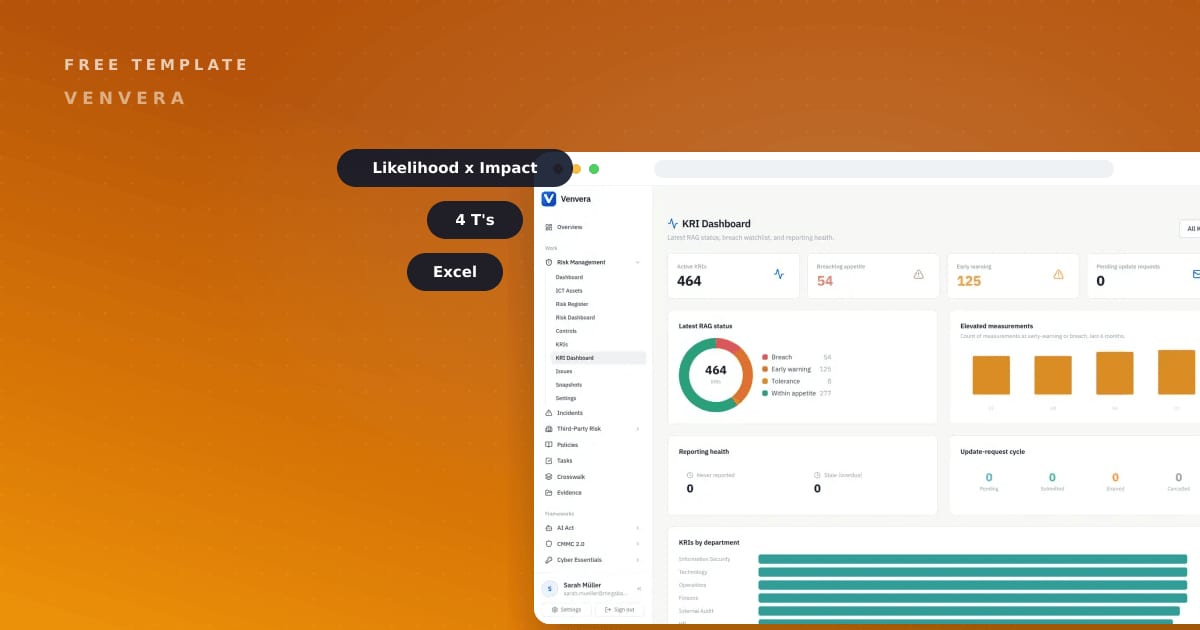
This risk register template is a free Excel workbook for logging, scoring and tracking information security risk in one place. Download the risk register template below, add your risks, and you have the working core of an ISO/IEC 27001 risk assessment without building a spreadsheet from scratch. It is aimed at compliance leads, CISOs and anyone who owns risk for a growing team and needs a defensible, auditable record rather than a pile of notes. Each row scores likelihood and impact on a 1-5 scale, records the controls already in place, and forces a clear treatment decision with a named owner and a target date. The point is not a perfect first draft; it is a consistent, scored list you actually keep current.
Free download
Get the Risk Register Template
An information security risk register with likelihood x impact scoring, treatment options, owners and residual risk. Includes a scoring key and example.
What the Risk Register Template covers
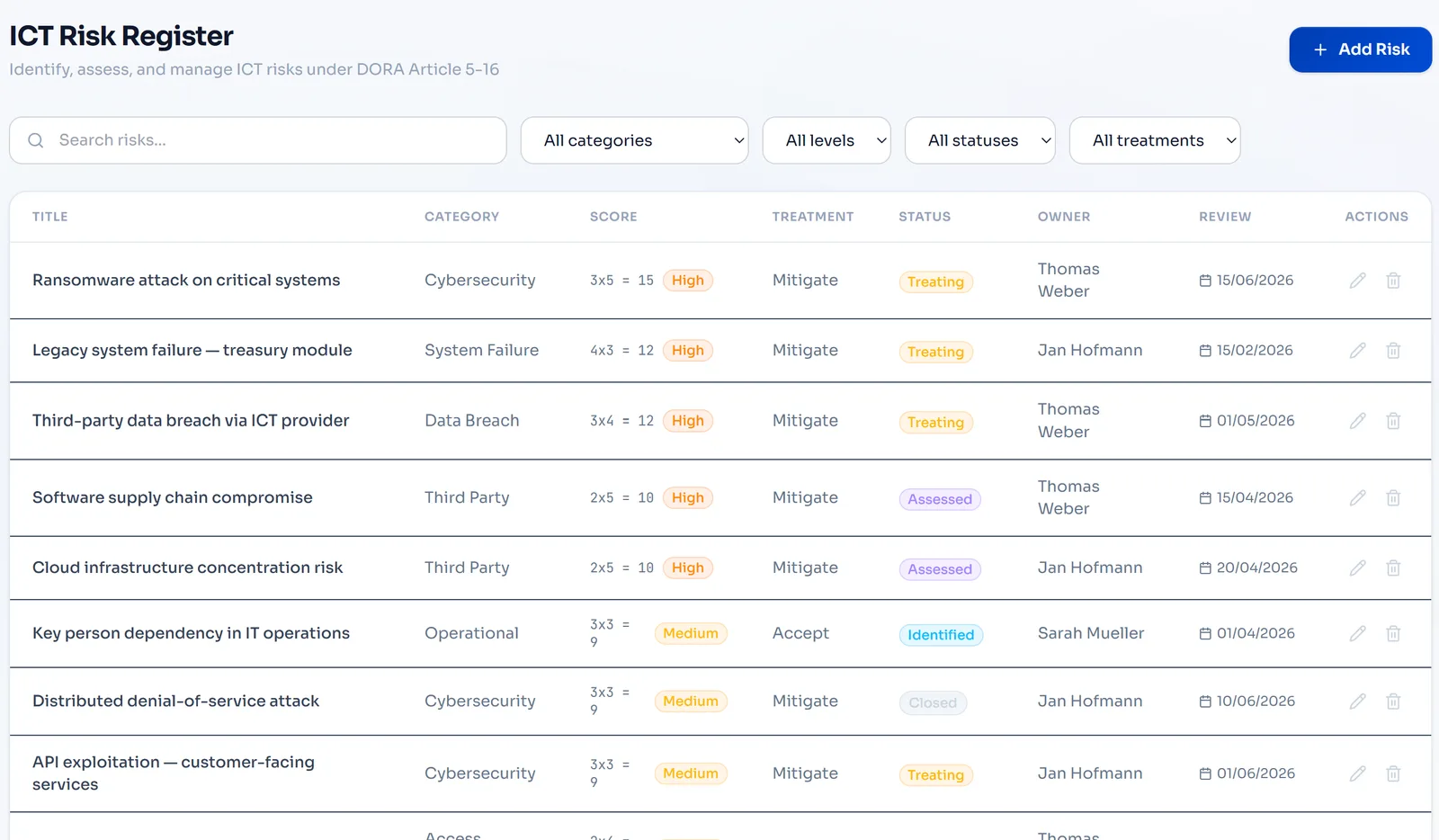
The workbook is a single sheet where every row is one risk, and the columns walk it from raw exposure to a decision you can defend. Each entry captures:
- A risk ID and a plain-language description of what could go wrong.
- Likelihood and impact, each scored on a 1-5 scale.
- An inherent (or gross) score, which is simply likelihood times impact, giving a 1-25 range that ranks the list for you.
- Existing controls: what already reduces this risk today.
- A treatment decision, chosen from Treat, Tolerate, Transfer or Terminate.
- An owner who is accountable for the risk, plus a target date for the action.
- A residual score: the likelihood times impact you expect once the treatment is in place.
Nothing here is exotic. It is the smallest set of columns that turns a vague worry into an owned, scored, trackable item, which is exactly what an auditor and your own board want to see.
Resist the urge to add columns. Every extra field is one more thing that goes blank under time pressure, and a register with three empty columns reads far worse to an auditor than a narrow register that is completely filled in.
information security risk the honest way: what actually matters
A risk register is the backbone of risk management under ISO/IEC 27001. Clause 6.1 asks you to identify and assess information security risks and to plan how you will treat them; clauses 8.2 and 8.3 ask you to actually run that assessment and treatment as an ongoing operating process. The output of that work is what feeds your Statement of Applicability, where you justify which controls apply and why.
Here is the part people get wrong. There is no legally fixed set of risks you are supposed to list. ISO/IEC 27001 does not hand you a catalogue of mandatory risks to copy. The standard cares that your process is consistent, that scores are applied the same way across the register, that every risk has a named owner, and that you can show the list is maintained over time rather than written once for an audit and forgotten. That is the right design. A fixed catalogue of mandatory risks would be out of date within a year and would tempt everyone into copying it verbatim. The cost of the freedom is that nobody can tell you whether your register is good enough, so you have to form a view and be able to defend it.
So the value of this template is not the rows; it is the discipline of the columns. A likelihood times impact score on a 1-25 scale only means something if you use the same 1-5 definitions for every row. A treatment decision only holds up if someone owns it and there is a date attached. Residual risk only matters if you revisit it after the control actually lands. Get those habits right and the register becomes evidence. Skip them and it stays a spreadsheet. The scoring definitions are the part worth arguing about, and you should have that argument once, in a room, before anybody scores anything. It takes an afternoon and it spares you a register where one team's high is another team's medium. Everything after that is upkeep.

How to use the Risk Register Template
- Download the file below and set your scoring key first. Agree what 1 to 5 means for likelihood and for impact before you score a single risk, so the whole team scores the same way.
- List your risks, one per row. Start with the obvious exposures such as access, data loss, third parties and availability, and describe each in plain language.
- Score likelihood and impact for each row. The template multiplies them into an inherent score from 1 to 25 and pushes your worst risks to the top.
- Record existing controls and choose a treatment: Treat, Tolerate, Transfer or Terminate. Assign an owner and a target date to every risk you are not simply tolerating. Owner means a named individual who knows they own it. A department name in that column is a risk with nobody behind it, and it will still be sitting open at the next review.
- Set the residual score you expect once the treatment is done, then schedule a review. Revisit the register on a fixed cadence and after any incident or major change. Until the control is actually live, the residual score is a forecast, so treat it as one. The review date is what turns it into a fact.
- When you are ready, map the controls you rely on into your ISO 27001 Statement of Applicability so the register and the SoA tell the same story.
Do this automatically in Venvera
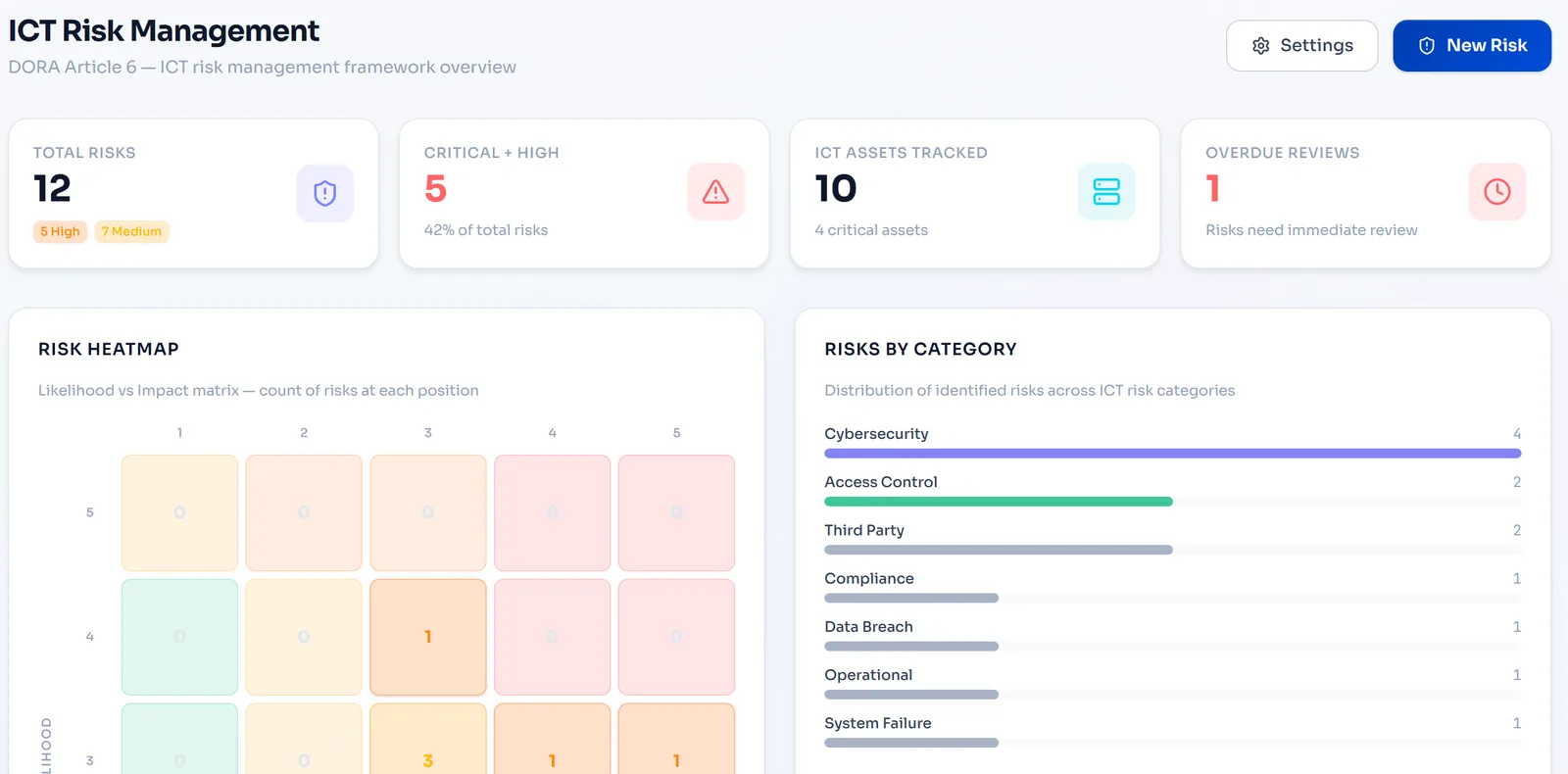
A spreadsheet is a fine place to start and often the right tool for a first pass. It stops scaling the moment you have real owners, real review dates and more than one standard asking about the same risks. In Venvera's ISO 27001 workspace, your register lives as structured records: owners get reminders, residual scores update as controls change, and the same risk and control evidence is reused wherever another framework asks for it, so you are not re-keying the same facts into four workbooks. Plans start from EUR 399/month. The template teaches the shape of the work; the platform keeps it current.
Frequently Asked Questions
What is an information security risk register?
It is a single, maintained list of the information security risks facing your organisation. Each entry records the risk, scores its likelihood and impact, notes the controls already in place, sets a treatment decision, and names an owner, a target date and a residual score. It is the working record behind your ISO/IEC 27001 risk assessment.
How does the likelihood x impact scoring work?
You score likelihood and impact separately, each on a 1-5 scale, then multiply them. That gives an inherent score between 1 and 25, so a risk scored 4 for likelihood and 5 for impact carries a 20. The multiplication ranks the register automatically, pushing your highest-scoring risks to the top of the list.
Is a risk register required for ISO 27001?
ISO/IEC 27001 does not prescribe a fixed list of risks, but it does require a risk management process: clause 6.1 covers identifying risks and planning treatment, and clauses 8.2 and 8.3 cover running the assessment and treatment. A register is the standard way to evidence all of that, and its output feeds your Statement of Applicability.
What is the difference between inherent and residual risk?
Inherent risk is the likelihood times impact before your planned treatment takes effect. Residual risk is the score you expect once the treatment or additional control is in place. Tracking both, on the same 1-5 scale, is how you show that a treatment actually reduced exposure rather than just being logged.