
Resources
This DPIA template is a free Excel workbook that structures a Data Protection Impact Assessment around the minimum content that GDPR Article 35(7) requires. If you are a compliance lead, DPO, or CISO who has to document why a new processing activity is lawful, proportionate, and safe, this DPIA template gives you a repeatable form instead of a blank page. It walks you through a systematic description of the processing, an assessment of necessity and proportionality, a structured view of the risks to people's rights and freedoms, and the measures you plan to reduce them. Everything maps back to the article, so an auditor or supervisory authority can follow your reasoning. Download it below, complete one per processing activity, and keep it as living evidence rather than a one-off document. Your first assessment will take a few days, because you are inventing the house style while you write it. The ones after that take an afternoon.
Free download
Get the DPIA Template
A structured Data Protection Impact Assessment following the Article 35(7) minimum content: description, necessity, risks and measures.
What the DPIA Template covers
The workbook mirrors the four-part structure of Article 35(7), with a dedicated block for each part so nothing gets skipped:
- Systematic description of the processing: the operations and their purposes, the categories of data and data subjects, recipients, retention periods, and any international transfers.
- Necessity and proportionality: your lawful basis, why the processing is necessary for the purpose, whether a less intrusive option exists, and how data minimisation and data subject rights are handled.
- Risk assessment: each risk to the rights and freedoms of individuals, scored by likelihood and severity, covering illegitimate access, unwanted modification, and loss of data.
- Measures: the technical and organisational controls that address each risk, the residual risk left after those measures, plus an owner and a due date.
A header block records the activity name, the assessment date, whether the DPO advice was sought under Article 35(2), and a flag for whether Article 36 prior consultation is triggered.
Of the four parts, necessity and proportionality is the one that takes real thought. The description is transcription. The risk table is a workshop. The measures are usually things you were already doing. Necessity is where you have to argue with your own product team about a field they want to collect and cannot justify, and that conversation is the entire value of the exercise. Write that section once you know what the data is actually doing.
GDPR (DPIA) the honest way: what actually matters
A DPIA is not paperwork for its own sake. Article 35(1) requires one wherever a type of processing is likely to result in a high risk to the rights and freedoms of individuals, and you have to make that judgement before the processing starts, not after.
The threshold itself is vague, deliberately so, and that vagueness is the honest price of a technology-neutral law. "Likely to result in a high risk" will not resolve by reading it harder. Treat borderline cases as a DPIA and move on: an assessment you did not strictly need is cheap, and it is far easier to defend than a decision to skip one.
Three cases are singled out in Article 35(3) as always requiring a DPIA:
- a systematic and extensive evaluation of personal aspects based on automated processing, including profiling, that produces legal effects concerning the individual or similarly significantly affects them;
- large-scale processing of special categories of data, or of personal data relating to criminal convictions and offences;
- systematic monitoring of a publicly accessible area on a large scale.
If your activity matches any of these, the assessment is mandatory. Two further obligations sit around the assessment itself. Where you have designated a data protection officer, Article 35(2) says you must seek their advice when carrying out the DPIA. And if, after you apply your measures, a high residual risk remains, Article 36 requires you to consult your supervisory authority before you begin the processing. The template flags both points so they become decisions you record rather than steps you forget. Be honest with yourself about the Article 36 flag. Almost nobody wants to consult a supervisory authority before a launch date, so there is a standing pull towards scoring residual risk down to medium and getting on with it. If you catch yourself arguing the score down instead of arguing the measures up, you already know the answer.

How to use the DPIA Template
- Copy the workbook for the specific processing activity you are assessing and fill in the header: name, date, and whether a DPO has been designated.
- Complete the systematic description. Pull the processing details straight from your record of processing activities (use our RoPA template for that) so the DPIA and your RoPA stay consistent.
- Work through necessity and proportionality. State the lawful basis and challenge whether every field and every recipient is genuinely needed for the purpose.
- Identify and score the risks to individuals, then record the measures for each one and the residual risk that is left after those measures are in place. Do this with an engineer in the room. Risk sessions run by the compliance function alone produce tidy tables that describe a system nobody actually built.
- Seek DPO advice where you have one, and if any residual risk is still high, consult your supervisory authority before you start.
- Save the finished assessment as evidence and review it whenever the processing materially changes.
Do this automatically in Venvera
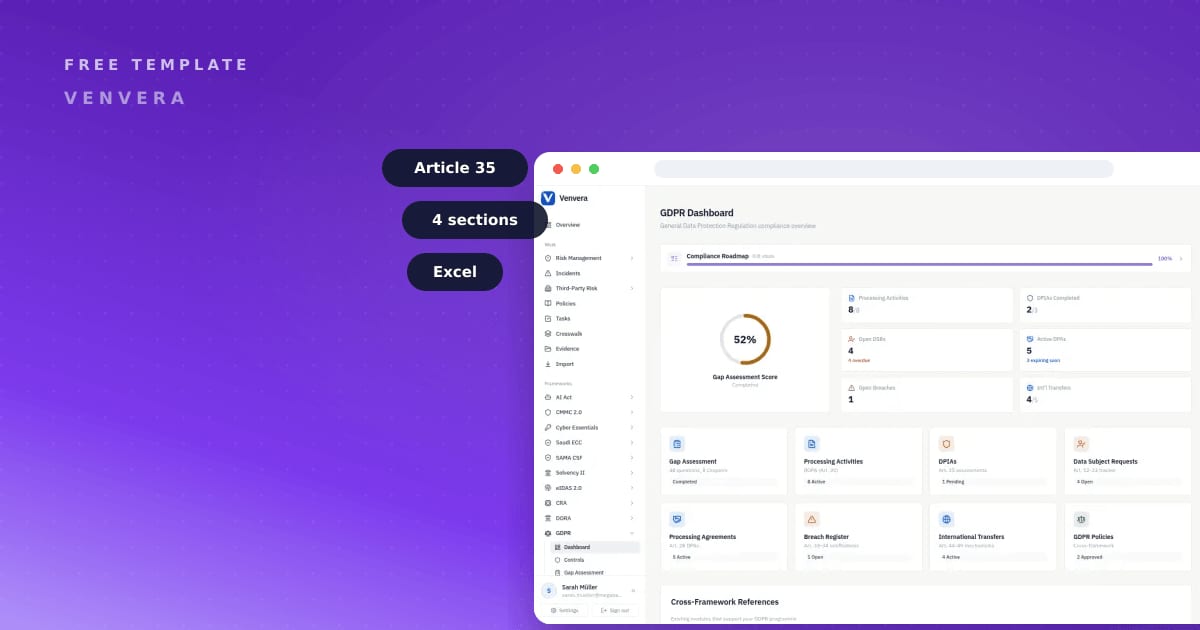
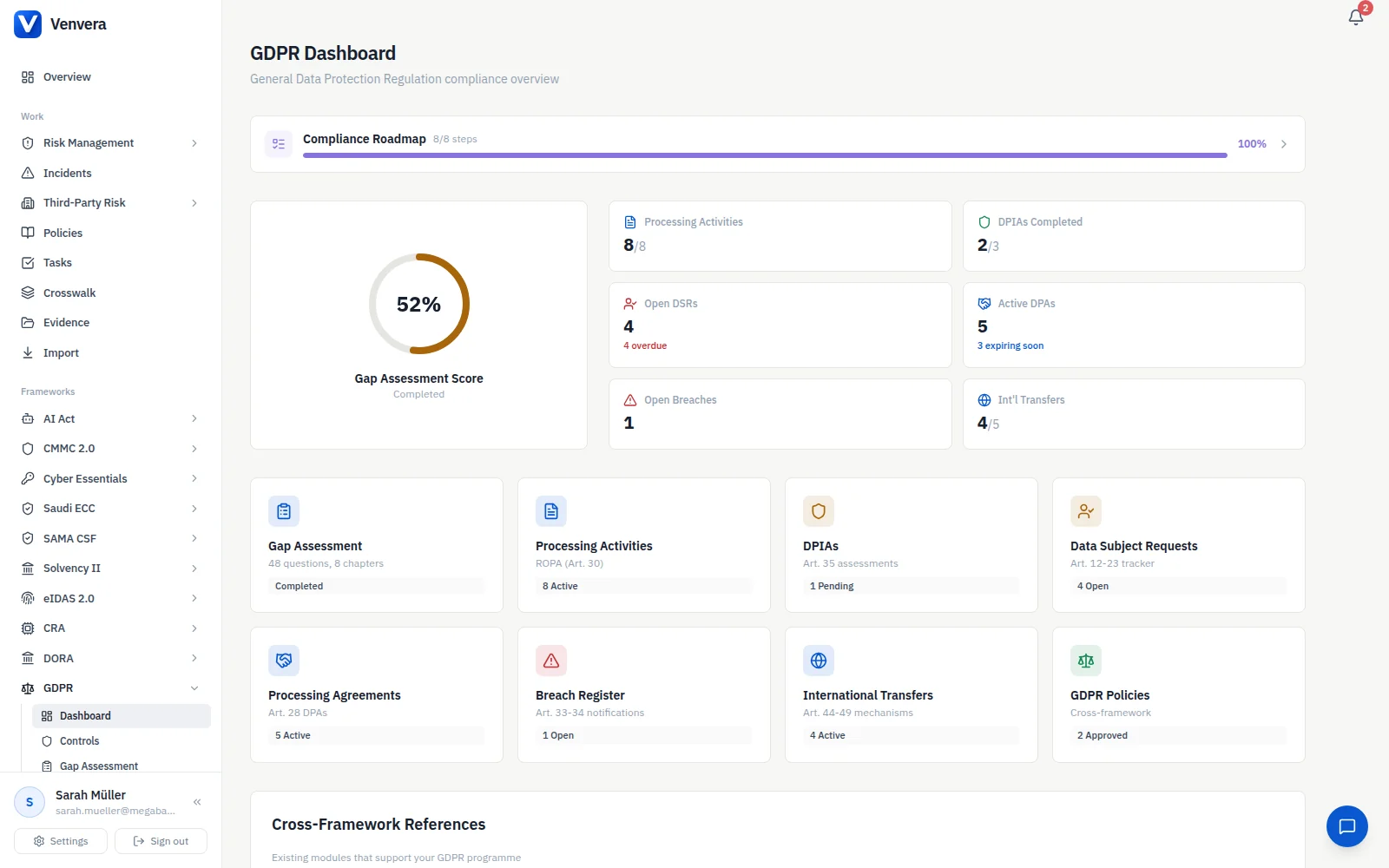
The template is a solid starting point, but a spreadsheet does not stay current on its own. In Venvera's GDPR framework, the same Article 35(7) structure becomes a live assessment: the description reuses the data you already hold in your record of processing activities, risks link to the controls that treat them, and the DPO advice and any Article 36 consultation are tracked as evidence with owners and dates. Because the underlying controls are shared, the work you do for GDPR reuses across your other obligations instead of being re-entered for every audit. If you want to move from a static file to a maintained programme, Venvera starts from EUR 399/month. Pair the download with our GDPR compliance checklist to scope the wider programme.
Frequently Asked Questions
When is a DPIA mandatory under GDPR?
A DPIA is required under Article 35(1) whenever processing is likely to result in a high risk to the rights and freedoms of individuals. Article 35(3) names three cases where it is always mandatory: systematic and extensive automated evaluation or profiling with legal or similarly significant effects; large-scale processing of special-category or criminal-offence data; and systematic monitoring of a publicly accessible area on a large scale.
What are the four required parts of a DPIA?
Article 35(7) sets the minimum content: (a) a systematic description of the processing and its purposes; (b) an assessment of the necessity and proportionality of the processing; (c) an assessment of the risks to the rights and freedoms of individuals; and (d) the measures envisaged to address those risks. This template gives each part its own section.
Do I have to consult my supervisory authority?
Only in one situation: if a high residual risk remains after you have applied your measures, Article 36 requires you to consult your supervisory authority before starting the processing. Separately, where you have designated a DPO, Article 35(2) requires you to seek their advice while carrying out the assessment.
Is this DPIA template free?
Yes. The DPIA template is a free Excel download that you can use for as many processing activities as you need. Enter your details in the form above to get the file.