
Resources
This GDPR compliance checklist is a free Excel workbook that turns the General Data Protection Regulation into a list of concrete tasks you can actually work through. Whether you are a compliance lead, a Data Protection Officer, or a CISO preparing for a customer security review or a supervisory authority query, the GDPR compliance checklist gives you one place to see where you stand. It covers the obligations that buyers and regulators ask about first: a lawful basis for each processing activity, data subject rights, your Record of Processing Activities, security of processing, breach notification, DPIAs, international transfers, and whether you need a DPO. Each of the 51 rows has a status column and an evidence column, so the file works as a living record rather than a one-time audit. Download it below and start filling it in today.
Free download
Get the GDPR Compliance Checklist
Work through the GDPR obligations - lawful basis, data subject rights, records, security, breach and transfers. 51 items with status and evidence columns.
What the GDPR Compliance Checklist covers
The workbook is one Excel sheet, 51 items, organised into eight groups that map to the core obligations of the Regulation. Every row carries the same columns so you can filter, sort, and report on progress without reformatting anything:
- Item: the specific task, written as something you can verify.
- Article reference: the GDPR article or chapter the task comes from, so you can trace it back to the text.
- Status: Not started, In progress, Done, or Not applicable.
- Owner: the person or team accountable for that item.
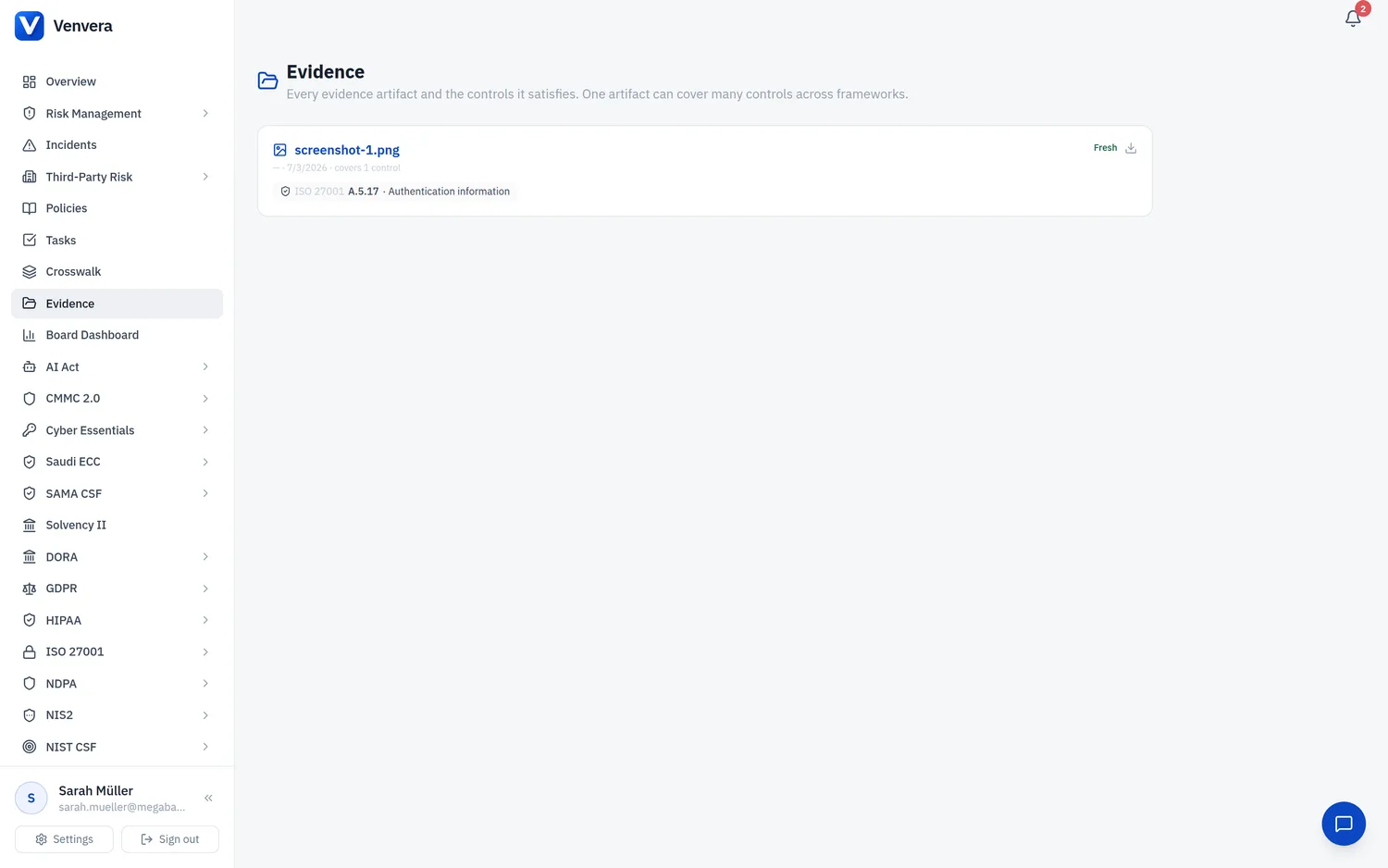
- Evidence: a link or note pointing to the document, screenshot, or record that proves the item is met.
- Notes: caveats, dates, and follow-ups.
The eight groups are: lawful basis (Article 6, plus Article 9 for special-category data), data subject rights (Articles 12 to 23), Record of Processing Activities (Article 30), security of processing (Article 32), breach notification (Articles 33 and 34), data protection impact assessments (Article 35), international transfers (Chapter V), and governance including the DPO question (Article 37). The checklist complements, and does not replace, the deeper artefacts. For the actual processing register use the RoPA template, and for high-risk processing use the DPIA template.
GDPR the honest way: what actually matters
GDPR is not a single control you can switch on. It is a set of obligations that each need their own evidence. For all the noise around it, the Regulation is well drafted: it states outcomes and leaves you to work out proportionate means, which is why two honest organisations can land on different answers and both be defensible. That freedom is also why a checklist earns its keep, because it forces you to record the answer you chose and why. Here is what a GDPR compliance checklist is really testing, obligation by obligation.
A lawful basis for every processing activity (Article 6). Each thing you do with personal data needs a lawful basis under Article 6, and you should be able to name it. Where the data is special-category data, such as health or biometric data, you also need a separate condition under Article 9. This is where most gaps hide: activities that were never mapped to a basis at all. It is also the group that takes the longest, for a dull reason: nobody in the business thinks of what they do as a processing activity, so you spend weeks getting a straight answer out of marketing, HR and product about why they hold what they hold. Naming the basis takes minutes once the list exists. Building the list is the job.
Data subject rights (Articles 12 to 23). Individuals can ask for access, rectification, erasure, portability, and can object to processing. The checklist asks whether you can actually action each right within the statutory timelines and whether you have a documented, repeatable process rather than an ad hoc scramble.
Record of Processing Activities (Article 30). The RoPA is the backbone. It lists what you process, why, on what basis, who you share it with, and how long you keep it. If your RoPA is stale, nearly everything downstream is unreliable. Build it with the RoPA template.
Security of processing (Article 32). Article 32 requires technical and organisational measures appropriate to the risk. The checklist covers the practical basics: access control, encryption where appropriate, backups, and the ability to restore.
Breach notification (Articles 33 and 34). A personal data breach must be notified to the supervisory authority within 72 hours of becoming aware of it under Article 33, and to affected individuals where the breach is likely to result in a high risk to their rights under Article 34. The checklist verifies you have a process that can actually meet the 72 hour clock. 72 hours sounds generous until you count the steps inside it. Someone has to notice. Someone has to decide it is a personal data breach. Legal gets involved, and an executive usually wants to read the wording before it goes anywhere. If any of those steps depends on one named person being reachable, you do not have a process yet. Walk it through on a quiet afternoon and time it honestly.
DPIAs for high-risk processing (Article 35). Where processing is likely to result in a high risk, Article 35 requires a data protection impact assessment before you start. Run these with the DPIA template.
International transfers (Chapter V). Moving personal data outside the EEA needs a valid transfer mechanism under Chapter V. The checklist prompts you to map your transfers and confirm each one has a lawful route. Mapping them is straightforward. The friction is that a single SaaS vendor can move data in ways nobody asked about at purchase, so the exercise doubles as an audit of what your architecture really does. Budget time for asking vendors blunt questions and for disliking some of the answers.
A DPO where required (Article 37). Article 37 requires a Data Protection Officer in defined circumstances. The checklist asks whether you have assessed the requirement and, if it applies, whether the role is filled and independent. This one is genuinely quick. Working out whether Article 37 catches you is an afternoon of reading and a short written conclusion. The step people skip is writing the conclusion down, which is the only part anyone else can ever see.

How to use the GDPR Compliance Checklist
- Assign an owner per group. Send the eight groups to the people who actually run each area, rather than trying to complete all 51 items yourself.
- Set status honestly. Mark each item Not started, In progress, Done, or Not applicable. Resist the urge to mark things Done without evidence.
- Attach evidence as you go. For every Done item, put a link or reference in the evidence column. If you cannot point to proof, it is not Done.
- Work the gaps. Filter to Not started and In progress to get your remediation backlog, and prioritise breach readiness, lawful basis, and your RoPA first.
- Re-run on a schedule. Revisit the checklist quarterly, and immediately after any new product, vendor, or transfer, because your processing changes faster than the Regulation does.
Do this automatically in Venvera
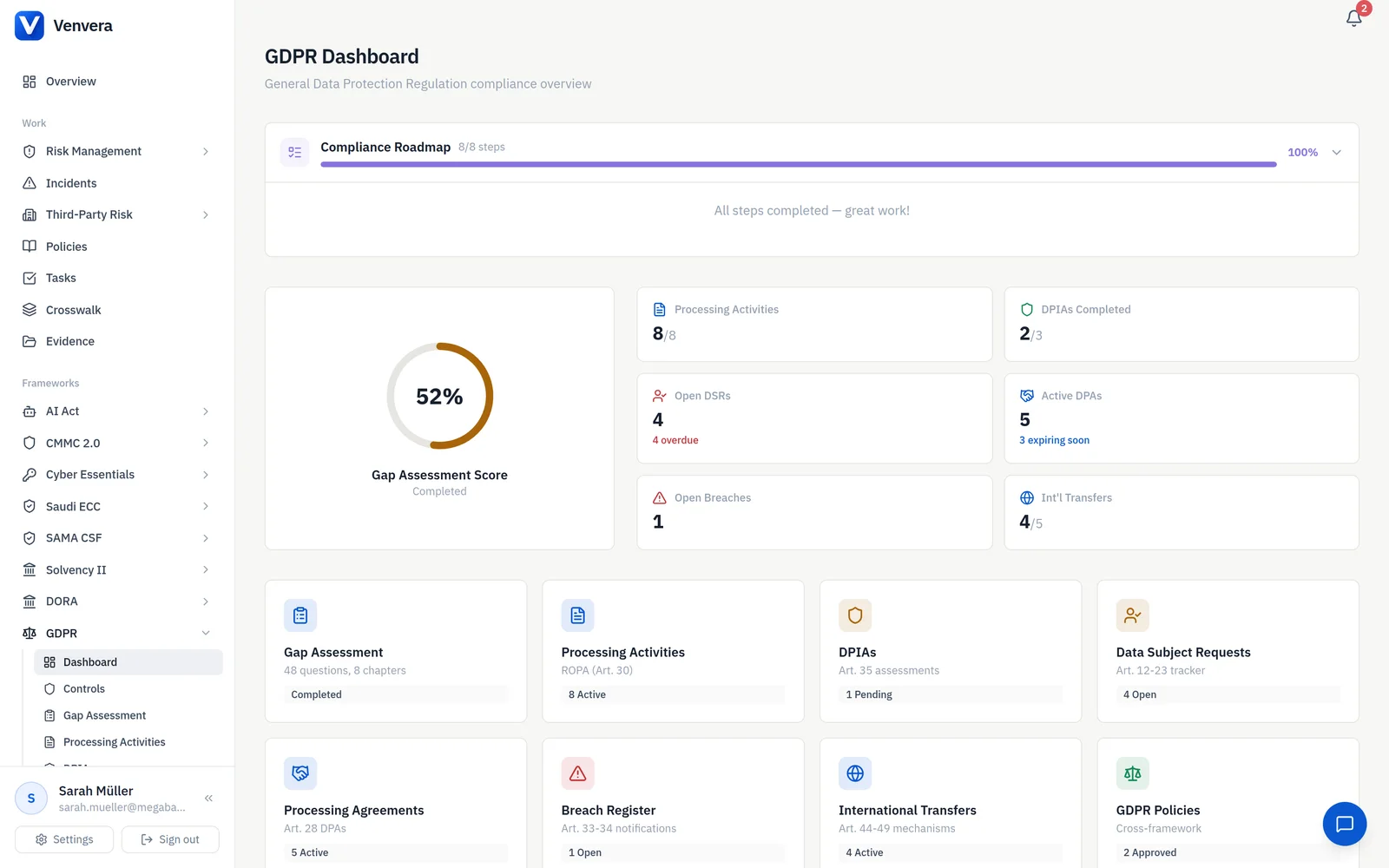
The Excel file is a strong starting point, but a spreadsheet goes stale the moment your processing changes. In Venvera, the same work becomes a live GDPR framework where each obligation is tracked continuously, evidence is attached once and reused across other frameworks you run, and status stays current instead of decaying between reviews. If you are weighing tools, this is also where teams look at an alternative to Vanta for GDPR compliance. Plans start from EUR 399/month. The checklist stays useful either way: it is a clean way to understand the obligations before you decide how to operationalise them.
Frequently Asked Questions
Is this GDPR compliance checklist enough to make us compliant?
No single checklist makes you compliant. This file gives you a structured, article-referenced view of the GDPR obligations and a place to record evidence, which is the fastest way to find your gaps. Compliance comes from actually meeting each obligation and being able to demonstrate it, which is what the evidence column is for.
Does the checklist replace a RoPA or a DPIA?
No. The checklist tracks whether those artefacts exist and are current, but it does not contain them. Use the dedicated RoPA template to build your Record of Processing Activities under Article 30, and the DPIA template for high-risk processing under Article 35.
How often should we update the GDPR compliance checklist?
Review it at least quarterly, and update it immediately whenever you launch a new product, add a vendor, or start a new international transfer. Your processing activities change more often than the Regulation does, so a checklist that is only touched once a year quickly stops reflecting reality.
Who should own the GDPR compliance checklist?
A single accountable owner, usually the Data Protection Officer or the compliance lead, should own the whole file, while individual groups are delegated to the teams that run them. That keeps one person responsible for the overall picture while the people closest to each obligation supply the evidence.