
Best
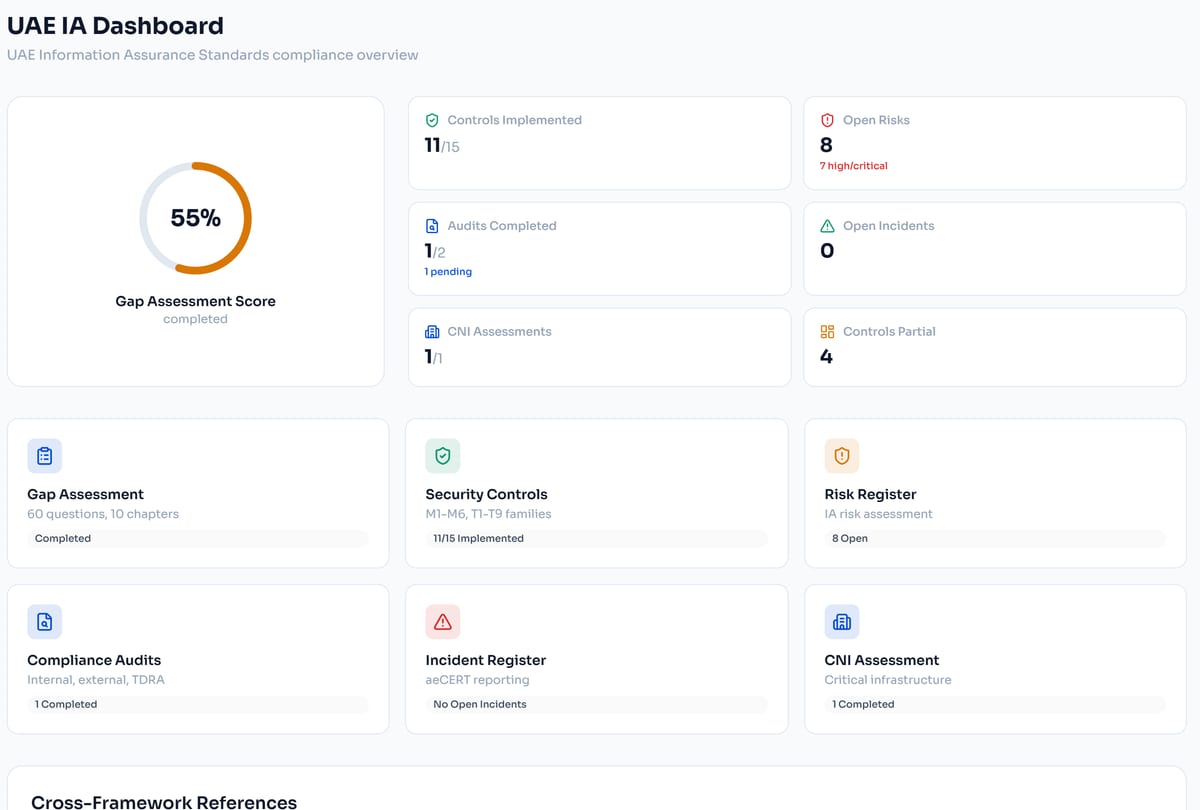
The UAE IA checklist is a free Excel workbook that walks you through the UAE Information Assurance controls so you can see exactly where you stand before an audit or self-assessment. If you run security or compliance for a UAE government entity or an operator of critical national infrastructure, this UAE IA checklist gives you a structured place to record the status, evidence and owner of every control. The Information Assurance Standards are overseen by the Telecommunications and Digital Government Regulatory Authority (TDRA) alongside the UAE Cyber Security Council, having originally been published by the National Electronic Security Authority (NESA), and they are mandatory in scope. This resource does not replace the standard itself. It gives you a working sheet to plan, sequence and track your implementation, control by control. You can download it below and start filling it in today.
Free download
Get the UAE Information Assurance Checklist
Every control of UAE IA Standard v2 with its priority and applicability, ready to record status, evidence and owner. 134 items.
What the UAE Information Assurance Checklist covers
The workbook contains all 134 controls of UAE Information Assurance Standard v2, each under its real reference from M1.1.1 through to T9.2.1. Those controls sit in 15 families and 47 sub-families, split into six management families (M1 to M6) covering governance, risk, training, human resources, compliance and performance evaluation, and nine technical families (T1 to T9) covering assets, physical security, operations, networks, access, third parties, development, incidents and continuity.
Two things are carried alongside every control. The first is applicability: 70 of the 134 controls are always applicable and cannot be scoped out, while the remaining 64 are selected by risk, and each exclusion needs a justification in your Statement of Applicability. The second is priority, which sets the intended order of work: 39 controls are P1, 60 are P2, 24 are P3 and 11 are P4.
For each of the 134 controls you get columns to record:
- The control reference and its title as the standard states them
- Its priority level, from P1 to P4
- Whether it is always applicable or selected by risk
- What good evidence looks like for that specific control
- Current status, for example not started, in progress, or met
- Evidence: where the proof of the control lives
- Owner: the person accountable for closing it
That structure turns a dense standard into something you can actually work through, review in a meeting, and hand to an assessor without reformatting it first.
On effort: the Management controls are mostly writing and sign-off, which is slow but predictable. The Technical controls are where you find out that the answer depends on three teams and a supplier, so start that half early. Reading and sorting the sheet is a day. Getting to honest statuses across both halves is a quarter.
UAE Information Assurance the honest way: what actually matters
A checklist is only useful if you understand what the standard is asking for. Four things matter more than the rest.
Scope. The Information Assurance Standards are mandatory for UAE government entities and for operators of critical national infrastructure. If you fall into either group, compliance is an obligation you carry today. The scoping question that causes the most friction is outsourced systems. Where a supplier runs a system for you, the control still has to be evidenced, and suppliers are rarely ready to hand over proof on your timetable. Get the evidence expectation into the contract before you need it, because asking after an assessment is booked puts you at the back of their queue.
Structure. The controls split into Management controls and Technical controls. Management controls set the direction: governance, risk management, policy, and the human side of security. Technical controls implement that direction inside the systems and networks themselves. Both halves have to move together. Strong technical controls with no governance behind them will not satisfy an assessor, and well-written policy with no technical enforcement is just paper.
Priority. Every control carries a priority from P1 to P4. This is the single most useful design feature of the standard, because it tells you the intended order of work. Working strictly by priority stops teams from polishing low-priority items while a P1 gap sits open. When you use the UAE IA checklist, sort by priority and let it drive your sequence. The friction arrives when a P1 control needs budget you do not have this year. Write that down in the sheet with a date and a named owner rather than quietly reclassifying it. An open P1 with a plan against it is a defensible position; an open P1 nobody has recorded is the one that hurts in an assessment.
Version. This checklist follows Standard v2, the 134-control edition. Confirm the applicable version for your sector before you rely on any control list, including this one. Different sectors and regulators can point to different editions, and you want to be assessed against the right one. This sounds like a formality and takes an email, so do it first. Building a programme against the wrong edition is the kind of error that only surfaces when someone senior asks a simple question in front of an assessor.

How to use the UAE Information Assurance Checklist
- Confirm the version of the UAE Information Assurance Standards that applies to your entity and sector, then read the checklist against it.
- Assign an owner to every control. A control with no owner never gets closed. Name individuals; a team name in that column is how a control sits unclaimed for a year.
- Filter by priority and start with P1. Record the current status of each item honestly, even where the honest answer is not started.
- For every control you mark as met, link the evidence in the evidence column. If you cannot point to evidence, it is not met.
- Review the sheet on a fixed cadence with the owners, moving items forward and re-checking that the evidence you cited is still current.
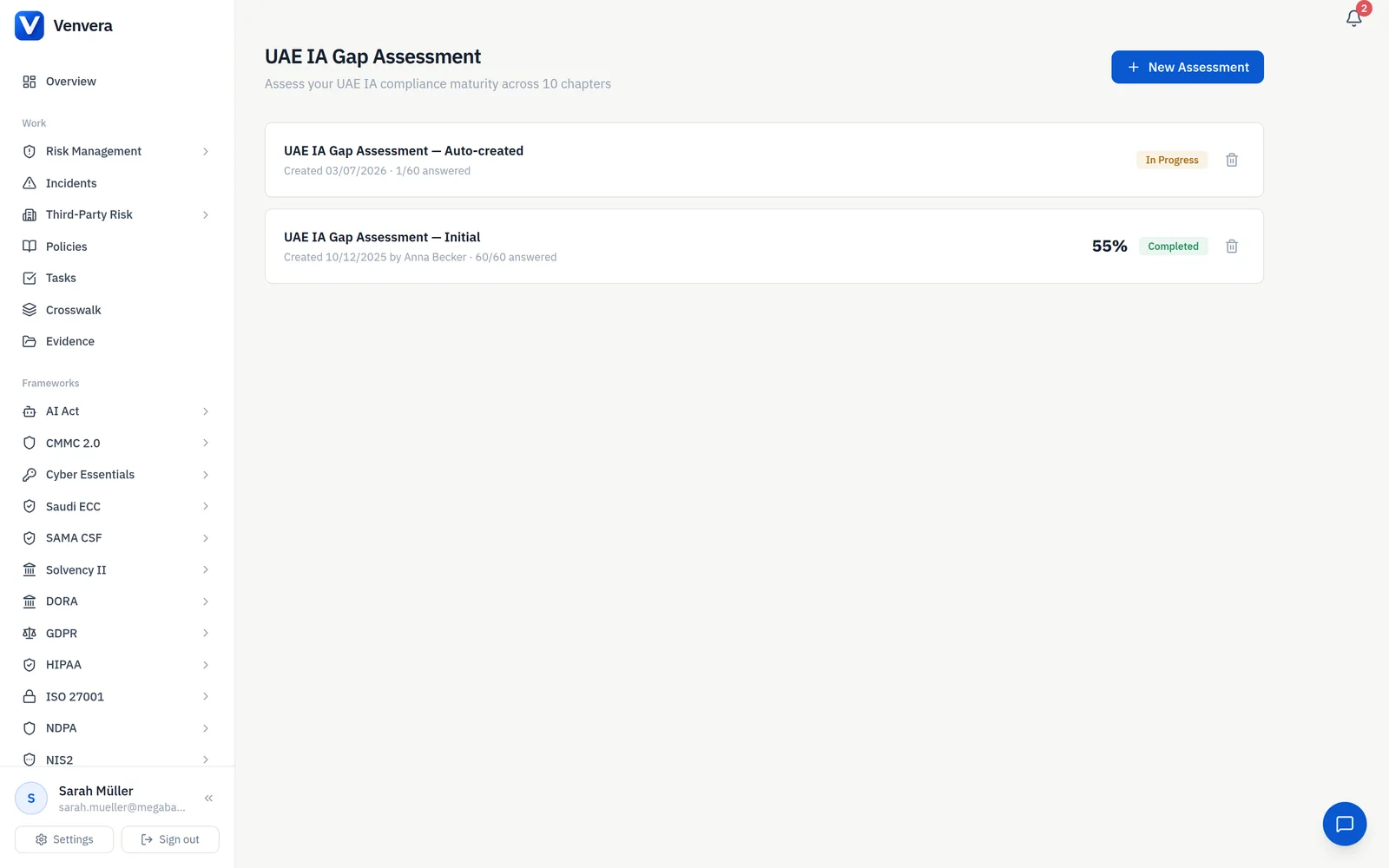
Do this automatically in Venvera
If your policies are written in Arabic while your evidence comes out of systems in English, running bilingual policies and evidence for Gulf regulators explains which language has to bind and what genuinely needs translating.
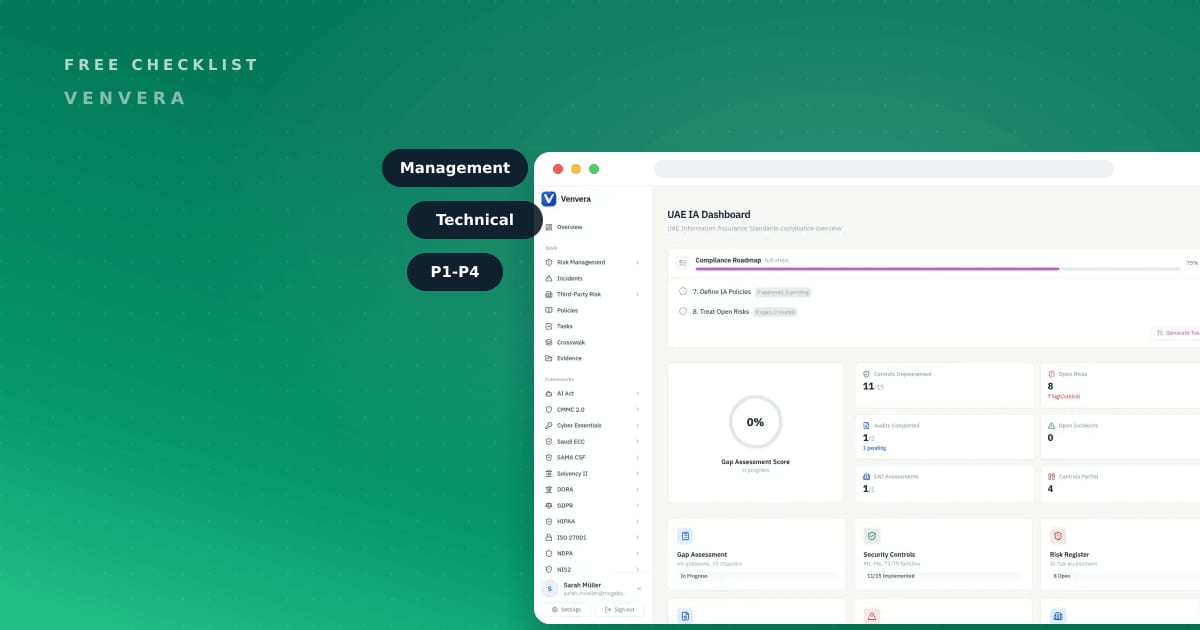
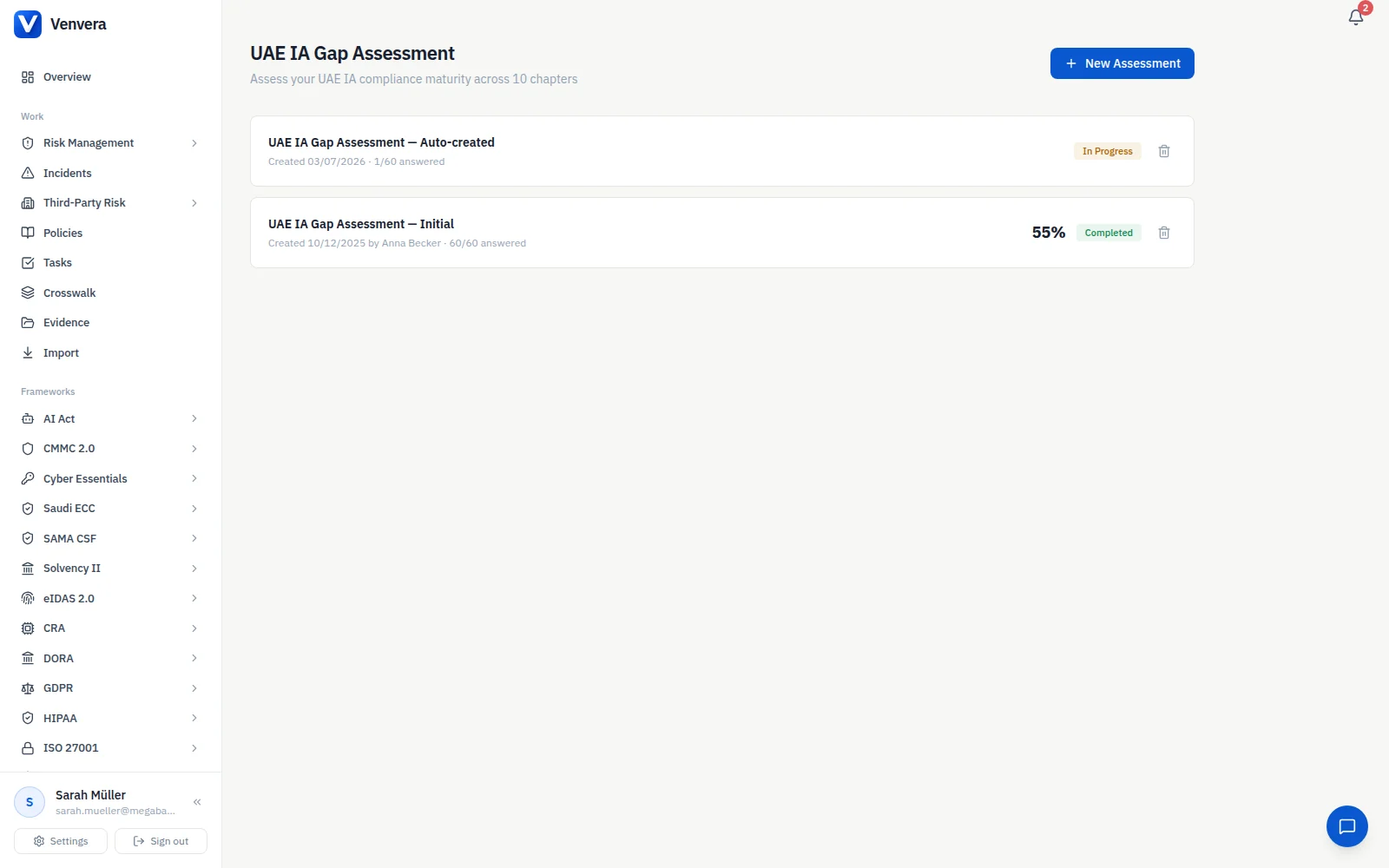
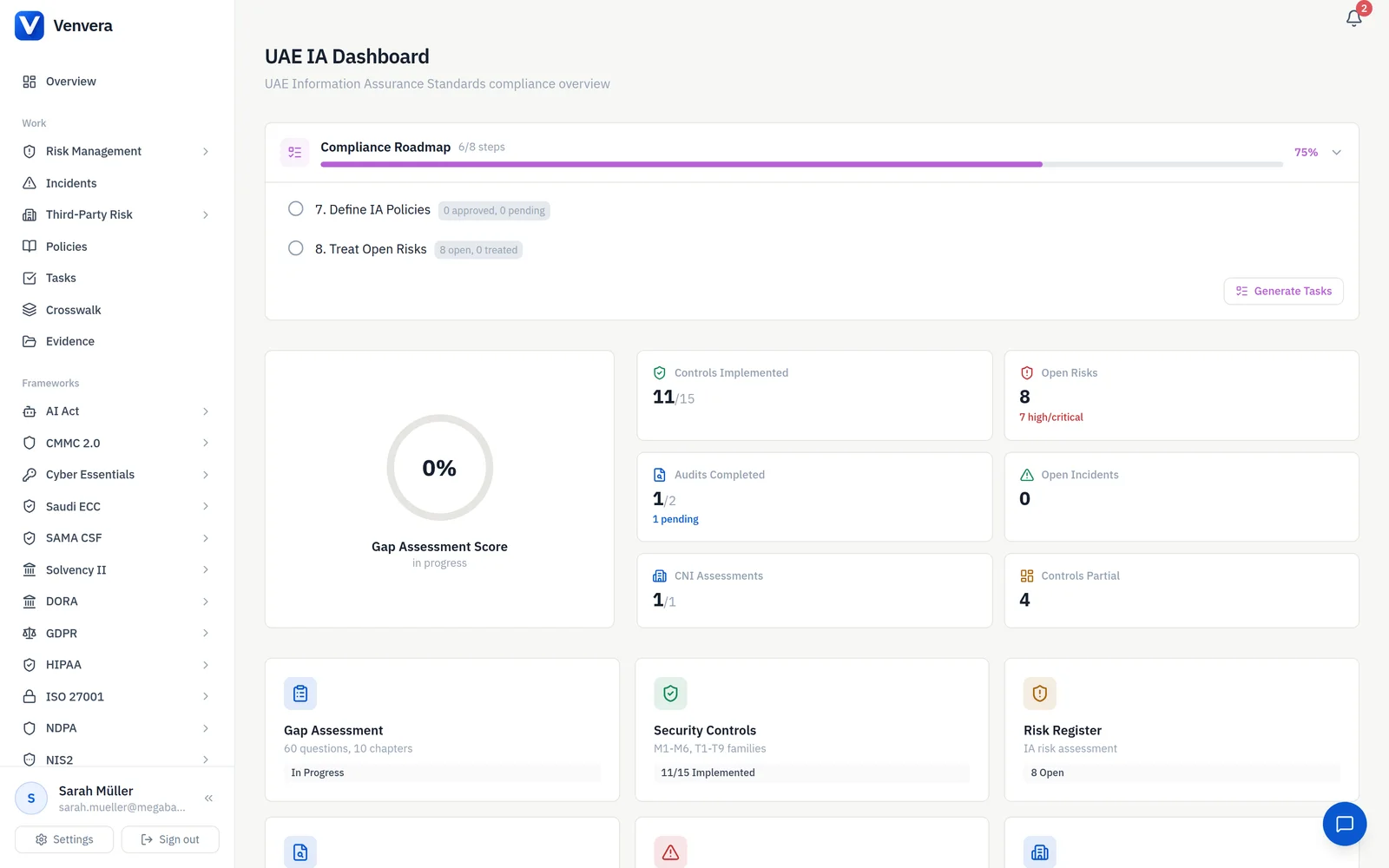
A spreadsheet is a good way to start, but it goes stale the moment you close it. Owners change, evidence expires, and no one is told. In Venvera the same UAE Information Assurance controls live in a system that tracks status, owner and evidence for you, keeps the P1 to P4 priority levels in view, and reuses evidence you have already collected across your other frameworks instead of asking for it again. You can see the mapped control set on the UAE IA framework page. Venvera starts from EUR 399/month, and the checklist you download here maps cleanly onto it when you are ready to move off the spreadsheet.
Frequently Asked Questions
Who must comply with the UAE Information Assurance Standards?
The standards are mandatory for UAE government entities and for operators of critical national infrastructure, and they are overseen by TDRA alongside the UAE Cyber Security Council, having originally been published by NESA. If your organisation sits in either category, treat compliance as a requirement rather than a choice, and confirm the version that applies to your sector.
What is the difference between Management and Technical controls?
The UAE Information Assurance controls are organised into two groups. The six management families (M1 to M6, 47 controls) cover governance, policy and process, meaning how security is directed and overseen. The nine technical families (T1 to T9, 87 controls) cover the safeguards implemented in systems and networks. Both groups are in scope, and the checklist includes every control from each.
What do the P1 to P4 priority levels mean?
Each control carries a priority level from P1 to P4 so that entities can sequence implementation by priority. In Standard v2 that works out as 39 P1 controls, 60 P2, 24 P3 and 11 P4, totalling 134. Higher-priority controls are the ones to address first. The checklist keeps each item's priority visible so you can plan the order of work instead of treating every control as equally urgent.
Is this checklist the official standard?
No. It is a free working tool to help you plan and track your implementation. It does not replace the UAE Information Assurance Standards themselves, and you should always confirm the applicable version of the standard for your sector as the authoritative source.