Learn
The Solvency II ORSA checklist below is a free Excel tool for insurers and reinsurers that need to test their System of Governance and Own Risk and Solvency Assessment against Pillar 2. If you are a compliance lead, risk officer, or actuary trying to turn the qualitative pillar into something you can actually work through, this Solvency II ORSA checklist gives you 45 concrete items instead of a blank page. Solvency II deliberately prescribes no ORSA template, which is helpful in principle and painful in practice: you are left to structure the assessment yourself. This resource does that structuring for you, mapping the governance and ORSA requirements into a single worksheet you can score, assign, and evidence. Download it below, then read on for how the requirements really fit together.
Free download
Get the Solvency II Pillar 2 Governance Checklist
Assess your System of Governance and ORSA process against Solvency II Pillar 2. 45 items.
What the Solvency II Pillar 2 Governance Checklist covers
The file is a single Excel worksheet with 45 items, each written as a plain requirement you can answer yes, partial, or no. It is organised into two blocks that mirror how Pillar 2 is actually built. The requirements behind each item are set out in our guide to Solvency II Pillar 2 requirements.
The first block covers the System of Governance: the effective, proportionate governance arrangements Solvency II expects, and the four key functions that sit inside them - risk management, compliance, actuarial, and internal audit. Each function gets its own items, so you can see, function by function, whether it exists, is resourced, is independent where it needs to be, and produces the outputs the business relies on.
The second block covers the ORSA process: how your firm runs its own forward-looking assessment of its risks and solvency needs, from trigger and scope through to board challenge and use in decisions.
Pay attention to those last three words. Producing an ORSA document is the straightforward half; showing that it changed a decision is the item firms answer most weakly. If your board minutes record the ORSA being noted and nothing more, that is the gap to work on, and it takes a full cycle to fix because you cannot backdate a discussion.
Alongside every item you get columns for status, owner, evidence reference, and notes, so the checklist doubles as a working record rather than a one-off tick sheet. It follows the Solvency II Directive and EIOPA guidelines, and it does not hand you a mandated ORSA form, because none exists.
Solvency II the honest way: what actually matters
Solvency II has three pillars. Pillar 1 is quantitative capital, Pillar 3 is reporting and disclosure, and Pillar 2 is the qualitative pillar: it is about how the firm is run and how it thinks about its own risk. This checklist lives entirely in Pillar 2.
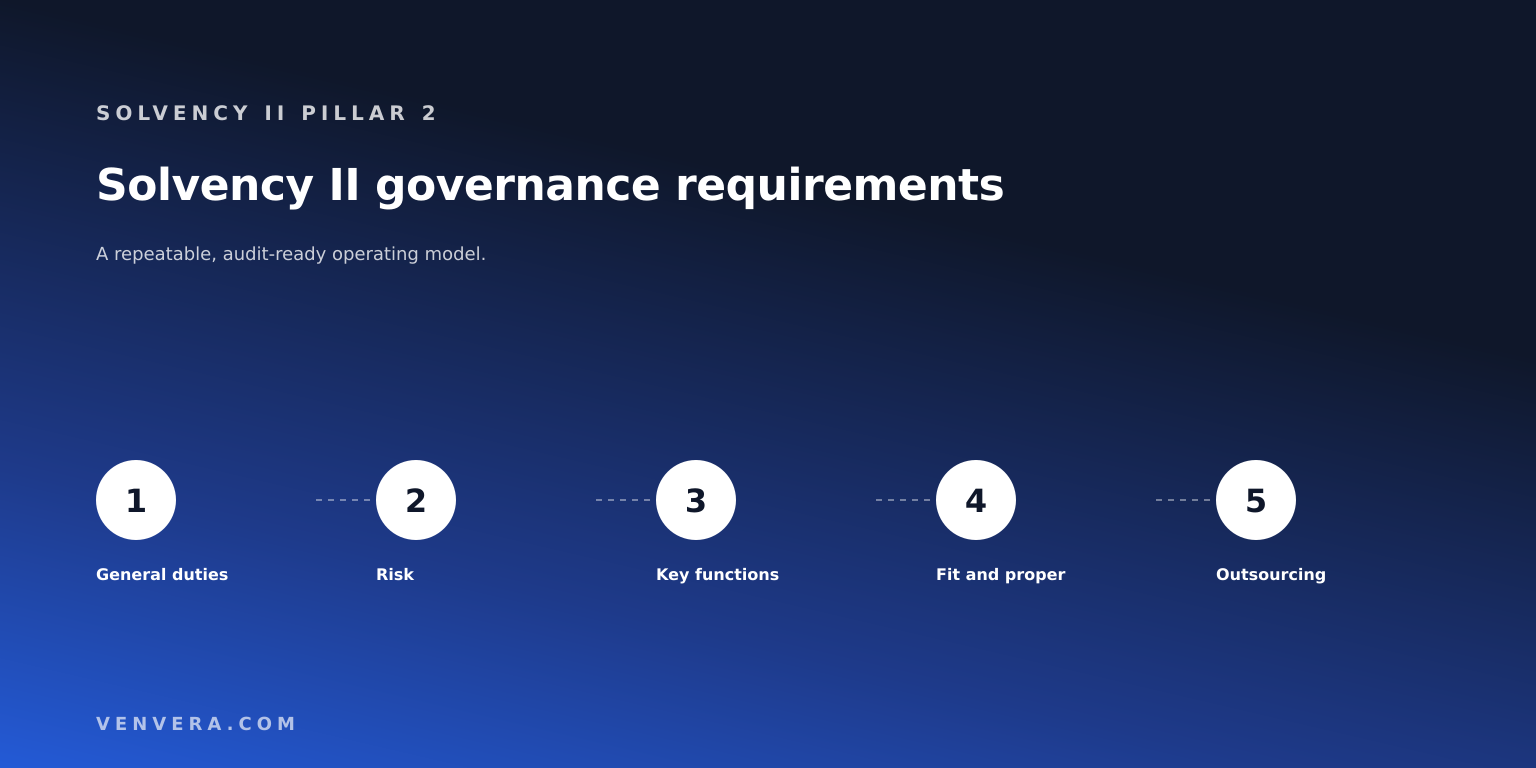
Two obligations sit at the centre of it. The first is an effective System of Governance. Solvency II expects insurers and reinsurers to operate sound, proportionate governance and to maintain four key functions: risk management, compliance, actuarial, and internal audit. These are not job titles you can leave blank on an org chart. Each function has to exist in substance, be adequately resourced, and be independent enough to do its job.
Independence is where smaller firms get uncomfortable, because one person often wears more than one of those hats. Proportionality can make that workable, but you have to argue it deliberately and write the reasoning down before anyone asks. Combining functions and hoping the question never comes is a different thing entirely, and it is usually visible from the org chart.
The second is the Own Risk and Solvency Assessment, or ORSA: your firm's own forward-looking assessment of its risks and solvency needs. The ORSA is where governance stops being a paperwork exercise and starts driving decisions. It asks whether, given your actual risk profile and your business plan, you will stay solvent, and what you would do if you were not.
Here is the part people find frustrating, and it is deliberate: there is no prescribed ORSA template. Solvency II and the EIOPA guidelines describe what the assessment must achieve. That freedom is the point, because no single form fits every firm's risk profile. But it means you need a structuring aid, not a template, something that reminds you of every requirement without pretending the regulator issued a form. That is exactly what a good Solvency II ORSA checklist is for.
Since it is worth stating a view: the absence of a template is the right call and the most disliked feature of Pillar 2. A prescribed form would turn the ORSA into a filing exercise within a cycle or two, and firms would optimise for the form. The cost falls on smaller insurers, who have the least capacity to design an assessment from scratch and carry the heaviest share of the drafting. Proportionality is supposed to answer that, and in practice it moves the argument from what to write to how much is enough.

How to use the Solvency II ORSA checklist
Scoring the sheet is half a day with the right people in the room. The chasing afterwards is the real timeline, because most partial answers belong to a key function that is already stretched and the evidence lives in someone else's committee pack. Book the follow-ups in the same meeting where you score.
- Set your scope. Confirm which legal entity or group the assessment covers, and note the reporting period at the top of the sheet.
- Assign an owner to each item. Governance items usually belong to the relevant key function; ORSA items belong to whoever runs the process. An item without an owner will not get answered.
- Score honestly. Mark each of the 45 items yes, partial, or no. Resist the urge to round partial up to yes, because the gaps are the whole reason you are doing this. Partial is the most informative answer on the sheet and the one people avoid, since it invites a follow-up question. Invite the question.
- Attach evidence. For every yes, drop a link or document reference in the evidence column. A yes with no evidence is merely a claim.
- Turn the no and partial rows into actions. Give each one an owner and a date, and track them to closure.
- Re-run it before each ORSA cycle and after any material change to your business or risk profile, so the picture stays current.
Do this automatically in Venvera
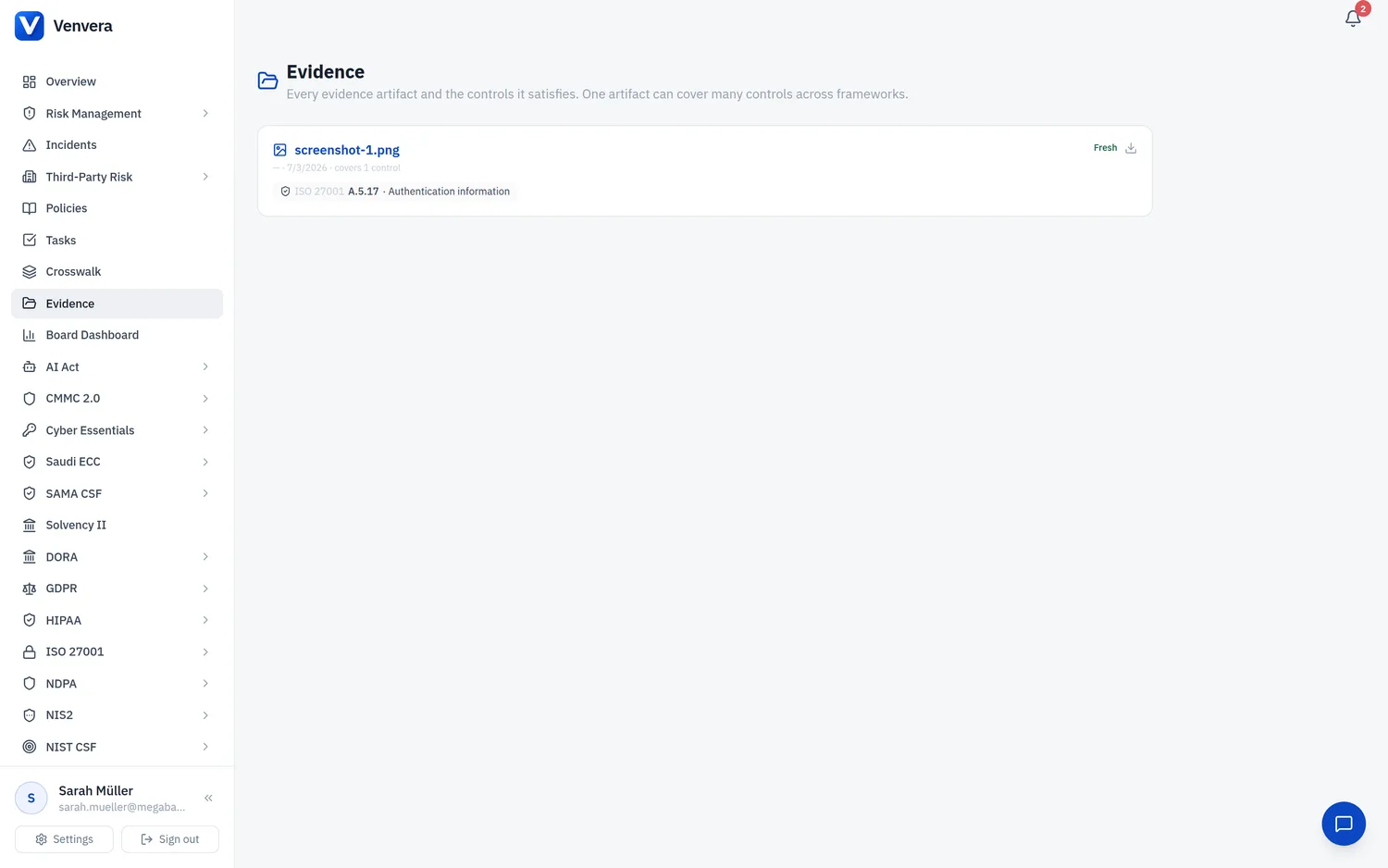
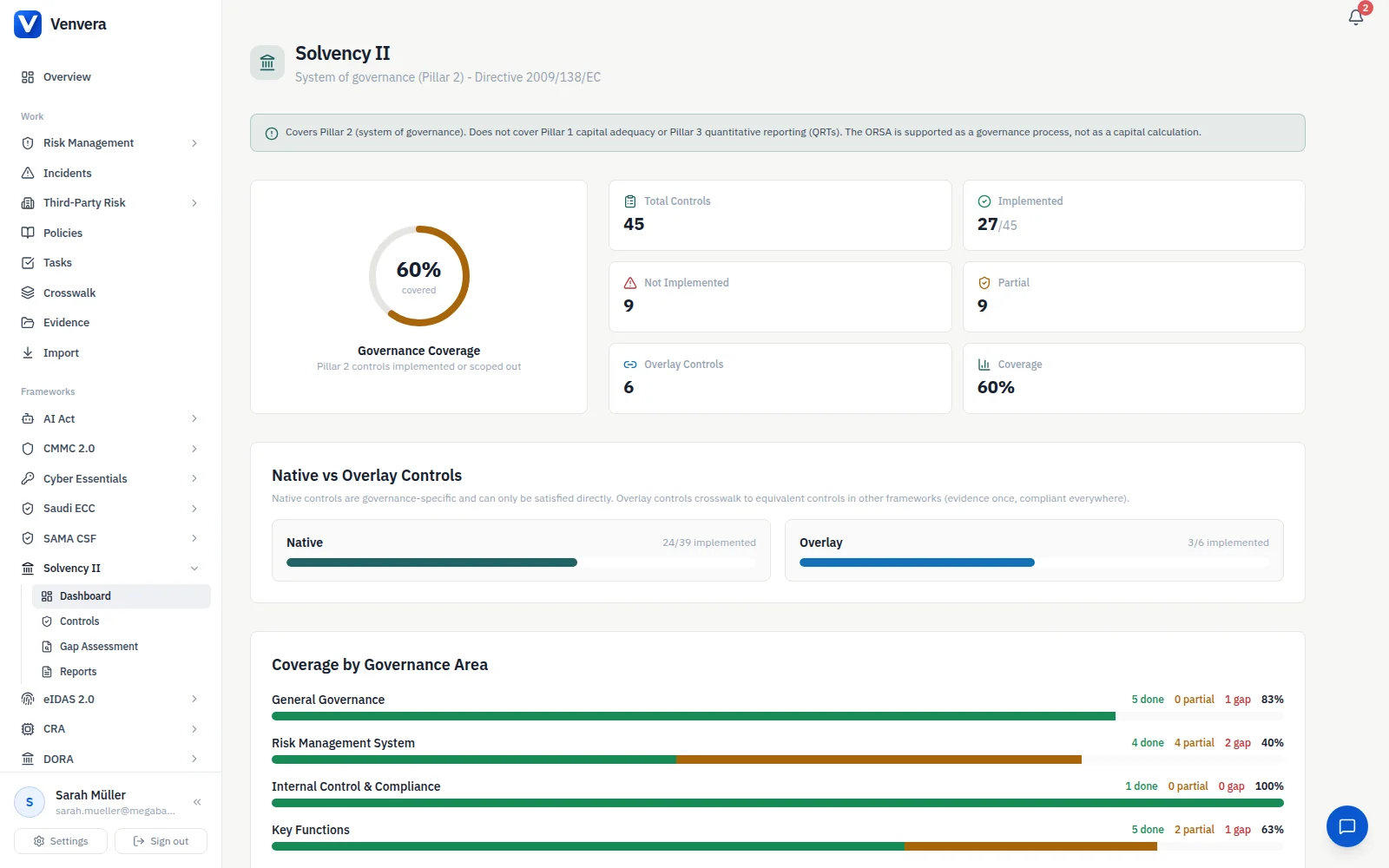
A spreadsheet is a good starting point, but it is a snapshot: the moment you close the file it begins going stale, and every answer lives apart from the evidence that proves it. In Venvera's Solvency II framework the same governance and ORSA requirements become live controls with owners, due dates, and attached evidence, so your assessment stays current instead of being rebuilt from scratch each cycle. Because evidence is stored once, a control you satisfy for Solvency II Pillar 2 can be reused wherever another framework asks for the same proof, instead of being gathered twice. Plans start from EUR 399/month. The checklist below still earns its place: use it to learn the requirements and to run a fast first pass before you commit to anything.
Frequently Asked Questions
Is there an official Solvency II ORSA template?
No. Solvency II and the EIOPA guidelines describe what the Own Risk and Solvency Assessment must achieve, but deliberately prescribe no template or form. That is why a structuring aid like this checklist is useful: it walks you through the requirements without pretending a mandated form exists.
Who is this Solvency II ORSA checklist for?
Insurers and reinsurers in scope of Solvency II, and the people who run Pillar 2 inside them: compliance leads, risk officers, actuaries, and internal audit. It is written to be worked through by the key functions themselves.
What is the difference between the System of Governance and the ORSA?
The System of Governance is the standing structure, effective governance plus the four key functions of risk management, compliance, actuarial, and internal audit. The ORSA is the forward-looking assessment those functions produce, testing whether the firm will stay solvent given its real risk profile and plans. The checklist covers both.
Does this cover Pillar 1 or Pillar 3?
No. This checklist is Pillar 2 only, the qualitative pillar covering the System of Governance and the ORSA. Pillar 1, quantitative capital, and Pillar 3, reporting and disclosure, are out of scope here.