

Features
A company becomes multi-jurisdictional the moment two regulators can ask it the same question and expect different paperwork. That happens in two shapes. One legal entity can answer to several regimes at once, as a Frankfurt payment institution does under DORA, NIS2, GDPR and ISO 27001. Or a group can hold several entities, each with its own regulator, as a holding company does with a bank in Germany, an insurer in France and a fintech in Dubai. Venvera is built for both, and this page shows exactly how, with the parts that are tier-gated named as such.
The short version: one control set proves a requirement once and counts it in every regime that asks for it, each legal entity keeps its own registers, evidence and audit trail, and the platform produces the artefact each regulator actually collects rather than a generic report. If you are still comparing tools rather than looking at ours, the multi-jurisdictional compliance software buyer guide scores the category on those same three tests.
What multi-jurisdictional actually means in software terms
Most compliance tools were built for one company answering to one regime, usually SOC 2 or ISO 27001. They break in predictable places once a second jurisdiction arrives, and the breakage is structural rather than cosmetic.
| The moment it breaks | What a single-jurisdiction tool does | What the work actually needs |
|---|---|---|
| A second framework arrives | A second checklist, separately evidenced | The same control counted in both, proved once |
| A second legal entity arrives | A second tenant, or one shared pile of evidence | Separate registers and audit trails, one group standard |
| The regulator asks for a filing | Export to spreadsheet, reformat by hand | The regulator's own template, generated |
| An incident happens in two regimes | One incident record, one clock | One record, each authority's clock counted separately |
| The board asks about the group | A report per entity, merged manually | Group roll-up with per-entity drill-down |
| Staff do not read English | English only | The interface in the language people work in |
Twenty frameworks, four regions, one control library
Coverage is the part buyers check first, and it is the easiest to verify. Venvera runs twenty frameworks, and a control you implement for one is mapped to every requirement it satisfies in the others. Every framework below has its own page explaining scope and what the platform does for it.
| Region | Frameworks | What the region adds |
|---|---|---|
| European Union | DORA, NIS2, GDPR, EU AI Act, eIDAS 2.0, Cyber Resilience Act, MiCA, Solvency II | Short statutory clocks, named management-body liability, prescribed filings |
| United Kingdom and global standards | Cyber Essentials, ISO 27001, PCI DSS v4 | Certification cycles and surveillance audits on fixed calendars |
| United States | SOC 2, NIST CSF 2.0, NIST SP 800-53, HIPAA, CMMC 2.0 | Observation periods, attestations and supplier flow-down |
| Gulf | SAMA CSF, Saudi NCA ECC, UAE IA | Maturity self-assessment, regulator portals, Arabic-language work |
| Africa | Nigeria NDPA | An annual audit return filed through a licensed compliance organisation |
The economics of that list matter more than its length. A company running ISO 27001 and adding DORA does not start again, because the supplier, access, logging and continuity controls already exist and are simply mapped to the new articles. The second regime is mostly evidence you already hold, which is why the control crosswalk is the first thing to look at rather than the framework count.
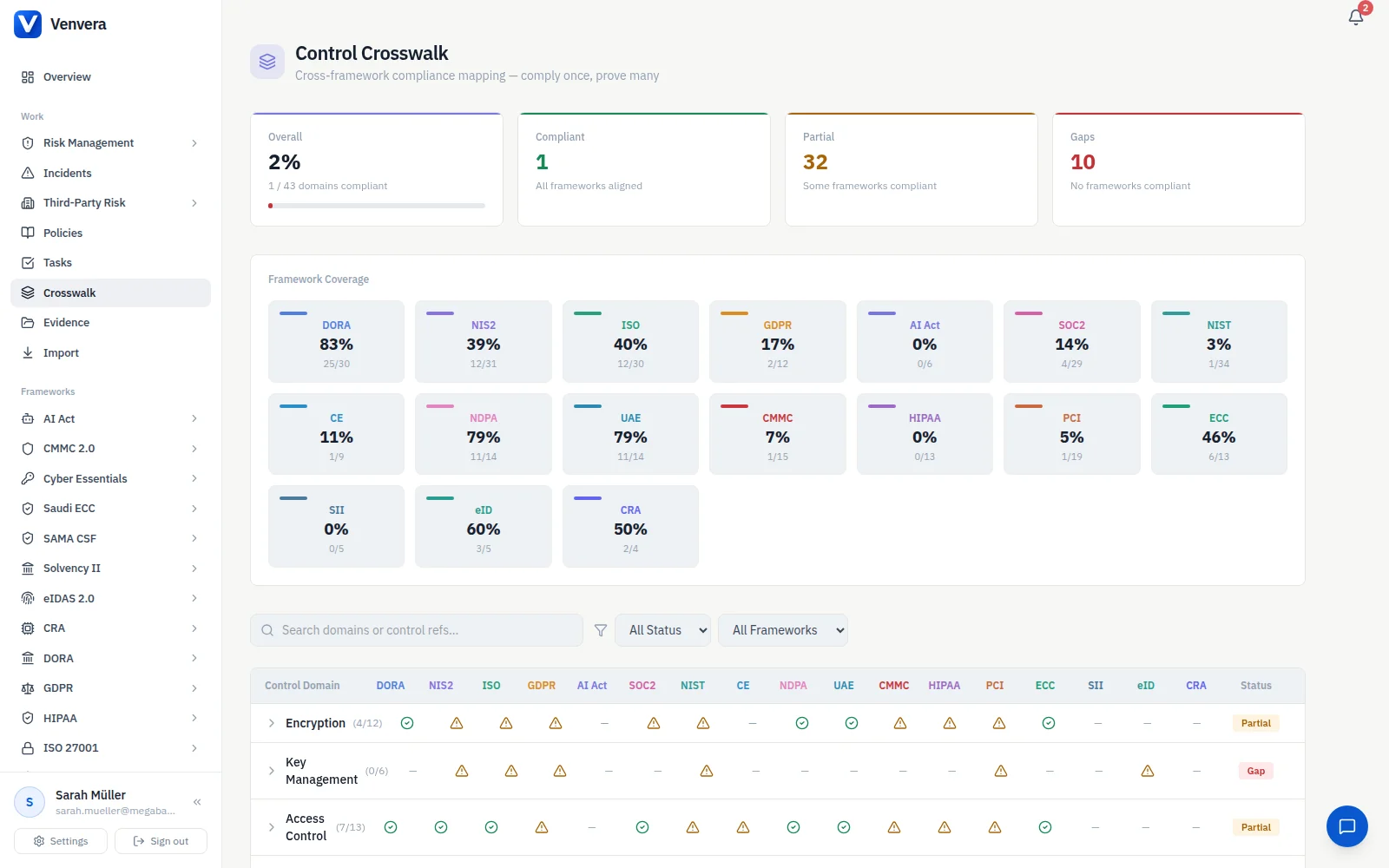
One control proven once, counted in every jurisdiction
Take supplier oversight, the requirement every regime words differently. ISO 27001 Annex A 5.19 wants information security in supplier relationships. DORA Article 28 wants a register of information with the arrangements that support critical or important functions flagged. NIS2 Article 21(2)(d) wants supply chain security including direct suppliers. SOC 2 CC9.2 wants vendor risk assessed. Saudi ECC and UAE IA both want third-party requirements set and monitored.
In Venvera that is one control with one owner and one evidence set. Attach the due diligence file and the contract clause check once, and the matching requirement closes in each framework the organisation runs. The third-party risk module holds the vendor record behind it, so the same provider feeds the DORA register, the NIS2 supply chain measure and the SOC 2 vendor review without being entered three times.
The test to run on any platform, ours included: add a second framework to a tenant that already has one, and see how many controls are already green before anyone uploads anything. If the answer is none, the tool is running two checklists side by side rather than one control set. The public crosswalk explorer lets you compare any two frameworks before you sign up for anything.
Company Groups: one standard, separate evidence per entity
A group has a problem a single company does not: the parent wants one standard, and each subsidiary needs its own defensible record. Those pull in opposite directions, and most tools resolve them badly, either by giving every entity its own disconnected tenant or by pooling everything into one.
Venvera's answer is Company Groups. Policies authored in the parent tenant are shared down to every member, so the group runs to one written standard. Everything else stays per entity: each subsidiary keeps its own registers, its own evidence, its own audit trail and its own regulator-facing output. Cross-entity access is read-only by design, and writes remain isolated to the entity that owns them, which is what keeps a German bank's evidence out of a UAE fintech's audit file. The guide to compliance software for groups of companies walks through the structures this fits, from holding companies to private equity portfolios.
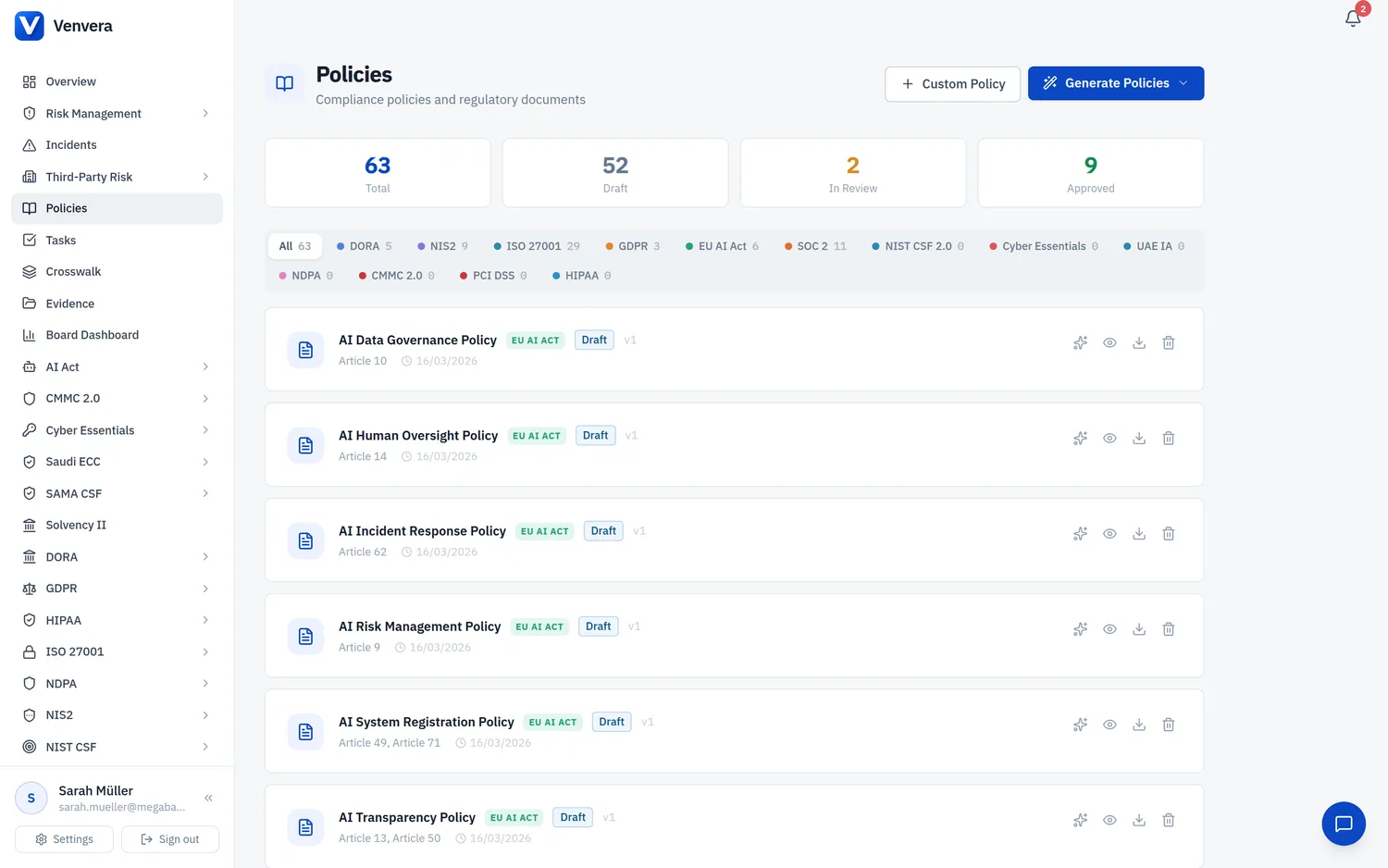
Framework choice is per entity rather than per group, which matters when the subsidiaries are not alike. A Dublin insurer needs Solvency II and DORA; a Riyadh subsidiary needs SAMA CSF and ECC; the Nigerian arm needs the NDPA. On Basic and Professional each tenant picks two or five frameworks, and Enterprise sets the count per entity.
Each regulator wants its own artefact, not a generic report
This is where multi-jurisdiction work is actually lost. Having the evidence is not the same as being able to file it. Supervisors collect specific things in specific formats, and a tool that only produces a PDF summary leaves the last mile to a person with a spreadsheet.
| Regime | What the regulator collects | What the platform produces |
|---|---|---|
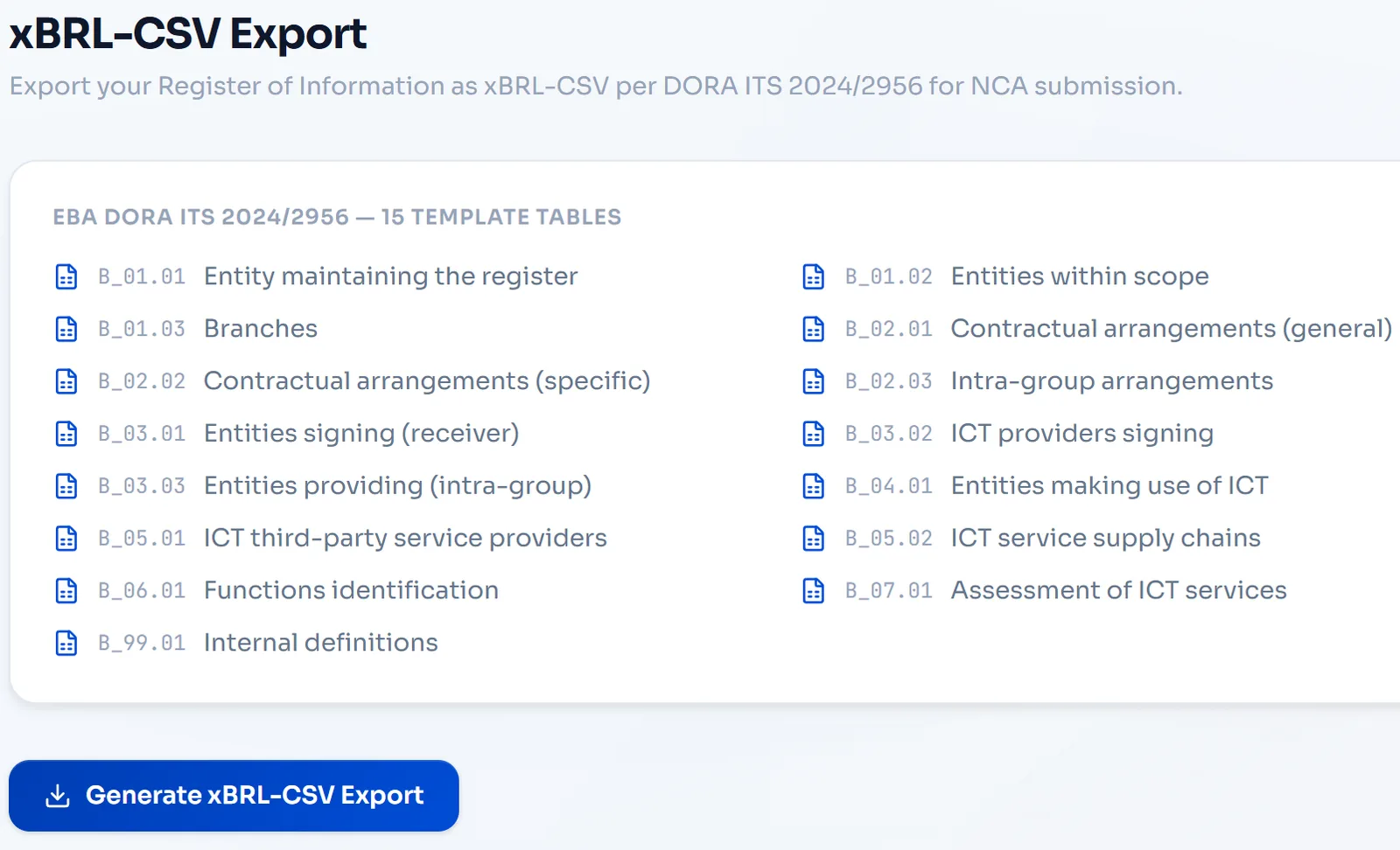
| DORA | The register of information in the ESA template, filed through the national competent authority | xBRL-CSV export of the register, built from the provider and contract records |
| DORA, NIS2, GDPR | Incident notifications on different clocks from different trigger points | One incident record, each deadline counted separately, authority-ready reports from incident management |
| NIS2, DORA | Evidence that the management body approved and understood the measures | The board dashboard with per-officer approval and liability tracking |
| Nigeria NDPA | An annual compliance audit return, filed by 31 March | The obligation scheduled with its owner, its legal basis and its task |
| SAMA, NCA ECC, UAE IA | Maturity and control self-assessments against the local catalogue | Per-framework assessment with evidence attached to each control |
| ISO 27001, SOC 2 | Auditor access to the record, the evidence and the change log | A time-boxed read-only auditor login and generated reports |
The incident clocks deserve a note, because they are the most common place a multi-jurisdiction programme gets caught out. They do not start at the same moment. DORA runs four hours from classifying an incident as major and no later than twenty-four hours from becoming aware of it. NIS2 runs twenty-four hours from awareness. GDPR runs seventy-two hours from awareness. One event, three different countdowns, which is why the deadlines are tabulated by regulation and counted per authority rather than once.
The obligations calendar, across jurisdictions
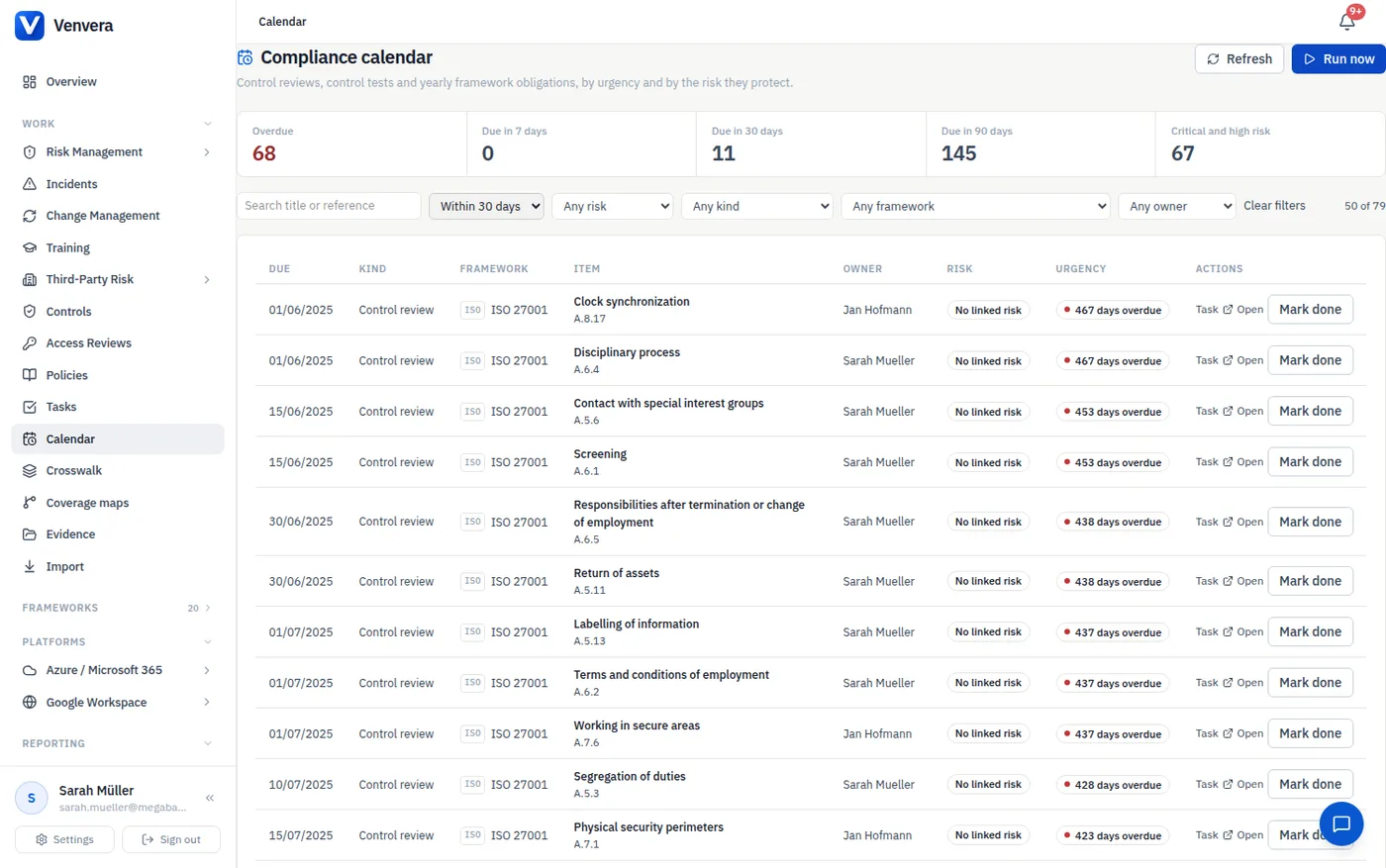
Multi-jurisdiction work is mostly calendar work: yearly filings, periodic reassessments, certification cycles and control reviews, each with its own date and its own legal basis. Venvera ships a catalogue of sixty-seven recurring obligations across the twenty frameworks and schedules the ones that apply to your organisation, with an owner, a task and a reminder.
- Fixed national deadlines are anchored to their date, such as the NDPA audit return and most DORA register filings falling on 31 March.
- Cadenced obligations repeat from the day you complete them, such as the ISO 27001 internal audit and management review, or PCI DSS quarterly scans.
- Control reviews and control tests sit on the same calendar, so the yearly filing and the evidence behind it are not tracked in different places.
- Everything can be filtered by urgency and by the risk the control protects, which is how a group decides what to do first across entities.
Language, data residency and who can see what
A multi-jurisdiction programme fails quietly when the people who own controls cannot use the tool. The interface runs in English, German, Spanish, Bulgarian, Arabic and Chinese, with right-to-left layout for Arabic, which matters for Gulf entities where the control owner and the group compliance lead do not share a working language.
The platform is hosted in Amsterdam on infrastructure in the European Union, with per-tenant encryption and separate master keys, and the security page sets out the detail. Data residency is a feature of where we host rather than a statement about who our customers are: the same platform serves entities regulated in the Gulf, in Nigeria and in the United States.
What it does not do
A page like this is worth more with the limits stated, and these are the ones that come up in multi-jurisdiction evaluations.
- Regulatory update feeds are EU-weighted today. The daily feeds cover EBA, ESMA, ENISA, the ECB, the European Commission, the AI Office and EUR-Lex, plus BaFin, the CSSF and the AFM by country. There is no equivalent feed yet for SAMA, the NCA, the UAE or the NDPC, so those regimes are tracked through the obligations calendar rather than a live feed.
- Some capabilities are tier-gated. Evidence Autopilot, auto-computed key risk indicators, security awareness training and the xBRL-CSV register export are Professional and above. Sub-outsourcing chain mapping and concentration analytics are Enterprise.
- Company Groups share policies, not evidence. That is deliberate, because a subsidiary's audit file has to stand on its own, but it means a group cannot evidence a control once for every entity at the same time.
- Venvera records access, it does not grant it. Access reviews score and evidence entitlements; provisioning stays in your identity system.
- It is not a legal opinion. The platform tells you what each regime expects and tracks whether you did it. Whether a particular entity is in scope of a particular regime is a question for your counsel, and the framework pages say so.
How to test this on your own footprint
Three checks, none of which need a sales conversation. Use the crosswalk explorer to compare the two regimes you actually run and see the overlap before you buy anything. Run the free compliance check for a scored gap list in two minutes with no signup. Then start the fourteen-day trial with no card, connect one entity and add the second framework, and count how much of it was already green.
If you run several entities, ask for the group walkthrough rather than the standard demo. A fifteen-minute session on your own structure will tell you more than any feature list, and the buyer guide for multi-jurisdictional compliance software gives you the questions to ask us and everyone else.
Frequently asked questions
What is multi-jurisdictional compliance software?
Software that keeps one control set and one evidence library, maps them to every regulation the organisation answers to across countries, keeps a separate register and audit trail per legal entity, and produces what each regulator collects in its own template. The category guide covers how to score it across vendors.
Does Venvera work for a single company with several regulators?
Yes, and that is the more common case. One entity running DORA, NIS2, GDPR and ISO 27001 gets one control set with each control mapped to every article it satisfies, one evidence library, and one calendar carrying the obligations of all four.
How does it handle a group with subsidiaries in different countries?
Company Groups shares policies from a parent tenant to every member, while each entity keeps its own registers, evidence and audit trail, and chooses its own frameworks. Cross-entity access is read-only, so one subsidiary's evidence never lands in another's audit file.
Which regions are covered?
Europe, the United Kingdom, the United States, the Gulf and Africa: twenty frameworks in total, from DORA and NIS2 to SAMA CSF, Saudi NCA ECC, UAE IA and Nigeria's NDPA. The frameworks index lists each with its own page.
Can it file with the regulator?
It produces the artefact the regulator collects, such as the DORA register of information as xBRL-CSV in the ESA template, and the authority-ready incident report with the right clock. Submission itself happens on the supervisor's portal, because that is where filing is done.
What happens when the same incident is reportable in three regimes?
One incident record carries three separate deadlines, because the clocks start at different moments. The platform counts each one and generates the report each authority expects. The deadline table sets out which is which.
Is the platform available in languages other than English?
Yes: English, German, Spanish, Bulgarian, Arabic and Chinese, with right-to-left layout for Arabic. That matters when a control owner in Riyadh and a group compliance lead in Frankfurt work in the same system.
Where is the data held?
Amsterdam, on infrastructure in the European Union, with per-tenant encryption and separate master keys. Hosting location is a data residency feature, not a statement about which customers the platform serves.
Primary sources
- Regulation (EU) 2022/2554, DORA, Article 28 and the register of information
- Directive (EU) 2022/2555, NIS2, Articles 20, 21 and 23
- Regulation (EU) 2016/679, GDPR, Articles 30 and 33
- Nigeria Data Protection Commission, compliance audit returns
- Saudi National Cybersecurity Authority, Essential Cybersecurity Controls
- ISO/IEC 27001:2022, Annex A
Written by the Venvera compliance team. Capabilities described here are in the product today, with tier-gated features named. Checked in September 2026.