

Learn
The short answer
There is no single figure, because the Act does not price organisations, it prices roles and risk classes. A company that only uses general-purpose AI tools has an obligation measured in training and disclosure. A company that puts a high-risk system on the market carries conformity assessment, a technical file and a quality management system. The most expensive mistake is assuming you are in the second group before checking, because classification is the step that removes most of the cost for most companies.
On this page
- Why nobody can quote you one number
- Your role decides your cost before anything else
- What the money is actually spent on
- What the published estimates say, and where they came from
- The order that keeps the bill down
- Where budgets go wrong
- What non-compliance costs instead
- Doing this in Venvera
- Frequently asked questions
Why nobody can quote you one number
Search for EU AI Act compliance cost and you will find confident figures: fifty thousand euros per high-risk system, or a range from five thousand to half a million. Some of those numbers trace back to the European Commission's own impact assessment, some to consultancies with a service to sell, and a good many to blog posts citing other blog posts.
They are not wrong so much as unusable, because the Act does not impose a single obligation on a single kind of company. Regulation (EU) 2024/1689 assigns duties by role (provider, deployer, importer, distributor) and by risk class (prohibited, high-risk, limited-risk transparency obligations, and minimal risk). Your cost is the intersection of those two, multiplied by how many systems you have. Two companies of identical size and revenue can differ by two orders of magnitude, legitimately.
So the useful exercise is not finding a number to copy. It is working out which cells of that grid you occupy, because that is what a budget is built from and it is also the thing you can change.
Your role decides your cost before anything else
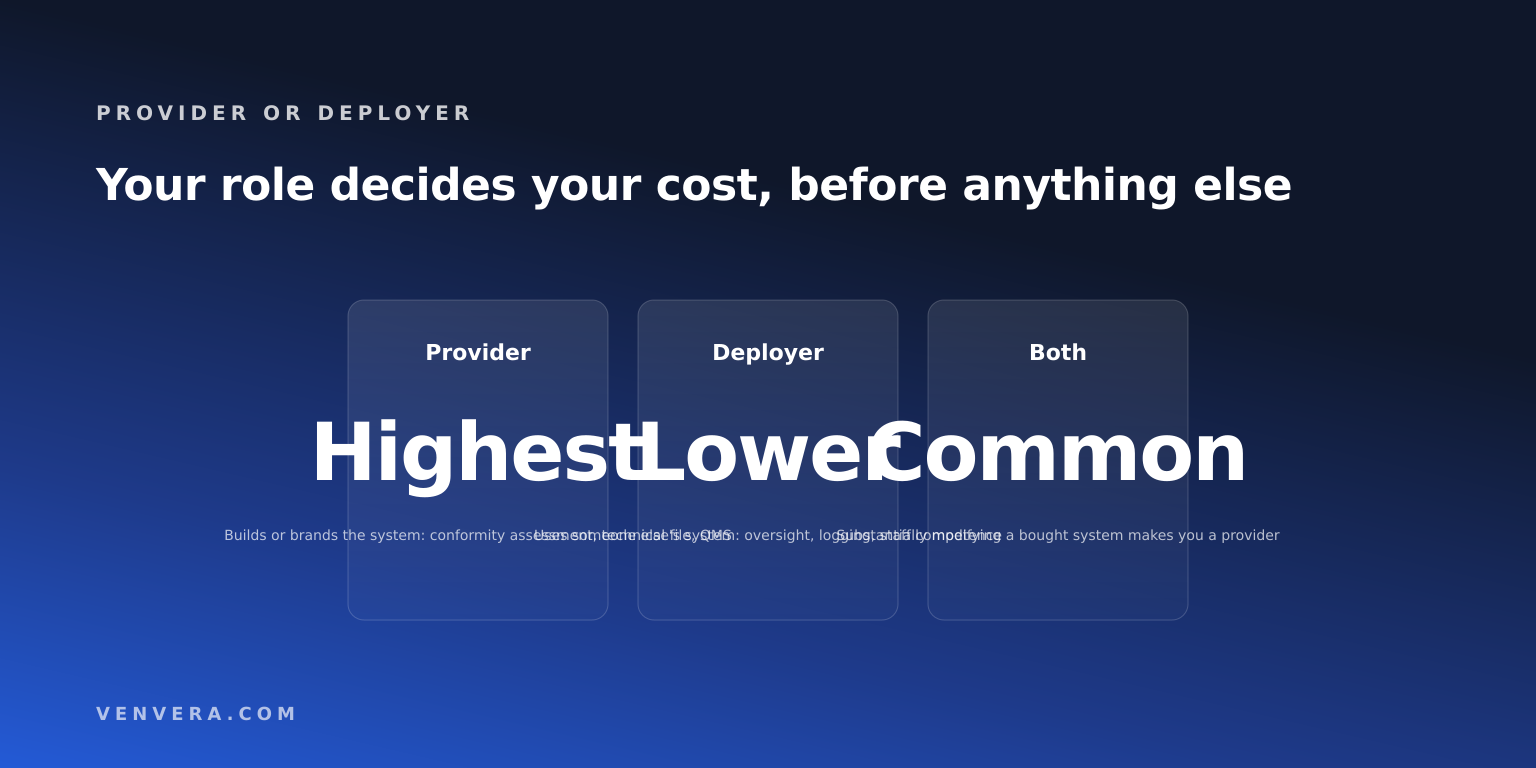
Providers develop an AI system, or have one developed, and place it on the market or put it into service under their own name or trademark. For a high-risk system this is where the heavy obligations sit: a risk management system, data governance for training and testing data, technical documentation, logging, human oversight design, accuracy and robustness measures, a quality management system, and a conformity assessment before the thing goes on the market.
Deployers use an AI system under their own authority. The duties are real but much lighter: use the system according to its instructions, assign human oversight to people with the competence and authority to exercise it, keep the logs the system generates, and inform workers where a system is used in an employment context. For most companies buying AI rather than building it, this is where they land.
The trap is that the boundary moves. Putting your own name on someone else's high-risk system makes you its provider. So does substantially modifying one, or changing its intended purpose so that a system becomes high-risk. Companies that fine-tune a bought model for a regulated use case are frequently providers without having budgeted as one, and that is the single most expensive misclassification in practice.
What the money is actually spent on
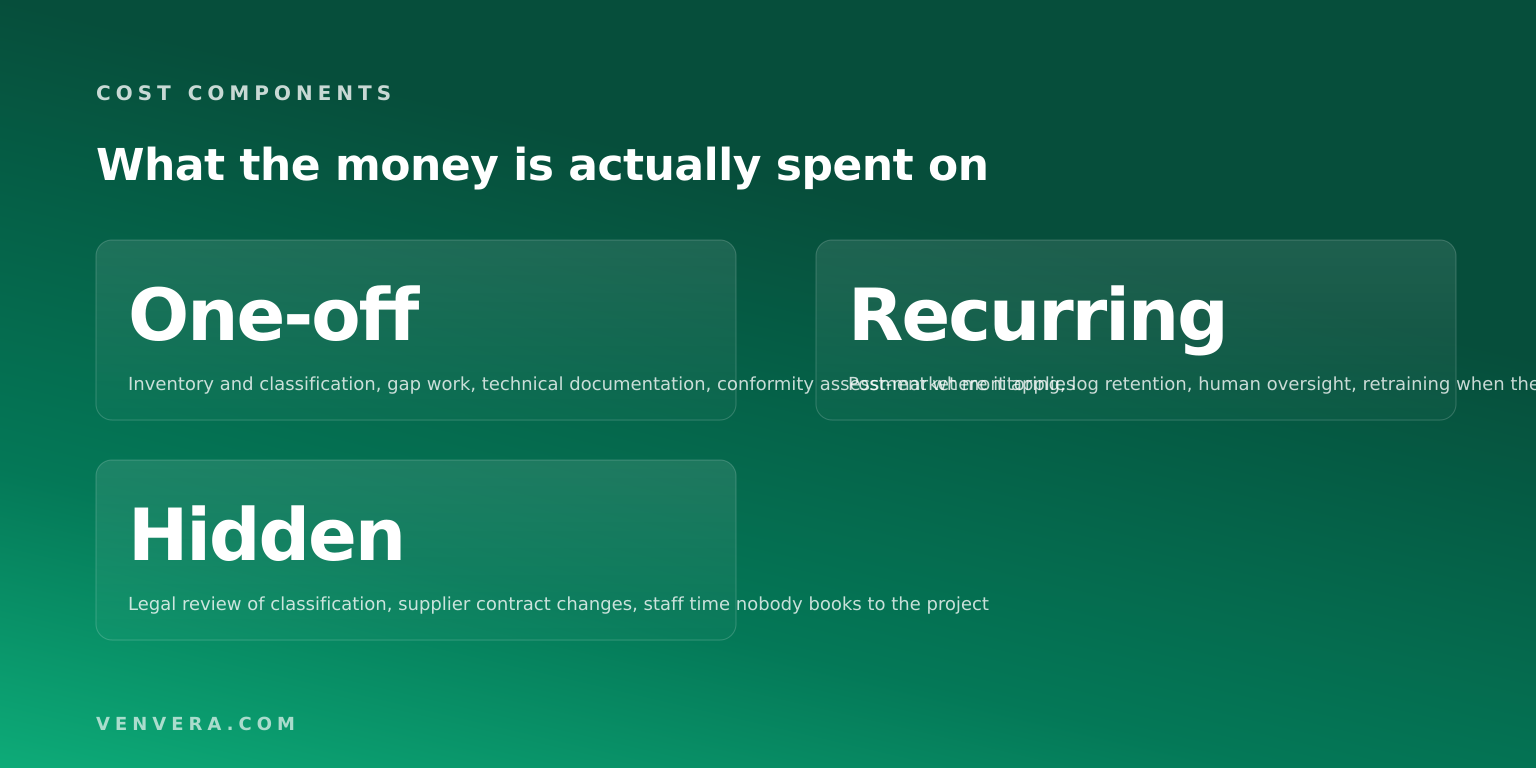
One-off
Inventory and classification of every AI system in the business, which is nearly always harder than expected because AI arrives through procurement rather than engineering. Gap work against the obligations that apply. Technical documentation, which for a high-risk system is a substantial artefact rather than a README. Conformity assessment where it applies, which for most high-risk categories is an internal control procedure and for some is a notified body.
Recurring
Post-market monitoring, log retention, human oversight actually being exercised by someone whose time it costs, and re-assessment when the system changes materially. Models are retrained, and a retrained model is not automatically still the thing you assessed. This is the line that turns a project into an operating cost, and it is why the second year is rarely much cheaper than the first for a genuine high-risk deployment.
Hidden
Legal review of your classification, because getting it wrong in either direction is expensive. Contract renegotiation with AI suppliers, since deployer duties depend on information the provider has to give you and older contracts do not require them to. And internal time, which nobody books to the project and which usually exceeds the external spend.
What the published estimates say, and where they came from
Worth being precise about provenance, because these figures circulate without it.
The most-quoted number, around 50,000 euros of one-off compliance cost per high-risk AI system, comes from the European Commission's impact assessment accompanying the original 2021 proposal. That is a real source and it is also five years old, written against a draft that changed substantially before adoption, and expressed as an economy-wide average rather than a quotation for your system. It has been repeated so widely that it now reads like a market rate. It is not one.
Ranges published by advisory firms, typically 5,000 to 25,000 euros for a deployer with no high-risk systems, 25,000 to 100,000 for a mid-sized company with one or two candidates, and six figures upward for a genuine provider of high-risk AI, are more useful in shape than in value. They correctly capture that the distribution is wide and driven by role and count. Treat the shape as informative and the numbers as someone else's project.
The one figure you can rely on is the penalty ceiling, because that is written in the Act itself rather than estimated: up to 35 million euros or 7% of total worldwide annual turnover, whichever is higher, for deploying a prohibited practice. Other infringements carry lower ceilings.
The order that keeps the bill down
Inventory first, because you cannot cost what you have not listed, and because the list is always longer than the engineering team thinks. Include the AI inside tools you bought for something else.
Classify second, and take it seriously. Most systems in most companies are minimal risk or carry only transparency obligations. Establishing that in writing, with reasoning, is the step that legitimately removes most of the projected cost, and it is also the artefact a regulator will ask for if they ever ask anything.
Establish your role per system third, because the same system can make you a deployer today and a provider the moment you rebrand or substantially modify it.
Only then scope the work. Conformity machinery for the high-risk few. Transparency and AI literacy for everything else. Building the recurring monitoring last, because it is an operating capability rather than a project deliverable.
Where budgets go wrong
| Mistake | What it costs | What to do instead |
|---|---|---|
| Budgeting before classifying | Paying for high-risk machinery on systems that were never high-risk | Classify first, in writing, with the reasoning kept |
| Treating it as a one-off project | A second-year surprise when monitoring and re-assessment arrive unbudgeted | Split the budget into build and run from the start |
| Missing the provider boundary | Discovering mid-year that fine-tuning made you a provider | Re-check role whenever a system is modified or rebranded |
| Ignoring supplier contracts | Deployer duties you cannot discharge because the provider owes you nothing | Add AI Act information duties at renewal, not after an incident |
| Running it separately from other regimes | Paying twice for governance, logging and risk management you already have | Map the overlap with what you run for ISO 27001, DORA or NIS2 |
What non-compliance costs instead
The Act sets tiered ceilings. Prohibited practices carry up to 35 million euros or 7% of worldwide annual turnover, whichever is higher. Most other infringements of obligations, including the provider and deployer duties around high-risk systems, carry up to 15 million euros or 3%. Supplying incorrect, incomplete or misleading information to authorities carries up to 7.5 million euros or 1%. For SMEs and start-ups the applicable ceiling is the lower of the amount and the percentage rather than the higher.
Those are maxima rather than expectations, and the practical near-term cost of getting it wrong is more likely to be a customer's procurement team asking a question you cannot answer.
Doing this in Venvera
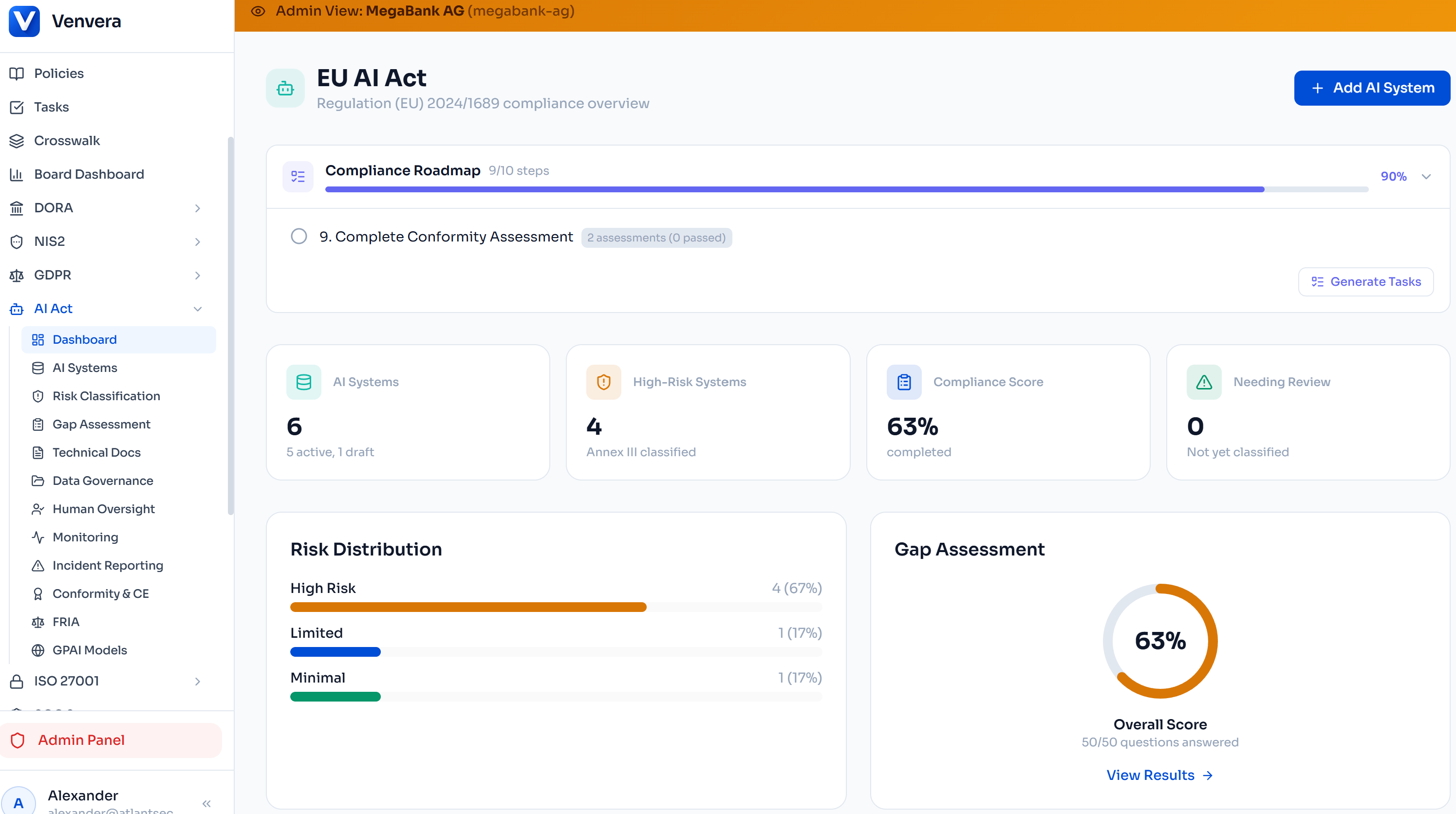
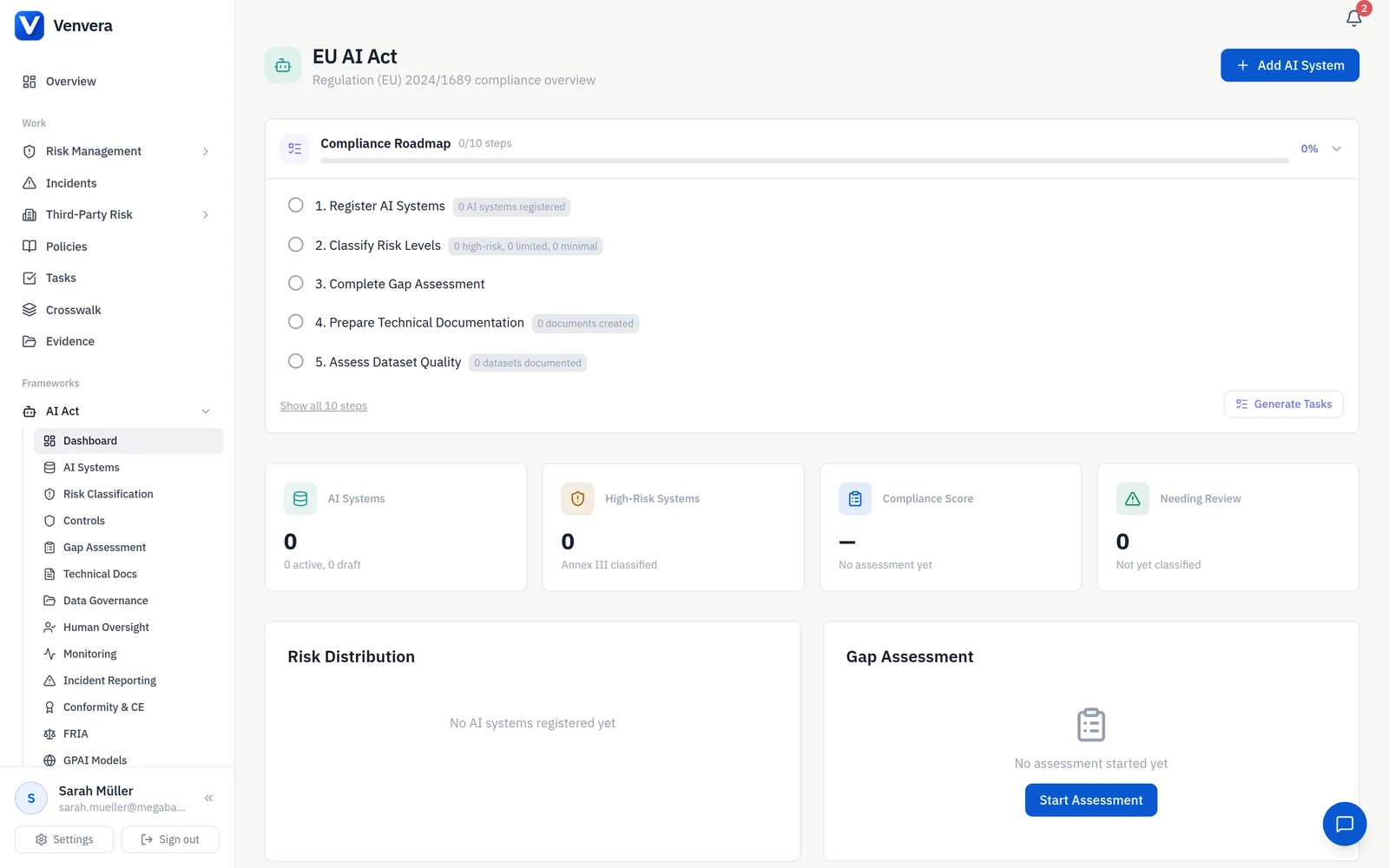
The expensive part of AI Act work is not the writing, it is knowing which obligations attach to which system and keeping that current as systems change. Venvera runs the EU AI Act as a first-class framework: a register of AI systems with role and risk classification per system, the obligations that follow from that classification, gap assessment against them, and the documentation and monitoring evidence held alongside everything else you answer to.
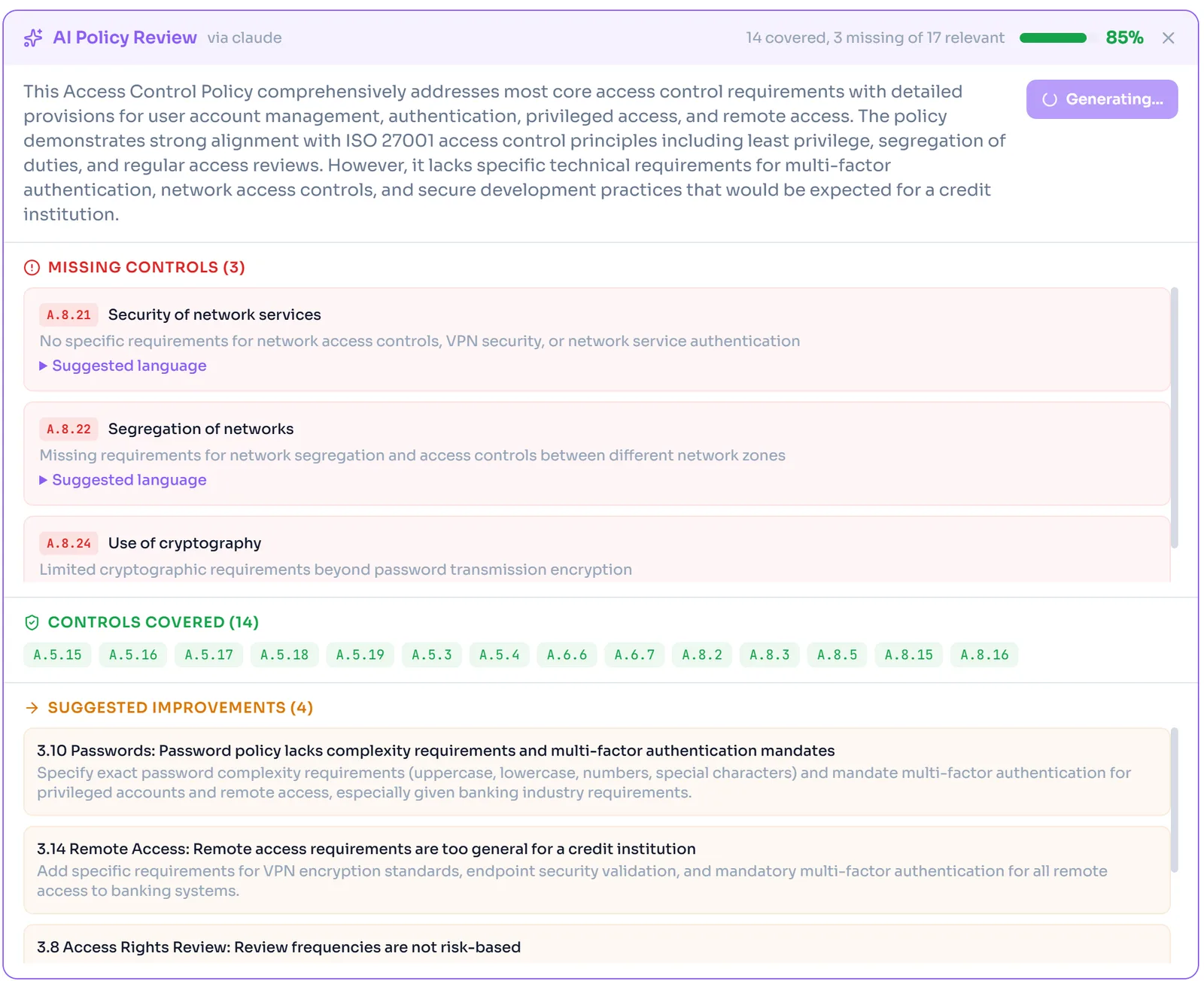
The overlap point matters for cost. If you already run ISO 27001, DORA or NIS2, a large part of the AI Act's governance, logging and risk-management expectations is work you have done once already. Cross-framework control mapping means evidencing it once and having it count in both places, which is the difference between an AI Act programme and an AI Act line item.
Get a real number for your situation
Book 30 minutes, bring your list of AI systems, and we will classify them with you and tell you which obligations actually attach. Most of the cost people budget for disappears at that step.
Pick a timeFrequently asked questions
How much does EU AI Act compliance cost?
It depends on your role and your risk class, not your revenue. A deployer with no high-risk systems is looking at AI literacy, transparency notices and oversight arrangements, which is a modest cost. A provider of a high-risk system carries conformity assessment, a technical file and a quality management system, which is a programme. The published per-system figure of roughly 50,000 euros comes from the Commission's 2021 impact assessment and should be read as an economy-wide average from a draft text, rather than a quote.
Is the EU AI Act cost a one-off or ongoing?
Both, and the ongoing part is the one budgets miss. Post-market monitoring, log retention, human oversight and re-assessment after material change are permanent operating costs. A retrained model is not automatically still the system you assessed.
Do small companies have to comply?
Yes, but the obligations scale with role and risk rather than headcount, and for SMEs and start-ups the penalty ceilings apply as the lower of the fixed amount and the percentage. Most small companies are deployers of minimal-risk or limited-risk systems, where the duties are training, transparency and oversight rather than conformity assessment.
What is the difference between a provider and a deployer for cost purposes?
A provider develops or brands the system and carries the heavy obligations for high-risk categories. A deployer uses someone else's system under their own authority and carries lighter operational duties. Rebranding or substantially modifying a system moves you from the second to the first, which is the most expensive boundary in the Act.
Can we reduce the cost by classifying systems as minimal risk?
You can reduce it by classifying correctly, which usually means fewer high-risk systems than a first pass assumes. What you cannot do is decide the answer first. Classification has to follow the Act's criteria and the reasoning has to be written down, because that record is the thing that defends the decision later.
Does existing ISO 27001 or DORA work reduce the AI Act bill?
Materially, yes, where the platform maps the overlap. Risk management, logging, documentation control and supplier governance appear in all of them. Evidencing a control once and having it count across frameworks is the mechanism; doing the same work three times in three systems is what makes multi-regime compliance expensive.
When do the obligations actually apply?
The Act applies in phases rather than all at once, with prohibitions and AI literacy duties arriving first and the high-risk obligations later. Check the current phase against your own systems rather than assuming a single date, because the sequencing is what determines when your spending has to happen.