
Best
Unmetered on Professional
Vendor questionnaire campaigns are unmetered on Venvera.
Templates, secure vendor links, auto-scoring and a full audit trail are included in Professional and Enterprise at no extra cost, and they are unmetered: send as many as you need, all year. Vanta charges extra to send vendor questionnaires (an arm-and-a-leg add-on, at the time of writing, 29 July 2026) - confirm current pricing with their sales team before you budget.
If you build health technology and your software touches protected health information, you are a business associate under HIPAA, and you need a program that proves it. Vanta and Venvera both give you that program layer. This comparison is written for one specific reader: the EU-based health-tech team, or any business associate serving US customers, that has to satisfy HIPAA and often GDPR at the same time. We are not going to pretend Venvera wins every round. We name where Vanta is genuinely stronger, in its own prominent section, before we make our own case. Vanta is US-hosted with a deep automation library and HITRUST certification paths. Venvera is EU-hosted, runs HIPAA and GDPR from one shared evidence library, and publishes flat pricing. Read to the end and you will know which one truly fits your situation.
Quick answer
- Pick Venvera if you are an EU-based health-tech company or business associate that must cover HIPAA and GDPR together, wants evidence hosted in the EU, and wants published flat pricing from EUR 399/month rather than a sales quote.
- Pick or stay with Vanta if you are US-focused, want HITRUST certification (e1, i1, or r2), and want the widest integration and continuous-monitoring automation library on the market.
- The honest tradeoff: Venvera does not offer HITRUST certification paths and has a smaller automation catalogue than Vanta. If either of those is a hard requirement, that decides it.
Keep comparing
Where Vanta is stronger
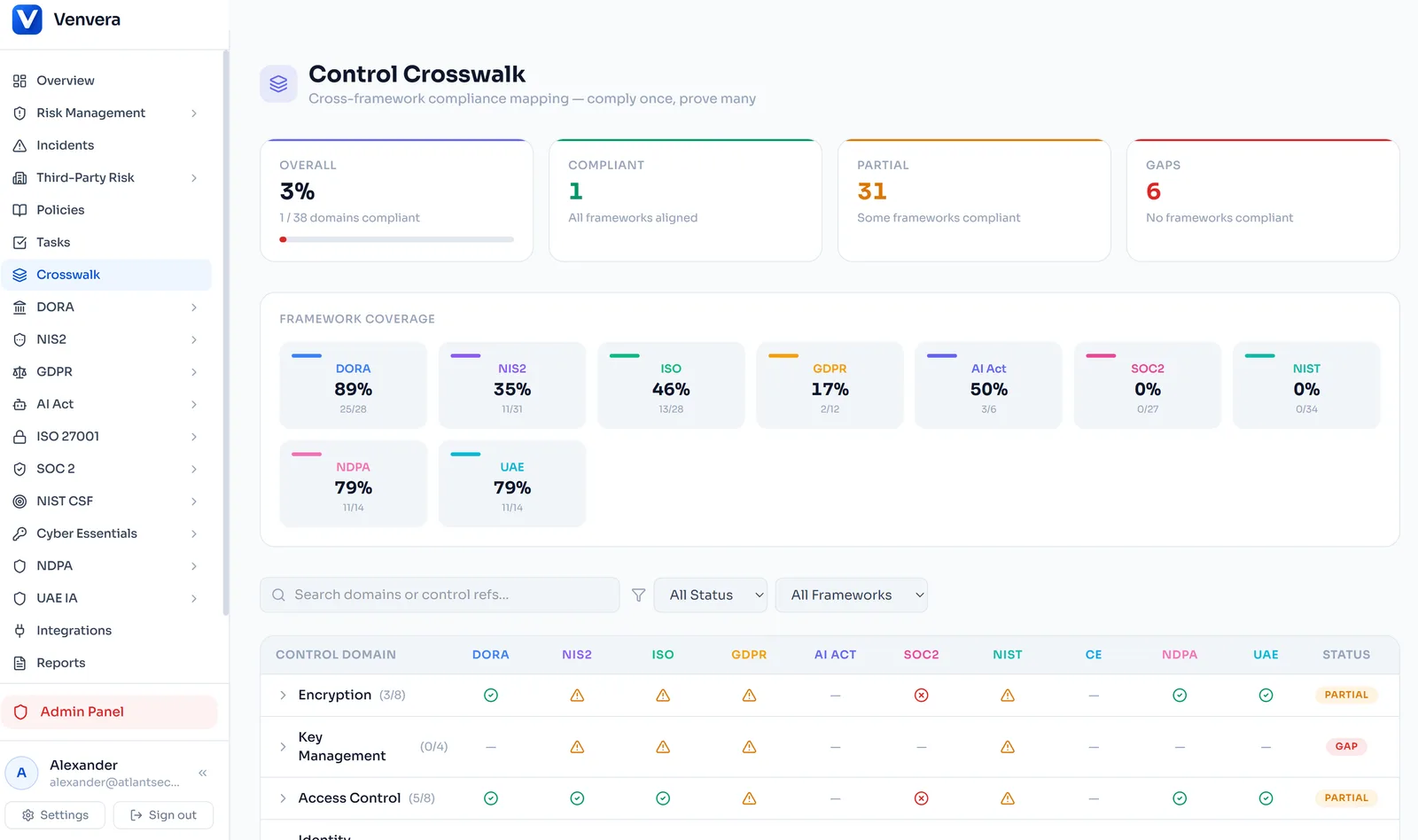
Vanta has been building its platform longer, and it shows in two places that matter for HIPAA buyers. First, the integration catalogue is deeper. If your stack is broad and you want the widest possible library of connectors pulling evidence automatically, Vanta's continuous-monitoring automation is more mature than what Venvera offers today. That means fewer manual evidence uploads and more checks that run on their own in the background. Second, and this is the bigger one, Vanta offers HITRUST certification paths, including the e1, i1, and r2 assessments. HITRUST is a recognised certification that many US health systems and enterprise buyers ask for by name, and Venvera does not offer it. So if you are a US-focused company whose customers demand a HITRUST certificate, or you simply want the largest automation library available, Vanta is the better fit, and we would tell you that before you signed anything. We put this up front because it is the deciding factor for a real slice of buyers, and pretending otherwise would waste your time. One caveat to carry into either demo: integration count is the easiest number for any vendor to inflate and the hardest to use. What matters is whether the connectors cover the systems your PHI actually passes through. Bring that list to the call and check it line by line, because a long catalogue is worth nothing if the one system that matters is missing from it.
Where Venvera fits better
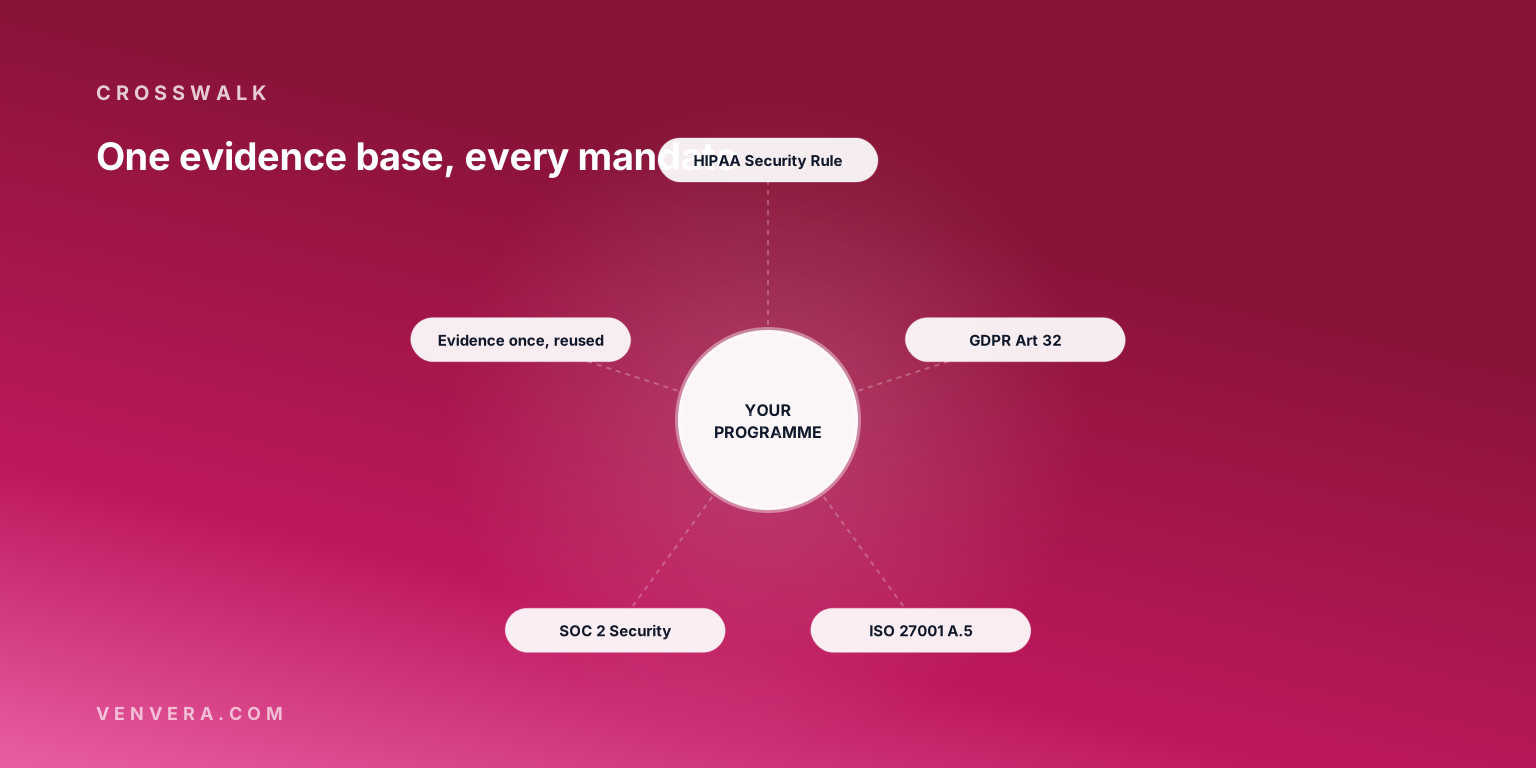
Venvera is built for a narrower reader and serves them well. If you are an EU-based health-tech company, or any business associate with EU customers, you almost never have only HIPAA to worry about. You have GDPR too. Venvera runs HIPAA and GDPR from one shared evidence library, so a single control that proves access management or encryption is captured once and counts toward both regimes. You do the work one time, not twice, and you stop copying the same screenshot into two different tools. Your evidence is hosted in the EU, which matters the moment your own customers, regulators, or data protection officers ask where personal data actually lives. And the pricing is published: from EUR 399/month, with the Professional tier at EUR 899/month. There is no sales call required just to learn the number, and no quote-only wall between you and a budget. For a lean team that needs HIPAA and GDPR covered together, with EU data residency and a price you can plan against, that combination is hard to beat. The honest limit of that argument is worth stating too. Shared evidence removes the duplicated proof work. It leaves you running two regimes with different definitions, different clocks and different regulators, and you still have to understand both well enough to answer questions about either.

HIPAA the honest way: what actually matters
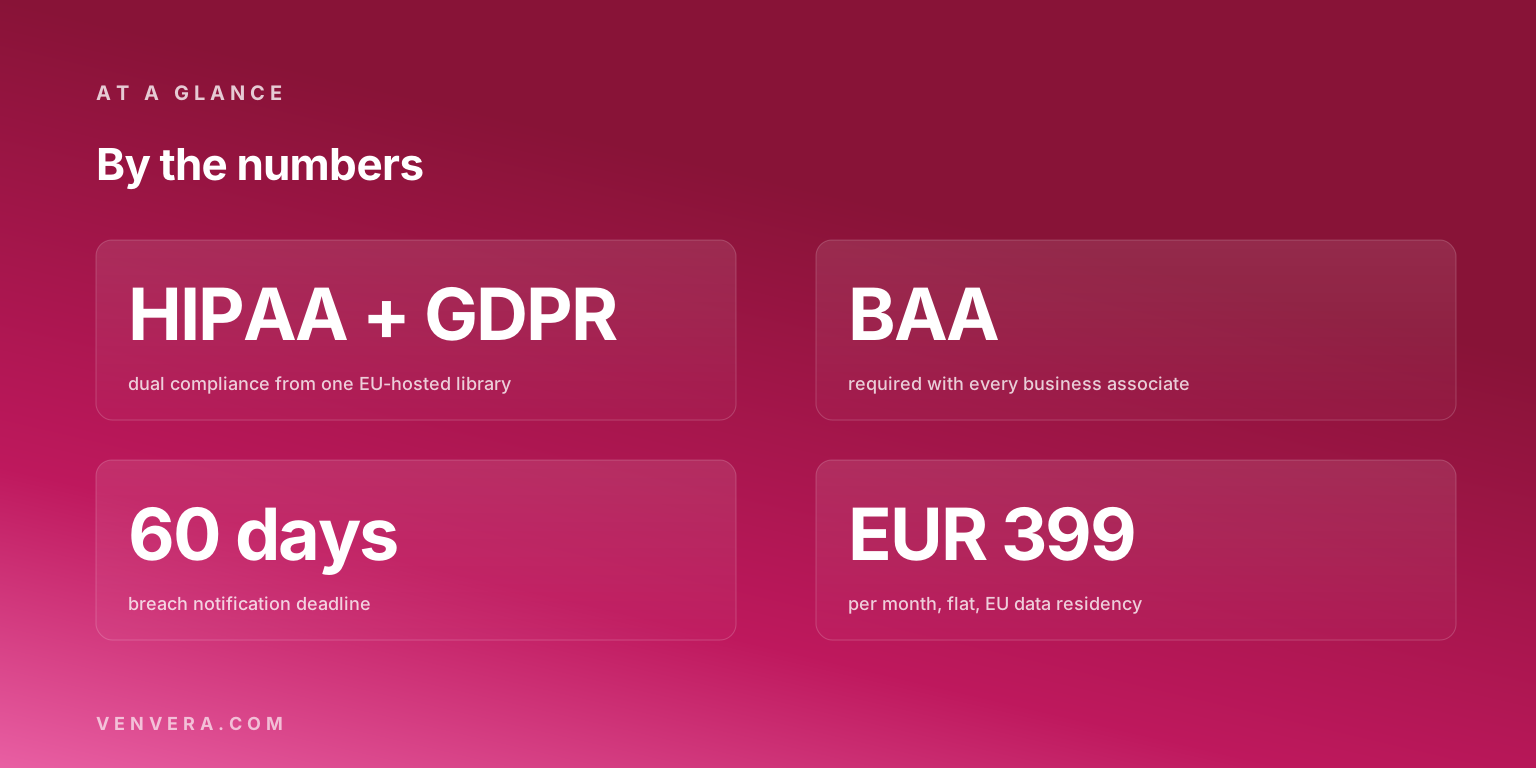
HIPAA sorts everyone into two buckets. Covered entities are health plans, healthcare providers, and clearinghouses. Business associates are the vendors that create, receive, maintain, or transmit protected health information (PHI) on a covered entity's behalf. If you run a SaaS product and PHI passes through it, you are a business associate, full stop, and you need a signed Business Associate Agreement (BAA) with every covered entity you serve. No tool signs that BAA for you. Expect the BAA to be the slowest part of your first US healthcare deal. Large health systems send their own paper, that paper usually asks for more than the rule itself requires, and it moves at their counsel's pace rather than yours. Get your own subprocessor agreements signed before that negotiation starts, because you cannot promise upstream what you have not secured downstream.
The rules you are proving compliance against come in three parts. The Privacy Rule governs how PHI may be used and disclosed. The Security Rule is where most engineering work lands: administrative, physical, and technical safeguards for electronic PHI. The Breach Notification Rule sets what happens when something goes wrong. You must notify affected individuals and HHS, and the individual-notice deadline is without unreasonable delay and no later than 60 days from discovery.
In day-to-day terms, the Security Rule safeguards translate into concrete artifacts. Administrative safeguards mean documented policies, workforce training records, and periodic access reviews. Physical safeguards mean control over where servers and workstations live and who can physically reach them. Technical safeguards mean encryption, audit logging, and authentication you can demonstrate on demand. An auditor does not want a policy that says you encrypt PHI; they want the configuration and the log entry that proves you actually do. This is the gap a program platform is meant to close: turning stated intent into standing evidence that is ready when someone asks, instead of a scramble in the week before a customer security review.
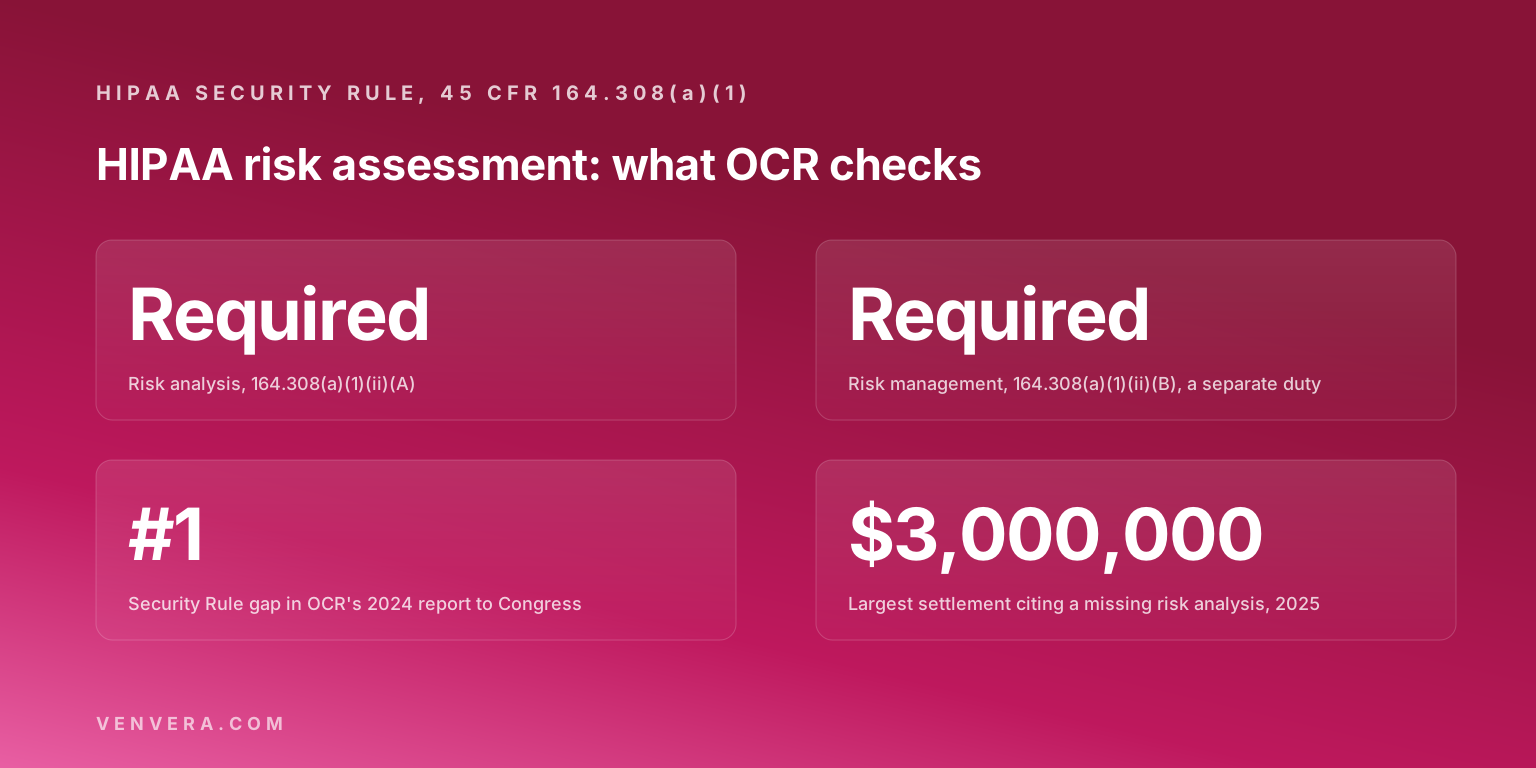
The single most important artifact is a current, documented risk analysis. It is the backbone Security Rule requirement, and it is the first thing an investigator asks to see. Not a risk analysis from three years ago, a current one that reflects your systems as they are now. In late 2025, HHS proposed strengthening the Security Rule, and while it is only proposed, the direction of travel is clear: tighter, evidence-backed, current programs. A platform earns its keep here by keeping that risk analysis and its supporting evidence fresh, rather than letting it rot in the gap between audits. That is the real job. Everything else is packaging around it. Be realistic about what the first one costs you. Filling in the template is an afternoon. Establishing where PHI genuinely lives, including the logging pipeline and the support tool somebody connected last spring, is weeks of asking colleagues questions they find annoying. No platform removes that work, and a vendor implying it does is selling you a document.
Venvera vs Vanta for HIPAA: side by side
Here is the fair, fact-based version of the comparison. Where one tool clearly leads, the table says so plainly rather than hiding it. Note in particular the pricing row: Venvera's numbers are public, while Vanta's are quote-only, so we do not guess at a figure we cannot verify.
| Dimension | Venvera | Vanta |
|---|---|---|
| Data residency and hosting | EU-hosted, EU data residency | US-based, data hosted in the US |
| Regimes covered for this buyer | HIPAA and GDPR from one shared evidence library | HIPAA plus HITRUST (e1, i1, r2) |
| HITRUST certification path | Not offered | Yes (e1, i1, r2) |
| Continuous monitoring and integrations | Core evidence collection | Deeper integration catalogue, more mature automation |
| Pricing | Published flat pricing, from EUR 399/month (EUR 899 Professional) | Not public (quote-only) |
| Signs your BAAs or replaces legal review | No, program layer only | No, program layer only |
How to choose
Match your situation to one of these and the answer usually falls out on its own. One thing neither vendor will volunteer on a call: switching later hurts. Evidence libraries and control mappings do not port cleanly between platforms, so choose against the obligations you expect to carry in two years rather than the ones sitting on your desk this quarter.
- EU health-tech selling into the US. You need HIPAA for your US customers and GDPR because you handle EU personal data. This is Venvera's core case: one shared evidence library covers both, hosted in the EU, at a price you can see before you talk to anyone.
- US-only startup that wants HITRUST. Your buyers ask for a HITRUST certificate by name, and you want the largest automation library you can get. Vanta offers the e1, i1, and r2 paths and the deeper integration catalogue. Choose Vanta.
- Business associate with EU customers and a tight budget. You want EU data residency and predictable, published pricing rather than a quote you have to negotiate. Venvera's flat EUR 399/month starting tier fits this better.
- Broad, integration-heavy stack chasing maximum automation. If your priority is the widest possible set of automated connectors pulling evidence with minimal manual work, Vanta's more mature automation is the stronger match today.
Frequently Asked Questions
Does Venvera or Vanta sign my BAAs for me?
No. Neither platform signs your Business Associate Agreements, and neither is a substitute for legal review. You sign BAAs directly with the covered entities you serve, and with your own subprocessors. Both tools are the program layer that manages your safeguards and evidence, not the lawyer that reviews and executes your contracts.
Can Venvera cover GDPR alongside HIPAA?
Yes, and that is the main reason EU health-tech teams choose it. Venvera runs HIPAA and GDPR from one shared evidence library, so a control you implement and evidence once, for example around access management or encryption, counts toward both regimes instead of being duplicated across two separate programs.
Can I get HITRUST certified through Venvera?
No. Venvera does not offer HITRUST certification paths. Vanta does, including the e1, i1, and r2 assessments. If your customers require a HITRUST certificate specifically, that is a strong reason to choose Vanta for this need.
What is the breach notification deadline under HIPAA?
For notifying affected individuals, the rule is without unreasonable delay and no later than 60 days from discovery of the breach. You also have to notify HHS. A program platform helps here by keeping your incident records and evidence organised so you are not reconstructing a timeline under pressure, but the notification obligation itself sits with you as the covered entity or business associate.
What does each one cost?
Venvera publishes flat pricing: from EUR 399/month, with the Professional tier at EUR 899/month, so you can budget before you ever book a call. Vanta does not publish pricing; it is quote-only, so you would need to contact their sales team for a number tailored to your environment. We do not quote a Vanta figure here because there is no public one to quote.
If you are an EU health-tech team weighing HIPAA and GDPR together, start with the details on the Venvera HIPAA framework page, then see how it stacks up in our roundup of the best HIPAA compliance software. If the fit looks right, a Venvera trial lets you build your risk analysis and shared evidence library before you commit, with the price on the table from day one. And whichever tool you choose, remember the shared caveat: the platform runs your program, but your BAAs and legal review are still your own.