

Best
DORA Compliance Software
A buyer's guide comparing five platforms for the Digital Operational Resilience Act on the capabilities that decide DORA readiness: the Register of Information, xBRL-CSV export, ICT third-party risk and incident classification.

The Digital Operational Resilience Act (Regulation (EU) 2022/2554) applied from 17 January 2025. For in-scope financial entities and their ICT providers, the practical challenge is turning the regulation's text into auditable, reportable processes: a structured Register of Information, regulator-ready reporting, ICT third-party risk management, and incident classification that follows the technical standards. This guide compares five platforms on those capabilities so you can match a tool to your situation.
Quick answer
DORA readiness tends to come down to three capabilities that general-purpose GRC tools were not originally built for: a structured Register of Information with the entity and function relationships the ESAs expect, native xBRL-CSV export for regulator submissions, and ICT third-party risk management mapped to Articles 28 to 30. Among the five platforms compared here, Venvera (the publisher of this comparison) is built around EU regulatory frameworks and cross-framework evidence reuse; OneTrust and ServiceNow GRC suit large enterprises that already run those platforms and can absorb their cost and configuration effort; and Vanta and Drata are strong for SOC 2 and ISO 27001 infrastructure-evidence automation rather than DORA-specific reporting. Which fits you depends on your size, existing stack and how many frameworks you run alongside DORA.
Below, the six evaluation criteria that matter for DORA, a transparent methodology box, a platform-by-platform read, a feature comparison with an explicit evidence key, indicative pricing, and buyer-fit conclusions. Whether you are a bank, insurer, investment firm, or an ICT provider to financial entities, the aim is to help you choose the tool that fits, not to crown a single winner.
🔍
Selection Criteria
What to look for in DORA compliance software
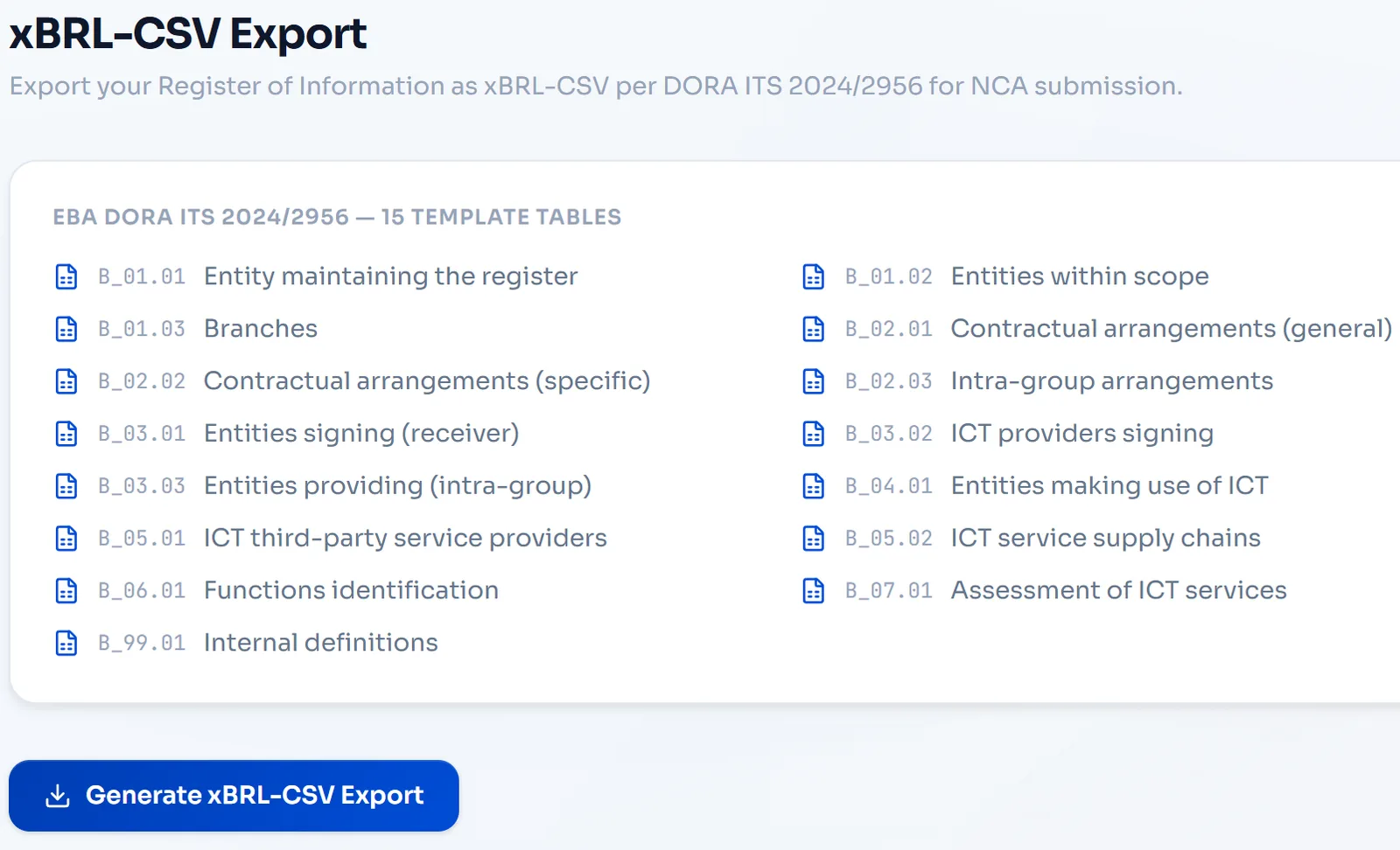
Unlike broad frameworks such as ISO 27001, DORA has prescriptive requirements that reward purpose-built tooling. These are the six criteria used in this comparison:
Two of the six decide your shortlist and four are hygiene. The Register of Information and the export format are where a general-purpose GRC tool genuinely breaks, because they demand a specific data model and a specific file that a regulator will either accept or reject. Risk workflows, incident records and test tracking are things most platforms already do, or can be configured to do in a few weeks.
1. Register of Information (RoI)
DORA Article 28(3) requires a structured register of ICT third-party arrangements. A capable platform manages providers, contracts, business functions and their interconnections. The register is straightforward until you reach sub-outsourcing, where you depend on your provider telling you who its providers are, and that is where registers tend to stall.
2. xBRL-CSV export
The ESAs specify reporting in xBRL-CSV format. If a platform cannot generate compliant exports natively, you are building custom extract pipelines, which is costly and error-prone. Judge this criterion on a produced file rather than a roadmap promise. A spreadsheet named after the template is a different artefact from a valid submission package.
3. ICT risk management
Articles 5 to 16 require an ICT risk management framework. A tool needs risk assessment workflows, gap analysis and remediation tracking.
4. Incident classification
DORA sets classification criteria and reporting timelines. A platform should support severity classification against the technical standards and track notification deadlines.
5. TLPT and resilience testing
Threat-Led Penetration Testing under Article 26 needs structured tracking of test plans, findings and remediation across the full lifecycle.
6. Entity identifiers and reference data
Reporting relies on correct LEI codes, entity identifiers and jurisdiction mappings. Built-in reference data reduces manual lookup and reporting errors.
How this comparison was produced
Methodology
| Date reviewed | July 2026. |
| Reviewer | Alexander Sverdlov, founder of Venvera. |
| Conflict of interest | Venvera publishes this comparison and is one of the products assessed. A full disclosure is shown with this article. |
| How capabilities were assessed | Venvera was assessed directly in its own product. The other four platforms were not hands-on tested; their capabilities were read from each vendor's public documentation. This is a comparison built from public documentation. |
| Products compared | Venvera, Vanta, Drata, OneTrust, ServiceNow GRC (5 platforms). |
| Evaluation criteria | Register of Information, xBRL-CSV export, ICT risk management, incident classification, TLPT and resilience testing, third-party risk, cross-framework evidence reuse, EU data hosting and pricing. The assessment is qualitative; no numeric weighting was applied. |
| Pricing source | Venvera pricing is from its own public pricing. Competitor pricing is generally not published; where that is the case it is shown as quote-based. |
| Limitations | Vendor capabilities and plans change. Statements about the other platforms reflect public documentation reviewed in July 2026 and should be verified with each vendor before you decide. Where a capability could not be confirmed from that documentation, it is marked "not confirmed" rather than assumed absent. |
🏆
Platform Reviews
Five DORA platforms compared
Publisher's own product
Venvera
Best for: EU regulatory frameworks and cross-framework evidence reuse.
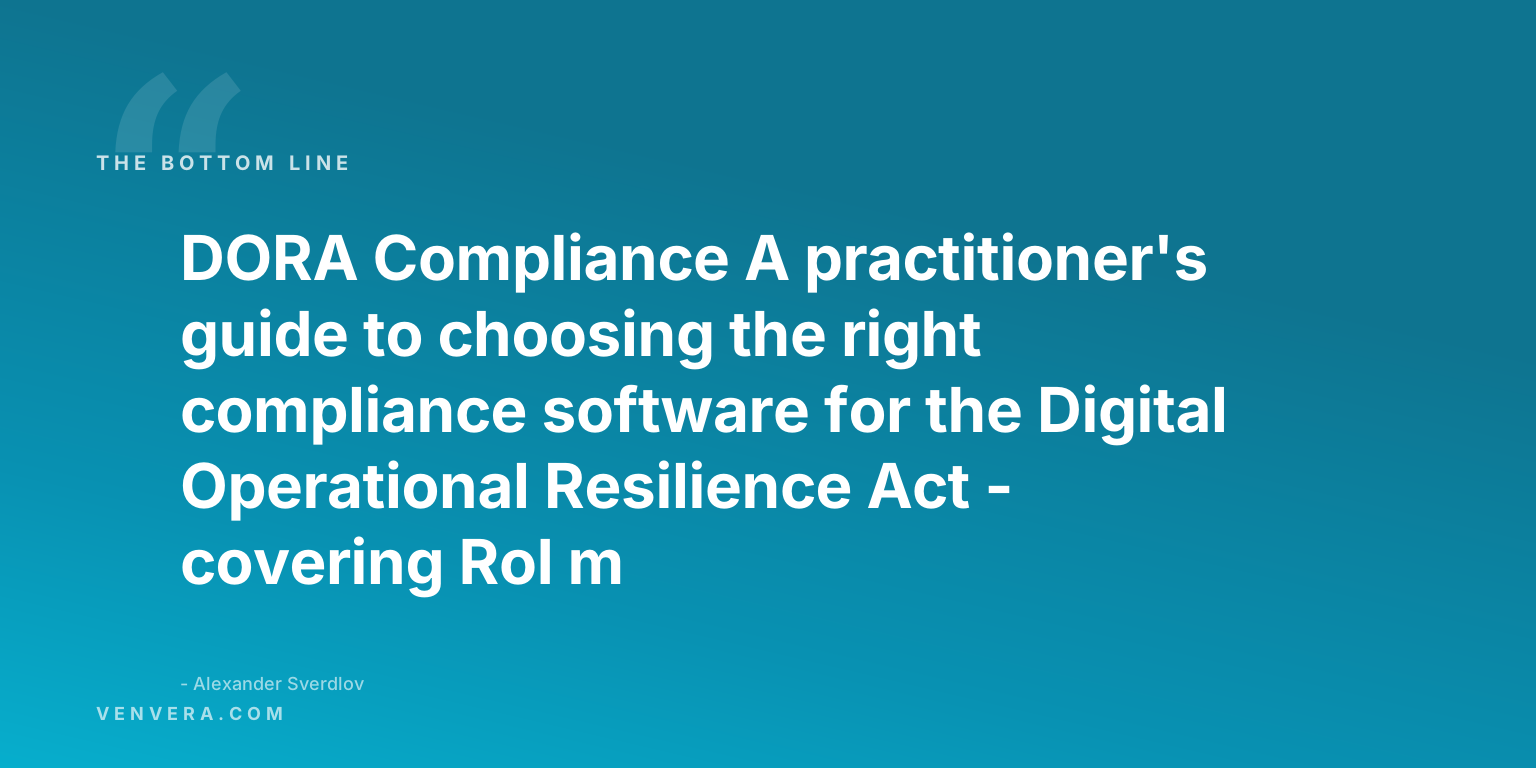
Venvera is built for EU financial-services regulation. In the product, it provides a structured Register of Information with entity identifiers, native xBRL-CSV export of the RoI, and ICT third-party risk management mapped to Articles 28 to 30. These capabilities are verified in the Venvera product as of July 2026.
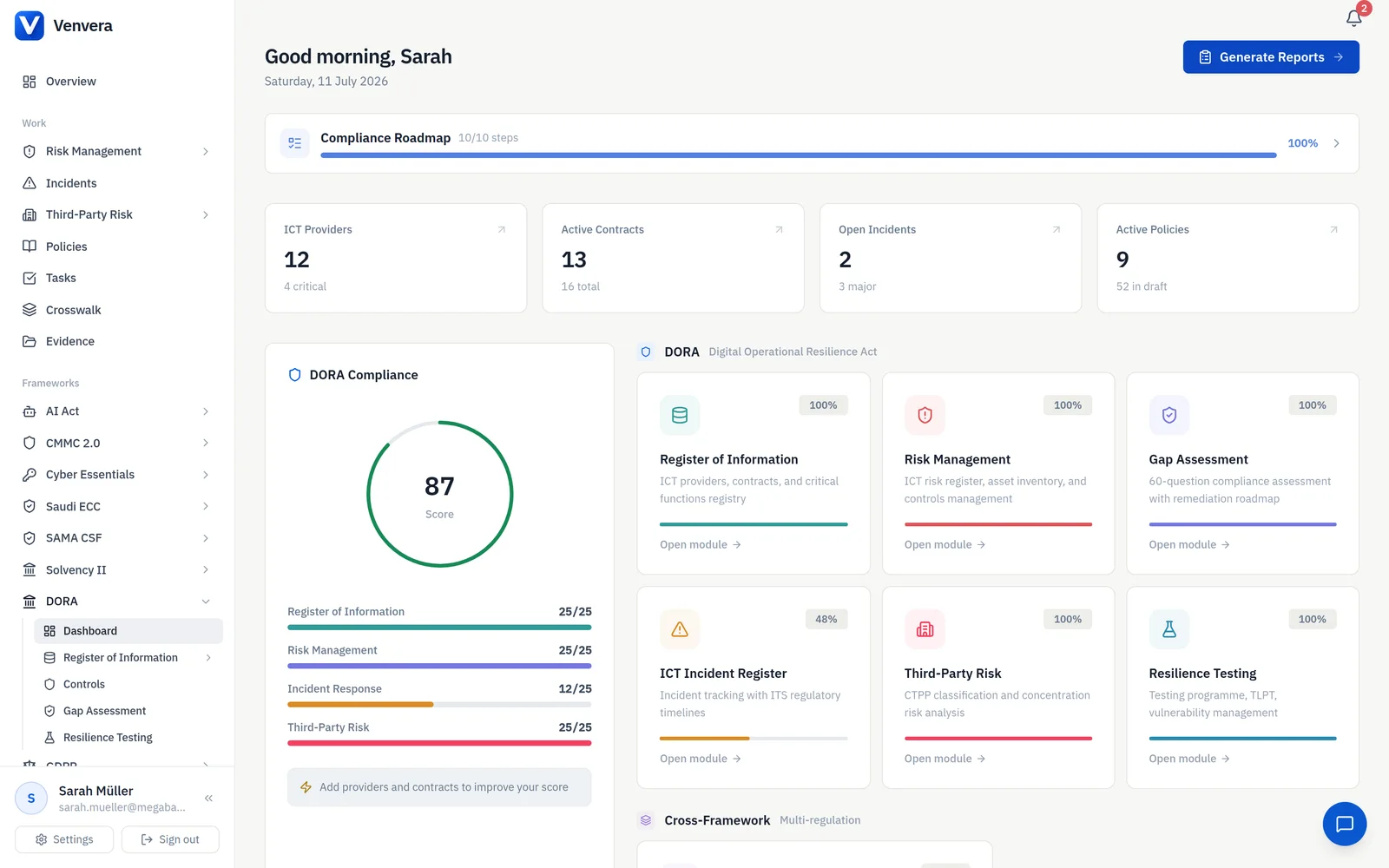
Its distinguishing design is cross-framework evidence reuse. Venvera covers DORA alongside other EU and international frameworks including GDPR, ISO 27001, NIS2, the EU AI Act, SOC 2, NIST CSF, Cyber Essentials, NDPA, UAE IA and CMMC. Pricing starts at €399/month for a single framework and €899/month for three.
Pre-built cross-framework control mappings mean a control you implement for one framework may support overlapping requirements in others, so evidence entered once can be reused rather than re-documented. Whether that overlap applies to a given control should be confirmed against the specific requirement.
Venvera hosts data in Amsterdam, providing European data residency, and includes incident classification with DORA severity criteria, gap assessments, policy templates, resilience-testing tracking and a full audit trail.
Strengths (verified in product)
- Native xBRL-CSV export of the RoI
- Structured Register of Information with entity identifiers
- Cross-framework evidence reuse across EU and international frameworks
- European data residency (Amsterdam)
- ICT third-party risk management
- Transparent pricing from €399/month
Considerations
- Newer platform with less brand recognition
- EU-focused, with less US coverage
- Growing integration ecosystem
Vanta
Best for: SOC 2 and ISO 27001-first teams automating infrastructure evidence.
Vanta has a strong reputation in the SOC 2 and ISO 27001 space, particularly for technology companies. Its public documentation describes continuous monitoring and an extensive integration library that automate much of the evidence collection for cloud-native organisations.
For DORA specifically, native xBRL-CSV export, a structured Register of Information and DORA incident classification against the technical standards were not confirmed from the public documentation reviewed in July 2026. If those are central to your DORA reporting, confirm the current position with Vanta before deciding.
Described in public docs
- SOC 2 and ISO 27001 automation
- Large integration library
- Continuous monitoring
Not confirmed for DORA
- Native xBRL-CSV export
- Structured RoI management
- DORA incident classification
- Default EU data hosting
Drata
Best for: continuous infrastructure monitoring across cloud providers.
Drata's public documentation describes continuous compliance monitoring with automated evidence collection from cloud providers such as AWS, Azure and GCP, and framework coverage that has expanded over recent years.
Its infrastructure focus addresses parts of ICT risk management. Native xBRL-CSV export, a Register of Information structure and DORA-specific incident classification were not confirmed from the public documentation reviewed in July 2026. Confirm the current position with Drata if DORA reporting is your primary need.
Described in public docs
- Continuous infrastructure monitoring
- Automated evidence collection
- Cloud provider integrations
Not confirmed for DORA
- xBRL-CSV export
- Register of Information structure
- Third-party contract management for DORA
- DORA-specific incident classification
OneTrust
Best for: large enterprises already running OneTrust GRC.
OneTrust is an established enterprise GRC vendor with deep capabilities in privacy management, risk assessment and third-party governance. Its public documentation describes DORA coverage within its GRC offering, including third-party risk management workflows.
The main considerations are complexity and cost: this is an enterprise platform typically sold as a larger contract, with implementation and configuration effort to match. For large banks and insurers already using OneTrust, adding DORA coverage can make sense. Native xBRL-CSV export was not confirmed from the public documentation reviewed in July 2026; verify the current position with OneTrust.
Described in public docs
- Enterprise GRC
- DORA coverage within GRC
- Third-party risk module
- Established market presence
Considerations / not confirmed
- Native xBRL-CSV export not confirmed
- Enterprise pricing and contracts
- Implementation and configuration effort
- May be more than mid-market firms need
ServiceNow GRC
Best for: large ServiceNow environments building DORA workflows in-house.
ServiceNow GRC builds on the broader ServiceNow platform to deliver integrated risk, compliance and audit management with strong workflow automation. For organisations already running ServiceNow, adding GRC modules keeps everything in one environment.
ServiceNow is an IT service management platform first, so DORA-specific functionality generally requires configuration. Out-of-the-box RoI management, native xBRL-CSV export and DORA incident classification were not confirmed from the public documentation reviewed in July 2026. It fits best where a large ServiceNow investment already exists and there is capacity to build.
Described in public docs
- Unified IT and GRC platform
- Strong workflow automation
- Established enterprise platform
- Audit management
Considerations / not confirmed
- Out-of-the-box DORA tooling not confirmed
- xBRL-CSV export not confirmed
- Configuration effort required
- Complex licensing
📊
Head-to-Head
Feature comparison
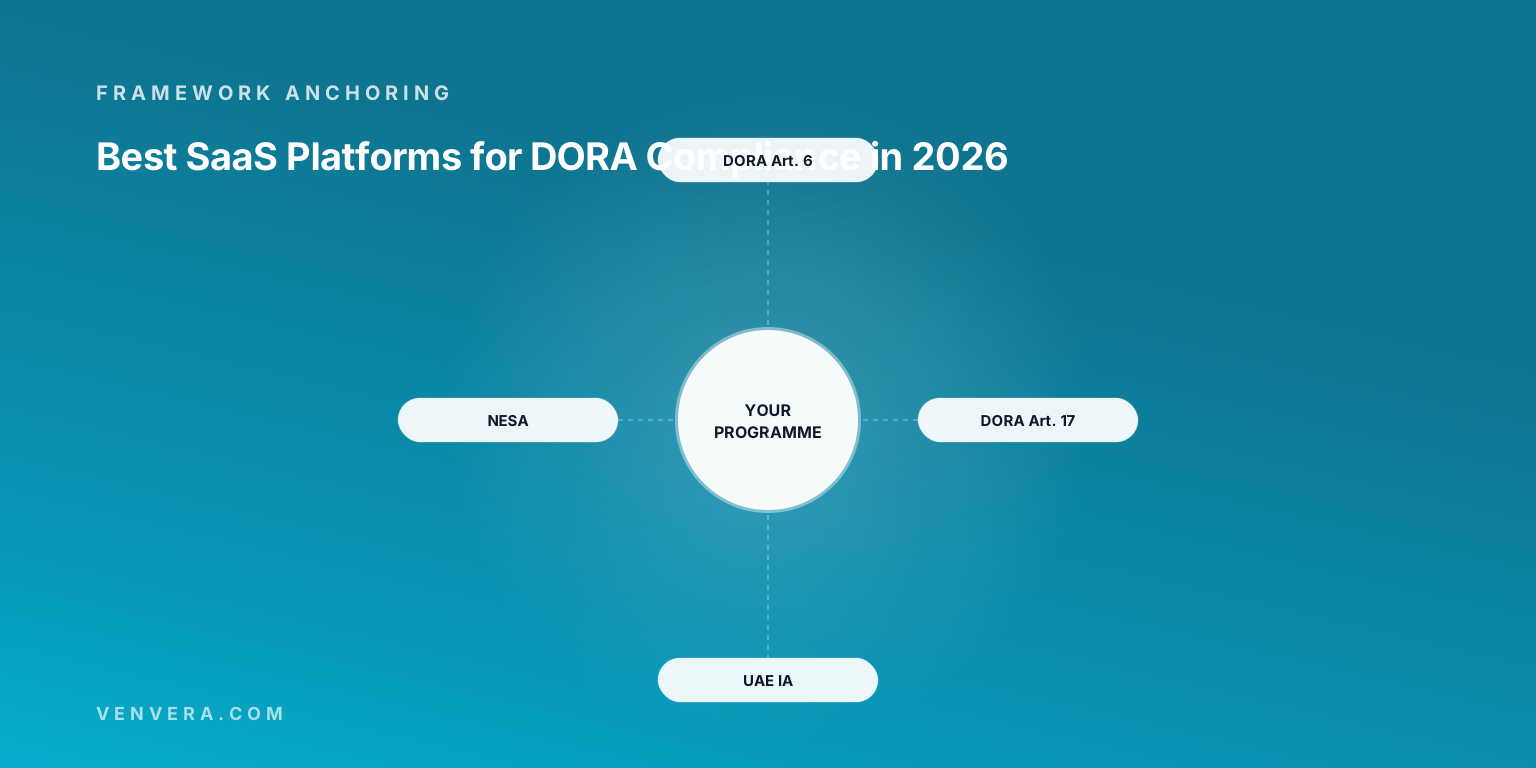
How to read this table. Venvera entries are verified in the Venvera product (July 2026). Entries for the other platforms come from public vendor documentation reviewed in July 2026 and should be verified with the vendor. "Not confirmed" means the capability was not found in that public documentation; it is not a statement that the feature is absent.
| Feature | Venvera | Vanta | Drata | OneTrust | ServiceNow |
|---|---|---|---|---|---|
| Register of Information (RoI) | Full (verified) | Not confirmed | Not confirmed | Partial (public docs) | Not confirmed |
| xBRL-CSV export | Native (verified) | Not confirmed | Not confirmed | Not confirmed | Not confirmed |
| ICT risk management | Full (verified) | Partial (public docs) | Partial (public docs) | Described (public docs) | Not confirmed |
| Incident classification (DORA technical standards) | Native (verified) | Not confirmed | Not confirmed | Partial (public docs) | Not confirmed |
| Third-party risk management | Full (verified) | Basic (public docs) | Basic (public docs) | Described (public docs) | Partial (public docs) |
| TLPT / resilience testing | Full (verified) | Not confirmed | Not confirmed | Basic (public docs) | Not confirmed |
| Cross-framework evidence reuse | Yes (verified) | Basic (public docs) | Basic (public docs) | Moderate (public docs) | Not confirmed |
| EU data hosting | Amsterdam (verified) | EU default not confirmed | EU option (public docs) | EU option (public docs) | Region choice (public docs) |
| Starting price | From €399/mo | Not publicly listed | Not publicly listed | Not publicly listed | Not publicly listed |
🔗
Efficiency Multiplier
Why cross-framework evidence reuse matters for DORA
Few EU financial entities are subject to DORA alone. Most also handle GDPR, often NIS2, sometimes ISO 27001 certification, and increasingly the EU AI Act. These frameworks overlap, and without cross-framework reuse a team treats each as a silo and re-documents the same measure repeatedly.
Illustrative scenario: access control
A single access-control policy may support related requirements across several frameworks:
- DORA Art. 9(4)(c) - ICT access control policies
- ISO 27001 A.9.1 - Access control policy
- NIS2 Art. 21(2)(i) - Human resources security and access control
- SOC 2 CC6.1 - Logical and physical access controls
- NIST CSF PR.AC - Access control
With pre-built cross-framework mappings, implementing this control once can surface it as candidate evidence for the related requirements above, rather than documenting it five separate times. Each framework still has its own specific wording, so the overlap should be confirmed per requirement rather than assumed to be automatic.
Be sceptical of mapping claims in a demo. Surfacing a control as candidate evidence saves you the search. It does not save you the argument with an auditor about whether the wording really lines up, and that argument is where the hours go. A good mapping shortens the work; no mapping removes the judgement.
The practical benefit is less duplicated effort where requirements genuinely overlap. The size of that benefit depends on how many overlapping frameworks you run and how similar the underlying evidence is.
💰
Cost Analysis
Pricing
Pricing in the GRC space is largely quote-based. Venvera publishes its pricing; the other platforms in this comparison generally require a sales conversation, so their figures are shown as not publicly listed rather than estimated.
| Platform | Pricing model | Published starting price | Notes |
|---|---|---|---|
| Venvera | Transparent tiered pricing | From €399/mo (1 framework) | €899/mo for three frameworks; multiple frameworks in one workspace |
| Vanta | Quote-based | Not publicly listed | Request a quote; confirm DORA scope |
| Drata | Quote-based | Not publicly listed | Request a quote |
| OneTrust | Quote-based (per module) | Not publicly listed | Enterprise contracts; implementation additional |
| ServiceNow GRC | Quote-based (per module + licensing) | Not publicly listed | Requires ServiceNow platform; developer effort extra |
Total cost of ownership
When comparing cost, factor in how many frameworks you expect to run over the next few years and whether pricing is per framework or per module. Add implementation and configuration effort, which can be significant for enterprise platforms. Always confirm current pricing directly with each vendor.
✅
Conclusion
Which of the five fits you
DORA is not a checkbox exercise, and no single tool is right for everyone. Match the platform to your situation:
- DORA Register of Information and xBRL-CSV reporting, plus other EU frameworks: Venvera is built for this, with the RoI, native xBRL-CSV export and cross-framework evidence reuse verified in its product. As the publisher, we note the disclosure shown with this article.
- Large enterprise already running OneTrust GRC: OneTrust for extending existing GRC to DORA, subject to confirming xBRL-CSV export and cost.
- Large ServiceNow environment with build capacity: ServiceNow GRC to keep DORA workflows in one platform.
- SOC 2 or ISO 27001-first team automating infrastructure evidence: Vanta or Drata, with the understanding that DORA-specific reporting may need to be confirmed or supplemented.
One test cuts through most of the sales conversation: ask each vendor to load sample data and produce a filled register and an export during the trial. Whoever can do it will do it in a day. Whoever cannot will offer a roadmap discussion instead, and that answer is as informative as the file would have been.
Whichever you shortlist, verify the DORA-specific claims that matter to you directly with each vendor before you commit. A platform choice made now will shape your DORA readiness for years.
See how Venvera handles DORA
Walk through the Register of Information, xBRL-CSV export and ICT third-party risk in one workspace, with European data residency in Amsterdam.
Book a demo →Comparison compiled July 2026 from public vendor documentation and the Venvera product. Competitor capabilities were not hands-on tested. Confirm current pricing and features with each vendor.
If you are starting from nothing rather than switching tools, the step-by-step route to becoming compliant is the better place to begin.