
Best

I'm not going to pretend Drata is bad at SOC 2. It's not. For SOC 2 in isolation, it's genuinely one of the top choices. So why is this article even here?
Because "SOC 2 in isolation" is increasingly fiction. The companies reaching out to me about Drata alternatives aren't unhappy with the SOC 2 experience. They're unhappy with the bill when they add GDPR. They're frustrated by the gaps when they try to do DORA. They're exhausted by implementing the same access control policy in four separate framework modules because Drata treats every framework as an island.
This article isn't about Drata failing at SOC 2. It's about the hidden costs of Drata when SOC 2 is one regulation among many - and why a platform built for multi-framework compliance might save you money, time, and sanity even if its SOC 2 automation is slightly less mature.
⚠
THE PROBLEM
When SOC 2 Isn't Your Only Framework
Here's what I keep seeing: a SaaS company gets SOC 2 sorted with Drata (great). Then a European client asks about GDPR (add $25-30K). Then a financial services prospect wants DORA (another $25-30K). Then the board wants ISO 27001 (another $25-30K).
⚠ The multi-framework cost trap:
Suddenly you're paying $100K+/year. Each framework is a silo - same access control policy documented three times, same evidence uploaded to four modules, same vendor assessed in four workflows. Worse, the non-SOC-2 frameworks aren't as strong. GDPR? No processing register. DORA? No xBRL-CSV. NIS2? No staged incident reporting. You're paying enterprise prices for controls lists.
🔍
WHERE DRATA FALLS SHORT
The Hidden Costs Beyond SOC 2
Let me be specific about what Drata does well, then show you where the pain starts.
✓
SOC 2 Evidence (Strength)
Automated, continuous evidence collection from 100+ integrations. AWS, Azure, Okta, GitHub - all connected. This is genuinely excellent.
✓
Auditor Portal (Strength)
Type II auditor logs in, reviews evidence, tracks work. Saves days of PDF-emailing back-and-forth during audit season.
✗
GDPR Gaps (Weakness)
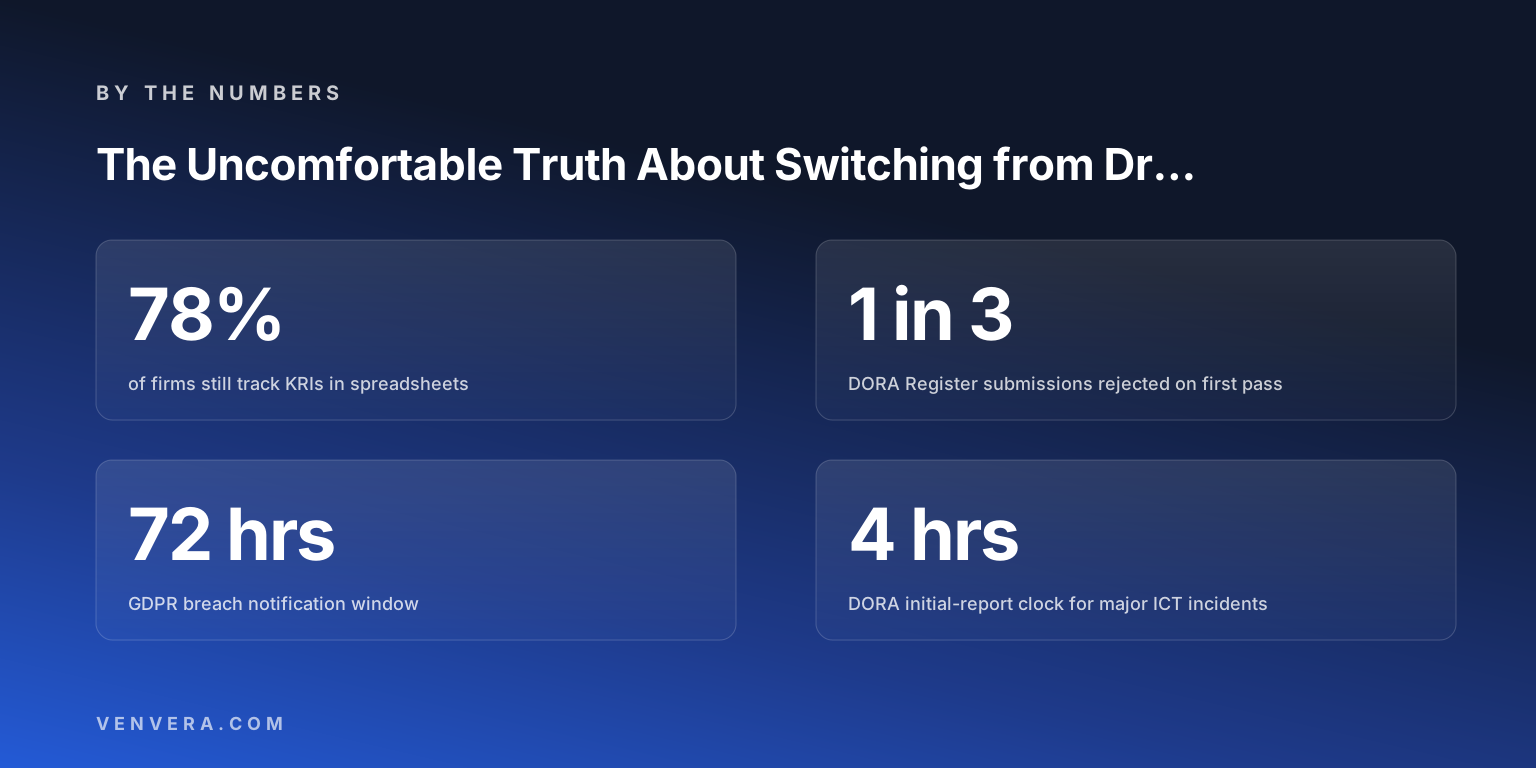
No processing activities register, no DPIA workflows, no 72-hour breach countdown. Controls mapped to articles, not operational requirements.
✗
DORA Gaps (Weakness)
No Register of Information, no xBRL-CSV export, no ESA entity codes. The DORA-specific requirements simply don't exist in Drata.
✗
Framework Silos (Weakness)
Same control documented separately in each framework module. No cross-framework mapping. Four modules, four times the work.
✗
Per-Framework Pricing (Weakness)
$25-30K per framework. Three frameworks = $75-90K/yr. Four = $100-120K. The costs compound faster than the compliance value.
⚖
FEATURE COMPARISON
SOC 2 Capabilities: An Honest Comparison
| SOC 2 Feature | Drata | Venvera |
|---|---|---|
| Trust Service Criteria (all 5 TSC) | ✓ All 5 TSC | ✓ All 5 TSC |
| Infrastructure Integrations | ✓ 100+ integrations | ◯ Growing |
| Continuous Monitoring | ✓ Mature | ✓ Available |
| Cross-Framework Mapping | ◯ Framework silos | ✓ 150+ mappings |
| EU Regulation Support (GDPR, NIS2, DORA) | ✗ Controls-mapping only | ✓ Purpose-built modules |
| Data Hosting | ◯ US default (EU option) | ✓ Amsterdam, EU |
| Single-Framework Annual Cost | ~$25-30K/yr | €4,788/yr (€399/mo) |
| Multi-Framework Annual Cost (3+) | $75-90K+/yr | €10,788/yr (€899/mo) |
🔬
DEEP DIVE
What Drata Gets Right About SOC 2
I genuinely mean this: Drata's SOC 2 implementation is strong. Let me give credit where it's earned.
- Evidence collection is automated and continuous. Connect AWS, Azure, GCP, Okta, GitHub. Evidence is timestamped and current. When your auditor asks "show me MFA enforcement," it's already there.
- The auditor experience is smooth. Auditor portal saves days of back-and-forth during audit season.
- Continuous monitoring catches drift. Someone disables MFA at 3am? Drata flags it before your auditor sees it.
- TSC mapping is comprehensive. Security, Availability, Confidentiality, Processing Integrity, Privacy - all five covered with pre-mapped controls.
If you only need SOC 2 and nothing else, Drata is a top-tier choice. But "only SOC 2 and nothing else" describes fewer and fewer companies each year. The inflection point where switching makes sense isn't because Drata's SOC 2 is bad - it's because the total cost and effort of multi-framework compliance on Drata is dramatically higher than it needs to be.
🔗
CROSS-FRAMEWORK MAPPING
SOC 2 + Everything Else
✓ Cross-framework impact:
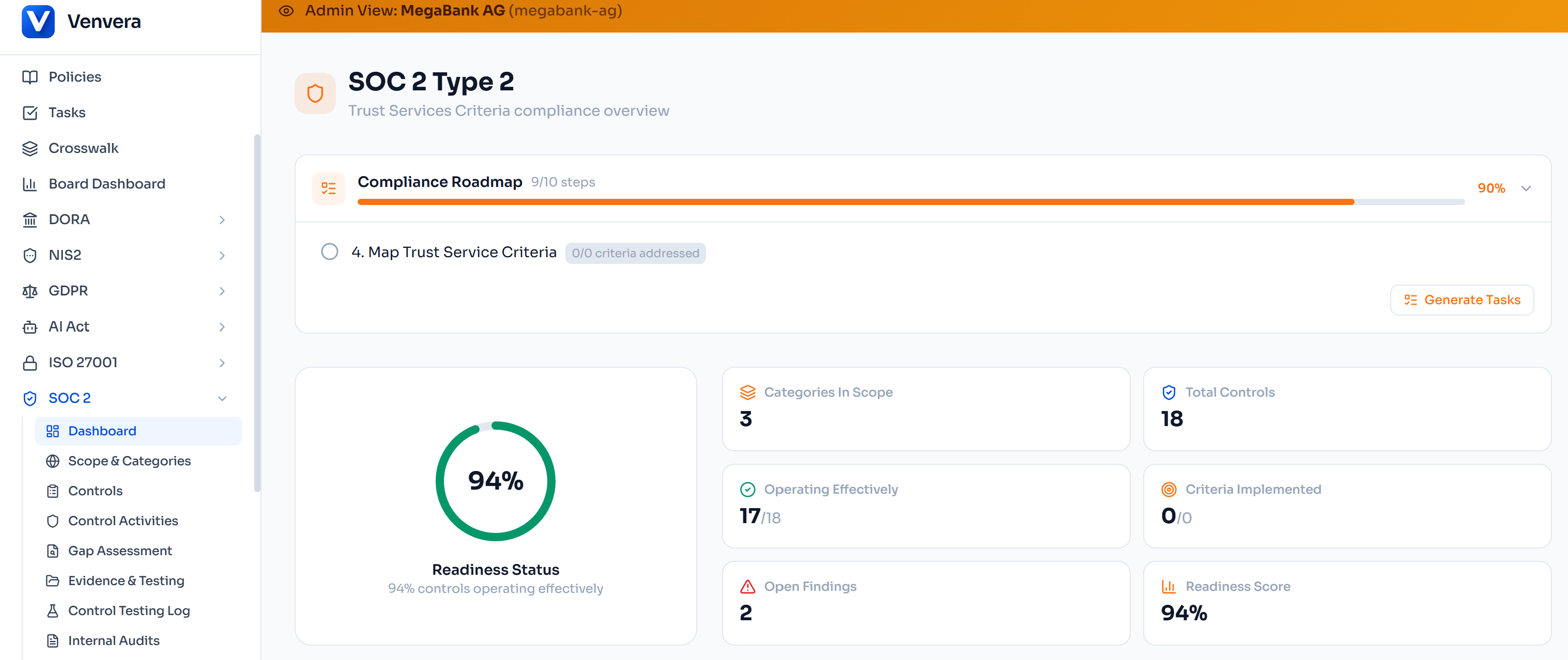
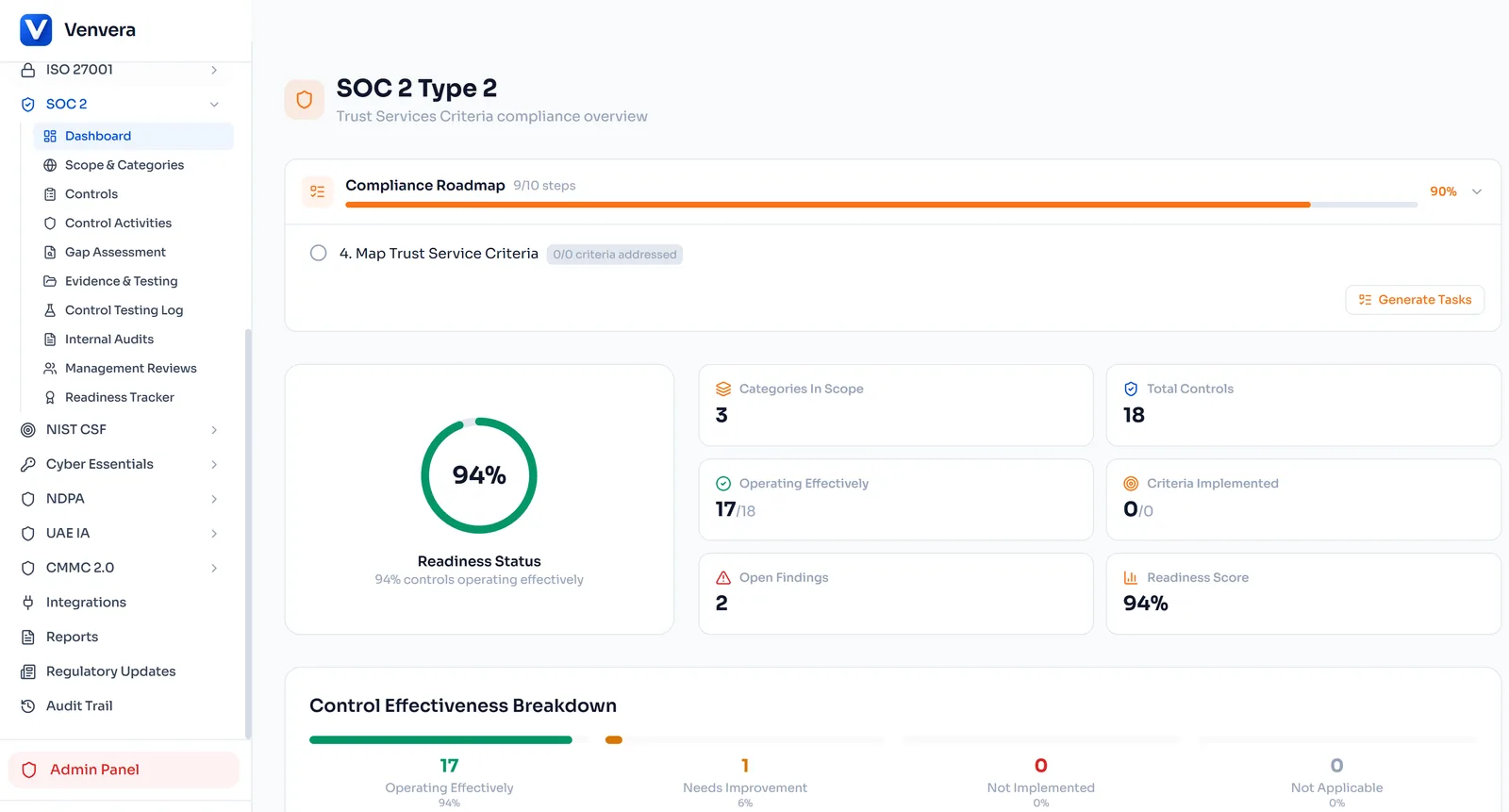
- SOC 2 controls overlap massively with ISO 27001 Annex A, GDPR Art. 32, and DORA ICT risk management
- 150+ pre-built mappings - implement one access control, satisfy requirements across SOC 2, ISO, GDPR, and DORA
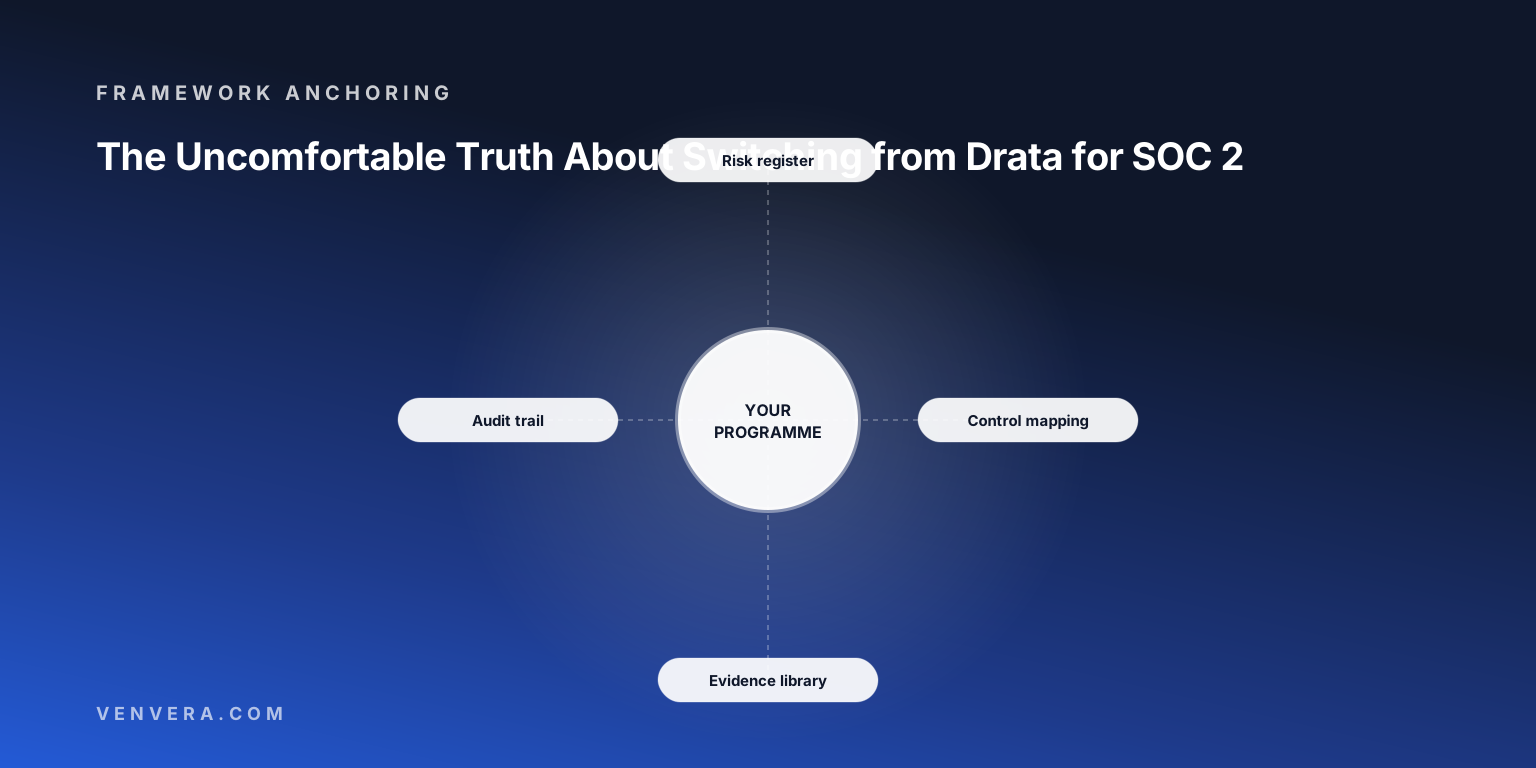
- With Drata: 4 frameworks = 4 separate modules, 4x the documentation, $100-120K/yr
- Venvera: €10,788/yr for all 16 frameworks with cross-mapping. The savings cover migration costs within a quarter.
💰
PRICING COMPARISON
The Numbers Nobody Puts in the Brochure
| Scenario | Drata | Venvera | You Save |
|---|---|---|---|
| SOC 2 only | ~$25-30K/yr | €4,788/yr | ~$20K/yr |
| SOC 2 + ISO 27001 | ~$50-60K/yr | €4,788/yr | ~$45-55K/yr |
| SOC 2 + ISO + GDPR | ~$75-90K/yr | €10,788/yr | ~$65-80K/yr |
| SOC 2 + ISO + GDPR + DORA | ~$100-120K/yr | €10,788/yr | $90-110K/yr |
🇪🇺
DATA SOVEREIGNTY
EU Hosting as Default
For companies with European clients or regulatory obligations, data hosting matters. Drata defaults to US hosting (EU option available). Venvera is hosted in Amsterdam with AES-256-GCM encryption. If you're adding GDPR or DORA alongside your SOC 2, EU hosting should be a given, not an add-on.
✅
WHO SHOULD SWITCH
Should You Actually Switch? The Honest Decision Tree
Switch to Venvera if:
- ☑ You need SOC 2 + EU regulations (GDPR, NIS2, DORA)
- ☑ You're paying $75K+ annually for multi-framework compliance tooling
- ☑ You want cross-framework mapping to eliminate duplicate documentation
- ☑ You're budget-constrained but need SOC 2 + one more framework
- ☑ You need purpose-built EU regulation modules, not controls-mapping
Stay with Drata if you only need SOC 2 (maybe + ISO 27001), you value deep infrastructure integrations above everything else, and you don't have EU regulatory obligations on the horizon. Drata is a genuine market leader for those specific use cases, and I'm not going to pretend otherwise. But the compliance landscape has changed. Regulations multiply. Frameworks overlap. And a platform that charges $25-30K per framework and treats each as an isolated silo creates a cost problem that gets worse every time your regulatory obligations expand.
SOC 2 + Everything Else, Without the Enterprise Price Tag
16 frameworks. 150+ cross-mappings. Purpose-built EU regulation modules.
All hosted in Amsterdam. From €399/month - not $25K per framework.
Book a Demo →Last updated: March 2026. Pricing and features based on publicly available data and hands-on evaluation. Contact vendors for current pricing.