
Best

Let me paint you a picture. It's January 2025. Your organisation has been classified as an "important entity" under NIS2. Your CISO just told the board that NIS2 compliance is handled because "we use Drata." The board nods. Everyone feels good.
Fast forward six months. A significant cybersecurity incident hits. Your team opens Drata to document it. They log the incident, assign a severity level, and... now what? NIS2 Article 23 requires an early warning to the CSIRT within 24 hours. Then a formal notification within 72 hours. Then a final report within one month. Drata's incident module doesn't know about any of this.
It's designed for tracking security incidents in the context of a SOC 2 audit - a completely different use case. No staged notification workflow. No CSIRT reporting fields. No cross-border impact assessment. Your team ends up scrambling through emails and documents while the 24-hour clock ticks. I've watched this happen three times now.
⚠
THE PROBLEM
NIS2 Is Not SOC 2 With a European Accent
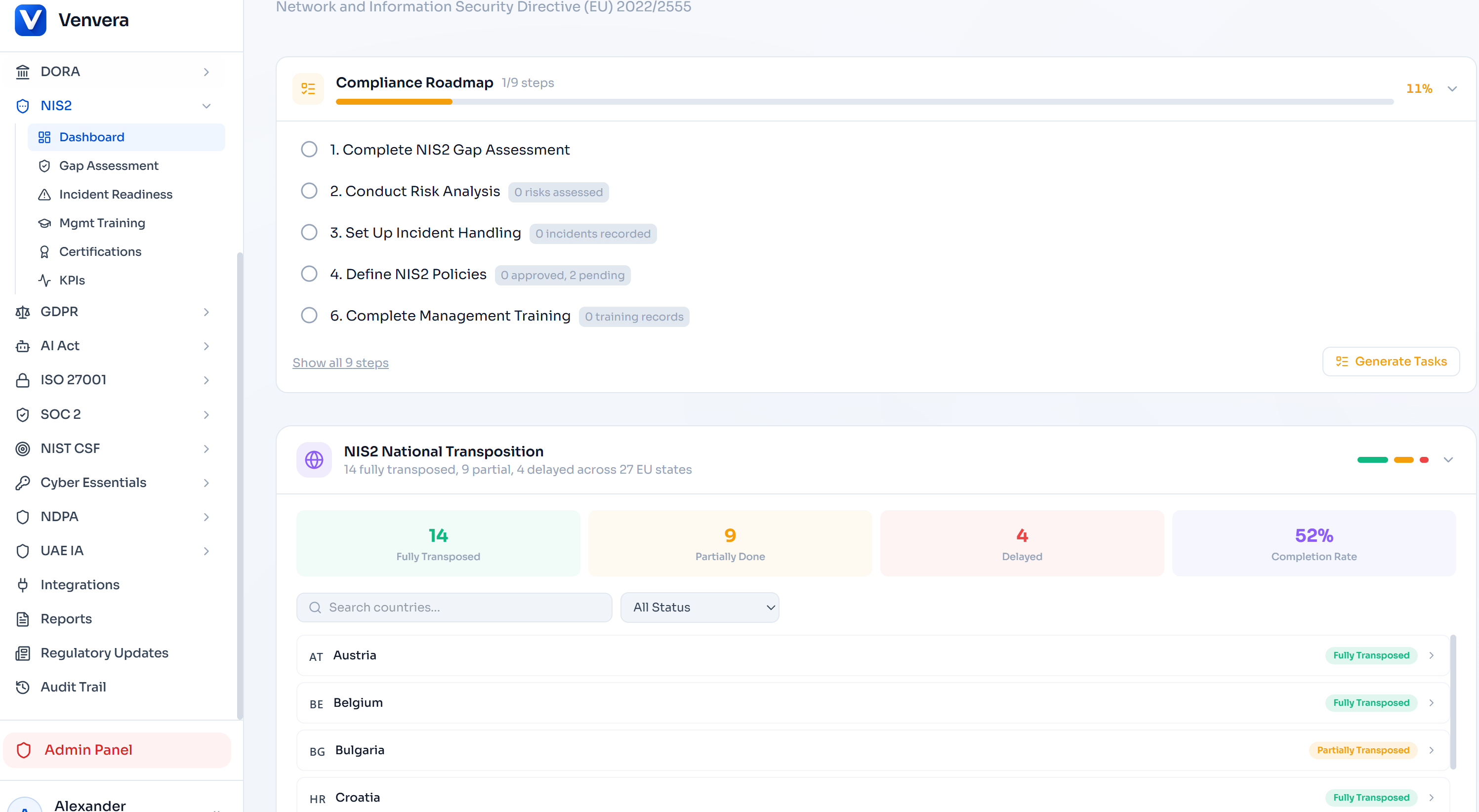
I keep hearing people describe NIS2 as "basically ISO 27001 but mandatory." That's dangerously wrong. NIS2 has specific operational requirements that go well beyond implementing security controls.
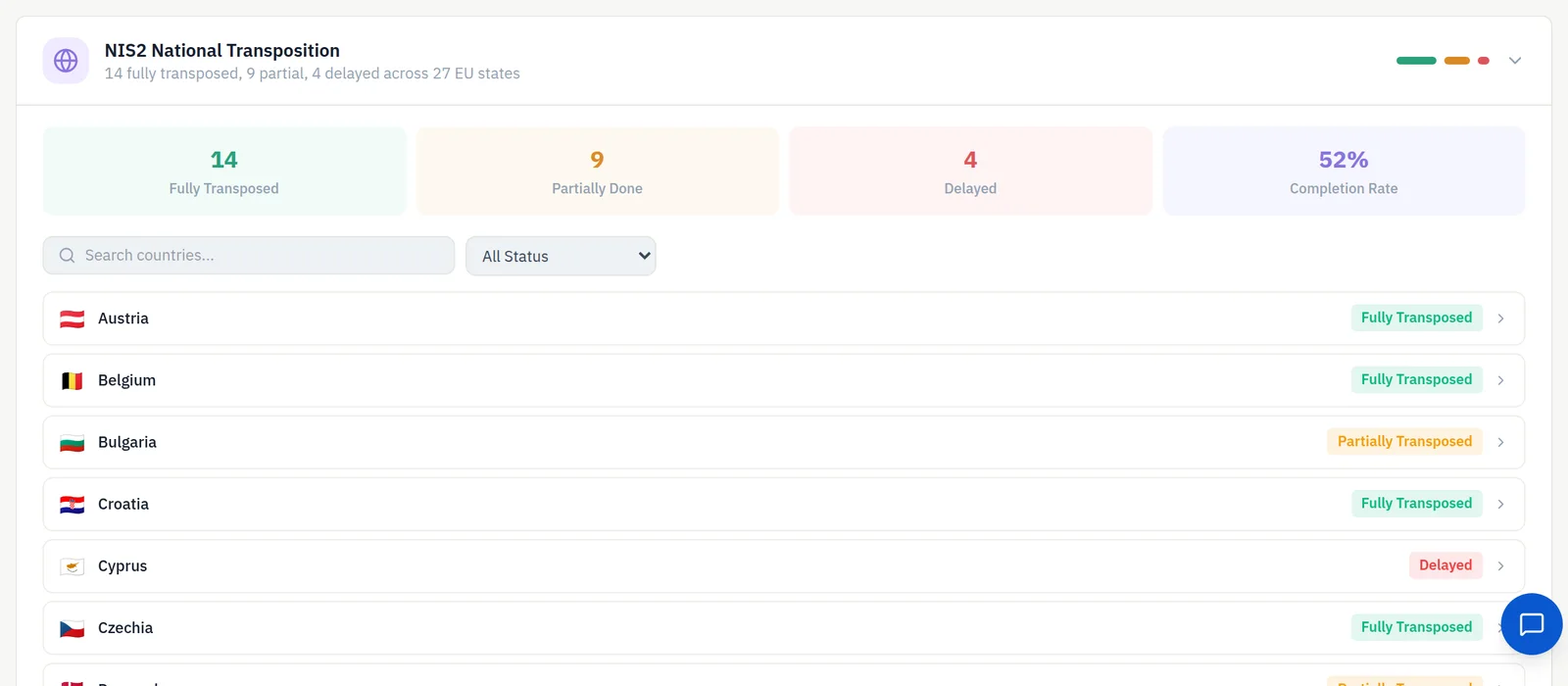
⚠ What makes NIS2 different:
- Incident reporting with teeth: Three-stage reporting to your national CSIRT - 24h early warning, 72h notification, 1-month final report. Miss the timeline and there are real penalties.
- Supply chain security (Art. 21): Actual risk assessment of critical suppliers with concentration analysis and contractual tracking - not just questionnaires.
- Management body accountability (Art. 20): Management personally responsible for approving and overseeing cybersecurity measures. They must also undergo training.
- Ten specific risk measures (Art. 21): Risk analysis, incident handling, business continuity, supply chain, vulnerability handling, cryptography, HR security, MFA - each needs documented implementation.
- Penalties that get attention: Up to €10M or 2% of global turnover for essential entities. Up to €7M or 1.4% for important entities. GDPR-level fines.
🔍
WHERE DRATA FALLS SHORT
Where Drata's Architecture Hits the Wall
Drata is genuinely good at what it was built for. Credit where it's due: their integration library is deep, their UI is clean, and for SOC 2 and ISO 27001, they're a top-tier choice. But NIS2 asks different questions.
🚨
Incident Reporting Workflow
No staged reporting (24h/72h/1mo), no CSIRT notification fields, no cross-border impact assessment. Tracks incidents for audit, not regulatory notification.
🔗
Supply Chain Risk Management
Vendor management focuses on security questionnaires and risk ratings. No concentration risk, dependency mapping, or contractual security provisions.
📊
KPI Tracking (Art. 21)
NIS2 requires demonstrating effectiveness over time. Drata shows pass/fail control status but doesn't track the KPIs that prove ongoing effectiveness.
👥
Management Governance (Art. 20)
No tracking for management approval of risk measures, training completion, or oversight documentation as required by Article 20.
🌐
EU Data Hosting
Default is US-based. EU hosting is an option, but for an EU cybersecurity directive, this should be the default, not an upgrade.
⚖
Risk Measures Assessment
Drata's answer to NIS2 is "controls mapped to articles." That's a starting point, not a solution for ten specific risk management areas.
⚖
FEATURE COMPARISON
Head-to-Head: What Matters for NIS2
| NIS2 Requirement | Drata | Venvera |
|---|---|---|
| Staged Incident Reporting (24h/72h/1mo) | ✗ Generic incidents only | ✓ Full staged workflow |
| Supply Chain Risk Assessment | ◯ Vendor questionnaires | ✓ Dependency + concentration |
| Article 21 Risk Measures (10 areas) | ◯ Controls mapped to articles | ✓ Purpose-built assessments |
| NIS2 KPI Tracking | ✗ Not available | ✓ Built-in KPI dashboards |
| Management Body Governance (Art. 20) | ✗ Not available | ✓ Governance tracking |
| Continuous Infrastructure Monitoring | ✓ 100+ integrations | ◯ Growing |
| Cross-Framework Mapping | ◯ Framework silos | ✓ 150+ mappings |
| Data Hosting | ◯ US default (EU available) | ✓ Amsterdam, EU |
| Risk Assessment Framework | ◯ Basic | ✓ Full framework |
| Annual Cost (multi-framework) | $25-30K+ per framework | €899/mo for 3 frameworks |
🔬
DEEP DIVE
Why Venvera Works for NIS2
Venvera treats NIS2 as what it is: an operational security directive that demands workflows, timelines, and structured reporting. Not a framework to be mapped to controls. That distinction matters when a CSIRT comes knocking.
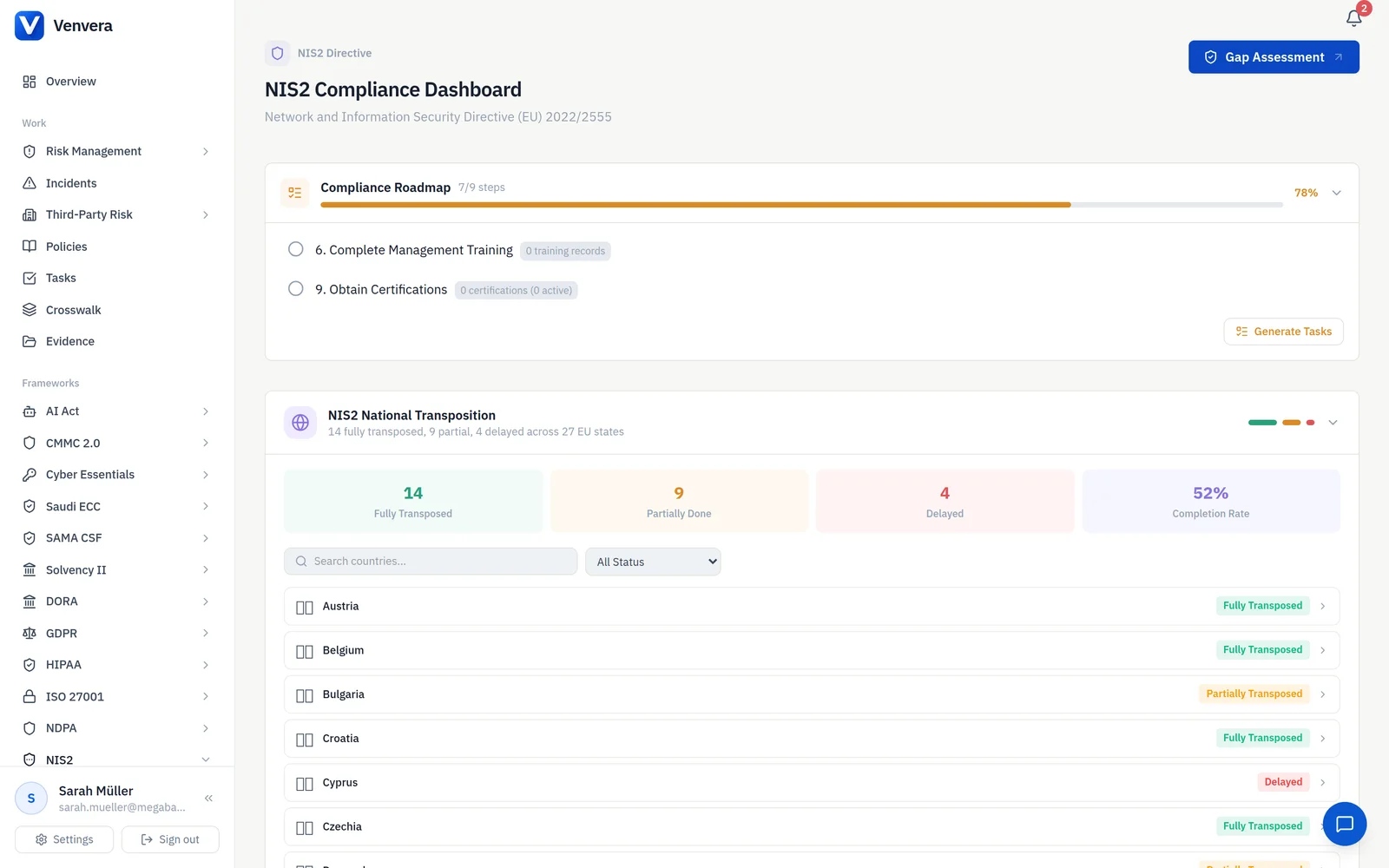
What changes when you switch:
- Incident reporting that matches NIS2 timelines - 24-hour early warning, 72-hour notification, one-month final report. Not generic "Low/Medium/High" tickets.
- Supply chain security beyond vendor questionnaires - actual risk assessment of your critical suppliers with concentration analysis and contractual tracking.
- KPI dashboards that demonstrate ongoing effectiveness of your ten Article 21 risk measures - not just pass/fail snapshots.
- Management governance tracking - approval records, training logs, oversight documentation as Article 20 requires.
🔗
CROSS-FRAMEWORK MAPPING
The Cross-Framework Argument (Stronger Than You Think)
NIS2 shares approximately 60-70% of its risk management measures with DORA and ISO 27001. If you're an EU financial entity, you need NIS2 + DORA + GDPR as a minimum. That's four frameworks with massive overlap - but only if your platform maps them.
✓ Cross-framework impact:
- 150+ pre-built mappings across NIS2, GDPR, ISO 27001, DORA, and 9 more
- Implement one business continuity plan and satisfy NIS2, ISO 27001 and DORA simultaneously
- With Drata, 3 frameworks at $25-30K each = $75-90K/year, none covering NIS2-specific requirements
- Venvera: €10,788/year - the difference funds a dedicated NIS2 programme manager
💰
PRICING COMPARISON
The Numbers That Change the Conversation
| Scenario | Drata | Venvera | You Save |
|---|---|---|---|
| NIS2 only | ~$25-30K/yr | €4,788/yr | ~$20K/yr |
| NIS2 + DORA + GDPR | ~$75-90K/yr | €10,788/yr | ~$65-80K/yr |
| 3-year total (3 frameworks) | ~$225-270K | €32,364 | $190-240K |
🇪🇺
DATA SOVEREIGNTY
An EU Directive Deserves EU Hosting
NIS2 is an EU cybersecurity directive protecting European essential and important entities. Your incident data, supply chain assessments, and risk measures documentation should live under EU jurisdiction. Drata's default is US hosting. Venvera is hosted in Amsterdam with AES-256-GCM encryption. No configuration needed, no add-on fees.
✅
WHO SHOULD SWITCH
The Honest Bottom Line
Switch to Venvera if:
- ☑ You need staged incident reporting with CSIRT notification timelines
- ☑ You need supply chain risk management beyond vendor questionnaires
- ☑ Your management body needs documented governance oversight (Art. 20)
- ☑ You're managing NIS2 alongside GDPR, DORA, or ISO 27001
- ☑ You need KPI-based effectiveness measurement, not just pass/fail controls
- ☑ You want EU-hosted compliance data as default, not an upgrade
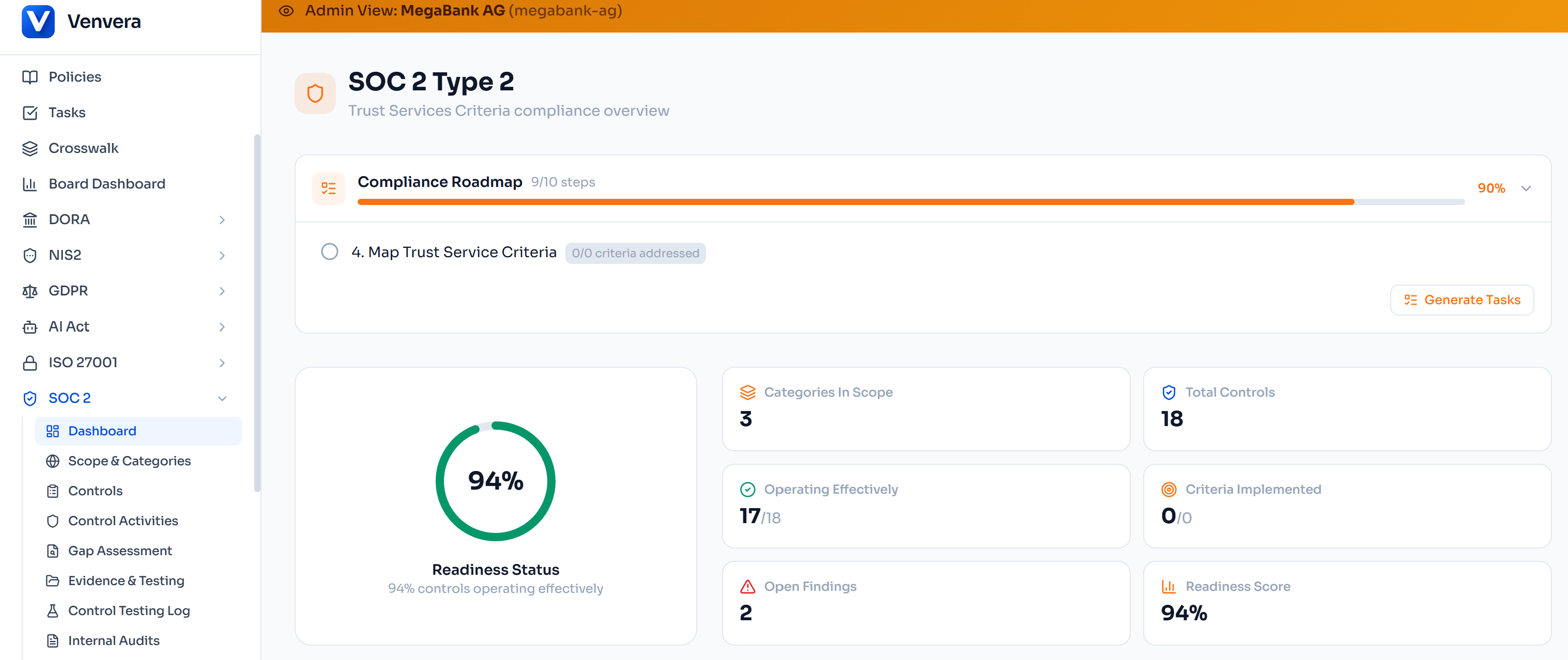
Keep Drata for SOC 2 or ISO 27001 if those are your primary obligations. It's genuinely excellent at infrastructure compliance automation. But don't rely on it for NIS2. The directive's operational requirements - staged incident reporting, supply chain risk management, management body governance - need purpose-built tooling. Mapping controls to NIS2 articles won't help when you're 20 hours into a 24-hour early warning deadline and your platform can't generate the CSIRT notification.
NIS2 Compliance That Meets the Directive's Actual Requirements
Staged incident reporting. Supply chain risk management. Management governance tracking.
16 frameworks with 150+ cross-mappings. EU-hosted. From €399/month.
Book a Demo →Last updated: March 2026. Feature and pricing information based on publicly available data and hands-on evaluation. Contact vendors for current details.