
Learn

After reading this, you’ll know definitively which regulation applies to your organisation, where they overlap, where they diverge, and how to handle the awkward case where you need both.
It is a question that surfaces in board meetings constantly: do we need to comply with DORA or NIS2? The instinct is to treat the two as different labels for the same set of rules. They are not, and the difference decides which obligations actually bind you.
They’re not the same thing. At all. But I understand the confusion. Both are EU regulations (well, DORA is a regulation, NIS2 is technically a directive - and yes, that distinction matters). Both deal with cybersecurity and digital resilience. Both came out of the same wave of EU digital regulation. And both use enough similar terminology that it’s easy to assume they’re just different labels for the same set of rules.
That assumption will cost you. Let me explain why.
The 60-Second Version
For the impatient (I get it), here’s the executive summary:
DORA
Full name: Digital Operational Resilience Act (Regulation 2022/2554)
Type: Regulation (directly applicable in all EU Member States)
Scope: Financial sector only - banks, insurers, investment firms, payment institutions, crypto-asset service providers, and their critical ICT providers
Focus: ICT risk management, operational resilience, third-party ICT risk, incident reporting, resilience testing
Applicable since: 17 January 2025
NIS2
Full name: Network and Information Security Directive 2 (Directive 2022/2555)
Type: Directive (must be transposed into national law by each Member State)
Scope: Cross-sector - energy, transport, health, digital infrastructure, banking, financial market infrastructure, public administration, space, ICT service management, and more
Focus: Cybersecurity risk management, incident reporting, supply chain security, governance obligations
Transposition deadline: 17 October 2024 (most Member States missed it)
Already you can see the key difference. DORA is laser-focused on the financial sector and goes deep into ICT-specific requirements. NIS2 casts a wide net across many sectors but stays at a higher level of abstraction. They’re complementary, not interchangeable.
The Lex Specialis Principle: Why This Changes Everything
Here’s the legal concept that most articles mention but few explain properly.
DORA is what lawyers call lex specialis in relation to NIS2. In plain language: when two laws cover the same ground, the more specific law takes precedence. DORA is the specific law for the financial sector; NIS2 is the general law for critical sectors broadly.
The mechanism sits in two provisions. DORA Article 1(2) states that DORA is a sector-specific Union legal act for the purposes of Article 4 of NIS2. Article 4 of NIS2 is the operative rule: where a sector-specific act such as DORA imposes cybersecurity risk-management or incident-notification requirements at least equivalent in effect to NIS2’s, the corresponding NIS2 provisions - and NIS2’s supervision and enforcement regime - do not apply to those entities. NIS2 recital 28 names DORA as exactly that act for financial entities. In practice, DORA displaces NIS2 on ICT risk management, incident reporting, and supervision.
What does this mean in practice?
- If you’re a bank and both DORA and NIS2 require incident reporting, you follow DORA’s rules (4-hour initial notification, specific RTS criteria), not NIS2’s rules (24-hour early warning, 72-hour notification).
- If both require cybersecurity risk management, DORA’s detailed ICT risk management framework (Articles 5-16) overrides NIS2’s more general requirements (Article 21).
- If both require governance, DORA’s specific board-level ICT risk oversight requirements (Article 5) take precedence.
But - and this is the crucial “but” - lex specialis only applies where both laws address the same topic. Where NIS2 covers something that DORA doesn’t, NIS2 still applies in full. And there are several areas where NIS2 goes further.
This is where most compliance teams trip up. They hear “DORA takes precedence” and assume they can ignore NIS2 entirely. They can’t.
Credit where it is due, though: the carve-out itself is well drafted. Article 4 of NIS2 gives you a real test to apply (is the sector-specific requirement at least equivalent in effect?) rather than a vague gesture at coherence, and DORA Article 1(2) writes itself into that test explicitly. The mechanism is the clean part. The mess is that nobody hands you the list of what falls outside it, so you have to build that list yourself and defend it.
Credit where it is due, though: the carve-out itself is well drafted. Article 4 of NIS2 gives you a real test to apply (is the sector-specific requirement at least equivalent in effect?) rather than a vague gesture at coherence, and DORA Article 1(2) writes itself into that test explicitly. The mechanism is the clean part. The mess is that nobody hands you the list of what falls outside it, so you have to build that list yourself and defend it.
Where They Overlap, Where They Diverge
The detailed breakdown your compliance team actually needs
Incident Reporting: Same Goal, Different Mechanics
Both DORA and NIS2 require incident reporting. But the specifics are meaningfully different:
| Aspect | DORA | NIS2 |
|---|---|---|
| What triggers reporting | Major ICT-related incidents meeting specific RTS thresholds | “Significant” incidents with criteria set by each Member State |
| Initial notification | Within 4 hours of classifying it as major, and no later than 24 hours after becoming aware | Early warning within 24 hours; full notification within 72 hours |
| Intermediate report | Within 72 hours (or sooner if status changes) | Updates upon request |
| Final report | Within 1 month | Within 1 month |
| Report to whom | National financial supervisor (NCA) | CSIRT and/or competent authority (varies by Member State) |
For financial entities: DORA’s incident reporting framework applies (lex specialis). The 4-hour initial notification is more demanding than NIS2’s 24-hour early warning, which means if you’re DORA-compliant on incident reporting, you’re effectively exceeding NIS2’s requirements in that area.
Risk Management: Different Depth, Different Focus
NIS2 Article 21 lists ten categories of cybersecurity risk management measures that entities must implement, including risk analysis policies, incident handling, supply chain security, encryption, access control, and more. It’s comprehensive but high-level - it tells you what to do without specifying how in granular detail.
DORA goes much deeper. Articles 5-16 lay out a detailed ICT risk management framework with specific requirements for:
- ICT asset management and classification
- Change management procedures
- ICT business continuity management with specific recovery time objectives
- Communication strategies during ICT incidents
- Learning and evolving from incidents
- Board-level approval and oversight of the ICT risk management framework
For financial entities, DORA’s framework is the one you build to. But if you’re a financial entity that also falls under NIS2 for non-ICT cybersecurity matters (e.g., physical security of network infrastructure), those NIS2 requirements may still apply alongside DORA.
Third-Party Risk: DORA Goes Way Further
This is where the gap between the two is widest. NIS2 Article 21(2)(d) requires entities to address “supply chain security” as part of their risk management. That’s one paragraph. One.
DORA dedicates an entire chapter (Articles 28-44) to ICT third-party risk management. It requires:
- A Register of Information documenting all ICT third-party relationships
- Specific contractual provisions for ICT outsourcing (audit rights, exit strategies, data location, sub-outsourcing controls)
- Due diligence and risk assessment before entering ICT contracts
- Ongoing monitoring of ICT third-party risk
- Concentration risk assessment
- Exit strategies for critical ICT providers
- A new ESA oversight framework for critical third-party ICT providers (CTPPs)
If you’re doing DORA properly, you’re doing supply chain security to a standard that far exceeds what NIS2 requires. This is the one area where DORA compliance gives you NIS2 compliance almost for free. My honest view of that asymmetry: NIS2 is too thin here for the risk it is aimed at. A single paragraph on supply chain security, stretched across energy, health, water and transport, is a lot of weight on a very small hook, and it leaves each national authority to invent the detail. Financial entities get the more demanding regime and, unusually, the easier life, because at least DORA tells you exactly what a contract has to contain.
When You Need Both: The Financial Entity + Essential Entity Problem
Here’s the scenario that keeps compliance teams up at night.
NIS2 Annex I lists “banking” and “financial market infrastructures” as essential sectors. This means many financial entities are also classified as essential or important entities under NIS2. DORA takes precedence on overlapping matters, but NIS2 adds some things that DORA doesn’t cover:
NIS2 management liability. NIS2 Article 20 introduces personal liability for management body members who fail to ensure compliance with cybersecurity obligations. DORA Article 5 requires board oversight of ICT risk, but the personal liability angle in NIS2 is more explicit and punitive in some Member State transpositions.
NIS2 cybersecurity training. NIS2 Article 20(2) requires management bodies to follow cybersecurity training and encourages similar training for all employees. DORA addresses ICT security awareness (Article 13(6)) but doesn’t match NIS2’s specific management training mandate.
NIS2 registration requirements. NIS2 Article 27 requires entities to register with the relevant CSIRT or competent authority. Financial entities may need to complete this registration even if they’re primarily regulated under DORA.
NIS2 penalty framework. NIS2’s penalties are harmonised at the EU level: up to €10 million or 2% of global annual turnover for essential entities. DORA’s penalties are set by each Member State. Depending on the jurisdiction, NIS2 penalties might actually be higher for certain violations.
The practical implication? Even if you’re fully DORA-compliant, you may still need to satisfy specific NIS2 requirements that DORA doesn’t address. This requires a gap analysis between the two - mapping exactly which obligations are covered by DORA and which remain open under NIS2.
Rank those items before you work on them, because they are wildly different in weight. Registration is administrative: someone finds the right portal, completes a form, files the confirmation. Board training is a half-day and an attendance record. Management liability is the one that deserves real board time, because it changes who personally carries the consequence, and it is also the item most likely to have been transposed differently in every country you operate in.
Rank those items before you work on them, because they are wildly different in weight. Registration is administrative: someone finds the right portal, completes a form, files the confirmation. Board training is a half-day and an attendance record. Management liability is the one that deserves real board time, because it changes who personally carries the consequence, and it is also the item most likely to have been transposed differently in every country you operate in.
Which Applies to You? A Decision Framework
Rather than give you another table comparing 20 dimensions, let me give you the decision tree that actually helps:
Are you a financial entity under DORA Article 2?
Credit institutions, investment firms, payment institutions, electronic money institutions, insurance undertakings, reinsurance undertakings, insurance intermediaries, IORPs, CRAs, securitisation repositories, trade repositories, CSDs, CCPs, trading venues, management companies, AIFMs, data reporting providers, crypto-asset service providers, crowdfunding service providers. If yes → DORA applies. It’s your primary regulation.
Are you also an essential or important entity under NIS2?
Banks and financial market infrastructures are listed in NIS2 Annex I as essential sectors. If you’re a credit institution or a financial market infrastructure, you’re likely dual-scope. Check your Member State’s NIS2 transposition for the exact entity classification. If yes → Both apply. DORA takes precedence on overlapping areas; NIS2 fills the gaps.
Are you NOT a financial entity but you provide ICT services to financial entities?
You might be designated as a critical third-party ICT provider (CTPP) under DORA’s oversight framework. Separately, if you’re a managed service provider, cloud computing provider, or digital infrastructure operator, NIS2 likely applies to you as an essential or important entity. If yes → NIS2 is your primary regulation, plus potential DORA CTPP oversight.
Are you in a non-financial sector covered by NIS2?
Energy, transport, health, water, digital infrastructure, public administration, space, postal services, waste management, food, manufacturing, chemicals, research. If yes → NIS2 only. DORA doesn’t apply to you.
If You’re Dual-Scope: The Efficient Approach
For financial entities subject to both DORA and NIS2, the good news is that DORA’s requirements are almost always equal to or more stringent than NIS2’s corresponding requirements. So if you build your compliance programme around DORA, you’re covering most of NIS2 as a byproduct.
The efficient approach has three steps:
Step 1: Build for DORA first. It’s the more detailed and demanding framework. Your ICT risk management framework, incident reporting process, third-party risk management, and resilience testing programme should all be built to DORA specifications.
Step 2: Gap-analyse against NIS2. Once your DORA programme is in place, map it against your Member State’s NIS2 transposition. Identify the specific NIS2 requirements that DORA doesn’t cover - management liability provisions, training mandates, registration requirements, any sector-specific measures.
Step 3: Fill the gaps with targeted controls. For each NIS2 requirement not covered by DORA, add a specific control to your compliance programme. This is usually a relatively small number of items, because the overlap is substantial. Realistically, if your DORA programme is genuinely working, the NIS2 delta is weeks of work and most of it is writing, filing and minuting rather than building anything. The expensive part was DORA. Be sceptical of anyone proposing a second full programme to close a gap that size.
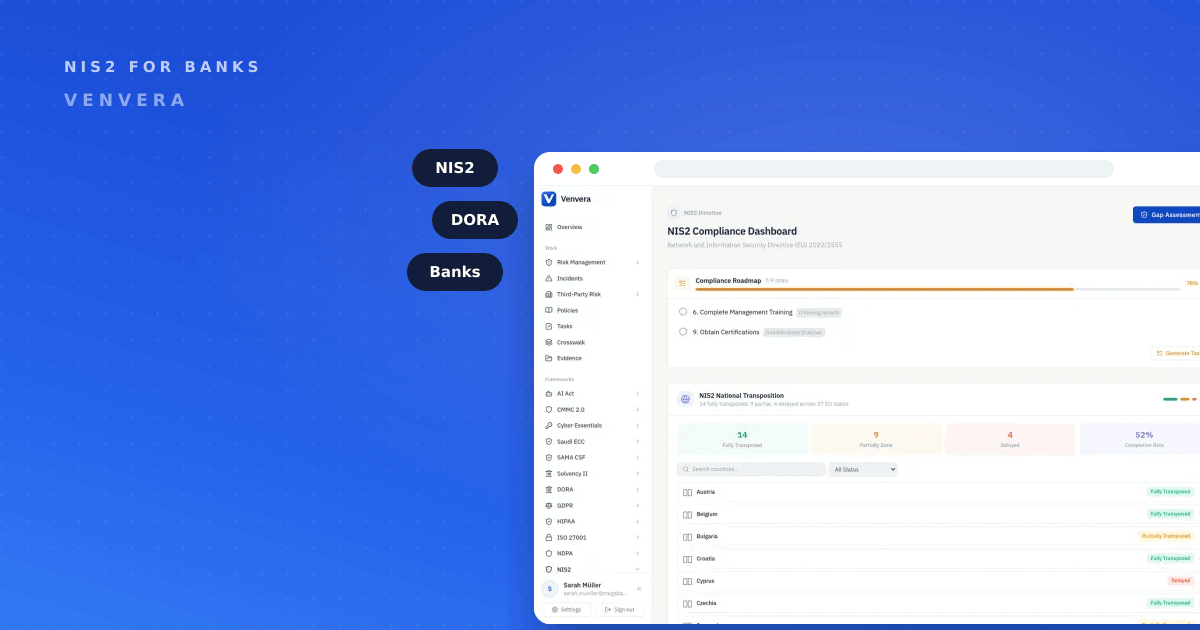
This is exactly the kind of cross-framework gap analysis that multi-framework compliance platforms are designed for. Venvera, for instance, supports both DORA and NIS2 and maps the overlaps automatically - showing you which DORA controls satisfy NIS2 requirements and where additional work is needed.
The alternative - building two separate compliance programmes with separate teams, documentation, and risk assessments - is roughly twice the work for the same outcome, and the two programmes tend to drift apart and contradict each other where they touch.
The NIS2 Transposition Problem
One more wrinkle that makes the DORA-NIS2 comparison harder than it should be: NIS2 is a directive. Unlike DORA (which applies directly and identically across all EU Member States), NIS2 had to be transposed into national law by each Member State by 17 October 2024.
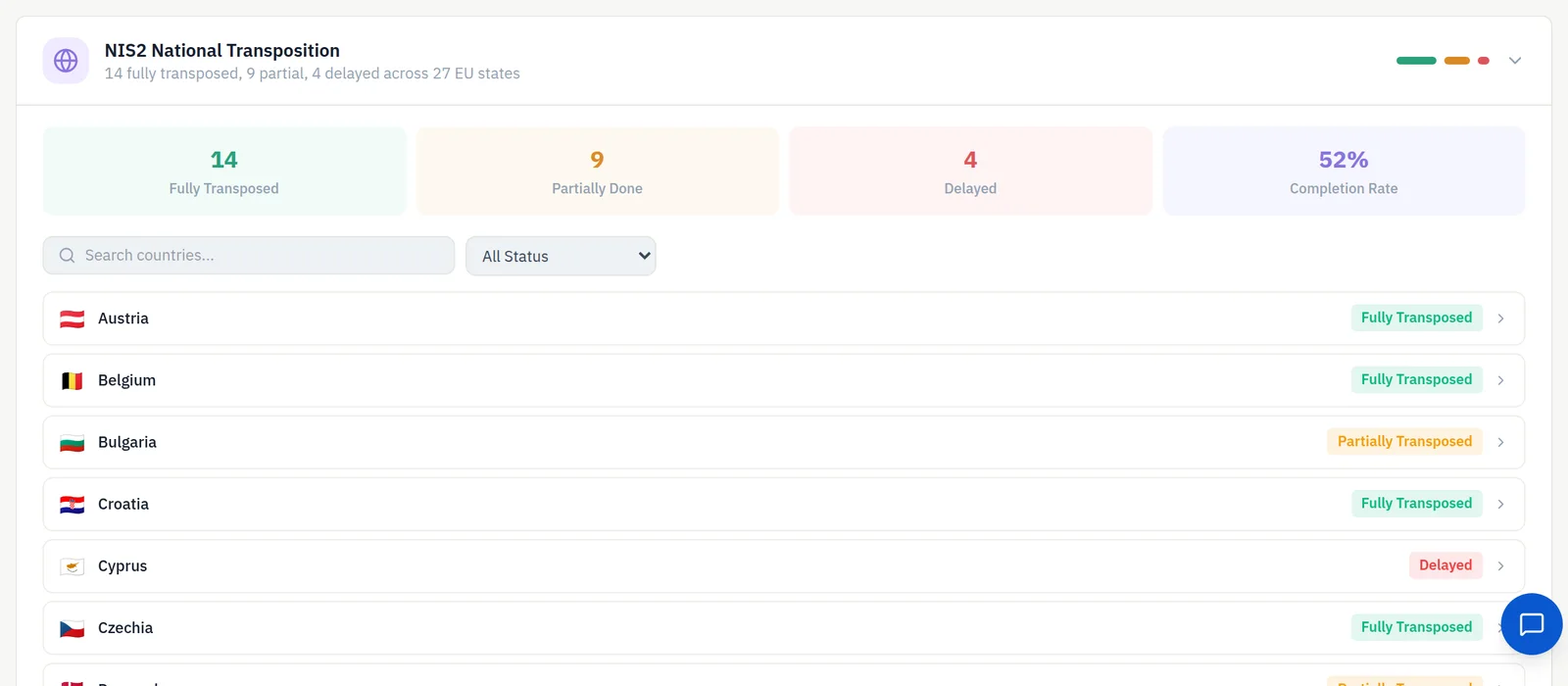
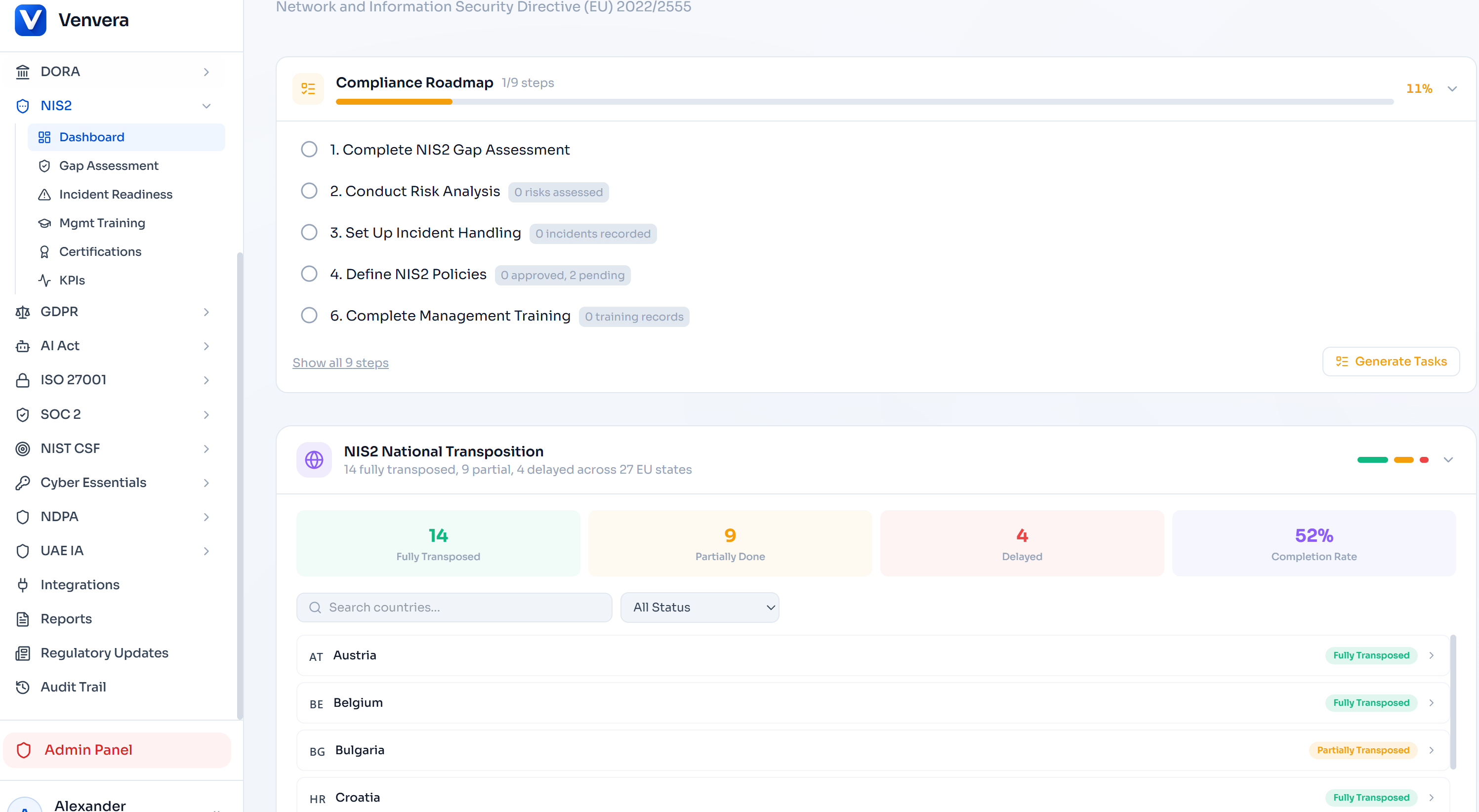
Most Member States missed that deadline. As of early 2026, several are still finalising their national transpositions. And the transpositions that do exist aren’t identical - they have different entity classification thresholds, different penalty levels, different registration procedures, and different national CSIRT arrangements.
For a multi-jurisdictional financial group, this means:
- DORA applies identically across all your EU entities (good for consistency)
- NIS2 varies by country, so your German subsidiary faces different NIS2 specifics than your French or Irish one (less good for consistency)
- You need to track multiple national transpositions to understand your NIS2 obligations in each jurisdiction
This is honestly one of the most frustrating aspects of the current regulatory landscape. DORA gives you one set of rules. NIS2 gives you 27 slightly different sets of rules. Managing this without a system that tracks regulatory frameworks across jurisdictions is, frankly, a headache nobody should have to endure manually. And it was an avoidable choice. The EU picked a regulation for finance and a directive for everything else, which handed the harmonised instrument to the sector with the most compliance capacity and left the sectors with the least to reconcile twenty-seven variants. If you operate across borders, assume the national detail will keep moving for a while yet, and build your NIS2 mapping so that one country can be updated without touching the rest.
The Bottom Line
DORA and NIS2 are not the same thing. They’re not interchangeable. For financial entities, DORA is your primary framework, but NIS2 likely applies too - and ignoring it creates real regulatory risk.
The smart approach is to build for DORA (the harder, more specific framework), then gap-analyse against NIS2 (the broader, more general one). The overlap is substantial - most of what NIS2 asks for in risk management and incident reporting has a DORA equivalent - so the incremental effort for NIS2 compliance, once you’re DORA-ready, is focused on the handful of areas NIS2 adds.
But only if you do it intentionally, with proper mapping between the two frameworks, rather than hoping that DORA compliance magically covers everything NIS2 requires. It doesn’t. Close, but not quite.
Managing more than one legal entity? See how Venvera handles compliance software for groups of companies - author policies once at the parent and let each subsidiary prove them with its own evidence. If both apply to you, budget them together: DORA compliance cost and NIS2 compliance cost break down each side.
Frequently Asked Questions
Do financial entities have to comply with both DORA and NIS2?
Often, yes. If you are a financial entity under DORA Article 2 and you also fall in a NIS2 sector - banking and financial market infrastructures are listed in NIS2 Annex I as essential sectors - both apply. DORA takes precedence on ICT risk management, incident reporting, and supervision, but NIS2 still applies to anything DORA does not cover, such as its management-training and registration duties.
Which incident reporting timeline applies to a bank, DORA’s or NIS2’s?
DORA’s. As lex specialis, DORA’s reporting rules govern financial entities: an initial notification within 4 hours of classifying an incident as major and no later than 24 hours after becoming aware, an intermediate report within 72 hours, and a final report within one month. You do not separately run NIS2’s 24-hour and 72-hour timeline for the same incident.
Does DORA compliance automatically make me NIS2 compliant?
Mostly, but not entirely. DORA is generally equal to or stricter than NIS2 on the overlapping areas, so building for DORA covers most of NIS2. The gaps are the items DORA does not fully match - management-body liability and training under NIS2 Article 20, and registration under NIS2 Article 27 - which you add on top.
Why does NIS2 vary between EU countries but DORA does not?
DORA is a regulation, directly applicable and identical across all Member States. NIS2 is a directive that each Member State transposes into its own national law (the transposition deadline was 17 October 2024), so entity thresholds, penalty levels, and registration procedures differ from country to country.
What are the penalties under DORA versus NIS2?
NIS2 caps administrative fines at up to EUR 10 million or 2% of total worldwide annual turnover for essential entities, and EUR 7 million or 1.4% for important entities. DORA leaves administrative penalties to each Member State, so the ceiling depends on the jurisdiction; separately, the EU oversight framework for critical ICT third-party providers can impose periodic penalty payments.
Primary sources
This comparison is drawn from the two instruments and the Commission’s interpretive guidance: Regulation (EU) 2022/2554 (DORA), in particular Article 1(2); the NIS2 Directive (EU) 2022/2555, in particular Article 4, Article 20, Article 27, Article 34 and recital 28; and the European Commission’s guidelines on the application of Article 4 of NIS2 to sector-specific acts. Confirm your Member State’s NIS2 transposition for jurisdiction-specific detail.
Map DORA and NIS2 Together
Venvera maps DORA and NIS2 together, so you can see exactly where your DORA compliance satisfies NIS2 and where gaps remain - starting at €399/month.
Book a Demo →Last reviewed: July 2026. NIS2 transposition status varies by Member State. Consult your local competent authority for jurisdiction-specific NIS2 requirements.