Resources

Search for Solvency II software and you will get three completely different kinds of product dressed in the same words. One vendor sells an actuarial capital engine. Another sells a reporting tool that spits out XBRL returns for the regulator. A third sells a governance and compliance platform that keeps your board, your policies, and your key functions in order. All three legitimately call themselves Solvency II software. None of them does the other two jobs. If you buy the wrong category, you either overpay for capability you will never use or you discover a gap three weeks before a supervisory review.
This guide is written for the person who actually owns the buying decision on the governance side: the CRO, the Head of Risk, the Head of Compliance, or a key-function holder at an EU insurer or reinsurer. It explains the categories in plain language, tells you what to look for in the governance layer specifically, and shows how the right tooling removes duplicate work if you are already running DORA, NIS2, or ISO 27001. It is deliberately scope-honest, because the fastest way to lose credibility with a supervisor is to claim a tool does something it does not.
What Solvency II actually requires, in three pillars
Solvency II is the EU prudential regime for insurers and reinsurers, built on Directive 2009/138/EC and the Delegated Regulation (EU) 2015/35, with detailed EIOPA guidelines layered on top. It is organised into three pillars, and the pillar you are in determines which software you need.
- Pillar 1 - quantitative requirements. The capital math: the Solvency Capital Requirement (SCR), the Minimum Capital Requirement (MCR), technical provisions, and the standard formula or internal model that produces those numbers. This is the domain of actuarial and capital-modelling software.
- Pillar 2 - system of governance. The qualitative requirements set out in Articles 40 to 49 of the Directive: board (AMSB) responsibility, written policies, the risk management system, the ORSA as a process, the four key functions, fit and proper, remuneration, and outsourcing. This is the domain of governance and GRC software.
- Pillar 3 - reporting and disclosure. The Quantitative Reporting Templates (QRTs), the Solvency II XBRL returns, the SFCR and RSR narratives. This is the domain of regulatory reporting software.
Most of the confusion in the market comes from buyers who type "Solvency II software" expecting one product and finding vendors from all three pillars competing for the click. The rest of this guide focuses on Pillar 2, because that is where the governance buyer lives, and because it is the pillar most often under-tooled. Firms spend heavily on the capital engine and the QRT tool, then run the entire system of governance on a shared drive full of Word documents and a spreadsheet of key-function holders.
That imbalance is rational up to a point. Pillar 1 and Pillar 3 have hard outputs and hard filing dates, so they win the budget argument every year. Pillar 2 has no filing date, which is precisely why it drifts. The bill arrives later as a governance finding, and governance findings are slow and expensive to close because they are about behaviour rather than a number you can recalculate over a weekend.
The three categories of Solvency II software
1. Actuarial and capital modelling (Pillar 1)
These platforms calculate the SCR and MCR, value technical provisions, run the standard formula or a full or partial internal model, and stress-test the balance sheet. They are the mathematical heart of the regime. If you need to produce the capital number, you need one of these, and no governance tool replaces it. Buyers evaluate these on model accuracy, computational performance, scenario flexibility, and audit trail over the calculation itself.
2. QRT and XBRL regulatory reporting (Pillar 3)
These platforms take the numbers from your actuarial engine and your ledgers and format them into the QRTs, validate them against EIOPA's taxonomy, and produce the XBRL instance documents you file with your national supervisor. They handle the SFCR and RSR narrative reporting too. Buyers evaluate these on taxonomy coverage, validation rule completeness, filing workflow, and how quickly the vendor ships each new EIOPA taxonomy release.
3. Governance and GRC (Pillar 2)
This is the layer that manages the system of governance: the controls, the written policies, the board and committee oversight, the ORSA as a governed process, the four key functions, fit and proper assessments, remuneration governance, and outsourcing registers. This is where Solvency II governance software like Venvera sits. It does not calculate your SCR and it does not file your QRTs. It complements your actuarial engine and your XBRL reporting tool by proving that the organisation running those tools is properly governed, controlled, and documented.
Being explicit about this boundary matters. A governance platform that claimed to produce capital numbers or file XBRL returns would be misrepresenting itself, and a supervisor would find that out fast. The honest position is that the three categories are complementary. You will very likely own one product from each pillar.

Inside Pillar 2: what governance software has to cover
The system of governance is a standing set of obligations that a supervisor can test at any time. Good Solvency II software turns each of these obligations into something structured, owned, evidenced, and reviewable rather than a document that was last touched eleven months ago. The core areas map directly to the Directive.
| Requirement | Legal basis | What the software manages |
|---|---|---|
| Board (AMSB) responsibility | Art 40 | Ultimate accountability, oversight records, sign-offs |
| Fit and proper | Art 42 | Assessments and re-assessments of key persons |
| Risk management system | Art 44 | Risk strategy, appetite, policy set, review cadence |
| ORSA (as a process) | Art 45 | Board workflow, documentation, policy, sign-off trail |
| Internal control and compliance function | Art 46 | Control library, compliance monitoring plan |
| Internal audit function | Art 47 | Independence, audit plan, findings tracking |
| Actuarial function | Art 48 | Function governance, opinions, reporting to the board |
| Outsourcing | Art 49 | Register, criticality, ICT outsourcing overlap with DORA |
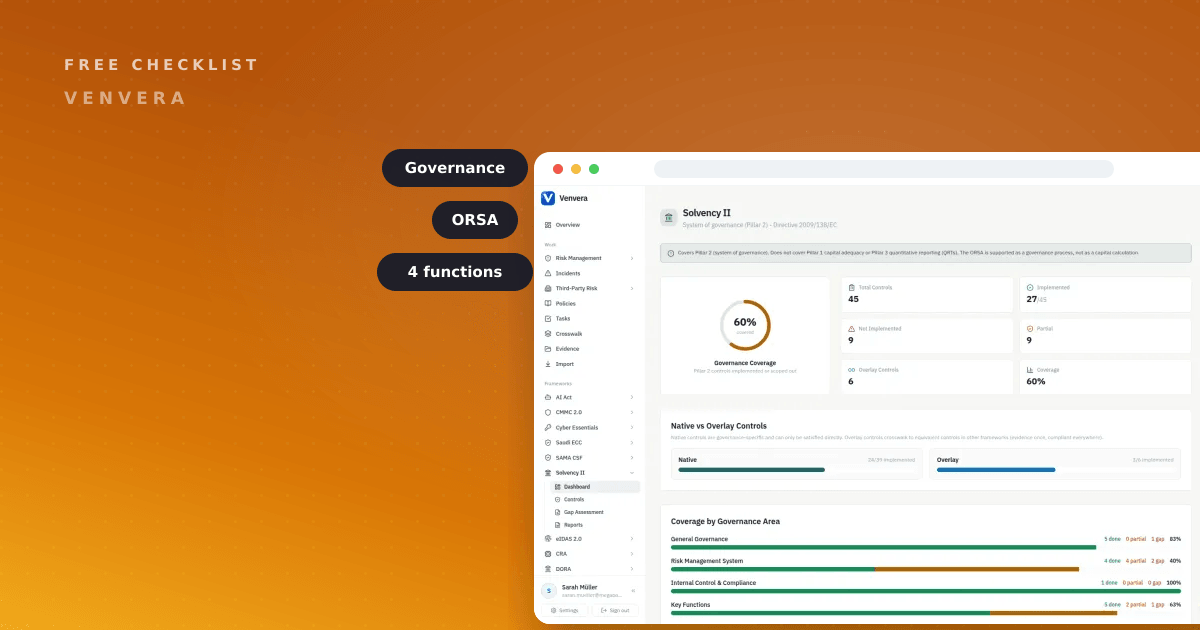
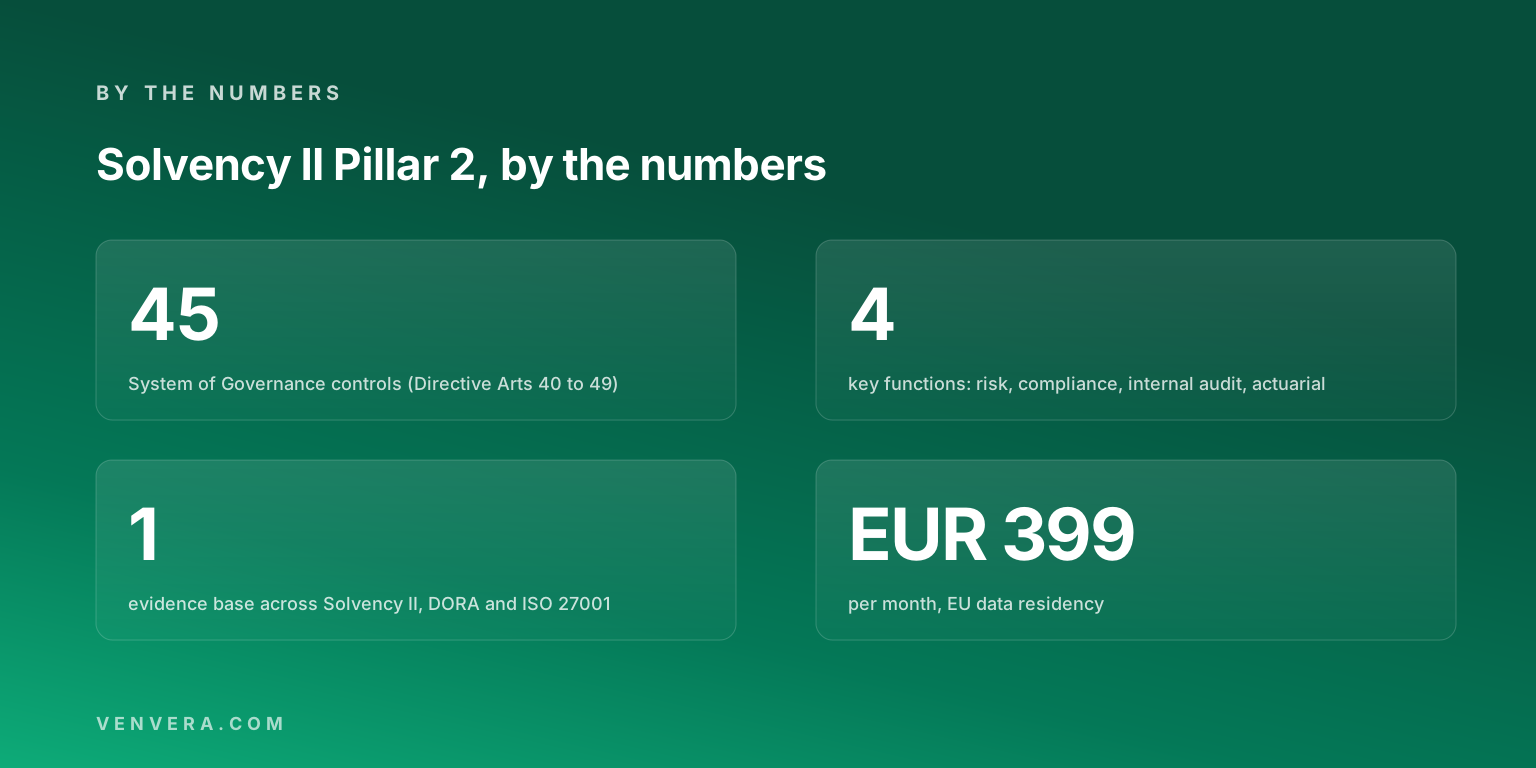
Venvera's Solvency II module covers this Pillar 2 surface with 45 controls mapped to those articles, the Delegated Regulation, and the EIOPA Guidelines on the System of Governance. The point of counting controls is that every obligation has a home, an owner, a piece of evidence, and a review date, instead of living in someone's memory.
Be realistic about which of these are paperwork and which are not. Fit and proper is administrative: gather the assessments, set a re-assessment date, and it is done in a fortnight if HR cooperates. Outsourcing is heavier, because your register is only as good as your visibility into what your providers subcontract, and that visibility has to be negotiated rather than looked up. The genuinely hard one is proving board challenge. Minutes that record a decision are easy. Minutes that record the board pushing back and an executive changing something in response are what supervisors are looking for, and you cannot retrofit them.
The ORSA is a process you run and document
The Own Risk and Solvency Assessment (Article 45) is the single most misunderstood item when people shop for Solvency II software. The ORSA has a quantitative output, the forward-looking assessment of overall solvency needs, and that number comes from your actuarial and capital modelling. Governance software does not produce it, and any tool that claims to is overreaching.
What governance software does own is the ORSA as a process. That means the ORSA policy, the annual and ad-hoc trigger workflow, the assignment of who does what, the evidence that the board actually challenged and approved the assessment, the version history of the ORSA report, and the audit trail that shows the process ran the way the policy says it should. Supervisors do not just want the ORSA number. They want proof that the ORSA is embedded in decision-making and genuinely owned by the board. That proof is a governance artefact, and it is exactly what the governance layer captures.
Article 45 is well drafted for what it sets out to do, and it is also the requirement most often gamed. An ORSA report written by the risk function in the fortnight before the board meeting, presented, noted and filed, technically discharges the words. It does not discharge the purpose, and an experienced supervisor can tell the difference quickly. If you want the ORSA to hold up, the work sits in the months before the report exists: triggers that actually fire, and decisions that visibly used the output.

So the clean division of labour is this: your capital engine computes the solvency needs, and your governance platform proves the process around that computation was properly run, documented, challenged, and signed off. Both are needed. Neither replaces the other.
The crosswalk: stop evidencing the same governance twice
Here is the insight that changes the economics of Pillar 2 for most EU insurers. If you are a mid-size or larger insurer, you are almost certainly already subject to other EU regimes with heavy governance requirements. The Digital Operational Resilience Act (DORA) has been applying to financial entities since January 2025. Many insurers hold ISO 27001. Plenty fall under NIS2. Each of those regimes demands governance controls that overlap heavily with Solvency II Pillar 2: organisational structure, segregation of duties, records management, ICT and third-party outsourcing oversight, incident governance, and board accountability.
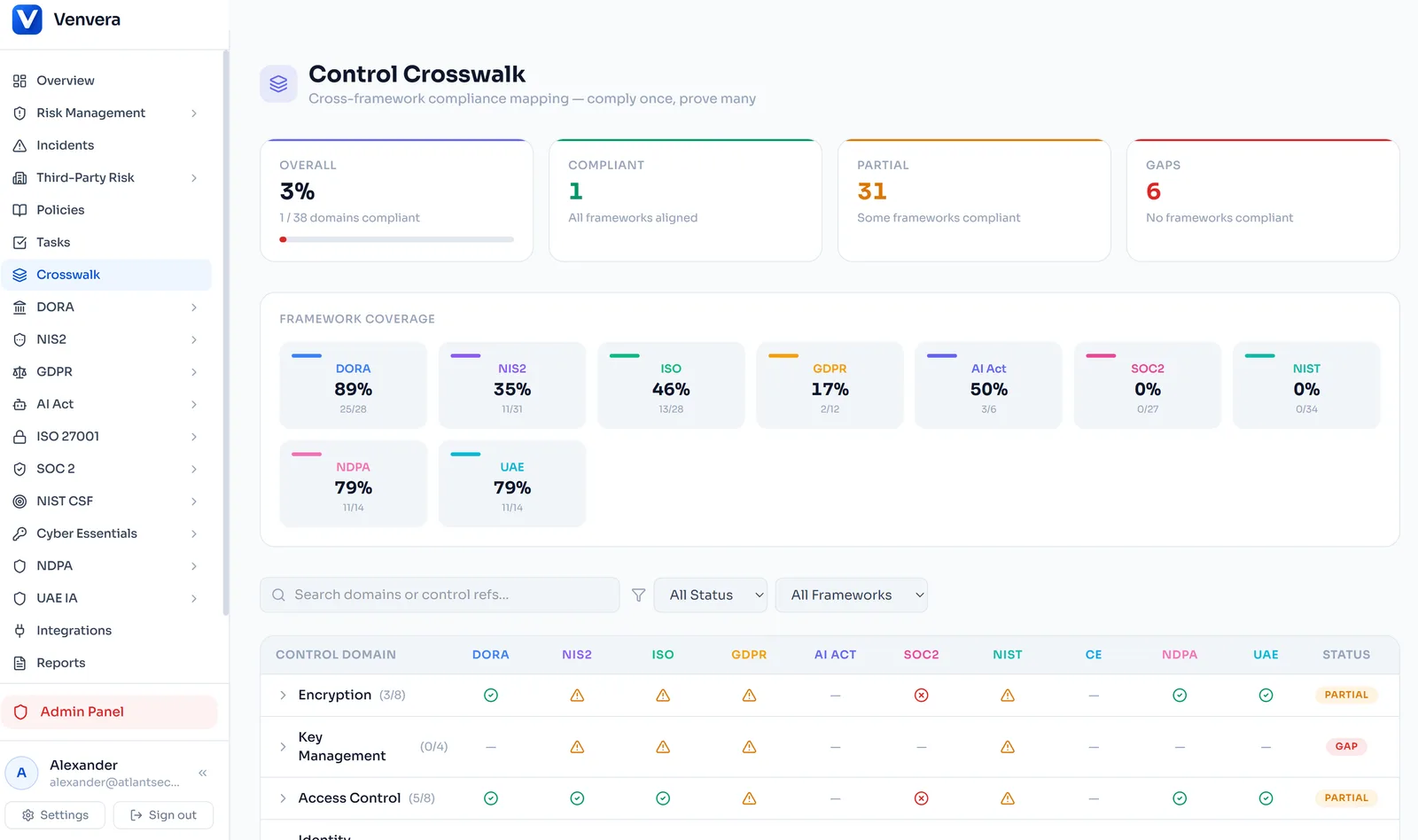
Without a crosswalk, you evidence each of these separately, once per framework, in a different tool or folder, reviewed on a different cadence. That is duplicated work, duplicated review fatigue, and duplicated risk of drift when one copy is updated and the others are not. The crosswalk approach maps a single piece of evidence to every framework it satisfies. Prove your ICT outsourcing governance once for DORA, and the overlapping Solvency II Article 49 governance control is auto-satisfied from that same evidence. Evidence once, compliant everywhere.
Square this with your internal audit function before you switch any of it on. Reuse is a legitimate saving, and to anyone who was not in the room when the mapping was agreed it looks identical to corner-cutting. Write down why each reused control is genuinely the same obligation seen through two regimes, and keep that reasoning where an assessor can find it. The conversation takes an afternoon and spares you a much longer one later.
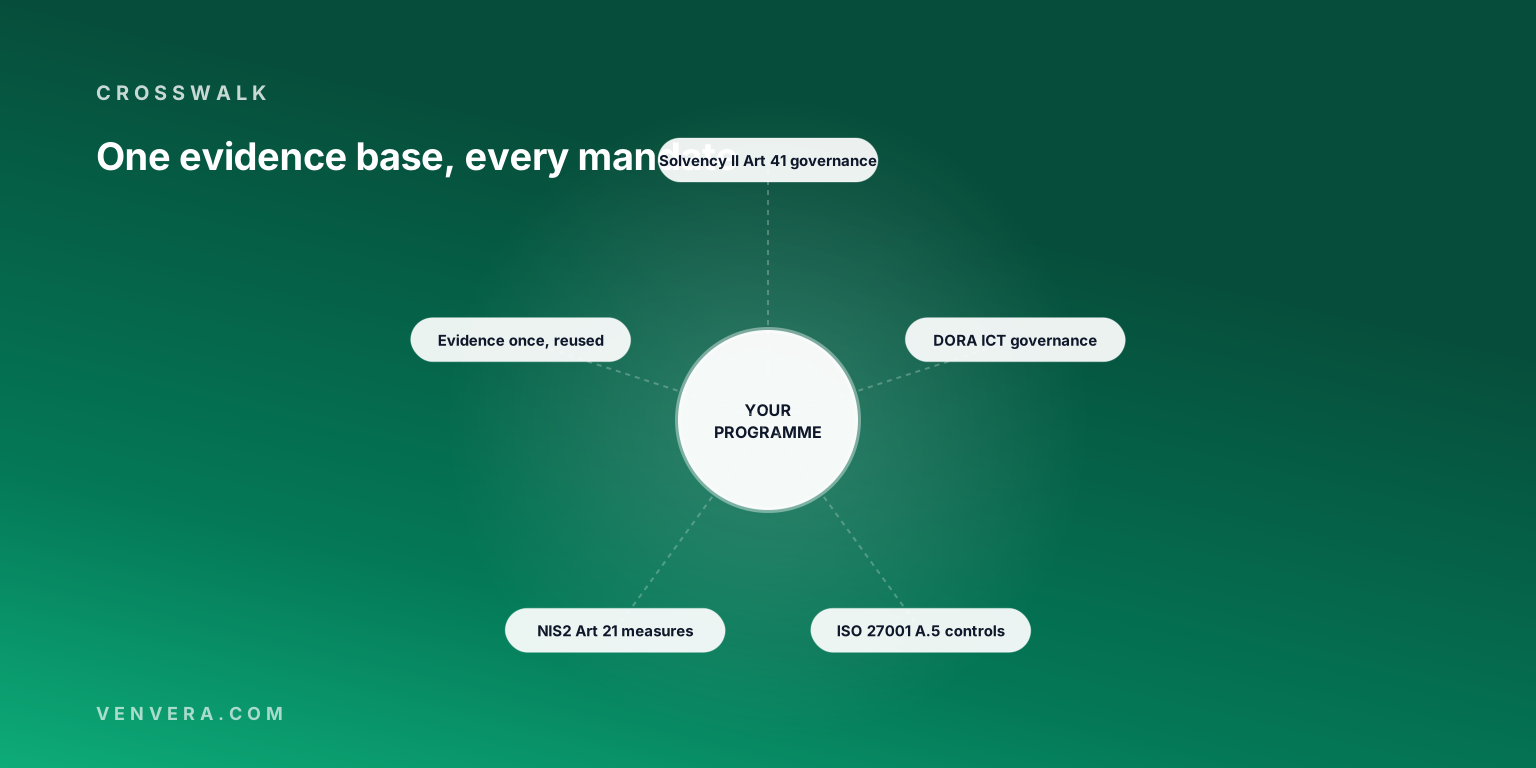
The discipline that makes this honest rather than a compliance shortcut is knowing what must never be auto-satisfied. Overlapping governance controls, the org-structure, segregation, records, and ICT-outsourcing kind, can legitimately be reused because they genuinely are the same control viewed through two regimes. But the insurance-specific controls are native and must be evidenced directly: the ORSA, the four key functions including the actuarial function, and fit and proper. There is no DORA or ISO evidence that satisfies "the actuarial function issued its opinion on the technical provisions." Pretending otherwise would create fake coverage, and fake coverage is worse than no coverage because it hides the gap. Venvera's Solvency II Pillar 2 module draws that line explicitly.
The four key functions
Solvency II mandates four key functions, and Pillar 2 software has to track each as an independent, properly staffed, properly reporting function rather than a name in an org chart.
- Risk management function (Art 44). Owns the risk management system, the risk appetite framework, and the integration of risk into decision-making.
- Compliance function (Art 46). Advises the board on compliance, assesses the impact of legal changes, and runs the compliance monitoring plan.
- Internal audit function (Art 47). Provides independent assurance over the whole system of governance, including the other functions. Independence is the control that gets tested.
- Actuarial function (Art 48). Coordinates technical provisions, opines on underwriting policy and reinsurance adequacy, and reports to the board. This one is insurance-specific and native to the governance layer, never auto-satisfied from another framework.
The software job here is to hold, for each function, the holder and their fit-and-proper status, the reporting lines that prove independence, the function's activities and outputs, and the evidence that it reported to the board on schedule. When a supervisor asks "show me your actuarial function reported to the board in the last cycle," the answer should be two clicks away.

What to look for when you buy governance software
Once you have established that you are shopping in the Pillar 2 category, use this checklist to separate serious platforms from generic GRC tools with a Solvency II label bolted on. The fastest test in a demo is to ask the vendor to put the actuarial function on screen as a first-class thing, with its holder, its reporting line and its last opinion to the board. If what appears is a custom field on a generic task, you are looking at a general GRC product with insurance wording in the marketing.
Native Solvency II control mapping
Controls should map to specific articles of Directive 2009/138/EC, the Delegated Regulation (EU) 2015/35, and the EIOPA guidelines, not to a vague "insurance" template. If the vendor cannot show you the article-level mapping, the content is generic.
A real cross-framework crosswalk
Ask how the tool handles overlap with NIS2, ISO 27001 and DORA. A genuine crosswalk reuses shared governance evidence and clearly refuses to auto-satisfy insurance-specific controls. If everything is "auto-satisfied," walk away, that is fake coverage.
ORSA and key-function workflows out of the box
The ORSA process, fit-and-proper assessments, and the four key functions should be first-class features, not something you assemble from generic tasks. This is what distinguishes insurance-native software from a rebadged general GRC platform.
Board and committee evidence, with an audit trail
Sign-offs, review dates, version history, and immutable evidence that oversight actually happened. Supervisors test embedding, not intention.
EU data residency and honest scope
Your governance data should stay in the EU. And the vendor should tell you plainly what the product does not do, that it complements rather than replaces your actuarial engine and your QRT reporting tool. A vendor who overclaims on scope will cost you credibility in front of your supervisor.
Building your Solvency II software stack
For most insurers the answer is a stack with clean boundaries. A typical, honest architecture looks like this:
- Actuarial and capital engine (Pillar 1) produces the SCR, MCR, and technical provisions.
- QRT and XBRL reporting tool (Pillar 3) validates and files the returns and produces the SFCR and RSR.
- Governance and GRC platform (Pillar 2) manages the system of governance, the ORSA process, the key functions, fit and proper, and outsourcing, and reuses overlapping governance evidence from DORA and ISO through the crosswalk.
Each layer feeds the others. The capital engine gives the ORSA process its number. The governance layer proves the process around both the capital work and the reporting was properly run. The reporting tool files the output. Nobody pretends to do a neighbouring pillar's job, and that honesty is what holds up under supervisory scrutiny.
If you are already carrying NIS2, DORA, or ISO 27001 obligations, the governance layer is where the biggest efficiency gain hides. The overlapping controls you have already evidenced for those regimes can carry across, so the incremental work to stand up Pillar 2 is concentrated on the genuinely insurance-specific pieces: the ORSA process, the four key functions, and fit and proper. That is the difference between a Solvency II governance programme that takes months and one that reuses what you already have.
The bottom line
Solvency II software is three markets wearing one name. Know which pillar you are buying for. If you already own an actuarial engine and a QRT tool, the gap is almost always Pillar 2, the system of governance, and that gap is usually being filled by shared drives and spreadsheets that will not survive a supervisory review. A purpose-built governance platform closes that gap, and a real cross-framework crosswalk closes it without making you evidence the same governance three times over. Just make sure the vendor is honest about the boundary: it complements your capital and reporting tools, it does not replace them.
Primary sources
The Pillar structure and the governance obligations cited above trace to the following primary sources. Article numbers are for Directive 2009/138/EC.
- Solvency II Directive 2009/138/EC - the system of governance is Articles 40 to 49: Art 40 (AMSB responsibility), Art 41 (general governance requirements), Art 42 (fit and proper), Art 44 (risk management), Art 45 (ORSA), Art 46 (internal control and compliance), Art 47 (internal audit), Art 48 (actuarial function), Art 49 (outsourcing). Art 45(1): "As part of its risk-management system every insurance undertaking and reinsurance undertaking shall conduct its own risk and solvency assessment." EUR-Lex.
- Commission Delegated Regulation (EU) 2015/35 - the detailed implementing rules for the system of governance and the four key functions. EUR-Lex.
- EIOPA Guidelines on the System of Governance (EIOPA-BoS-14/253). eiopa.europa.eu.
- DORA - Regulation (EU) 2022/2554 - the ICT and third-party governance overlap; it has applied to financial entities since 17 January 2025 (Art 64). EUR-Lex.
Scope note. Venvera's Solvency II module covers Pillar 2 (the system of governance) with 45 controls mapped to Articles 40 to 49, the Delegated Regulation and the EIOPA Guidelines. It does not cover Pillar 1 capital adequacy (SCR/MCR) or Pillar 3 quantitative reporting (QRTs); the ORSA is supported as a governance process, not as a capital calculation. This boundary is shown in-product as a scope banner.
See the Pillar 2 governance layer, built for EU insurers and reinsurers.
Venvera manages the Solvency II system of governance with 45 Pillar 2 controls, the ORSA as a governed process, the four key functions, and a cross-framework crosswalk that reuses your ISO 27001 and DORA evidence. From EUR 399/month, EU data residency. Explore the Solvency II Pillar 2 module.