

Best

The benefit of the right GDPR tool isn't avoiding fines. It's sleeping at night knowing your DPA won't find gaps you didn't know existed.
I've been in data protection long enough to remember when GDPR was still "that regulation nobody thinks will actually have teeth." Then came the €1.2 billion Meta fine, the €746 million Amazon penalty, and about 2,000 smaller enforcement actions that proved everyone wrong. By 2026, EU data protection authorities have collected over €4.5 billion in fines. GDPR has teeth. Big ones.
When I first evaluated StrikeGraph for our GDPR program, I was cautiously optimistic. They mention GDPR on their website. There's a GDPR "module" of sorts. But after spending two weeks trying to make it work for a real GDPR compliance program - with Records of Processing Activities, DPIAs, breach notification workflows, and cross-border transfer mechanisms - I realized I was trying to drive a nail with a screwdriver. Here's my honest, detailed account.
⚠
THE CORE PROBLEM
GDPR Is Not SOC 2 (And That's the Whole Problem)
StrikeGraph was founded in 2020 with a clear mission: make SOC 2 certification easier for startups. Their risk-based approach to scoping SOC 2 audits is genuinely clever. For a 30-person SaaS company getting its first Type II report, that's valuable. But GDPR operates in an entirely different universe.
SOC 2 is a voluntary certification. GDPR is a binding regulation with direct enforcement. SOC 2 cares about your security controls. GDPR cares about the legal basis for every piece of personal data you process, the rights of every data subject, the mechanisms for every cross-border transfer, and whether you've done a Data Protection Impact Assessment for every high-risk processing activity.
🚨 The enforcement reality
GDPR fines reached €4.5 billion+ by 2026. DPAs are increasingly auditing compliance programs, not just breach responses. If your "GDPR tool" can't produce Article 30 Records of Processing or demonstrate DPIA methodology, you'll be explaining the gap in person - to a regulator, not an auditor.
🔍
GAP ANALYSIS
Six Things I Couldn't Do in StrikeGraph
These aren't obscure requirements. They're the bread and butter of GDPR compliance. Every DPA in Europe expects you to have these in order.
📑
Records of Processing (Art. 30)
A detailed register of every processing activity: purposes, data subjects, recipients, transfers, retention periods. StrikeGraph has no RoPA functionality at all.
📜
DPIAs (Art. 35)
For high-risk processing, you need structured DPIAs following EDPB methodology. StrikeGraph doesn't have a DPIA workflow. At all.
🚨
Breach Notification (Art. 33-34)
72-hour notification to your supervisory authority. Classification criteria, timeline tracking, notification templates. StrikeGraph's incidents are SOC 2-shaped.
📄
DPA Management (Art. 28)
Every processor needs an Article 28-compliant DPA. Track which are in place, when they expire, what processing they cover. StrikeGraph tracks vendors, not DPAs.
🌐
Cross-Border Transfers (Ch. V)
SCCs, adequacy decisions, BCRs, derogations. Post-Schrems II, every EEA transfer needs documented legal mechanisms. StrikeGraph doesn't track any of this.
👤
Data Subject Rights
SARs, erasure, portability, restriction of processing. You must respond within 30 days. StrikeGraph has no DSR tracking or response workflow.
📊
HEAD TO HEAD
The Feature Gap, Quantified

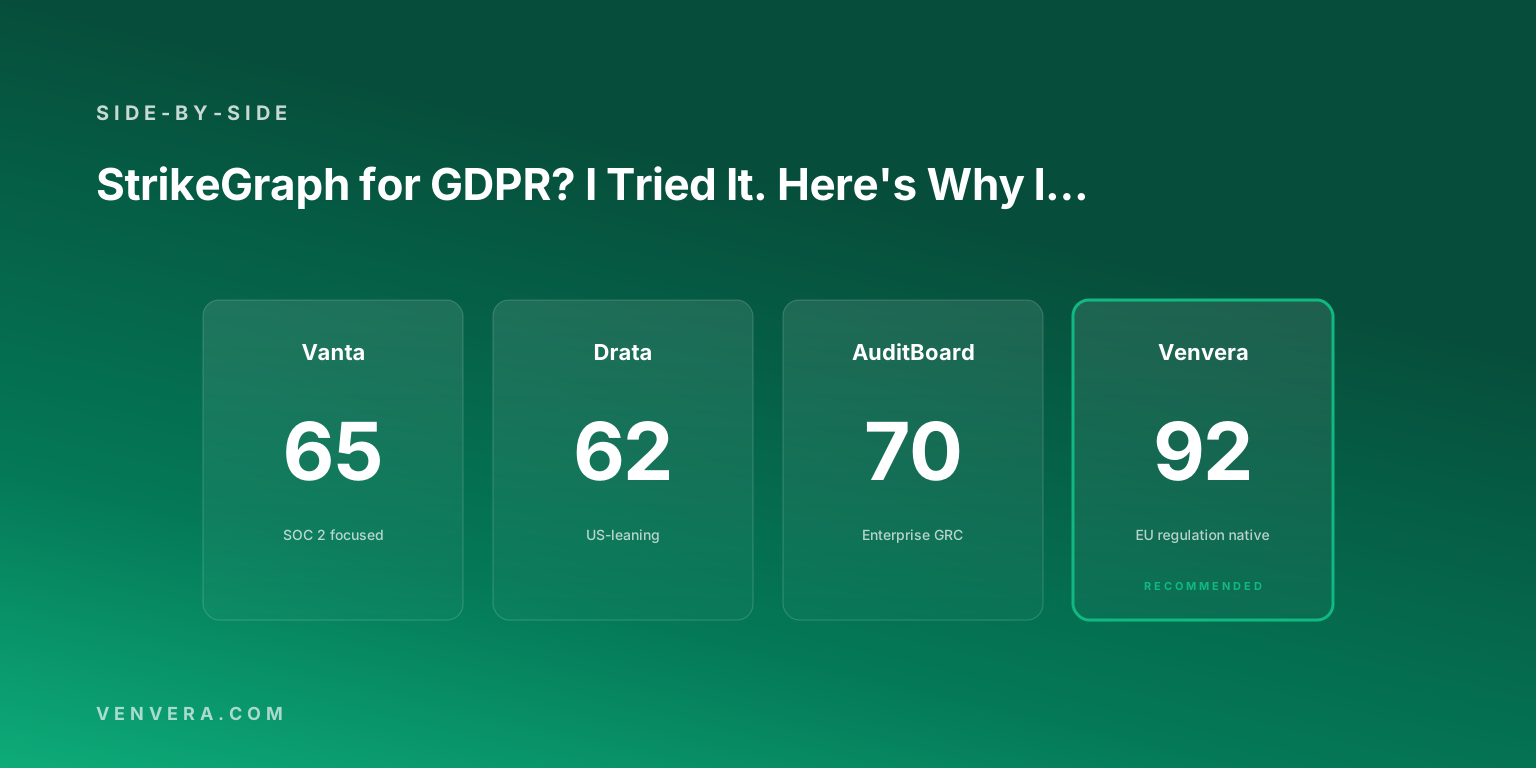
| GDPR Requirement | StrikeGraph | Venvera |
|---|---|---|
| Records of Processing (Art. 30) | ✗ | ✓ Full RoPA module |
| DPIAs (Art. 35) | ✗ | ✓ EDPB methodology |
| Breach notification (Art. 33-34) | ✗ | ✓ 72-hr workflow |
| DPA management (Art. 28) | ✗ | ✓ Full tracking |
| Transfer mechanisms (Ch. V) | ✗ | ✓ SCCs, adequacy, BCRs |
| Data subject rights (DSR) | ✗ | ✓ Full DSR workflows |
| Consent management | ✗ | ✓ Consent tracking |
| Legal basis documentation | ✗ | ✓ Per-activity tracking |
| Cross-framework mapping | ✗ | ✓ 150+ mappings |
| EU data hosting | ✗ US-based | ✓ Amsterdam |
| Total frameworks | ◯ 4 | ✓ 13 |
| Starting price | ~$8-12K/yr (SOC 2) | €399/mo (1 fw) |
🔬
DEEP DIVE
What Switching to Venvera Actually Looked Like
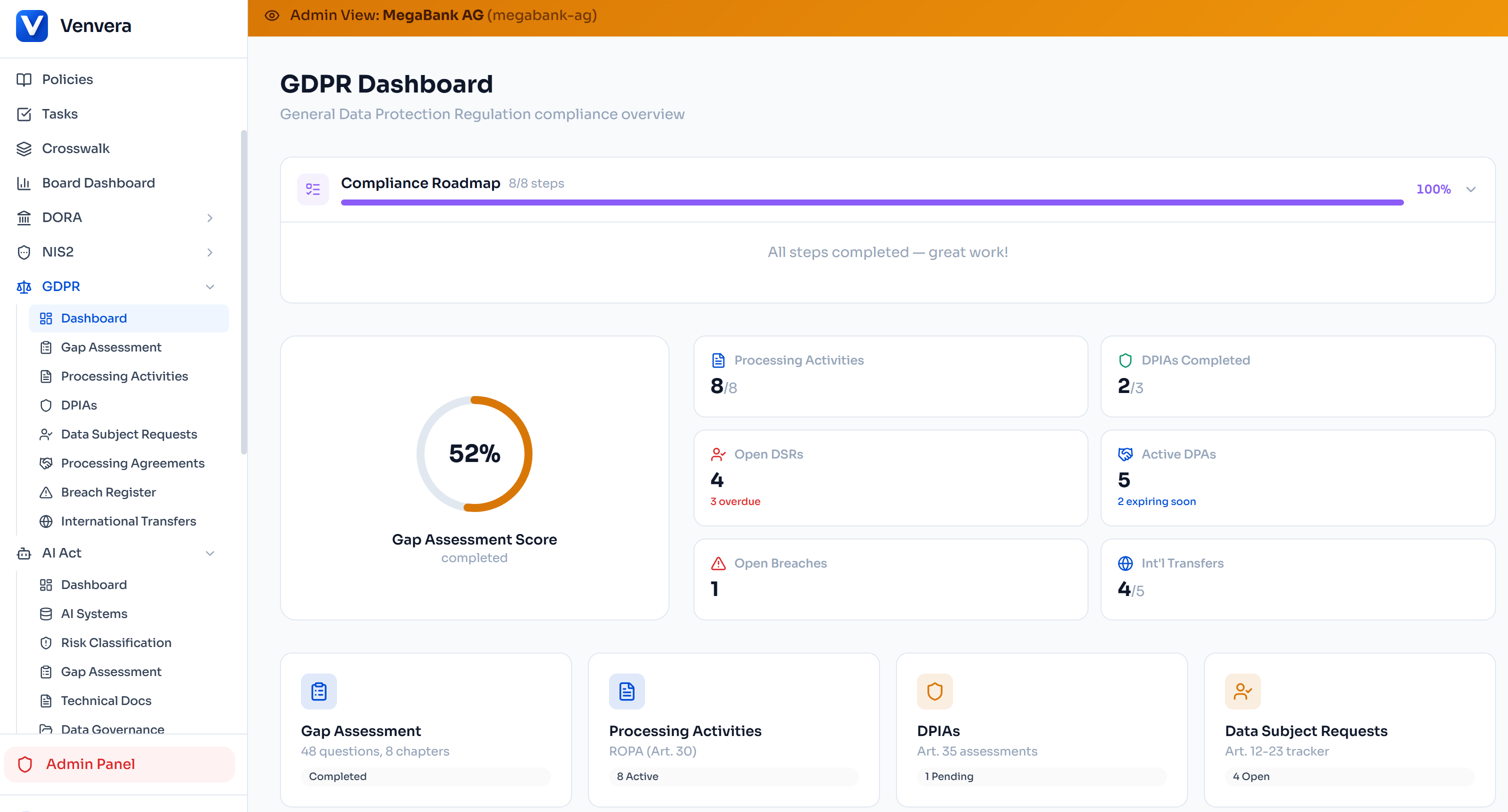
The first week was all about importing our existing processing activities into Venvera's RoPA module. Instead of spreadsheet columns with free-text fields, each processing activity has structured inputs for legal basis, data categories, retention periods, transfer mechanisms, and security measures. When our DPO reviewed it, she said: "This is the first time I've seen an Article 30 register that I'd actually feel comfortable showing to a DPA."
What made the biggest difference:
- DPIA templates follow the EDPB's recommended methodology - not generic risk assessment forms
- Breach notification workflow tracks the 72-hour clock automatically with escalation alerts
- DPA management links processors to specific processing activities in the RoPA
- Data subject rights portal tracks SAR response deadlines and documents every interaction
The rough parts? Like DORA, Venvera's integration ecosystem is smaller than Vanta or Drata. If automated infrastructure scanning is your top priority, you'll notice the gap. But for the actual substance of GDPR compliance - the legal and procedural requirements that regulators examine - Venvera covers ground that StrikeGraph doesn't even acknowledge exists.
🔗
EFFICIENCY MULTIPLIER
Why Cross-Framework Mapping Matters for GDPR Teams
Our GDPR program doesn't exist in isolation. We also need ISO 27001 (because customers ask for it), DORA (because we serve financial clients), and NIS2 (because our sector qualifies). That's four frameworks with significant overlap.
✓ One procedure, four frameworks satisfied
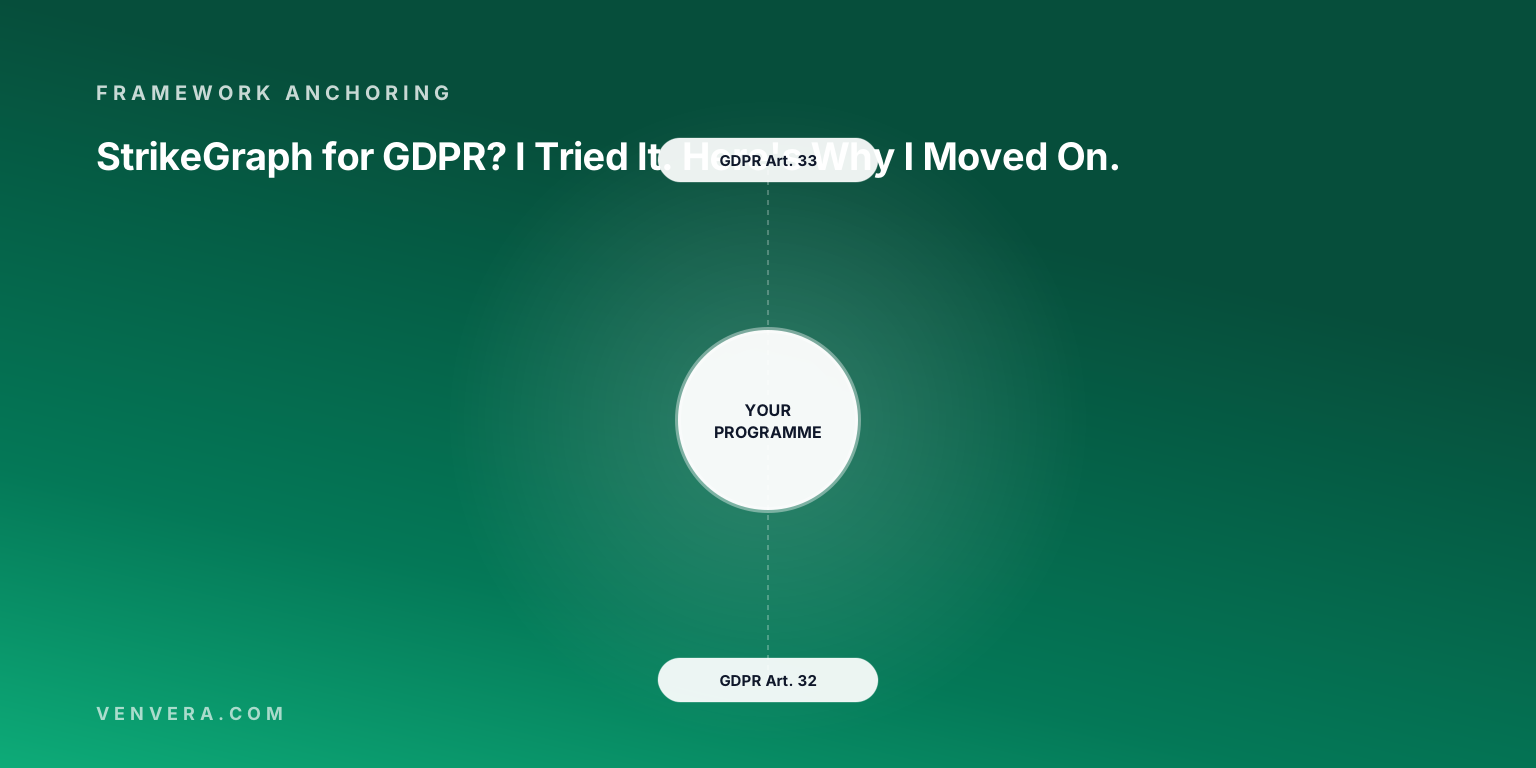
When we documented our GDPR Article 33 breach notification procedure, Venvera flagged that it partially satisfies NIS2 incident reporting, DORA's ICT incident classification, and ISO 27001 Annex A.16. One procedure, documented once, satisfying four framework requirements.
Thirteen frameworks total: DORA, GDPR, NIS2, ISO 27001, EU AI Act, SOC 2, NIST CSF, Cyber Essentials, NDPA, UAE IA, CMMC, HIPAA, PCI-DSS. 150+ pre-built control mappings.
💰
PRICING REALITY CHECK
The Multi-Framework Economics
| Scenario | StrikeGraph + Spreadsheets | Venvera |
|---|---|---|
| SOC 2 only | ~$10K/yr | €4,788/yr (€399/mo) |
| Need GDPR too | $10K + manual GDPR (~$20-25K total) | €10,788/yr (€899/mo for 3) |
| SOC 2 + GDPR + ISO 27001 | $10K + supplements (~$30-40K total) | €10,788/yr (€899/mo for 3) |
| Annual savings with Venvera | - | Save $15-30K/yr + EU hosting included |
StrikeGraph charges around $10K for SOC 2, but its GDPR support is essentially a checkbox - no RoPA, no DPIAs, no breach workflows. If you need real GDPR compliance, you'll supplement with consultants or manual processes costing $10-15K more. Venvera gives you full GDPR plus two additional frameworks for €899/month, including EU data hosting. The math speaks for itself.
🇪🇺
DATA SOVEREIGNTY
The Real Cost of a US-Hosted GDPR Tool
Let me paint a picture. You're a European company managing GDPR compliance. Your Records of Processing Activities - detailing every category of personal data you handle - are stored on servers in the United States. A country where government agencies can compel disclosure under FISA Section 702 without notifying the data subjects. A country whose data protection adequacy decision has been struck down twice by the CJEU.
You're basically using a tool to demonstrate GDPR compliance that itself creates a GDPR compliance problem. The irony is almost poetic. Almost. Until your DPA asks about it during an inspection.
Venvera: EU-native by design
Hosted entirely in Amsterdam. AES-256-GCM encryption with per-tenant keys. No transatlantic data transfer, no adequacy decision reliance, no FISA exposure. For a GDPR compliance platform, being in the EU isn't a feature - it's a prerequisite.
✅
DECISION GUIDE
When StrikeGraph Is the Right Call (And When It Isn't)
✓ Switch to Venvera if:
- GDPR is on your radar (EU customers, EU employees, or extraterritorial reach)
- You need RoPA, DPIAs, breach workflows, or DSR management
- You're managing multiple frameworks alongside GDPR
- You need EU data hosting for your compliance platform
- You want published, predictable pricing
◯ Stay on StrikeGraph if:
- You're a US-based startup with only SOC 2 needs
- You have zero EU data processing obligations
- You want the most affordable path to a first SOC 2 report
The gap isn't about features being slightly better or slightly worse. StrikeGraph doesn't have the fundamental building blocks of GDPR compliance - no RoPA, no DPIAs, no breach workflows, no DSR management. Trying to do GDPR on StrikeGraph is like trying to do your accounting in PowerPoint. You could probably make it look right. But nobody who knows what they're doing would trust it.
Take GDPR Seriously. Your DPA Already Does.
Full GDPR compliance management - RoPA, DPIAs, breach notification, DPA tracking, DSR workflows - plus 12 more frameworks.
Hosted in Amsterdam. Starting at €399/month (1 framework) or €899/month (3 frameworks).
Book a Demo →Last updated: March 2026. Based on publicly available platform information and direct usage experience.