

Best

I've spent the last three years helping mid-sized organisations in the EU get their GDPR house in order. Financial services, fintech, SaaS companies - the usual suspects. And I keep running into the same painful pattern: a company buys Drata for SOC 2 (smart move), sees the GDPR framework option (cool, one less tool to buy), enables it, and then six months later their DPO is quietly maintaining a parallel spreadsheet system because Drata doesn't actually do what GDPR requires.
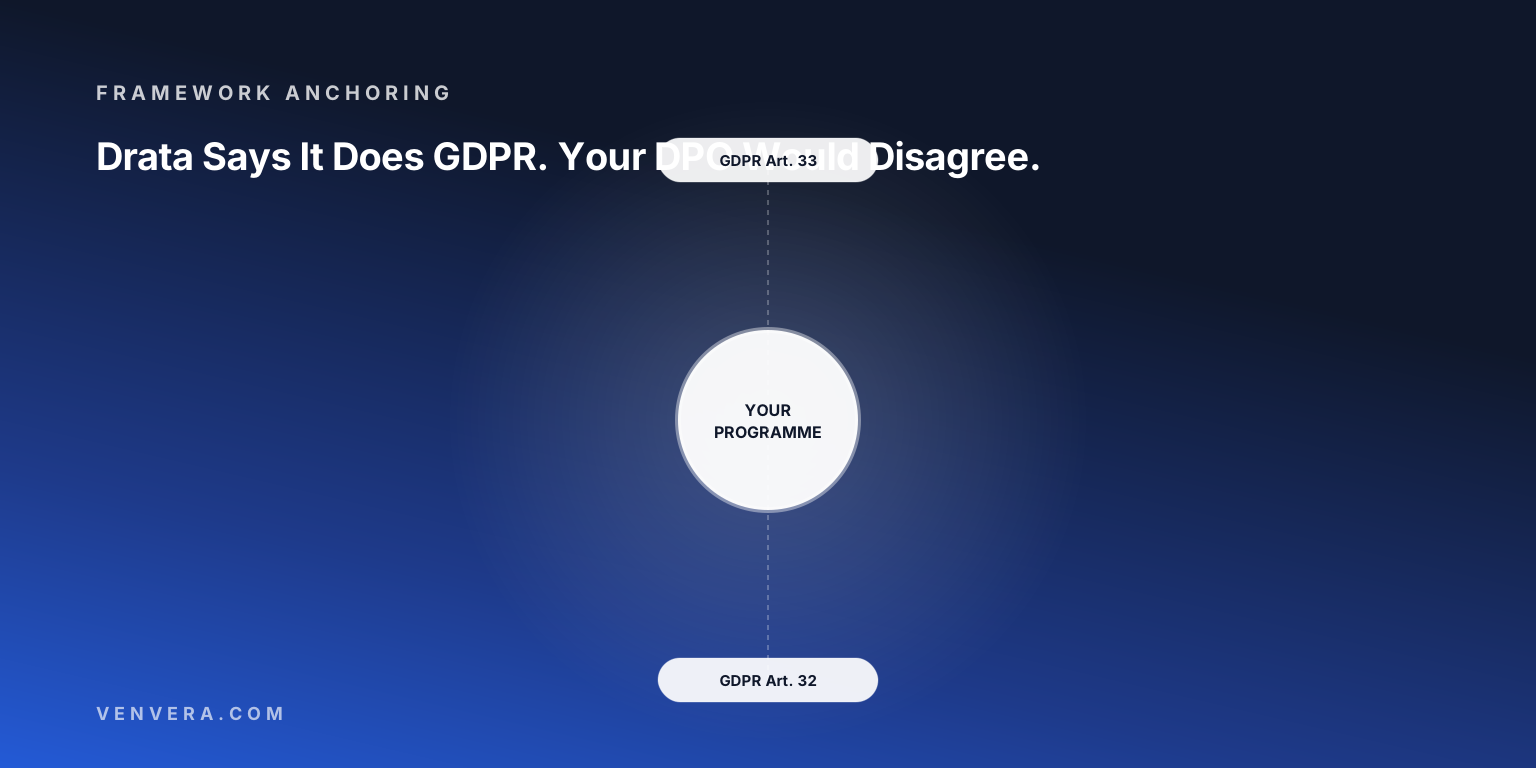
It's not that Drata lied. They do have a GDPR framework. It's just that their version of "GDPR support" means mapping infrastructure controls to GDPR articles. Which is roughly 20% of what GDPR compliance actually involves.
The other 80%? The processing activities register, the DPIAs, the breach workflows, the DPA tracking, the data subject request management? That's all happening in spreadsheets, emails, and somebody's head. Which is exactly the situation GDPR was designed to prevent.
⚠
THE PROBLEM
Two Completely Different Types of Compliance
Here's the thing most people don't realize until they're already committed: GDPR and SOC 2 aren't just different regulations. They're different kinds of regulation. They operate on completely different axes.
SOC 2 / ISO 27001
Question: "Are your systems secure?"
Evidence: Config screenshots, access logs, scan results
Drata's strength: Purpose-built for this
GDPR
Question: "Are you processing data lawfully?"
Evidence: Processing records, DPIAs, breach logs, DPAs
Drata's weakness: Not designed for this
⚠ The fundamental mismatch:
Drata automates the answer to "is MFA enabled on your AWS account?" brilliantly. But GDPR is asking "under what lawful basis are you processing employee health data, who are the recipients, what's the retention period, and have you conducted a DPIA?" No amount of infrastructure scanning answers that question. It's like using a thermometer to measure wind speed - excellent instrument, wrong measurement.
🔍
WHERE DRATA FALLS SHORT
What's Actually Missing (and Why It Matters)
Not theoretical gaps. Real operational problems I've watched teams hit.
📑
Processing Register (Art. 30)
The backbone of GDPR accountability. Drata has a list of controls referencing articles. That's an index, not a processing register. Your DPO can't hand an index to the DPA.
📋
DPIA Management (Art. 35)
A structured assessment with necessity analysis, risk identification, and DPO consultation. Drata gives you a checkbox. Maybe a file upload. Not the same thing.
🚨
Breach Notification (Art. 33)
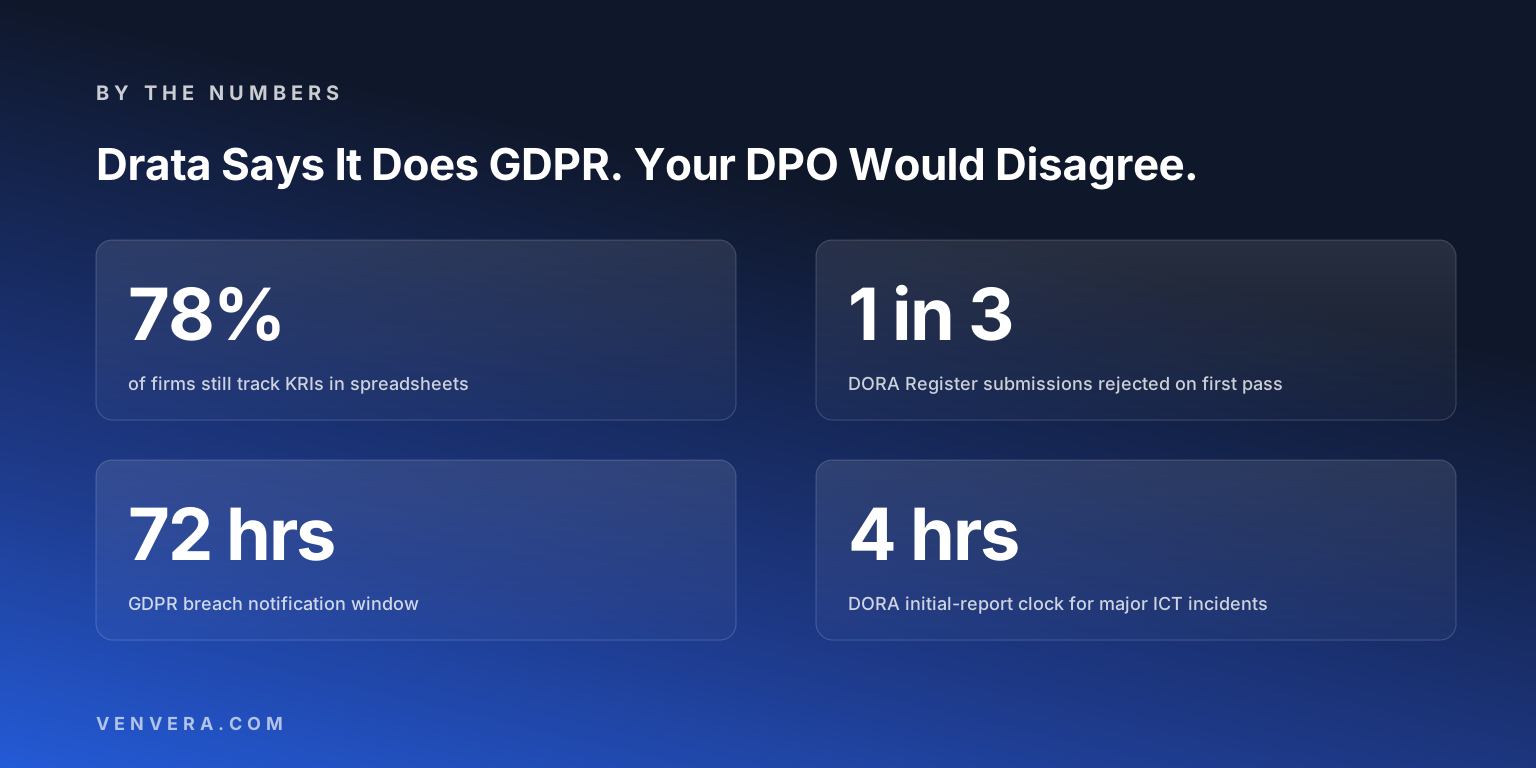
72 hours. No countdown timer, no mandatory GDPR fields, no severity assessment against Article 33 criteria. Drata's incidents are SOC 2-shaped.
📄
DPA Management (Art. 28)
Dozens of DPAs across your vendor landscape. They expire, sub-processors change. Drata has vendor management for security risk - not DPA lifecycle.
👤
Data Subject Rights
Access, erasure, portability requests. One month to respond. No intake tracking, no deadline management. Most teams use spreadsheets alongside Drata.
⚖
Lawful Basis Documentation
Every processing activity needs a documented lawful basis. Consent, legitimate interest, contract - tracked per activity. Drata has no concept of this.
⚖
FEATURE COMPARISON
Drata vs Venvera for GDPR: The Honest Comparison
| GDPR Requirement | Drata | Venvera |
|---|---|---|
| Processing Activities Register (Art. 30) | ✗ Not available | ✓ Full register, all fields |
| DPIA Workflow (Art. 35) | ✗ Not available | ✓ Full workflow + approvals |
| Breach Notification (Art. 33-34) | ✗ Generic incidents | ✓ 72h countdown + required fields |
| DPA Management (Art. 28) | ✗ Basic vendor list | ✓ Full DPA lifecycle |
| Data Subject Rights Tracking | ✗ Not available | ✓ Tracked with deadlines |
| Lawful Basis Documentation | ✗ Not available | ✓ Per processing activity |
| Technical Security Controls (Art. 32) | ✓ Excellent - automated | ✓ Full control framework |
| Cross-Framework Mapping | ◯ Framework silos | ✓ 150+ mappings |
| Compliance Data Hosting | ✗ US default (EU option) | ✓ Amsterdam, EU |
| Annual Cost | ~$25-30K+ | From €4,788 (€399/mo) |
🔬
DEEP DIVE
What a Typical Week Looks Like With Venvera vs Drata
Instead of listing features, let me walk through what a typical week looks like for a compliance manager using Venvera for GDPR versus the Drata+spreadsheet combo most teams end up with.
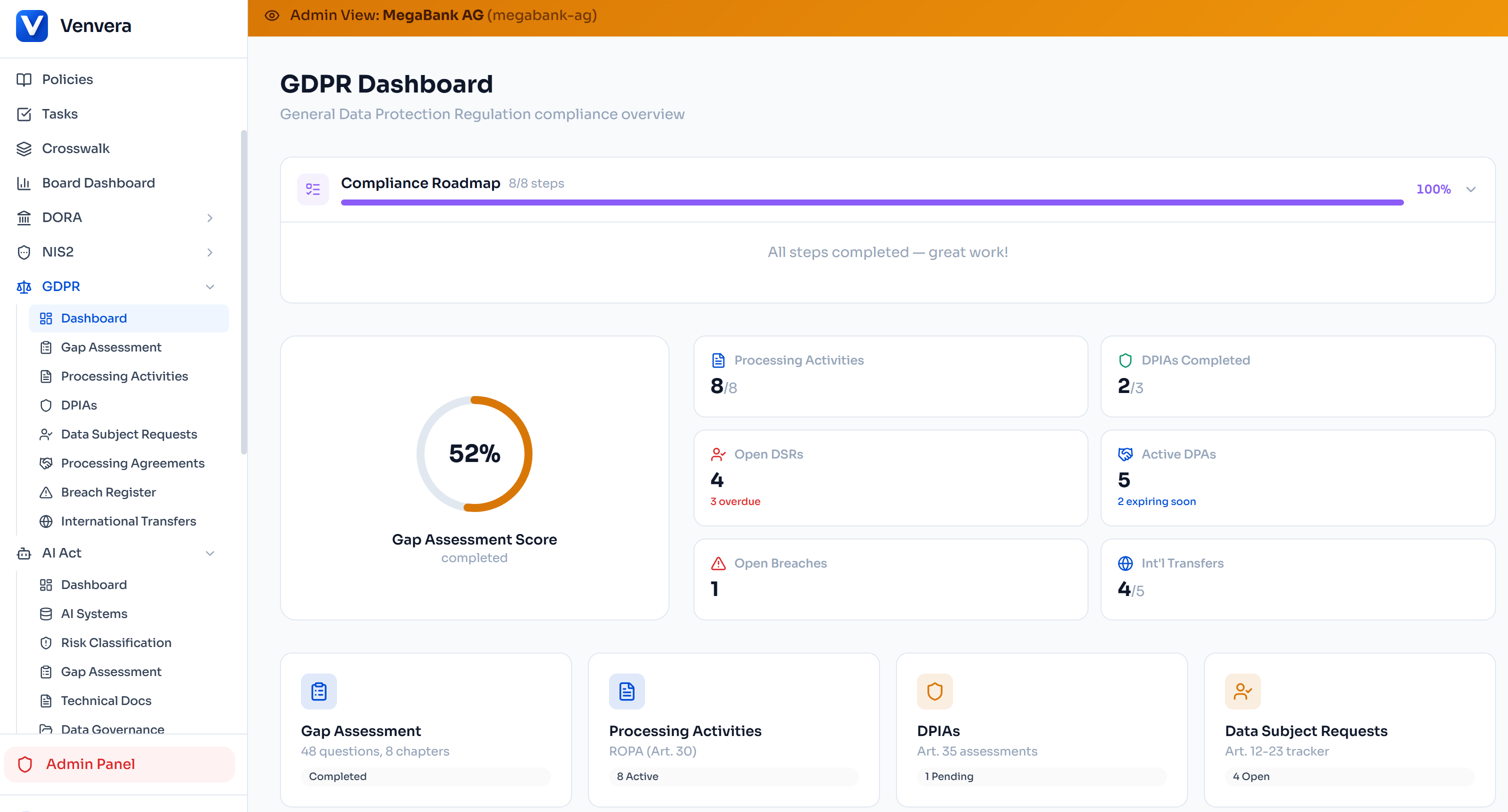
- Monday: Marketing launches customer profiling. Open Venvera, create a processing activity with purpose, lawful basis, data categories, retention. System flags it for a DPIA. In Drata? Update your spreadsheet and email the DPO separately.
- Wednesday: A data subject submits an access request. Log it in Venvera's DSAR module - 30-day clock starts, verification steps tracked. In Drata? Create a Jira ticket and hope someone remembers the deadline.
- Thursday: Security reports a potential breach. Open Venvera's breach module - 72-hour countdown begins, Article 33 notification fields pre-populated. In Drata? Log a generic incident and scramble manually.
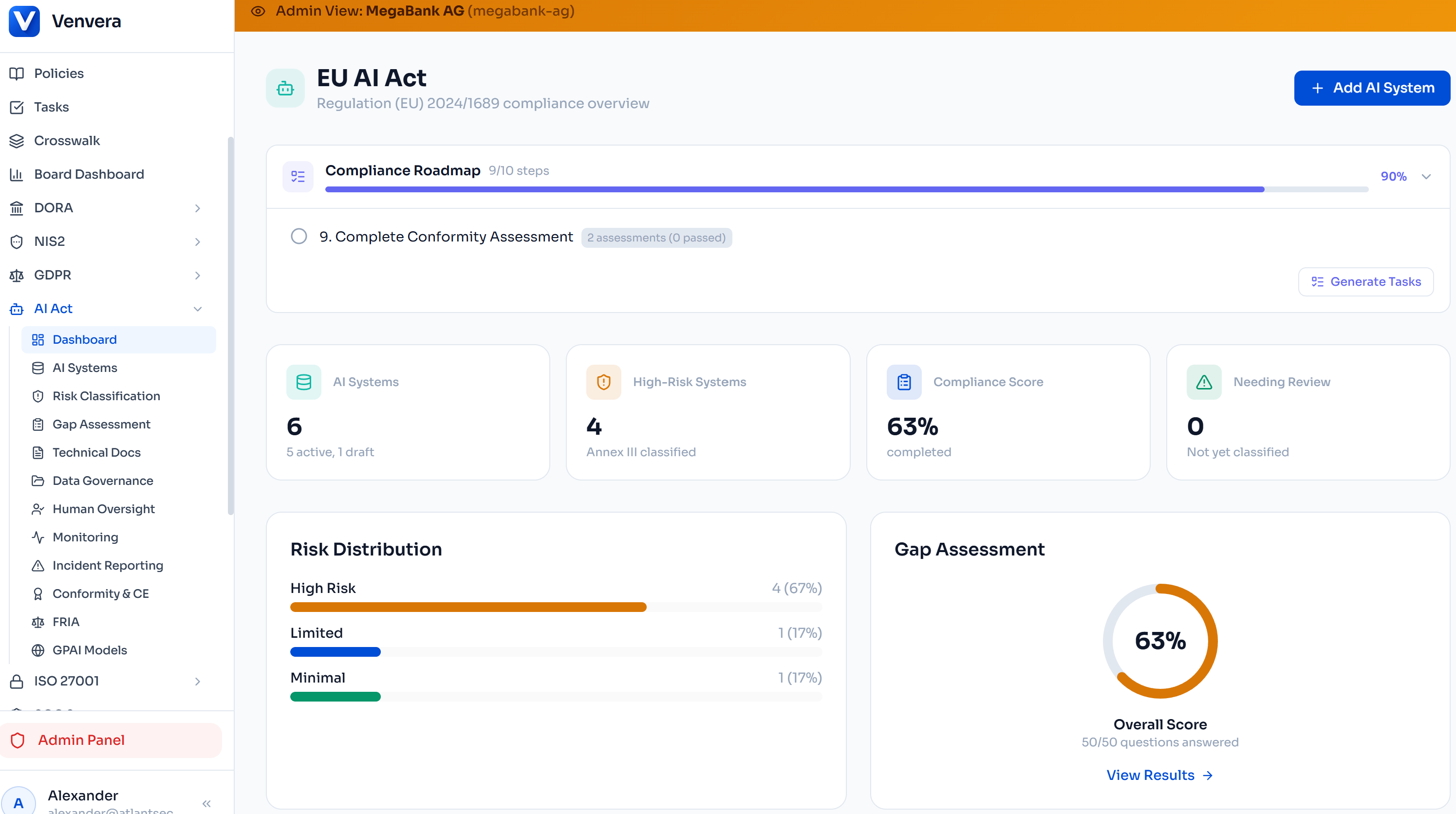
- Friday: DPO wants a compliance overview. In Venvera, it's one dashboard. In Drata? Cross-reference the Drata dashboard with three spreadsheets and a shared inbox. Ask me how I know.
🔗
CROSS-FRAMEWORK MAPPING
GDPR Doesn't Exist in a Vacuum
If you're doing GDPR, you're probably also doing something else. DORA if you're in financial services. NIS2 if you're an essential entity. ISO 27001 for certification. The overlap between these frameworks is massive - GDPR Article 32 maps to ISO 27001 controls, DORA's ICT risk management, and NIS2's risk measures.
✓ Cross-framework impact:
- 150+ pre-built mappings across GDPR, DORA, NIS2, ISO 27001, and 9 more frameworks
- Document an access control measure for GDPR Art. 32 and it automatically flags DORA, NIS2, and ISO 27001 requirements
- GDPR + DORA + NIS2 on Drata? You're looking at $75K+/year with duplicated effort across all three
- Three frameworks from Venvera: €899/month. Less work AND less money.
💰
PRICING COMPARISON
The Math That Changes Everything
| Scenario | Drata | Venvera | You Save |
|---|---|---|---|
| GDPR only | ~$25-30K/yr | €4,788/yr | ~$20K/yr |
| GDPR + DORA + NIS2 | ~$75-90K/yr | €10,788/yr | ~$65-80K/yr |
| 3-year total (3 frameworks) | ~$225-270K | €32,364 | $190-240K |
The savings over three years are staggering: $190-240K. That's not a rounding error. That's multiple senior hires. And you're getting more GDPR-specific functionality with Venvera - processing registers, DPIA workflows, breach timelines - than Drata provides at seven times the price.
🇪🇺
DATA SOVEREIGNTY
The Irony of US-Hosted GDPR Tools
This one still gets me. You're managing GDPR compliance - a regulation fundamentally concerned with protecting EU citizens' personal data from unauthorised access - and your compliance platform stores all that data on US servers. Your processing activities register, breach records, DPIA results - potentially subject to FISA Section 702 access. The exact concern that triggered Schrems II.
Drata does offer an EU hosting option. But Venvera is hosted in Amsterdam. Period. AES-256-GCM encryption, EU jurisdiction by default. For a data protection tool, this shouldn't be a selling point. It should be table stakes.
✅
WHO SHOULD SWITCH
Is the Switch Right for You?
Switch to Venvera if:
- ☑ Your DPO needs a real Article 30 processing activities register
- ☑ You need DPIA workflows with approval chains, not checkboxes
- ☑ You handle personal data breaches and need 72-hour countdown tracking
- ☑ You manage multiple DPAs and need lifecycle tracking
- ☑ You're also subject to DORA, NIS2, or ISO 27001
- ☑ You want GDPR compliance data hosted in the EU by default
Drata is genuinely excellent at infrastructure security monitoring. If SOC 2 and ISO 27001 are your only obligations, it deserves to be on your shortlist. But for GDPR? The regulation asks questions Drata wasn't built to answer. Processing registers, DPIAs, breach workflows, DPA lifecycle - these are operational requirements, not infrastructure controls. And only one platform treats them that way.
GDPR Compliance That Actually Covers GDPR
Processing activities register. DPIA workflows. 72-hour breach notifications. DPA management.
13 frameworks, 150+ cross-mappings, EU-hosted. From €399/month.
Book a Demo →Last updated: March 2026. Pricing and feature information based on publicly available data and hands-on evaluation. Contact vendors for current pricing.