
Best

If you get AI Act compliance wrong, you're looking at fines up to €35 million or 7% of global annual turnover. That makes GDPR penalties look modest.
I'll be direct. If you deploy AI systems for credit scoring, fraud detection, HR screening, customer service automation, or any of the dozens of other applications the EU AI Act classifies as "high-risk," your current compliance platform needs to handle it. If that platform is StrikeGraph, the answer is no. Not partially, not with workarounds, not with creative use of custom fields.
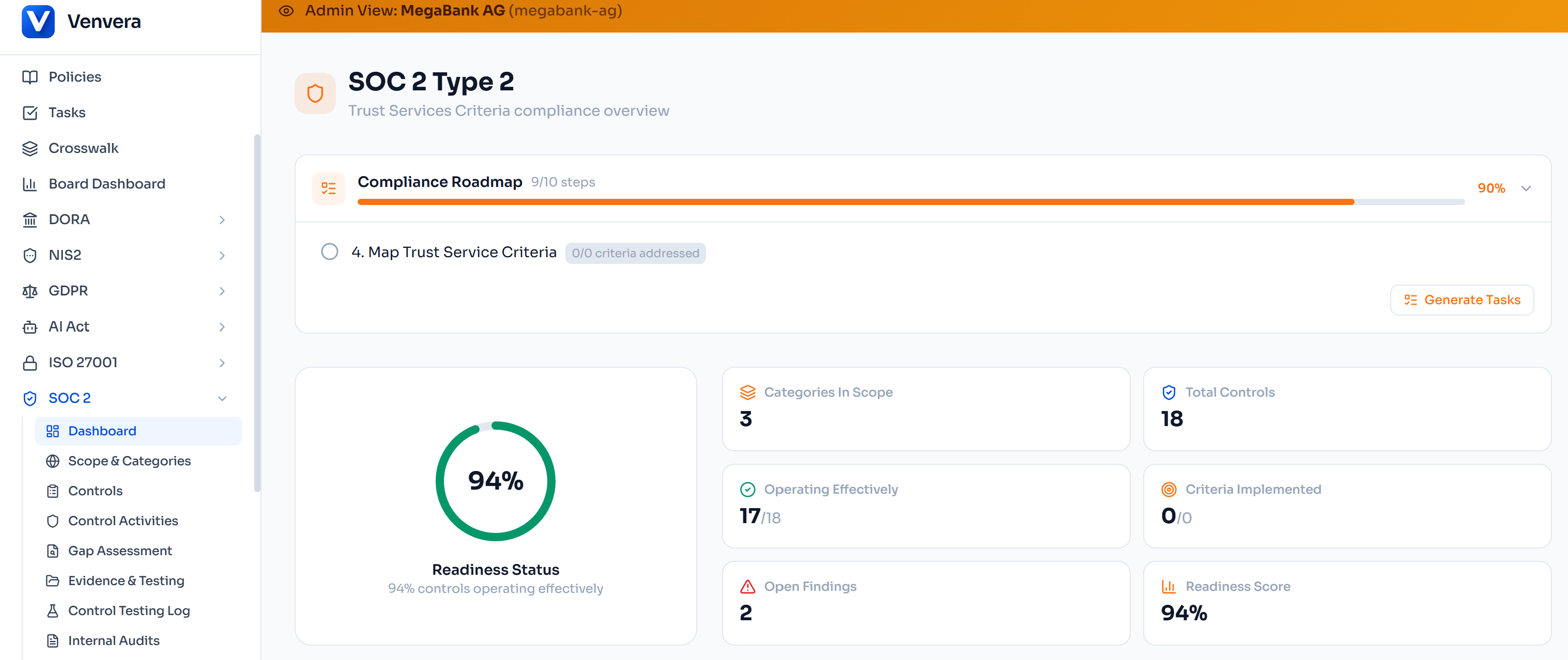
I spent two months evaluating compliance platforms for AI Act readiness. Most of them - including the big names - are still scrambling to add AI Act support. One platform, Venvera, already had it built in. Here's the full breakdown.
⚠
THE CORE PROBLEM
The AI Act Requires AI-Specific Governance. SOC 2 Tools Can't Do It.
Regulation (EU) 2024/1689 - the EU AI Act - entered into force in August 2024. It takes a risk-based approach: unacceptable risk (banned), high risk (heavy obligations), limited risk (transparency), and minimal risk (no obligations). The vast majority of compliance work falls on high-risk AI systems.
🚨 What high-risk systems need
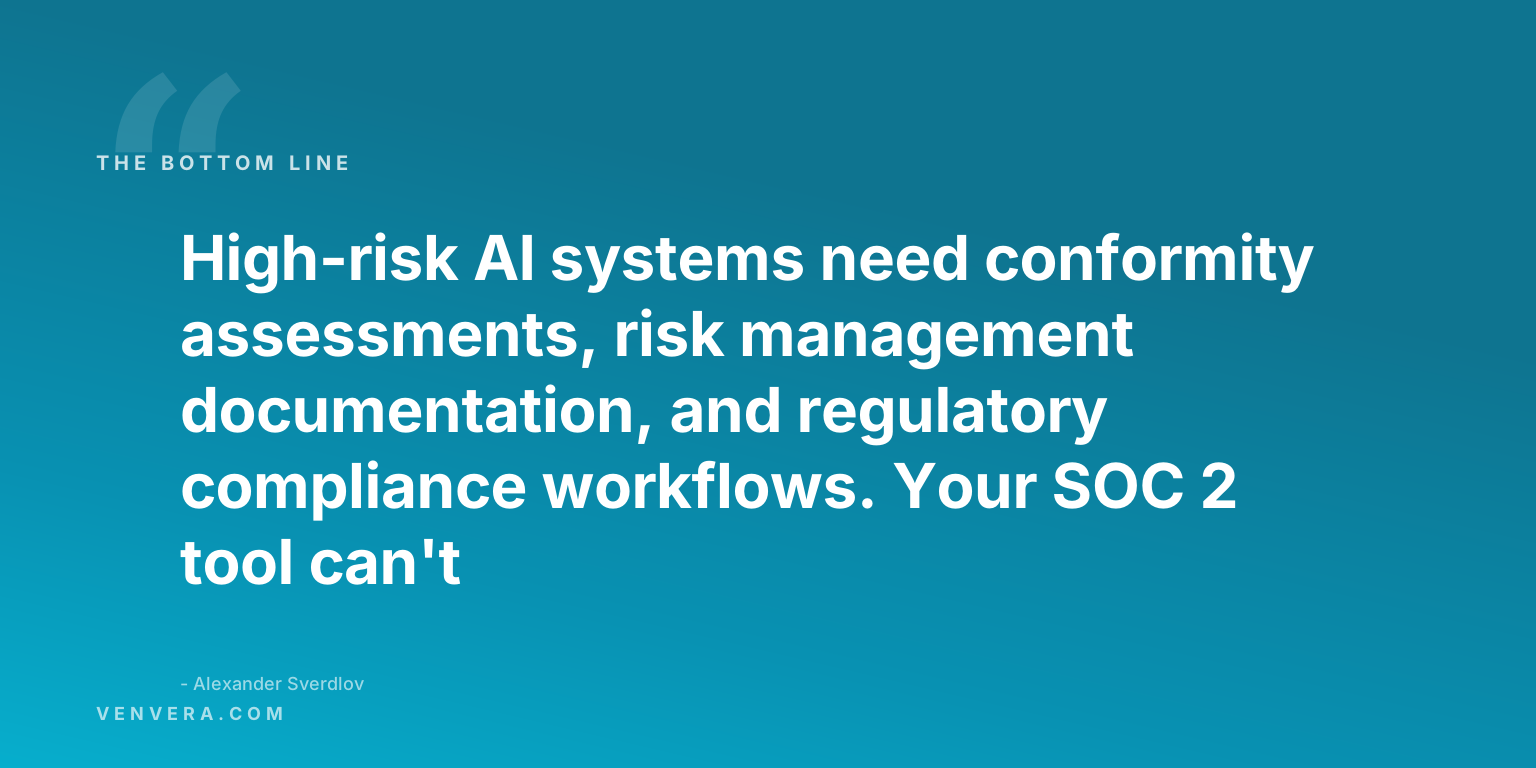
Risk management systems, data governance frameworks, technical documentation, record-keeping, transparency measures, human oversight provisions, and - for some categories - third-party conformity assessments. None of which StrikeGraph supports. StrikeGraph has no AI Act module, no AI risk classification, no conformity assessment workflow, no dataset documentation. It's a SOC 2 tool.
🔍
GAP ANALYSIS
What AI Act Compliance Actually Requires
These are the specific operational requirements for high-risk AI systems. Every one of them demands purpose-built tooling that doesn't exist in any SOC 2 platform.
📊
AI System Registry
Complete register of every AI system with risk classification, intended purpose, deployment context, and regulatory status. StrikeGraph has no AI system registry.
✅
Conformity Assessments
Before deploying high-risk AI, demonstrate conformity: risk management, data quality, technical docs, transparency. StrikeGraph has no conformity workflow.
💾
Dataset Documentation
Document training data characteristics, bias assessments, data quality measures, preprocessing methods. Can't be shoehorned into SOC 2 evidence collection.
👁
Human Oversight Mechanisms
High-risk systems must allow effective oversight by natural persons. Document what mechanisms exist, who exercises them, how. Not tracked in StrikeGraph.
📈
Post-Market Monitoring
Continuous monitoring for risks, performance degradation, emerging issues. Fundamentally different from SOC 2 infrastructure monitoring. Watches AI outputs and behavior.
📝
Technical Documentation
Comprehensive technical docs covering system architecture, algorithms, training, testing, validation, and deployment parameters. AI-specific, not generic security docs.
📊
HEAD TO HEAD
Platform Comparison at a Glance
| AI Act Requirement | StrikeGraph | Venvera |
|---|---|---|
| EU AI Act module | ✗ | ✓ Full module |
| AI system registry & classification | ✗ | ✓ Risk-tiered registry |
| Conformity assessment workflow | ✗ | ✓ Structured workflow |
| Dataset documentation | ✗ | ✓ Full documentation |
| Human oversight tracking | ✗ | ✓ Oversight mechanisms |
| Post-market monitoring | ✗ | ✓ AI-specific monitoring |
| Technical documentation templates | ✗ | ✓ AI Act-aligned |
| Cross-framework mapping | ✗ | ✓ 150+ mappings |
| EU data hosting | ✗ US-based | ✓ Amsterdam |
| Total frameworks | ◯ 4 | ✓ 13 |
| Starting price | ~$8-12K/yr (SOC 2) | €399/mo (1 fw) |
🔬
DEEP DIVE
What I Found in Venvera's AI Act Module
I was skeptical. The EU AI Act is new enough that most platforms haven't figured out how to support it. But Venvera's module covers the key requirements in a way that actually makes operational sense.
What stood out in practice:
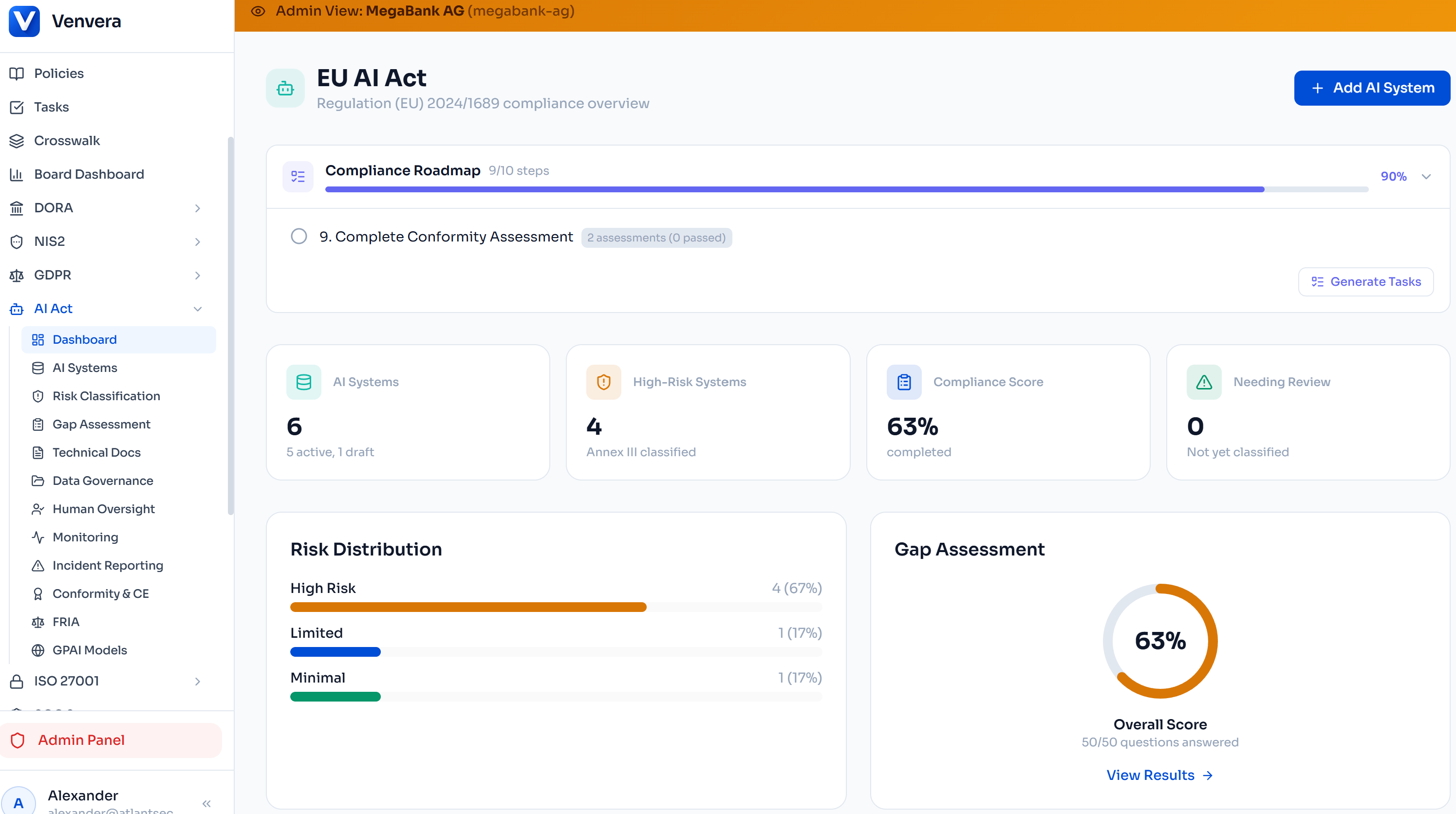
- Structured AI system registry with risk classification, intended purpose, deployment context, and regulatory status for each system
- Conformity assessment workflow walks through documentation requirements with templates aligned to the Act's specific articles
- Dataset documentation module for training data characteristics, bias assessments, data quality, and preprocessing methods
- Cross-framework mapping: AI data quality controls map to GDPR, risk management maps to ISO 27001 and NIST CSF, incident monitoring maps to NIS2 and DORA
The integration ecosystem is growing but not as deep as Vanta's. For the regulatory substance of AI Act compliance - the documentation, assessments, and governance that regulators will actually examine - Venvera is ahead of every other platform I evaluated.
🔗
EFFICIENCY MULTIPLIER
AI Act + GDPR + ISO 27001: Natural Allies
✓ Cross-framework mapping eliminates duplicate work
Your AI Act data quality controls map to GDPR data governance requirements. Your risk management procedures map to ISO 27001 and NIST CSF. Your incident monitoring maps to NIS2 and DORA incident management. One set of controls, multiple frameworks satisfied.
Thirteen frameworks total: DORA, GDPR, NIS2, ISO 27001, EU AI Act, SOC 2, NIST CSF, Cyber Essentials, NDPA, UAE IA, CMMC, HIPAA, PCI-DSS. 150+ pre-built control mappings.
💰
PRICING REALITY CHECK
The Economics of AI Compliance
| Scenario | StrikeGraph + Consultants | Venvera |
|---|---|---|
| SOC 2 only | ~$10K/yr | €4,788/yr (€399/mo) |
| SOC 2 + AI Act | $10K + AI consultants (~$30-50K total) | €10,788/yr (€899/mo for 3) |
| SOC 2 + AI Act + GDPR | $10K + consultants (~$45-65K total) | €10,788/yr (€899/mo for 3) |
| Annual savings with Venvera | - | Save $20-55K/yr + EU hosting included |
AI Act compliance consulting is expensive - the specialist firms we evaluated charge €2,500-4,000/day. A conformity assessment project can easily run €30,000-50,000. Venvera gives you the operational platform at €899/month for three frameworks, with structured workflows that reduce (though don't eliminate) the need for external consulting.
🇪🇺
DATA SOVEREIGNTY
AI Compliance Data Belongs in the EU
Your AI Act compliance documentation includes detailed information about your AI systems: algorithms, training data, performance metrics, deployment contexts. This is sensitive intellectual property and potentially includes references to personal data processing. Storing it on US servers subject to US law creates unnecessary risk.
Venvera: EU-native by design
Hosted entirely in Amsterdam. AES-256-GCM encryption with per-tenant keys. Your AI system documentation, conformity assessments, and dataset records stay in the EU, governed by EU law.
✅
DECISION GUIDE
Fair Credit to StrikeGraph (And the Honest Call)
✓ Switch to Venvera if:
- You deploy AI systems that qualify as high-risk under the Act
- You need conformity assessments, dataset documentation, or AI system registries
- Your AI systems affect EU citizens
- You want AI Act mapped to GDPR, ISO 27001, and other frameworks
- You need EU data hosting
◯ Stay on StrikeGraph if:
- You don't deploy high-risk AI systems in the EU
- You only need SOC 2 and you're US-based
- AI regulation isn't on your radar
StrikeGraph isn't a bad product. It's a focused SOC 2 tool that does one thing well. But the EU AI Act demands AI-specific governance, documentation, and assessment processes that don't exist in any SOC 2 platform. If you deploy AI in the EU, you need purpose-built tooling. StrikeGraph isn't it. Venvera is.
AI Compliance Is Too Important for Workarounds
System classification, conformity assessments, dataset documentation, and cross-framework mapping - plus GDPR, DORA, NIS2, and 9 more frameworks.
Amsterdam-hosted. Starting at €399/month (1 framework) or €899/month (3 frameworks).
Book a Demo →Last updated: March 2026. Platform comparisons based on publicly available information and direct evaluation.