
Best

I spent last autumn watching AI compliance go from “something we should probably look into” to “the board wants a status update by Friday.” That shift happened fast. One day the EU AI Act was a theoretical future regulation. The next, it was law - with obligations already in force and high-risk system requirements hitting in August 2026.
Our team’s first instinct was to check Secureframe. We were already using it for SOC 2. Surely they’d added some AI compliance features? A risk classification module? A conformity assessment workflow? Anything?
Nothing. And honestly? I don’t blame them. The EU AI Act is a fundamentally European regulation targeting AI systems in ways the US market hasn’t begun to regulate. It’s not Secureframe’s market. But that doesn’t help you if your organisation deploys AI systems in the EU and needs to demonstrate compliance before the deadlines hit.
⚠
THE PROBLEM
The AI Act Timeline Is Already Biting
The EU AI Act (Regulation (EU) 2024/1689) is the world’s first comprehensive AI regulation. If you use AI for credit scoring, insurance underwriting, hiring, fraud detection, or customer risk profiling in the EU - those are high-risk AI systems under Annex III. Here’s what’s already happening:
⚠ AI Act deadlines you cannot miss:
Feb 2025 (ALREADY PASSED): Prohibited AI practices ban in effect - social scoring, real-time biometric ID in public spaces.
Aug 2025 (ALREADY PASSED): General-purpose AI model obligations began - transparency, copyright compliance.
Aug 2026 (5 MONTHS AWAY): High-risk AI system requirements fully applicable - conformity assessments, risk management, data governance, human oversight.
Aug 2027: Remaining obligations for embedded AI systems.
🔍
GAP ANALYSIS
Where Secureframe Falls Short for the AI Act
The AI Act requires fundamentally different tooling from traditional compliance. These aren’t generic security controls - they’re AI-specific regulatory requirements that need purpose-built capabilities:
🤖
No AI System Registry
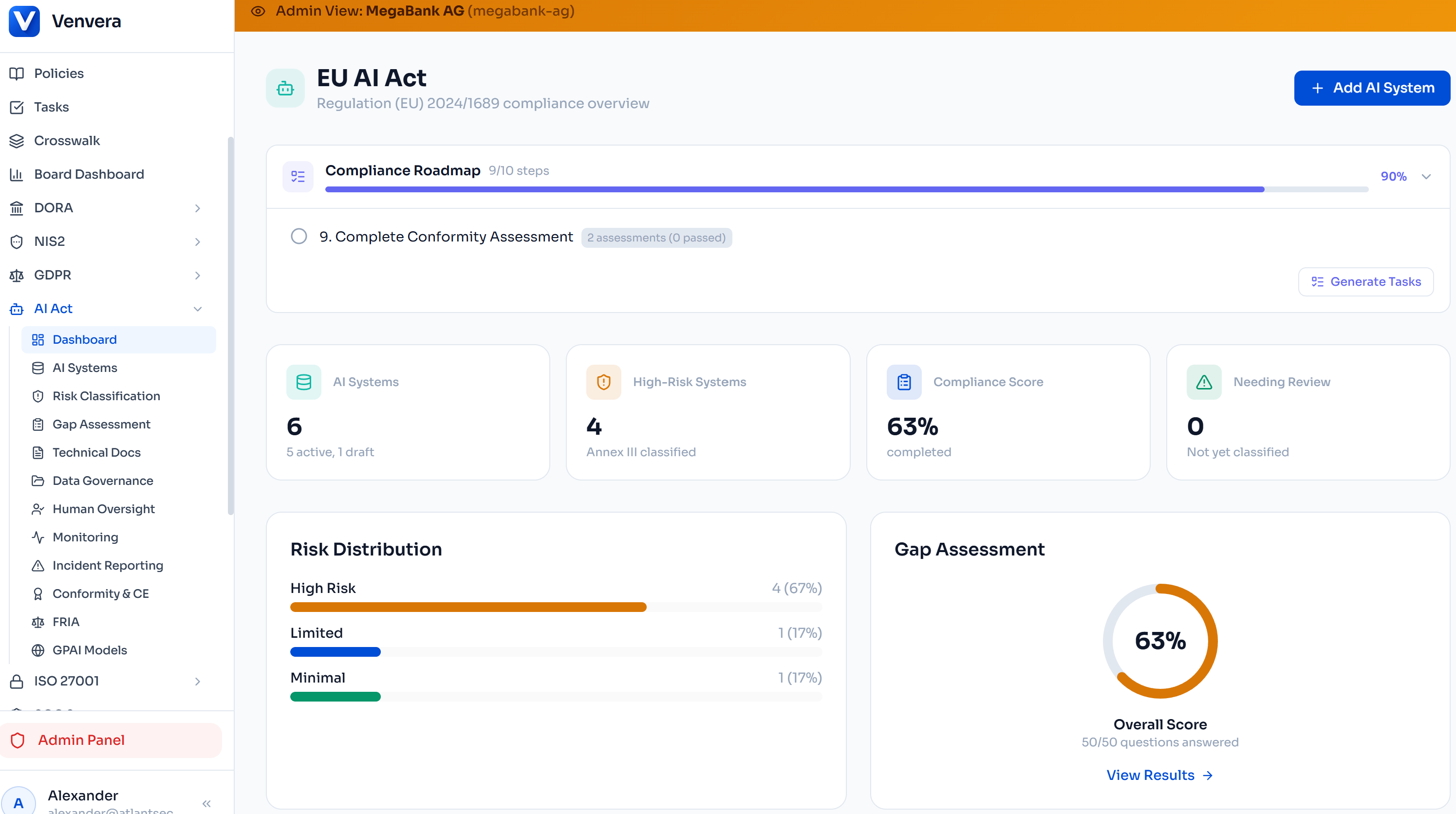
No way to catalogue AI systems with risk classification, deployment context, and regulatory status. You need a structured registry, not a spreadsheet.
📋
No Conformity Assessments
High-risk AI systems need structured conformity assessments: risk management, data governance, technical accuracy, human oversight. Not available in Secureframe.
📊
No Dataset Documentation
Article 10 requires thorough documentation of training, validation, and testing datasets. Representativeness, bias examination, gap identification. None available.
👁
No Human Oversight Tracking
The AI Act mandates human oversight mechanisms for high-risk systems. No tooling exists in Secureframe to document or track these.
📈
No Risk Classification
Which systems are high-risk? Which are limited-risk? Which fall under prohibited practices? Secureframe has no concept of AI-specific risk tiers.
⚖
HEAD-TO-HEAD
Feature Comparison: AI Act Readiness
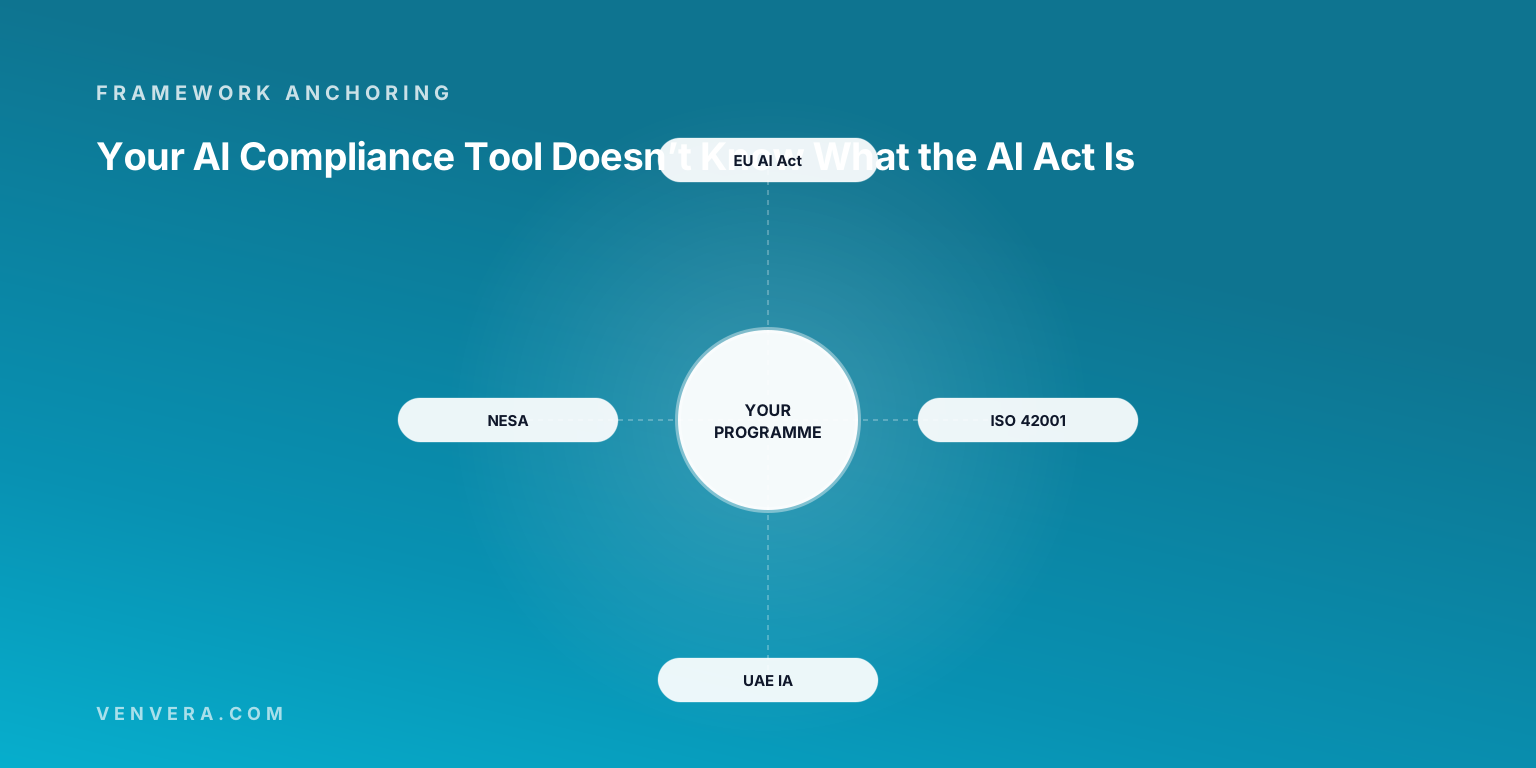
| AI Act & Compliance Need | Venvera | Secureframe |
|---|---|---|
| EU AI Act module | ✓ Full module | ✗ |
| AI system risk classification | ✓ Built-in | ✗ |
| Conformity assessment tracking | ✓ Structured | ✗ |
| Dataset documentation (Art. 10) | ✓ Built-in | ✗ |
| Human oversight documentation | ✓ Built-in | ✗ |
| Cross-mapping to GDPR Art. 22 / DORA | ✓ 13 frameworks | ✗ No EU frameworks |
| DORA / NIS2 / GDPR modules | ✓ All included | ✗ |
| SOC 2 / ISO 27001 | ✓ Included | ✓ Strong |
| EU data hosting | ✓ Amsterdam | ✗ US-hosted |
| HIPAA | ✗ | ✓ Strong |
🔬
DEEP DIVE
The Financial Services AI Problem
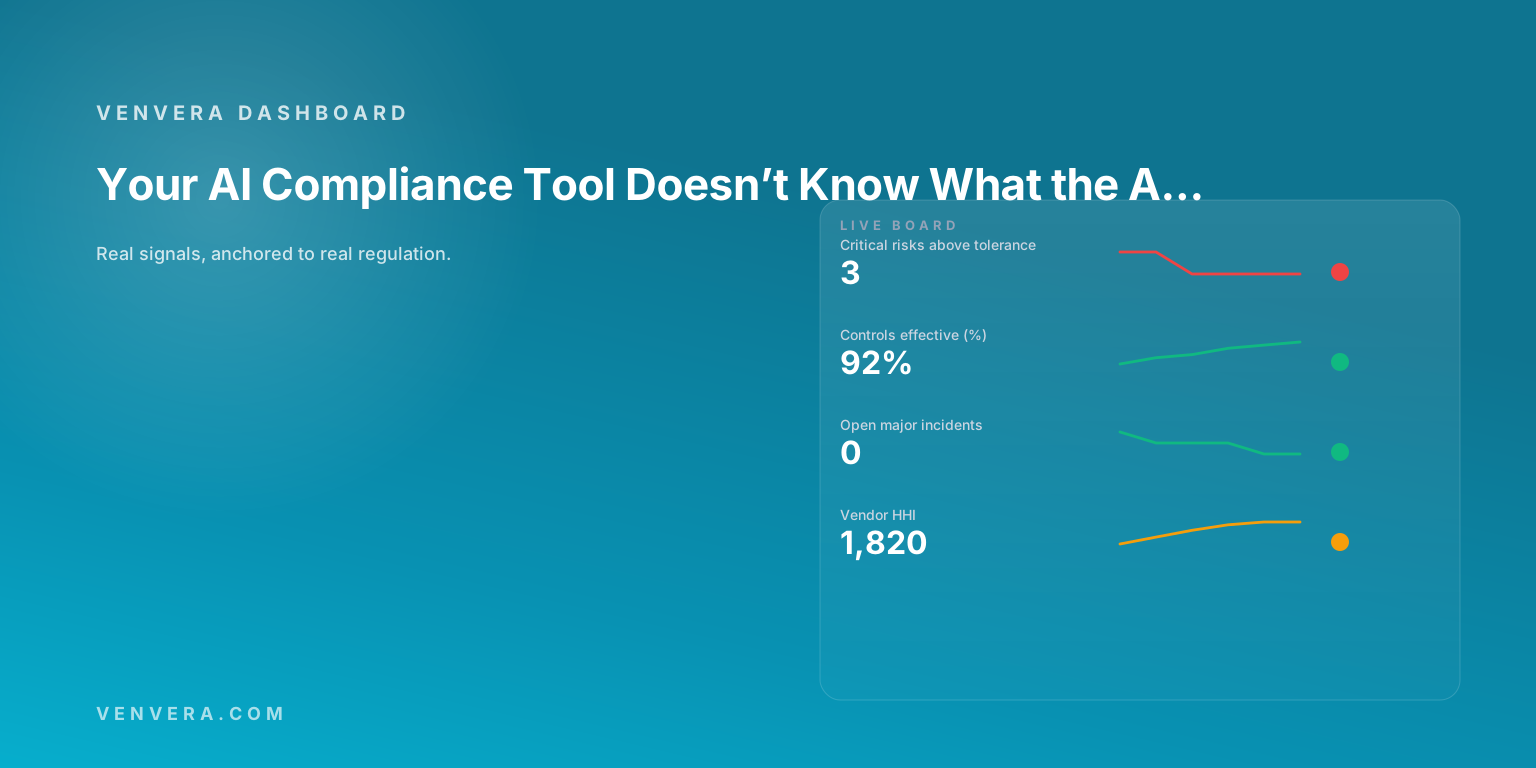
If you’re a financial institution deploying AI, your compliance obligations come from several regulations simultaneously. An AI system used for credit scoring triggers obligations across four different frameworks:
- AI Act: Risk classification, conformity assessment, data governance, human oversight, transparency requirements.
- DORA: ICT risk management for the AI system, third-party risk for the AI vendor, incident reporting if the AI fails.
- GDPR: Article 22 automated decision-making rights, data minimisation, purpose limitation, DPIA requirement.
- ISO 27001: Information security controls around the AI system and its data.
Managing four sets of requirements across four separate tools is a recipe for gaps. Venvera handles all of them in one platform with automatic cross-mapping.
🔗
CROSS-FRAMEWORK EFFICIENCY
AI Act + DORA + GDPR: One Platform, Not Three
When you document human oversight measures for the AI Act in Venvera, the platform automatically shows how that relates to your GDPR Article 22 obligations and your DORA ICT risk management requirements. Secureframe can’t participate in that conversation at all.
✅ Real-world efficiency gain:
A risk management framework for an AI credit scoring system satisfies AI Act requirements, DORA ICT risk management, and GDPR DPIA obligations simultaneously. One framework. Three regulations addressed.
Teams report 35-50% less compliance work when AI Act, DORA, and GDPR are managed in a single cross-mapped platform.
💰
PRICING COMPARISON
Don’t Pay for Tools That Can’t Do AI Compliance
Secureframe can’t do AI Act compliance at any price. If you keep it for SOC 2 and add separate AI Act, DORA, and GDPR tools, the cost compounds fast:
| Scenario | Secureframe + Others | Venvera | You Save |
|---|---|---|---|
| AI Act only | N/A (no AI Act) | €399/mo (€4,788/yr) | - |
| AI Act + DORA + GDPR | ~$30-50K/yr (multiple tools) | €899/mo (€10,788/yr) | $15-35K/yr |
| SOC 2 + ISO + AI Act + DORA + GDPR | ~$50-100K/yr | €899/mo (€10,788/yr) | $35-85K/yr |
🇪🇺
DATA SOVEREIGNTY
AI Compliance Data Should Stay in the EU
Your AI system registry, conformity assessments, dataset documentation, and risk management records all contain sensitive information about how your AI systems work. Hosting that data on US servers, subject to US jurisdiction, creates unnecessary risk when European market surveillance authorities come asking questions.
🇪🇺 Venvera: Built for EU AI governance
Hosted in Amsterdam. AES-256-GCM encryption. Your AI compliance documentation stays under EU jurisdiction - exactly where your market surveillance authority expects it.
✅
DECISION GUIDE
Who Should Switch - And Who Should Stay
✅ Switch to Venvera if:
- You deploy AI systems in the EU (especially high-risk under Annex III)
- You need conformity assessment tracking and dataset documentation
- Your AI systems also trigger DORA, GDPR, or ISO 27001 obligations
- The August 2026 deadline matters to your organisation
- Cross-framework mapping would reduce redundant compliance work
Stay with Secureframe if:
- You don’t deploy AI systems in the EU
- The AI Act genuinely doesn’t apply to your organisation
- SOC 2, ISO 27001, or HIPAA are your only needs
- You have no European regulatory obligations
Secureframe is good at SOC 2 and HIPAA. But the AI Act requires a fundamentally different kind of tooling that Secureframe doesn’t offer and isn’t building. The August 2026 deadline for high-risk AI systems is coming fast. Better to have your programme running on the right platform now than to scramble later.
AI Act Compliance Before the Deadline
Risk classification, conformity assessment, dataset governance, and 12 more frameworks.
From €399/mo (1 framework) or €899/mo (3 frameworks). Hosted in Amsterdam.
Book a Demo →Last updated: March 2026. Based on publicly available information and hands-on platform evaluation. Contact vendors for current pricing.