

Best

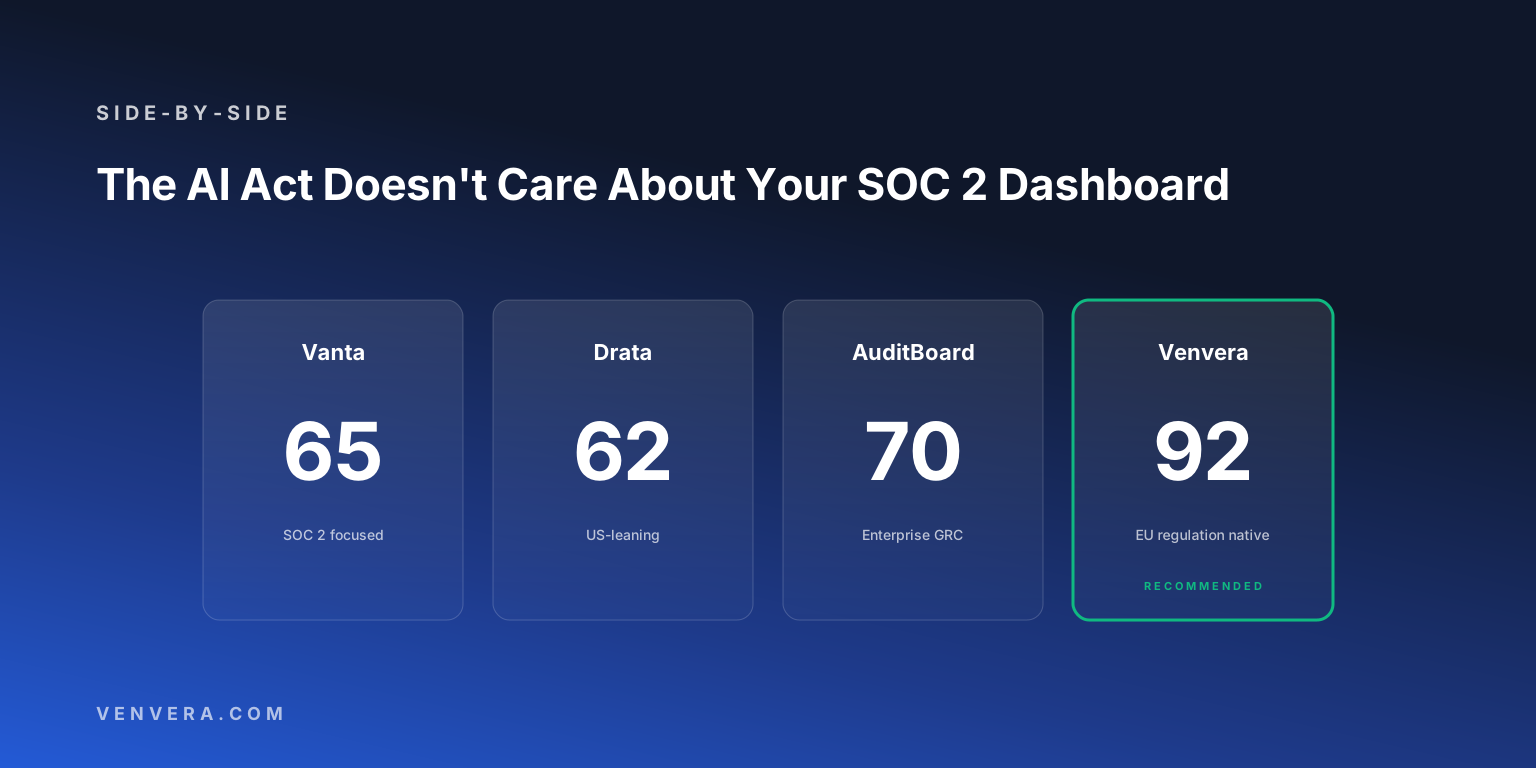
Let me save you the suspense: no infrastructure compliance platform - Drata, Vanta, any of them - was designed for AI governance. The question is whether you want a tool that acknowledges this gap or one that pretends it doesn't exist.
The EU AI Act is the world's first comprehensive AI regulation, and it's fundamentally different from anything the compliance industry has dealt with before. It doesn't ask "are your systems secure?" It asks "is your AI system transparent, fair, and accountable? Can you prove it? Can you show me the data governance, the human oversight mechanisms, the risk classification, the conformity assessment?"
Drata's response to the AI Act is the same response they have to every new regulation: map controls to articles, add it to the framework list, let customers check boxes. For SOC 2, that approach works brilliantly. For the AI Act? It's like using a ruler to measure temperature. You're holding a tool. It just doesn't measure what you need to measure.
⚠
THE PROBLEM
What the AI Act Actually Demands (and Why It's Weird)
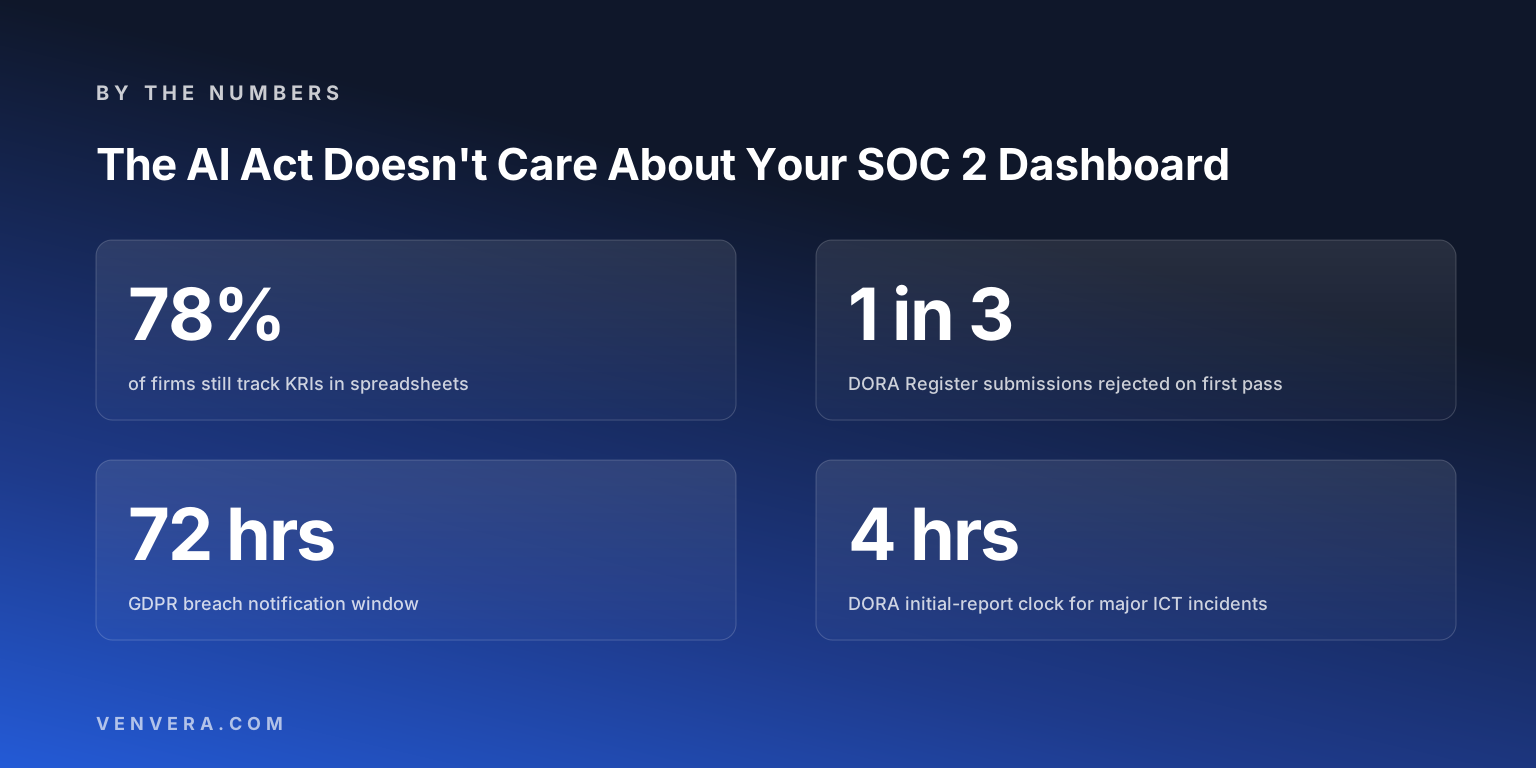
The AI Act is weird. I say that with love, but it's weird. Unlike GDPR or ISO 27001, it doesn't apply uniformly. It applies based on what your AI systems do and how risky they are. A chatbot answering return policy questions? Minimal risk. An AI system making credit decisions? High-risk, with a mountain of obligations.
⚠ What high-risk AI systems require:
- Risk Classification: Categorise every AI system by risk level. Not a technical control - an analytical exercise requiring domain knowledge of both AI and regulation.
- Data Governance (Art. 10): Training, validation, and testing datasets must meet quality criteria. Document sources, biases, gaps. Infrastructure monitoring can't help.
- Technical Documentation (Art. 11): A detailed technical dossier far beyond a SOC 2 system description.
- Human Oversight (Art. 14): Document oversight mechanisms, who exercises them, under what conditions humans can override AI decisions.
- Conformity Assessment (Art. 43): Structured evaluation process before placing high-risk systems on the market. Not a checkbox.
🔍
WHERE DRATA FALLS SHORT
Why Infrastructure Compliance Can't Solve AI Governance
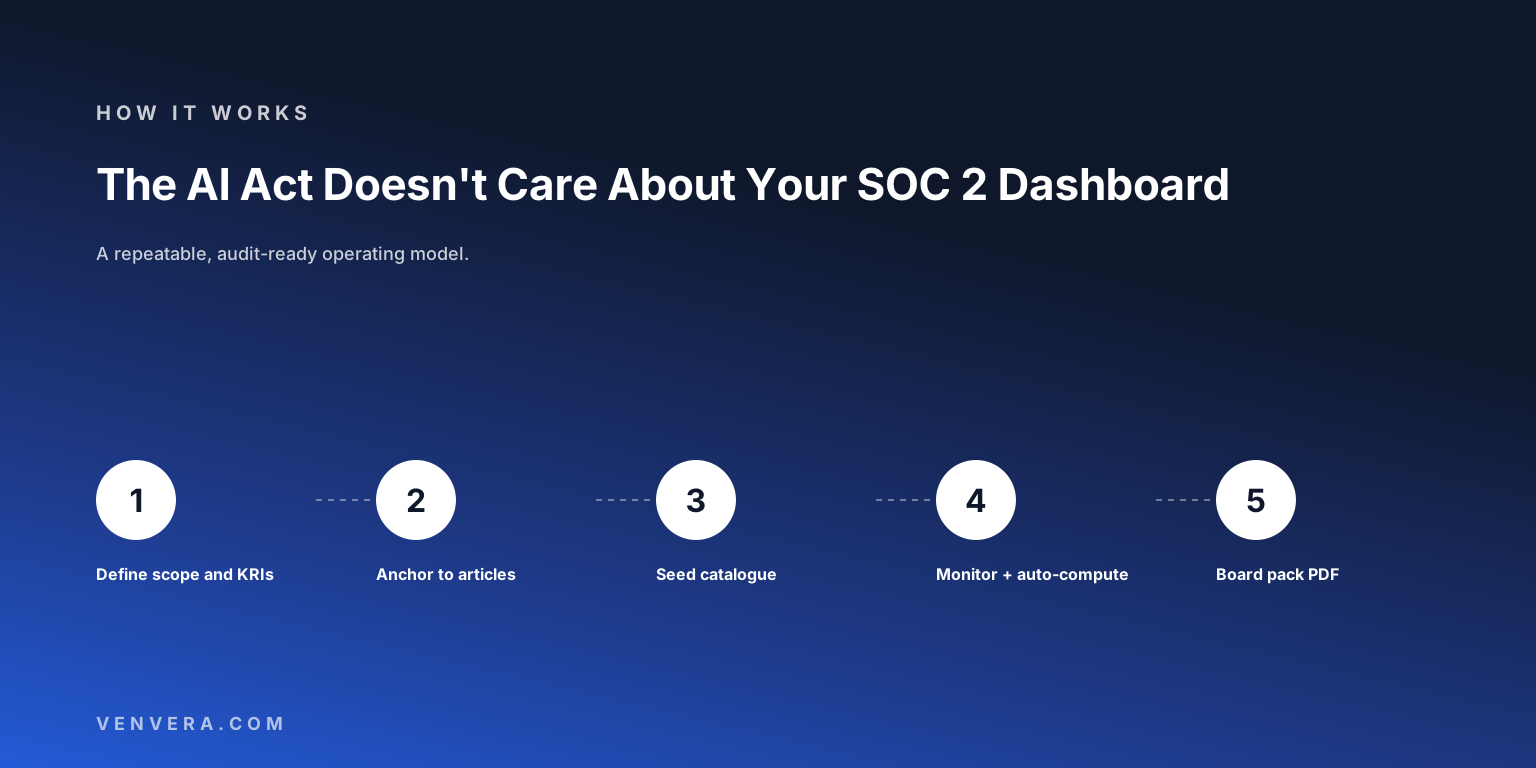
The hard parts of AI Act compliance have nothing to do with infrastructure. And that's exactly what Drata is built around.
🤖
AI System Inventory
How do you classify AI systems by risk level in Drata? You don't. No system inventory structured around AI-specific attributes.
📊
Data Governance
Training data quality, bias documentation, dataset provenance. Drata connects to infrastructure, not your ML pipeline.
📋
Conformity Assessments
No workflow for the structured evaluation process. You can upload files, but there's no Article 43-aligned assessment template.
👤
Human Oversight
Drata monitors automated controls. AI Act requires documenting human decision processes and override mechanisms. Different universe.
📄
Technical Documentation
Article 11 requires a structured technical dossier. Drata offers generic file upload. No structured template aligned to requirements.
🔗
AI Act + GDPR Overlap
AI Act data governance connects to GDPR Art. 25 and Art. 35. In Drata, these are separate modules that don't talk to each other.
⚖
FEATURE COMPARISON
AI Act Compliance: Drata vs Venvera
| AI Act Requirement | Drata | Venvera |
|---|---|---|
| AI System Risk Classification | ✗ Not available | ✓ Full inventory + classification |
| Data Governance (Art. 10) | ✗ Not available | ✓ Dataset documentation + tracking |
| Technical Documentation (Art. 11) | ✗ Generic file upload | ✓ Structured templates |
| Conformity Assessment (Art. 43) | ✗ Not available | ✓ Assessment workflow |
| Human Oversight Documentation | ✗ Not available | ✓ Oversight mechanism tracking |
| Infrastructure Security Controls | ✓ Excellent | ✓ Full control framework |
| Cross-Framework (AI Act + GDPR) | ◯ Separate modules | ✓ 150+ mappings |
| Data Hosting | ◯ US default (EU option) | ✓ Amsterdam, EU |
| Starting Price | ~$25-30K+/yr | €399/mo (€4,788/yr) |
🔬
DEEP DIVE
The AI Act + GDPR Overlap Nobody Talks About
Here's something that trips up almost every organisation I work with: if your AI system processes personal data (and most do), you need both AI Act and GDPR compliance. These overlap, interlock, and sometimes conflict.
- AI Act data governance (Art. 10) connects directly to GDPR data protection by design (Art. 25) and DPIA requirements (Art. 35)
- AI profiling triggers GDPR transparency and automated decision-making obligations (Art. 22)
- With Drata, these are separate framework modules at separate price points. The controls don't connect.
- Venvera's cross-framework mapping connects AI Act requirements to GDPR automatically. Document data governance measures once, satisfy both regulations.
🔗
CROSS-FRAMEWORK MAPPING
AI Governance Meets Multi-Framework Reality
✓ Cross-framework impact:
- 150+ pre-built mappings connecting AI Act to GDPR, DORA, ISO 27001, and 9 more
- AI Act security requirements (Art. 15) map to ISO 27001 and DORA controls
- AI Act transparency (Art. 13) connects to GDPR transparency obligations
- Document once, satisfy multiple regulators. In Drata, you'd document separately - and pay separately.
💰
PRICING COMPARISON
The Cost of AI Act Compliance
| Scenario | Drata | Venvera | You Save |
|---|---|---|---|
| AI Act only | ~$25-30K/yr | €4,788/yr | ~$20K/yr |
| AI Act + GDPR + ISO 27001 | ~$75-90K/yr | €10,788/yr | ~$65-80K/yr |
| 3-year total (3 frameworks) | ~$225-270K | €32,364 | $190-240K |
🇪🇺
DATA SOVEREIGNTY
EU Regulation, EU Hosting
The AI Act is an EU regulation governing AI systems operating in Europe. Your system inventories, conformity assessments, and data governance records should live under EU jurisdiction. Drata defaults to US hosting. Venvera is hosted in Amsterdam with AES-256-GCM encryption. No add-ons, no configuration - EU hosting as default.
✅
WHO SHOULD SWITCH
What to Do Right Now
Switch to Venvera if:
- ☑ You deploy AI systems that need risk classification and conformity assessment
- ☑ You need data governance documentation for training datasets
- ☑ Your AI systems process personal data (AI Act + GDPR dual compliance)
- ☑ You need human oversight mechanisms documented and tracked
- ☑ You're also subject to GDPR, DORA, ISO 27001, or NIS2
- ☑ You want a platform that treats AI governance as AI governance - not another set of infrastructure controls
Drata is excellent at infrastructure security compliance. If SOC 2 is your primary obligation and AI Act is a distant concern, it serves you well. But if you're deploying high-risk AI systems and need genuine AI governance tooling - system inventories, data governance, conformity assessments, human oversight tracking - you need a platform built for that purpose. Drata, respectfully, was not.
AI Act Compliance Built for AI Governance, Not Infrastructure
System inventory. Risk classification. Data governance. Conformity assessments.
Cross-mapped to GDPR, DORA, and 10 more frameworks. EU-hosted. From €399/month.
Book a Demo →Last updated: March 2026. Pricing and features based on publicly available data and hands-on evaluation. The AI Act's obligations phase in through 2027 - contact vendors to confirm current capabilities.