
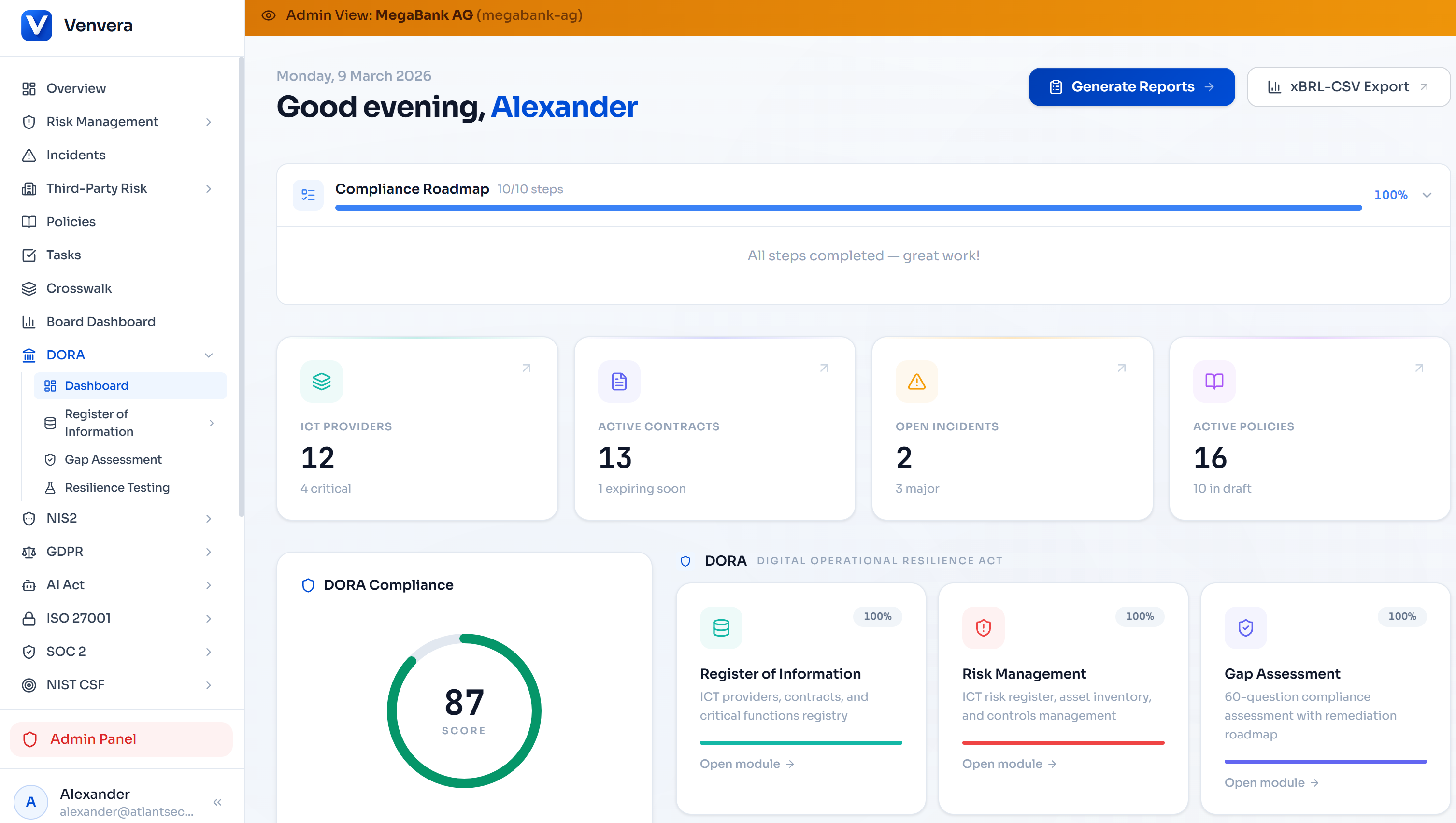

Best

Switching your compliance platform in the middle of a regulatory push feels terrifying. But staying on the wrong one? That's worse.
I'll tell you exactly what happened. Our team was using StrikeGraph for SOC 2 - it worked fine for that. Simple interface, reasonable pricing, got us through our Type II audit without major drama. Then the DORA deadline hit in January 2025, and suddenly we needed a Register of Information with ESA entity codes, xBRL-CSV exports, DORA-specific incident classification with four-hour reporting windows, and concentration risk analysis for our ICT providers. We went looking for the DORA module in StrikeGraph. There isn't one.
So we switched. And three months in, I can say it was one of the best decisions our compliance team made last year. Here's the full story - the good, the bad, and the numbers that made the choice obvious.
⚠
THE CORE PROBLEM
DORA Is Not SOC 2. Not Even Close.
StrikeGraph was founded in 2020 with a clear mission: make SOC 2 certification easier for startups. Their risk-based approach to scoping audits is genuinely clever - instead of drowning you in 300 controls on day one, it helps you focus on the ones that matter for your risk profile. For a 20-person SaaS company getting its first Type II report, that pragmatism is worth a lot.
But here's the thing about DORA: it doesn't care about your risk appetite in the same way SOC 2 does. DORA is a binding EU regulation. There's no auditor you can convince to scope things down. The ESAs have published Implementing Technical Standards that specify exactly what data you need, exactly how it needs to be structured, and exactly what format it needs to be exported in. You either meet the requirements or you don't.
🚨 Why this matters right now
DORA (Regulation 2022/2554) became applicable in January 2025. Financial entities that can't produce a compliant Register of Information, demonstrate ICT risk management, or report incidents within four hours face regulatory action from their national competent authority. StrikeGraph covers SOC 2, ISO 27001, HIPAA, and PCI DSS. It has zero DORA capability. No roadmap entry for one, either.
🔍
GAP ANALYSIS
Where StrikeGraph Falls Short for DORA
These aren't edge cases - they're the core of what DORA demands from every financial entity in the EU.
📑
Register of Information
DORA Article 28(3) requires 15 interconnected templates, 100+ mandatory fields, entity hierarchies, and sub-outsourcing chains. StrikeGraph has a basic vendor list.
📄
xBRL-CSV Export
ESAs require regulatory submissions in xBRL-CSV format with specific table relationships and validation rules. StrikeGraph can't generate this. Neither can most platforms.
🆔
ESA Entity Codes
LEI codes, EBA classifications, EIOPA identifiers, ESMA codes, jurisdiction mappings - every entity needs the right identifiers. StrikeGraph has never heard of one.
🚨
Incident Classification (RTS)
DORA defines specific severity criteria: transaction count, service availability, economic impact. Four-hour initial notification. StrikeGraph offers Low/Medium/High dropdowns.
🔗
Concentration Risk Analysis
Which critical business functions depend on the same provider? What if they fail? StrikeGraph doesn't model business function-to-provider dependencies at all.
📋
ICT Risk Management
DORA Articles 5-16 require a comprehensive ICT risk framework with specific governance structures. StrikeGraph's risk model is built for SOC 2 scoping, not regulatory ICT risk.
📊
HEAD TO HEAD
Feature Comparison: StrikeGraph vs. Venvera for DORA
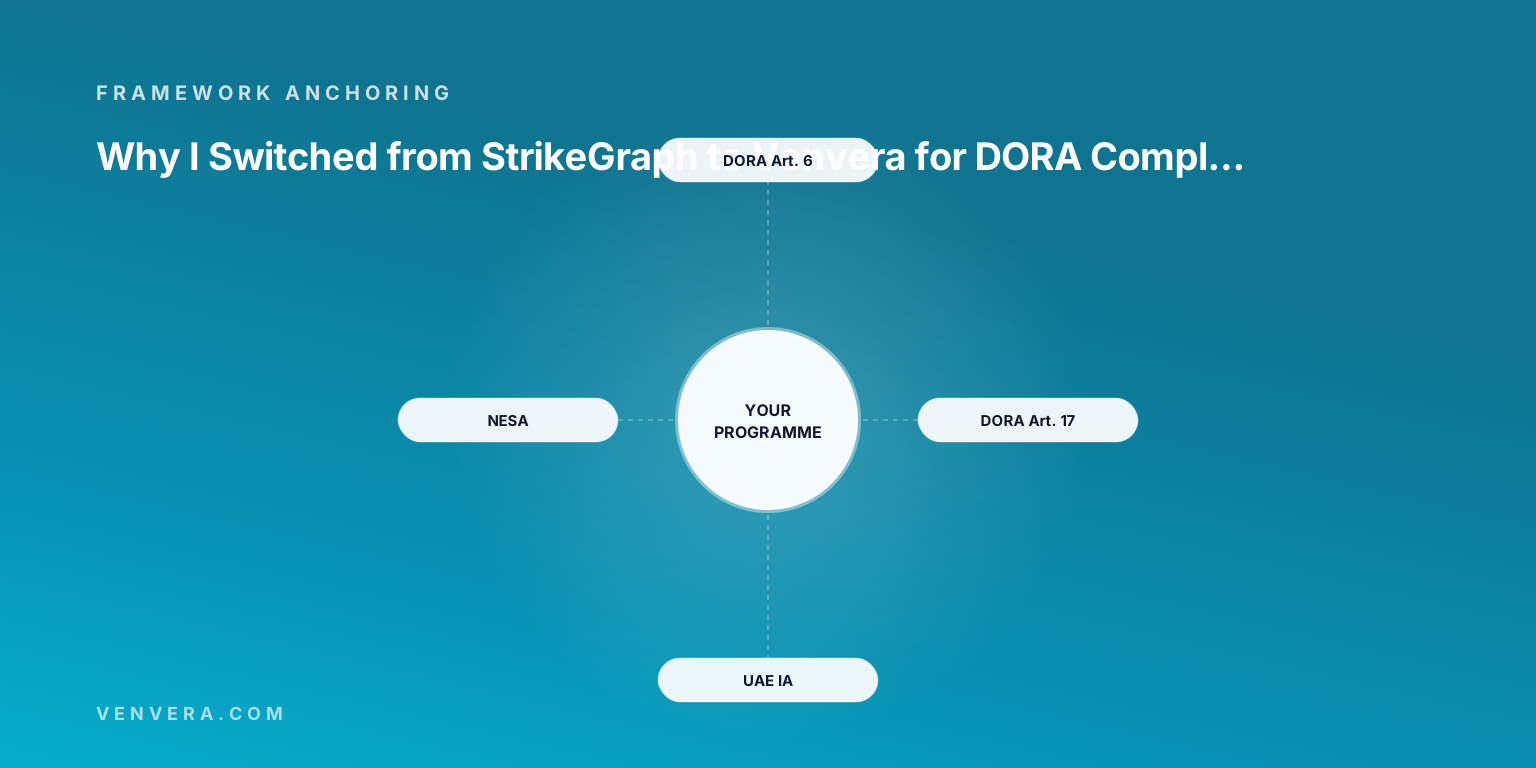
| What You Need for DORA | StrikeGraph | Venvera |
|---|---|---|
| DORA compliance module | ✗ | ✓ Full native module |
| Register of Information (ESA ITS) | ✗ | ✓ 15 templates, full structure |
| xBRL-CSV export | ✗ | ✓ Native generation |
| ESA entity codes (LEI, EBA, EIOPA) | ✗ | ✓ Built-in lookups |
| DORA incident classification (RTS) | ✗ | ✓ Full RTS criteria |
| ICT concentration risk analysis | ✗ | ✓ Built-in |
| ICT risk management framework | ✗ | ✓ Articles 5-16 mapped |
| Sub-outsourcing chain tracking | ✗ | ✓ Full chain mapping |
| Cross-framework mapping | ✗ | ✓ 150+ mappings |
| Frameworks supported | ◯ 4 (SOC 2, ISO, HIPAA, PCI) | ✓ 13 frameworks |
| Data hosting | ✗ US-based | ✓ Amsterdam, NL |
| Starting price | ~$8-12K/yr (SOC 2) | €399/mo (1 fw) |
🔬
DEEP DIVE
What Changed When We Moved to Venvera
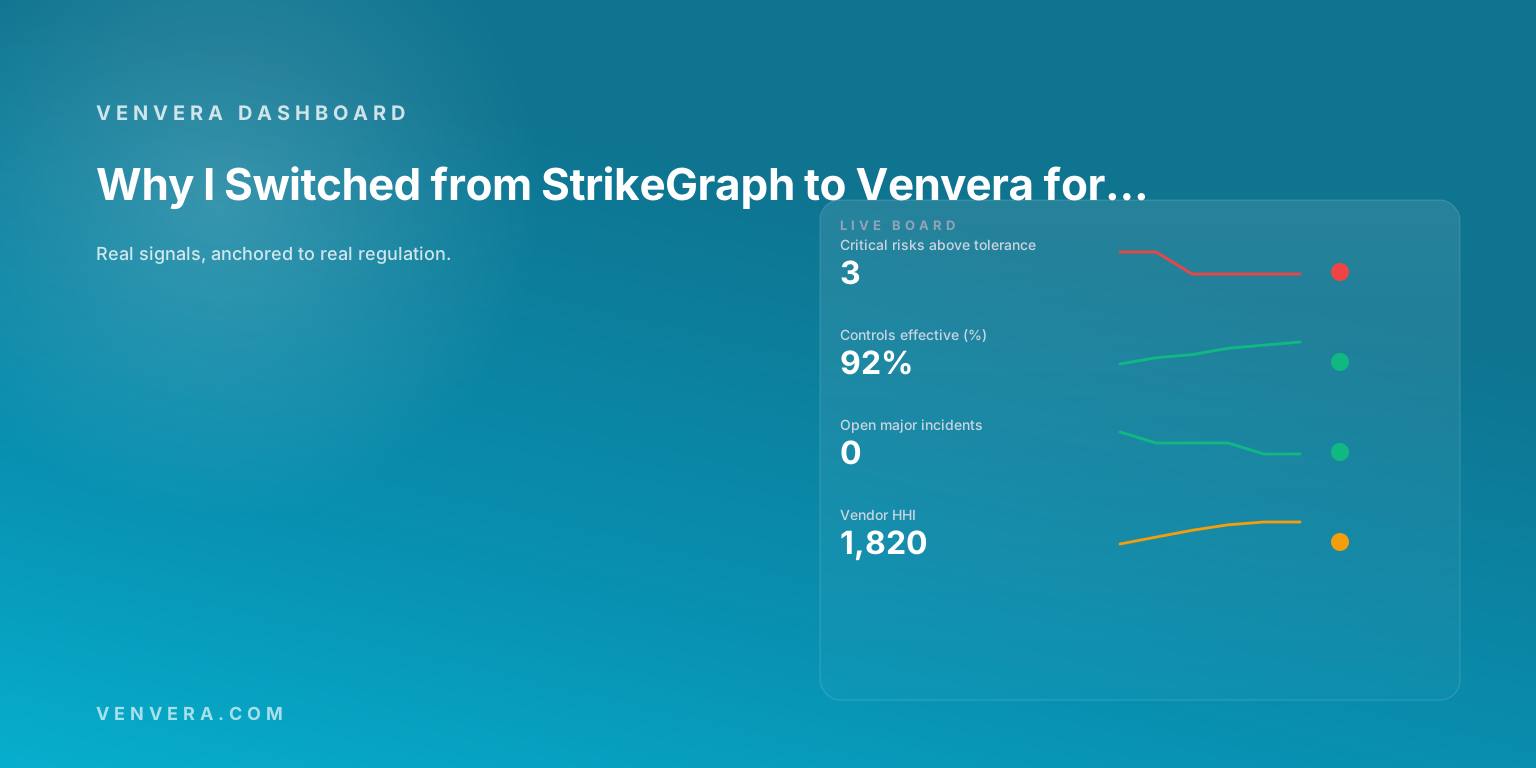
The first thing I noticed was that Venvera's data model actually mirrors DORA's concepts. ICT providers, contractual arrangements, business functions, the relationships between them - they're native entities in the system, not custom fields we had to create. Someone on that team has clearly read the regulation cover to cover.
We imported about 40 ICT providers in the first week. The structured RoI automatically linked providers to contracts, contracts to business functions, and business functions to entities. The sub-outsourcing chain tracking was built in. When I needed to trace which fourth-party cloud vendors our payment processor relied on, it was three clicks instead of the 45-minute spreadsheet archaeology we'd been doing.
What actually surprised us:
- The xBRL-CSV export worked on the first try. We'd been quoted €15,000 by a consulting firm to build a custom export tool.
- ESA entity codes are pre-loaded - LEI lookups, classification codes, jurisdiction mappings - all there.
- Incident classification follows the actual RTS criteria, not generic severity levels.
- Concentration risk analysis shows provider dependency across all critical business functions in a single view.
The rough parts? Venvera's integration ecosystem is smaller than what StrikeGraph or Vanta offer. If you need 200+ automated connectors pulling config data from AWS and scanning your infrastructure in real time, you'll notice the gap. It's a newer platform. But for the regulatory substance of DORA - the stuff that actually matters when regulators come knocking - nothing else I tested was even in the same league.
🔗
EFFICIENCY MULTIPLIER
Cross-Framework Mapping That Saves Hundreds of Hours
Here's what I didn't expect: the cross-framework mapping. When we set up our DORA incident response procedure, Venvera flagged the corresponding NIS2, ISO 27001, and NIST CSF requirements as partially addressed. We were already doing compliance work for three frameworks without realizing it. That alone saved us probably 200 hours over the next quarter.
✓ One control, multiple frameworks satisfied
Your DORA ICT risk management controls map to ISO 27001 Annex A, NIS2 Article 21, NIST CSF Identify function, and SOC 2 CC3. Document once. Satisfy everywhere.
Thirteen frameworks total: DORA, GDPR, NIS2, ISO 27001, EU AI Act, SOC 2, NIST CSF, Cyber Essentials, NDPA, UAE IA, CMMC, HIPAA, PCI-DSS. 150+ pre-built control mappings across all of them.
💰
PRICING REALITY CHECK
The Multi-Framework Economics That Sealed the Deal
StrikeGraph is startup-friendly on price - roughly $8-12K/year for SOC 2. But they don't cover DORA at all. So the real comparison is: what does it cost to get DORA compliance handled alongside your other frameworks?
| Scenario | StrikeGraph + Workarounds | Venvera |
|---|---|---|
| SOC 2 only | ~$10K/yr | €4,788/yr (€399/mo) |
| SOC 2 + DORA | $10K + consultants (~$25-30K total) | €10,788/yr (€899/mo for 3) |
| SOC 2 + DORA + GDPR | $10K + consultants (~$35-45K total) | €10,788/yr (€899/mo for 3) |
| Annual savings with Venvera | - | Save $15-35K/yr + EU hosting included |
The pricing made the switch a no-brainer. StrikeGraph charges around $10K for SOC 2 alone, but can't do DORA at any price. The consultants we were quoted for DORA compliance tooling wanted €15,000 just for the xBRL-CSV export engine. With Venvera at €899/month for three frameworks, we got DORA, SOC 2, and GDPR together for less than StrikeGraph charged for SOC 2 alone - and that includes purpose-built regulatory modules and EU data hosting.
🇪🇺
DATA SOVEREIGNTY
The Data Sovereignty Problem Nobody Talks About
Here's an irony that kept me up at night: we were using a US-hosted compliance platform to manage our European regulatory obligations. Our Register of Information - containing details about every ICT provider, every contract, every critical business function - was sitting on American servers subject to US law.
DORA requires financial entities to understand and control where their data resides. Using a US-based compliance platform to manage your DORA data means you've essentially created a new third-party risk that needs to go into your own Register of Information. You're using the tool to track the risk that the tool itself creates. That's not compliance - that's a Kafka novel.
Venvera: EU-native by design
Hosted entirely in Amsterdam. AES-256-GCM encryption with per-tenant keys. No transatlantic data transfer. No Schrems II analysis required. No adequacy decision to worry about. When our DPO asked where compliance data was stored, the answer was "the Netherlands" instead of "we'll need to schedule a meeting about that."
✅
DECISION GUIDE
Who Should Actually Switch (And Who Should Stay)
I believe in being honest about this. StrikeGraph isn't wrong for everyone - it's wrong for DORA.
✓ Switch to Venvera if:
- You're subject to DORA (or GDPR, NIS2, EU AI Act)
- You need a Register of Information that actually works
- You need xBRL-CSV export and ESA entity codes
- You're managing multiple regulatory frameworks
- You need European data hosting
◯ Stay on StrikeGraph if:
- You're a US-based startup that only needs SOC 2
- You like their risk-based scoping approach
- You don't have EU regulatory obligations
- You want the most affordable path to a first SOC 2 report
The gap between these two products for DORA compliance isn't a matter of degree. It's a matter of category. One supports DORA. The other doesn't. That's not a competitive comparison - it's a binary fact.
Ready to Actually Do DORA Compliance?
Register of Information, xBRL-CSV export, ESA entity codes, incident classification, and 12 more frameworks.
All hosted in Amsterdam. Starting at €399/month (1 framework) or €899/month (3 frameworks).
Book a Demo →Last updated: March 2026. Feature and pricing details based on publicly available information and direct platform testing.