
Best

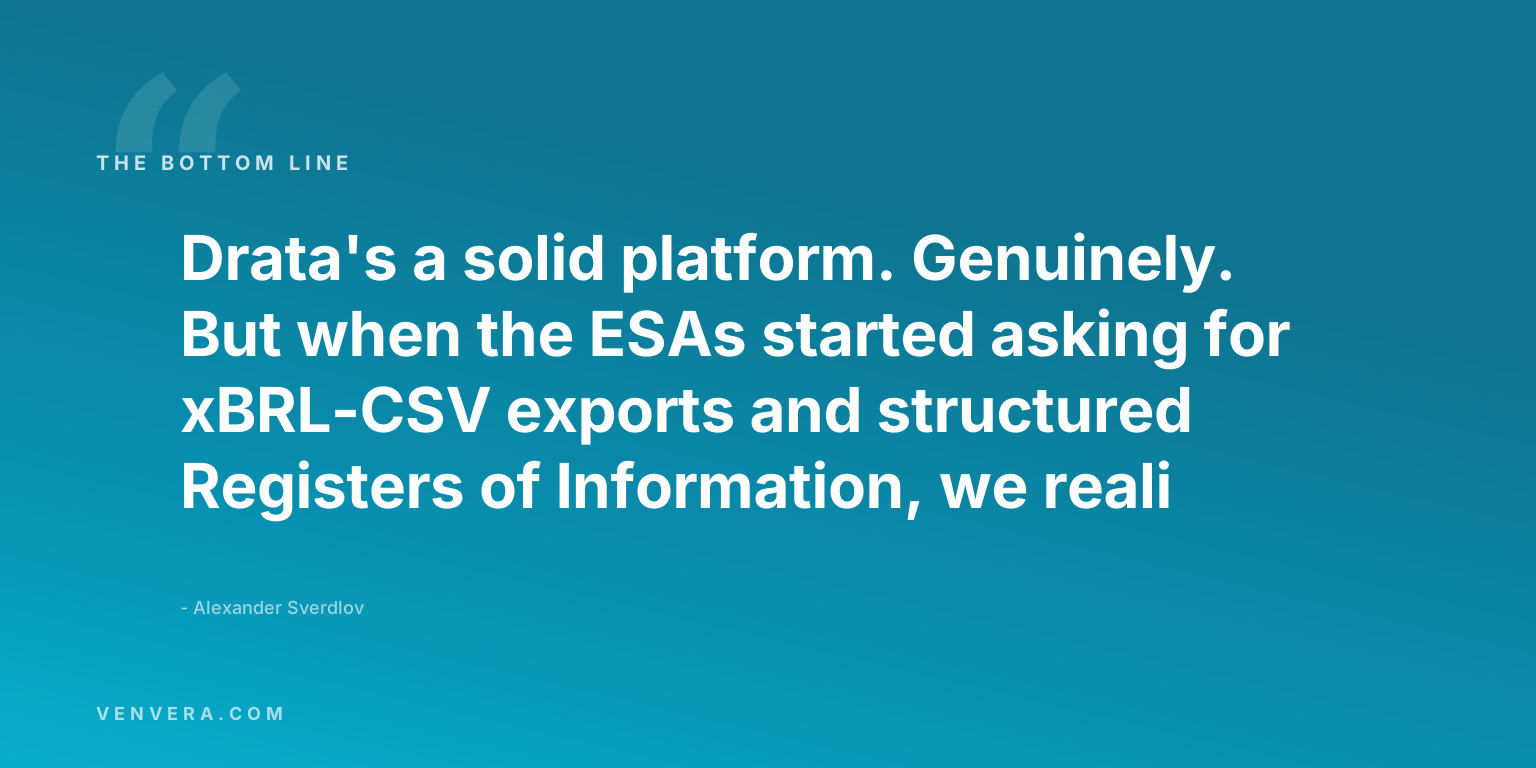
I want to be fair to Drata upfront. They built one of the best continuous compliance platforms on the market. Their SOC 2 automation is genuinely impressive - the way it pulls evidence from your infrastructure, maps controls automatically, and keeps everything current is exactly what audit-prep should look like. If SOC 2 or ISO 27001 is your primary concern, Drata deserves to be on your shortlist.
But DORA isn't SOC 2. Not even close. DORA is an operational resilience regulation with very specific data structure requirements. It doesn't just want you to prove your systems are secure - it wants you to maintain a relational Register of Information that maps ICT providers to contracts to business functions to legal entities, with ESA-specific entity codes, and then export the whole thing in xBRL-CSV format for regulatory submission.
That's not a "framework with controls." That's a structured reporting obligation. And Drata's architecture just wasn't built for it. We found that out the hard way on a Tuesday afternoon when our regulator asked to see our Register of Information - and we had nothing to show them.
⚠
THE PROBLEM
DORA Isn't SOC 2 With a European Flag
It was a Tuesday. One of those Tuesdays. We'd spent three months setting up DORA "compliance" in Drata - mapping controls to DORA articles, uploading evidence, feeling productive. Our dashboard was green. Everything looked great.
Then our regulator asked to see our Register of Information. Not a vendor list. Not a risk register. A structured Register of Information per Article 28(3) - with ICT third-party service providers linked to contractual arrangements linked to business functions, complete with LEI codes, ESA entity classifications, sub-outsourcing chains, and jurisdiction mappings. In xBRL-CSV format.
⚠ The moment it broke:
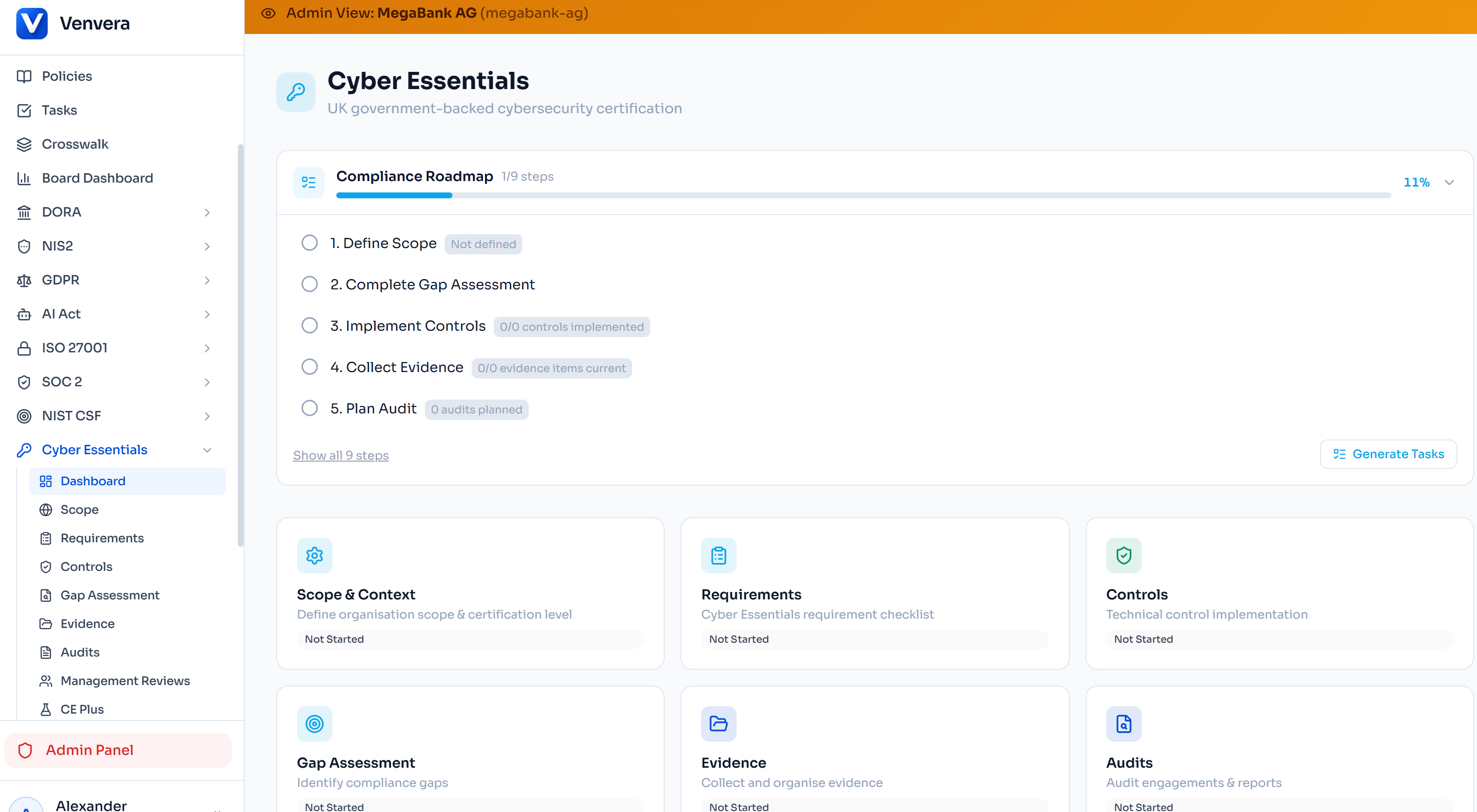
We looked at Drata. Drata looked back at us. There was nothing there. No structured RoI. No entity codes. No xBRL-CSV export. What we had was a list of controls mapped to DORA article numbers - a bit like having a travel itinerary when someone asks for your passport. Related to travel, sure. But not what they're asking for.
🔍
WHERE DRATA FALLS SHORT
Five DORA Requirements That Broke Our Drata Setup
These aren't edge cases. They're core DORA obligations.
📑
Register of Information
DORA requires a relational graph: ICT providers → contracts → business functions. Drata has flat vendor lists. No relational mapping, no sub-outsourcing chains.
📊
xBRL-CSV Export
ESAs want xBRL-CSV - a specific structured format with defined table relationships and validation rules. Drata can't export in this format. Full stop.
🆕
ESA Entity Codes
LEI codes, EBA codes, EIOPA codes, ESMA classifications - all needed in your Register. Drata doesn't have them. We spent three weeks manually researching codes for 47 providers.
🚨
Incident Classification (RTS)
DORA uses RTS-specific criteria: transaction count, availability duration, economic impact. Drata's "Low/Medium/High/Critical" dropdown doesn't cut it.
🔗
ICT Third-Party Risk (Ch. V)
Concentration risk analysis, exit strategies, sub-outsourcing oversight. Drata covers security questionnaires - architecturally different from Chapter V.
🌐
EU Data Sovereignty
Drata's default hosting is US-based. For a regulation about EU financial operational resilience, your compliance data should be in the EU by default.
⚖
FEATURE COMPARISON
Side by Side: Where It Actually Matters
| DORA Capability | Drata | Venvera |
|---|---|---|
| Register of Information (Art. 28) | ✗ Flat vendor list | ✓ Full relational RoI |
| xBRL-CSV Export | ✗ Not available | ✓ Native export |
| ESA Entity Codes (LEI, EBA, EIOPA, ESMA) | ✗ Not available | ✓ Built-in lookups |
| Incident Classification (RTS Criteria) | ✗ Generic severity levels | ✓ RTS-specific fields |
| ICT Third-Party Risk (Chapter V) | ◯ Basic vendor risk | ✓ Full Chapter V |
| Gap Assessment | ✗ Not available | ✓ Structured gap analysis |
| Risk Assessment Framework | ◯ Basic | ✓ Full framework |
| Continuous Infrastructure Monitoring | ✓ 100+ integrations | ◯ Growing |
| Cross-Framework Mapping | ◯ Framework silos | ✓ 150+ mappings |
| Data Hosting | ◯ US default (EU option) | ✓ Amsterdam, EU |
| Frameworks Available | 14+ | 13 |
| Starting Price | ~$25-30K+/yr | €399/mo (€4,788/yr) |
🔬
DEEP DIVE
What We Switched To (and Why It Worked)
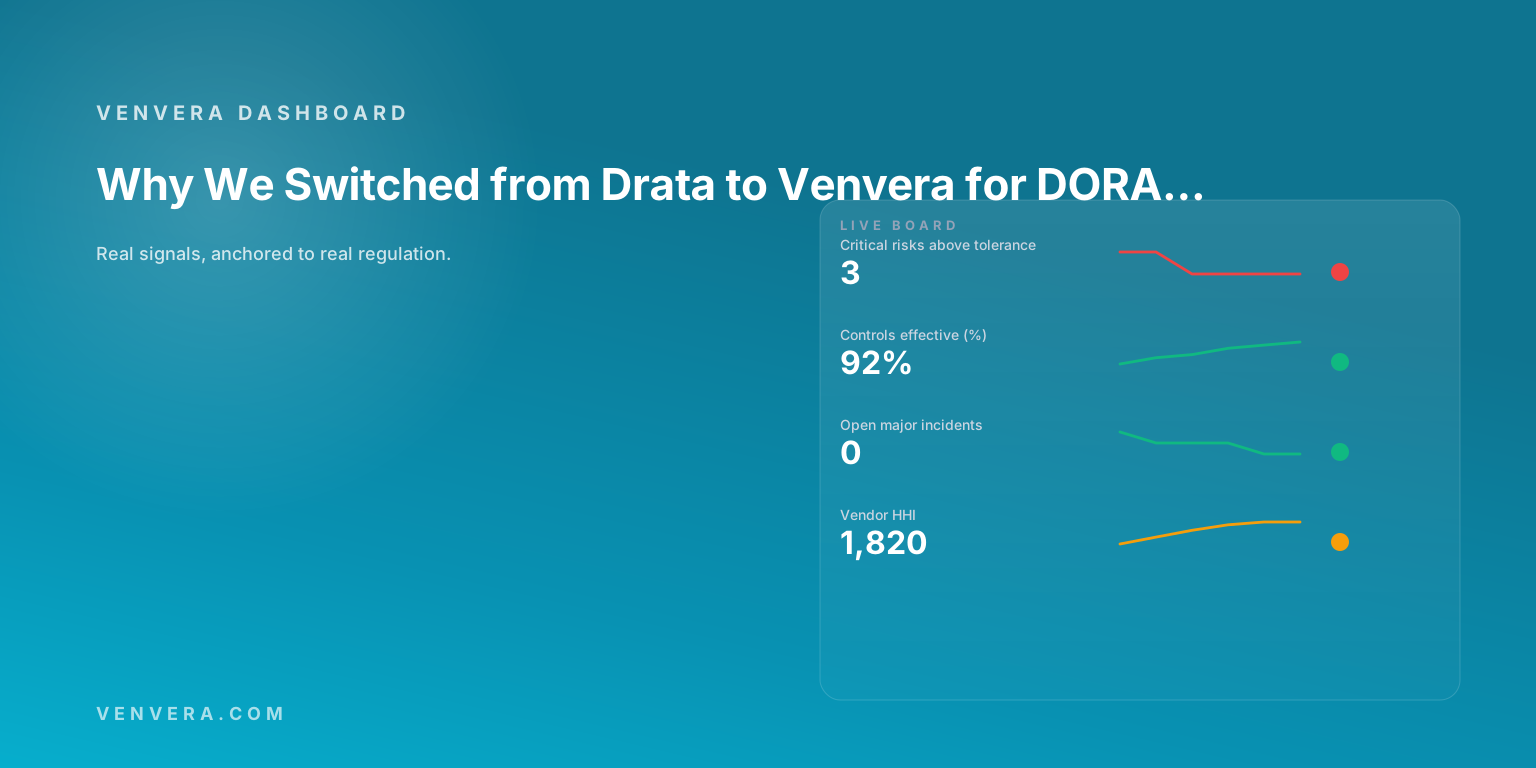
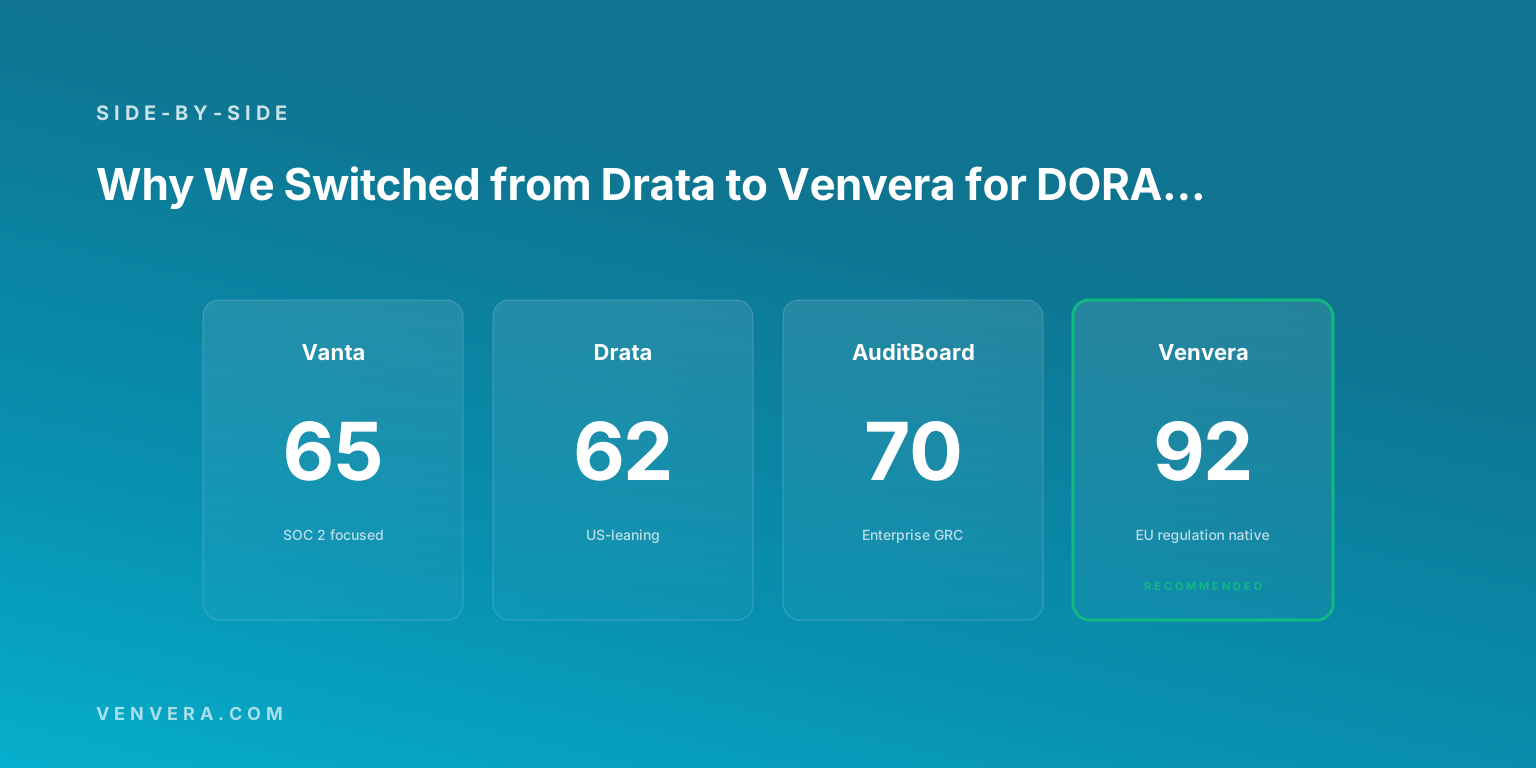
After evaluating everything from OneTrust (too expensive, no xBRL-CSV) to ServiceNow (are you kidding me with that implementation timeline?) to various EU-based GRC tools (well-intentioned but feature-light), we landed on Venvera. And I'll tell you exactly why.
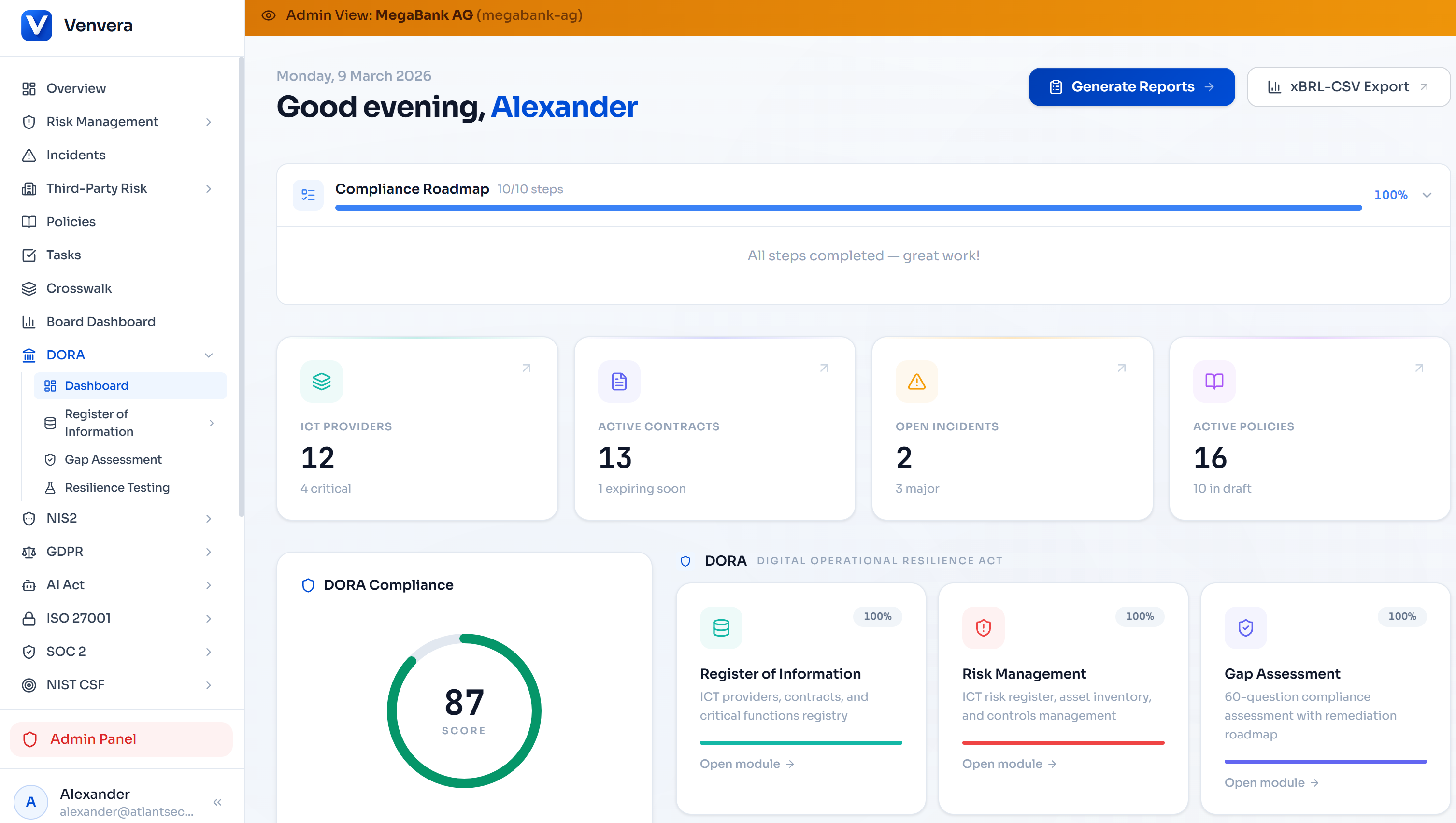
Someone on the Venvera team has actually read DORA. I know that sounds like a low bar, but you'd be amazed how many "DORA-ready" platforms clearly haven't. Venvera's data model is structured around DORA's actual concepts: ICT third-party service providers, contractual arrangements, business functions, the many-to-many relationships between them. It's not an afterthought bolted onto a SOC 2 product. It's the core architecture.
What made the difference:
- The xBRL-CSV export was the moment I stopped evaluating and started implementing. I clicked "export," got a valid file, and our regulatory affairs team confirmed it matched the ESA specification. Four seconds vs. weeks of manual reformatting.
- ESA entity codes are built in - LEI lookups, EBA/EIOPA/ESMA classifications, jurisdiction mappings. Those three weeks we spent manually researching codes for Drata? Gone.
- The relational data model mirrors DORA's actual structure: providers → contracts → functions → entities. Not a flat vendor list force-fitted into a compliance checkbox.
- Cross-framework mapping flagged corresponding NIS2 and ISO 27001 requirements when we implemented DORA controls. Three people doing the work of five.
🔗
CROSS-FRAMEWORK MAPPING
DORA Doesn't Exist in a Vacuum
We're also doing NIS2 and GDPR (because who isn't at this point). When we implemented access controls for DORA Article 9, Venvera flagged the corresponding NIS2 and ISO 27001 requirements as partially addressed. That's not window dressing. That's the difference between three people doing the work of three and three people doing the work of five.
✓ Cross-framework impact:
- 150+ pre-built mappings across DORA, NIS2, GDPR, ISO 27001, and 9 more frameworks
- ~60% work reduction on overlapping controls when managing 3+ frameworks
- Single evidence base - implement once, satisfy four regulators
- With Drata, each framework is siloed. Same control documented three times, paid for three times.
💰
PRICING COMPARISON
Let's Talk Money
Drata's pricing for a single framework runs about $25-30K per year. Reasonable for SOC 2 automation. But here's the math that gets ugly: most EU financial entities need DORA + GDPR + NIS2 at minimum.
| Scenario | Drata | Venvera | You Save |
|---|---|---|---|
| DORA only | ~$25-30K/yr | €4,788/yr | ~$20K/yr |
| DORA + GDPR + NIS2 | ~$75-90K/yr | €10,788/yr | ~$65-80K/yr |
| 3-year total (3 frameworks) | ~$225-270K | €32,364 | $190-240K |
The savings alone could fund a compliance hire. And before you say "you get what you pay for" - for DORA specifically, the more expensive option gives you less. Drata's price buys you infrastructure compliance automation. Venvera's price buys you actual DORA compliance tooling. These are different products for different problems, and only one of them solves the DORA problem.
🇪🇺
DATA SOVEREIGNTY
Your DORA Data Belongs in the EU
Your Register of Information contains the complete operational map of your ICT third-party dependencies. Your incident records document your most sensitive operational failures. Your risk assessments reveal exactly where your resilience gaps are. All of this is sitting in a US data centre when you use Drata's default hosting - potentially subject to FISA Section 702 access.
Drata does offer an EU hosting option, which is good. But it's an option, not the default. Venvera is hosted in Amsterdam. Period. AES-256-GCM encryption, EU jurisdiction by default. No options to configure, no add-ons to purchase. For a regulation about operational resilience of EU financial entities, this shouldn't be a selling point. It should be table stakes.
✅
WHO SHOULD SWITCH
Is the Switch Right for You?
Switch to Venvera if:
- ☑ You need to submit a Register of Information to your regulator
- ☑ You need xBRL-CSV exports for ESA regulatory submissions
- ☑ DORA is your primary or critical compliance obligation
- ☑ You're managing DORA alongside GDPR, NIS2, or ISO 27001
- ☑ You need EU-hosted compliance data by default
- ☑ You'd rather spend $65K/year on people than on platform fees
Stay with Drata if SOC 2 and ISO 27001 are your primary frameworks and DORA is a secondary concern you can address with manual processes. Drata is genuinely excellent at infrastructure compliance. If you're not a financial entity subject to DORA's full regulatory reporting, it may serve you well. But if DORA is your primary obligation - if you need a Register of Information, xBRL-CSV, and DORA-specific ICT risk management - then Drata is the wrong tool. Not a bad tool. The wrong tool.
Ready to See What DORA Compliance Actually Looks Like?
Native xBRL-CSV export. Structured Register of Information. ESA entity codes.
13 frameworks with 150+ cross-mappings. Amsterdam-hosted. From €399/month.
Book a Demo →Last updated: March 2026. Pricing and feature information based on publicly available data and hands-on evaluation. Contact each vendor for current pricing.