
Best

I'm going to start with a confession that'll probably annoy some people: I used to think GDPR compliance tooling didn't matter much. You've got a privacy policy, you respond to DSARs, you document your processing activities in a spreadsheet. How hard can it be?
Turns out, really hard. Especially after the enforcement wave of 2024-2025, when Data Protection Authorities across Europe decided to stop sending polite letters and start sending invoices. Meta's €1.2 billion fine. TikTok's €345 million. And then the mid-market penalties started landing - companies you've never heard of getting hit with €200K-500K fines for inadequate Records of Processing Activities, missing DPIAs, or incomplete breach notifications.
That's when our team started looking seriously at our GDPR tooling. We'd been using Sprinto for SOC 2 - great experience - and someone suggested "just using Sprinto for GDPR too." Three weeks of evaluation later, here's what I learned: there's a canyon-sized gap between "we support GDPR" and actually providing what GDPR demands.
⚠
THE PROBLEM
The GDPR Requirements That Keep DPOs Awake
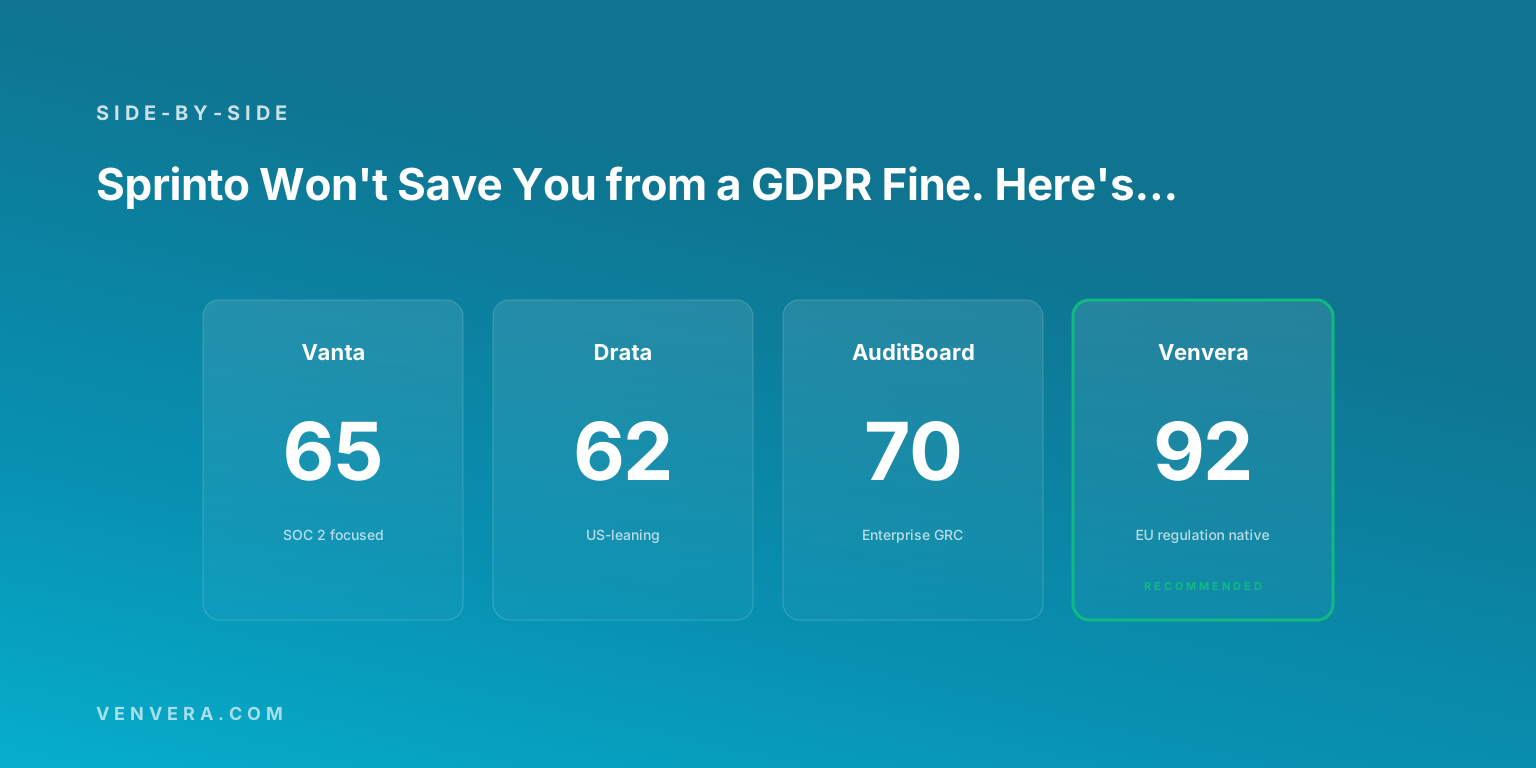
A DPA auditor doesn't check whether you have a "GDPR" checkbox ticked. They check whether your operational processes actually satisfy the regulation's structural requirements. And this is where the Sprinto-shaped hole becomes obvious.
⚠ Warning: Controls checklists are not GDPR compliance
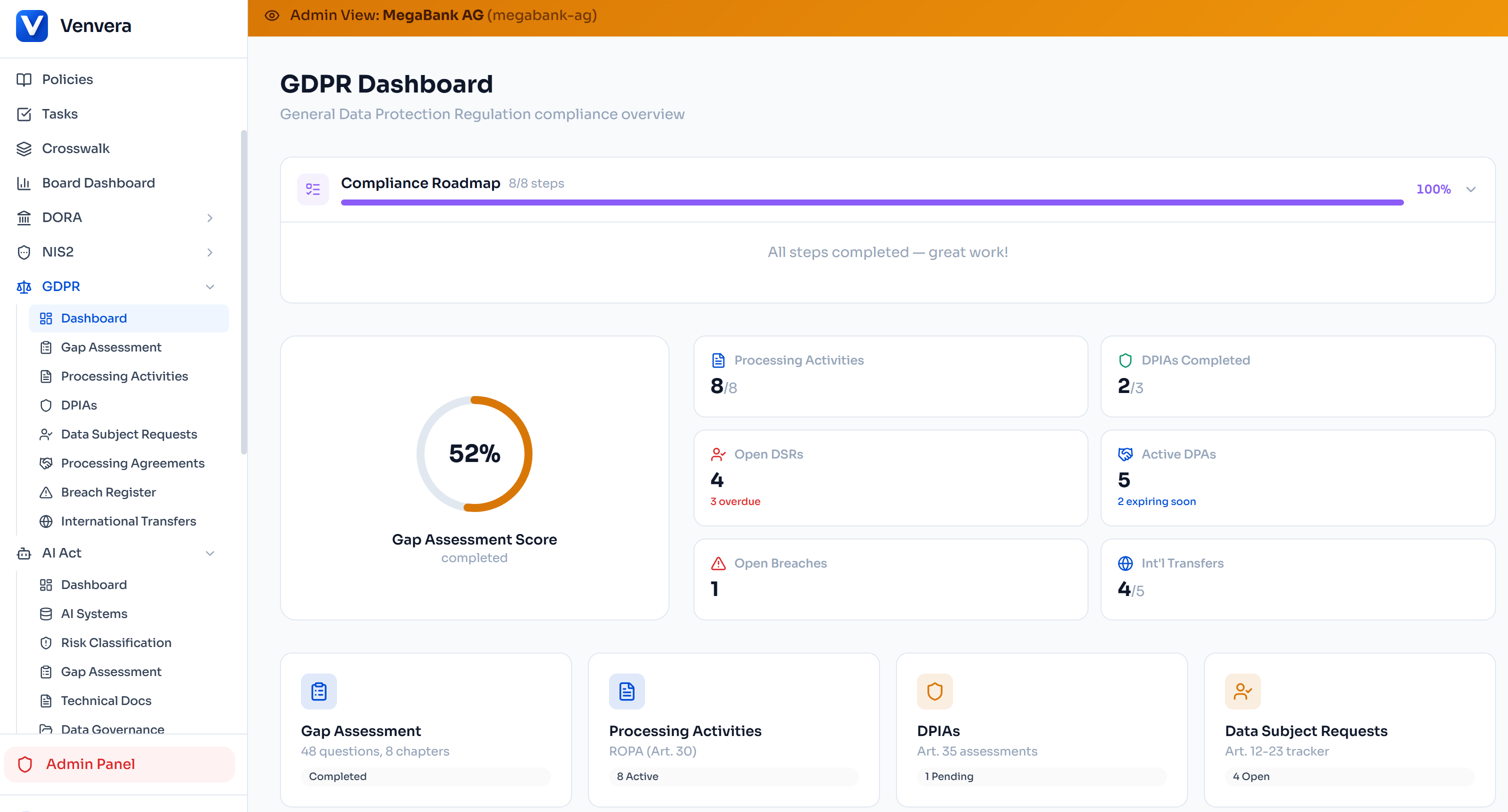
When Sprinto says they "support GDPR," they mean they have controls mapped to GDPR articles. That's compliance awareness, not compliance management. No ROPA builder. No DPIA workflows. No breach notification workflow aligned to 72-hour requirements. No DPA tracking with clause-level monitoring. A DPA auditor can tell the difference.
🔍
GAP ANALYSIS
Where Sprinto Falls Short for GDPR
📑
ROPA (Article 30)
Needs structured register with purpose, legal basis, data categories, recipients, retention. Sprinto gives a controls checklist that mentions Art. 30.
📋
DPIAs (Article 35)
Structured risk assessment with EDPB-aligned methodology. Necessity, proportionality, risk to data subjects. Sprinto has no DPIA module at all.
🚨
Breach Notification
72 hours to notify your supervisory authority. Timed, structured process with specific content requirements. Sprinto has no GDPR breach workflow.
📄
DPA Tracking (Art. 28)
Every processor needs a DPA with GDPR-mandated clauses. Sprinto tracks vendors generically - no clause-level compliance monitoring.
🌎
International Transfers
Post-Schrems II: every EEA transfer needs SCCs + Transfer Impact Assessments. Sprinto doesn't track transfer mechanisms. Period.
⚖
Legal Basis Tracking
Per-activity legal basis documentation: consent, contract, legitimate interest, etc. Sprinto has no structured legal basis fields.
⚖
FEATURE COMPARISON
The Full Picture in One View
| GDPR Capability | Sprinto | Venvera |
|---|---|---|
| GDPR Module | ◯ Controls checklist only | ✓ Full operational module |
| Records of Processing (Art. 30) | ◯ Mentions Art. 30 | ✓ Full ROPA builder |
| Data Protection Impact Assessments | ✗ Not available | ✓ Full DPIA workflow |
| Breach Notification (72hr) | ✗ No GDPR workflow | ✓ Timed workflow + templates |
| DPA Tracking (Art. 28) | ◯ Generic vendor tracking | ✓ DPA-specific + clause monitoring |
| Transfer Impact Assessments | ✗ Not available | ✓ Included with transfer tracking |
| Legal Basis Documentation | ✗ Not structured | ✓ Per-activity legal basis tracking |
| Cross-Framework Mapping | ◯ SOC 2 / ISO only | ✓ 13 frameworks, 150+ mappings |
| SOC 2 Automation | ✓ Strong | ✓ Full coverage |
| EU Data Hosting | ✗ No guarantee | ✓ Amsterdam, AES-256-GCM |
🔬
DEEP DIVE
Why GDPR Needs Purpose-Built Tooling
GDPR compliance management means maintaining a living, breathing ROPA that updates as your processing activities change. It means running DPIAs when you launch new products. It means having a breach notification workflow that can get your DPO, legal team, and supervisory authority in the loop within 72 hours. It means tracking your processor relationships, DPAs, and sub-processors. It means documenting your legal bases and being able to demonstrate them when a data subject asks.
Sprinto's roots are in the Indian tech startup ecosystem, serving primarily US and UK SaaS companies. The GDPR support was grafted on to serve European customers who also needed SOC 2. It's not the foundation - it's a wing added to the building after construction. And when a DPA auditor comes calling, they can tell the difference.
Venvera's approach: GDPR as a first-class regulation
Structured ROPA with all Article 30 fields. Full DPIA workflow with EDPB-aligned risk scoring. 72-hour breach notification workflow with supervisor templates. DPA tracking with clause-level compliance. Transfer impact assessments. Per-activity legal basis documentation. Built by a team that lives under GDPR, not one that added it as an afterthought.
🔗
CROSS-FRAMEWORK VALUE
GDPR Doesn't Travel Alone
Nobody mentions this in comparison articles: GDPR almost never exists in isolation. If you're European and processing personal data, you're also dealing with NIS2, DORA, EU AI Act, ISO 27001, or SOC 2. With Sprinto, you can cover SOC 2 and ISO 27001. Everything else means additional tools, subscriptions, vendors, and manual reconciliation.
✓ One implementation, multiple frameworks
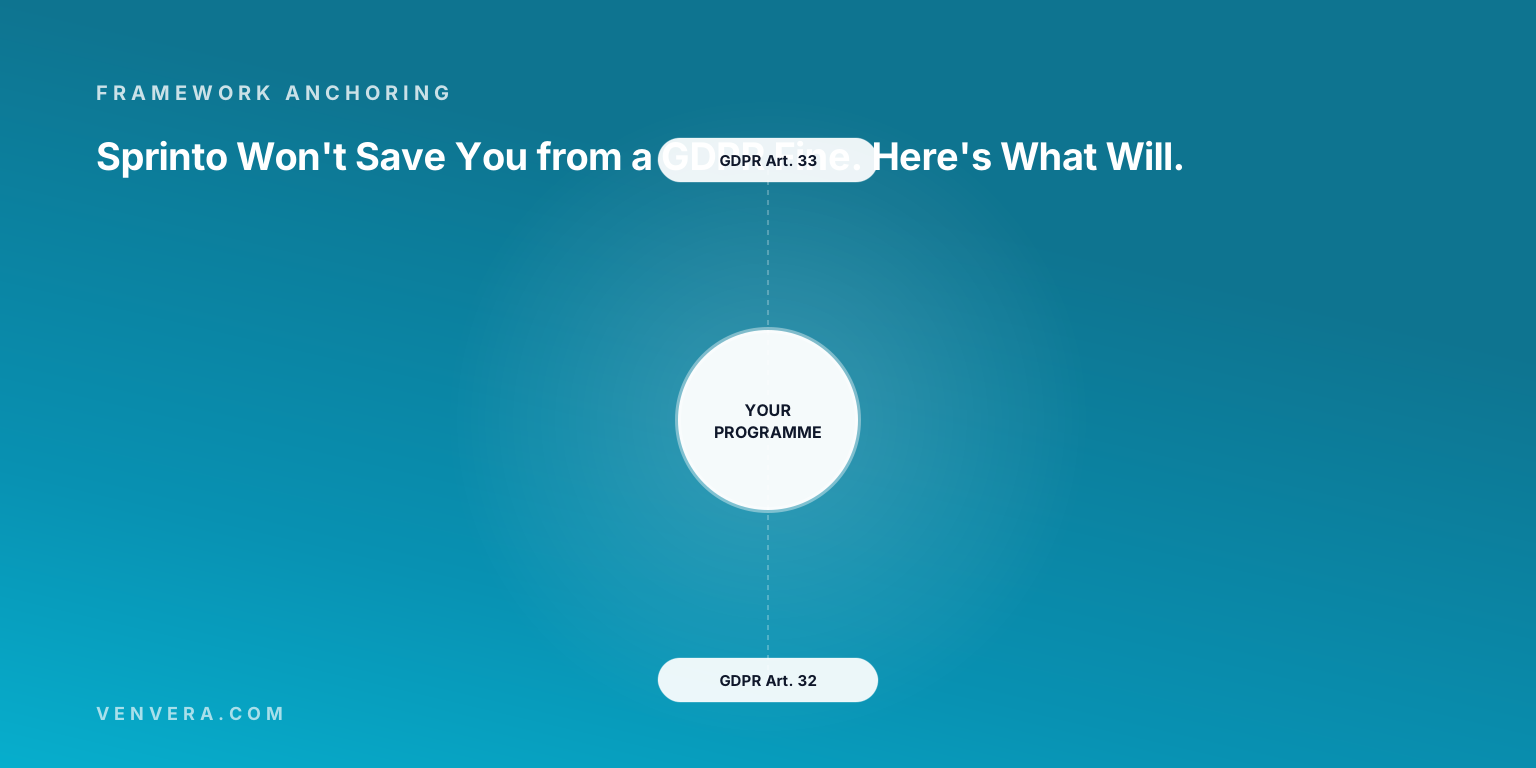
Implement an access control measure for GDPR Article 32 and Venvera automatically flags the corresponding ISO 27001 Annex A controls, NIS2 Article 21 measures, and DORA Article 9 requirements as partially addressed. That's the difference between a four-person compliance team drowning and a four-person compliance team actually getting through their programme.
💰
PRICING COMPARISON
The Multi-Framework Cost Reality
| Cost Component | Sprinto + Separate GDPR | Venvera (3 Frameworks) |
|---|---|---|
| Sprinto (SOC 2 + ISO) | ~$10,000/yr | Included |
| GDPR consultant/tool | ~€12,000-15,000/yr | Included |
| NIS2 gap assessment | ~€8,000-12,000 | Included |
| Reconciliation time | ~€8,000/yr | €0 (cross-mapping) |
| Annual Total | ~€38,000-45,000/yr | €10,788/yr |
| Annual Savings with Venvera | Save €27,000-34,000/yr | |
🇪🇺
DATA SOVEREIGNTY
The Irony Nobody Talks About
Here's an irony that's almost comical: your GDPR compliance data - the records of your processing activities, your DPIA assessments, your breach logs - is itself personal data or references personal data extensively. If your compliance tool stores that data outside the EU, you've got a data transfer problem nested inside your data protection solution.
Venvera is hosted in Amsterdam, Netherlands. EU jurisdiction. No data transfer issues. Per-tenant AES-256-GCM encryption. When a DPA asks where your compliance documentation is stored, "Amsterdam" is a much better answer than "we think it's in the US but we have Standard Contractual Clauses so it should be fine."
✅
WHO SHOULD SWITCH
When Sprinto Is Still the Right Call
☑ Switch to Venvera if:
☑ GDPR is a primary obligation, not a secondary concern
☑ A DPA could show up at your door
☑ You process sensitive data at scale and need DPIAs
☑ You need breach notification workflows that actually work
☑ You also need NIS2, DORA, or AI Act compliance
☑ EU data residency matters to your organisation
But if GDPR is a secondary concern - you're a SaaS company selling primarily to US/UK enterprises and your main need is SOC 2 Type II - keep Sprinto. Their ~$8K-10K/year delivers genuine value. The automation is good, the pricing is fair, and they're improving constantly. Don't switch for the sake of switching. Sprinto is a good product for the right use case.
GDPR Compliance That a DPA Would Respect
Full ROPA, DPIA workflows, breach notification, DPA tracking, and 12 additional frameworks.
From €399/mo (1 framework) | €899/mo (3 frameworks) - hosted in Amsterdam.
Book a Demo →Last updated: March 2026. Pricing and feature information based on publicly available data and direct evaluation. Sprinto is a trademark of Sprinto Technologies Pvt. Ltd.