
Best

I have a confession. For about eighteen months, I told people our company was “GDPR compliant” because Secureframe said so. Green checkmarks everywhere. Dashboard looked great. I even showed it to our board once.
Then we got a DSAR - a data subject access request - from a former customer. And I realised that our beautiful green dashboard couldn’t tell me where that person’s data actually lived, which processing activities involved it, what our legal basis was for each one, or when we were supposed to delete it. Secureframe had helped us document that we had a GDPR policy. It hadn’t helped us actually operationalise GDPR.
That’s the gap this article is about. Not whether Secureframe is good (it is, for certain things). But whether it’s enough for GDPR in 2026, when supervisory authorities have moved well past “do you have a privacy policy?” and into “show me your processing register, your DPIA methodology, your data flow documentation, and your breach response timeline.”
⚠
THE PROBLEM
GDPR in 2026 Is Not What It Was in 2018
Eight years in, the regulation hasn’t changed. But the enforcement landscape is unrecognisable. DPAs across Europe have issued over €4.5 billion in fines. The EDPB has published dozens of guidelines clarifying expectations. Supervisory authorities now conduct systematic audits of processing registers, DPIA records, and cross-border transfer mechanisms.
⚠ What supervisors are actually checking in 2026:
Records of Processing Activities (RoPA) - Article 30 requires a complete, up-to-date register: purposes, categories, recipients, transfers, retention periods. This isn’t a document you write once. It’s a living system.
Data Protection Impact Assessments - Article 35 DPIAs with documented methodology, necessity assessment, risk identification, and mitigation. DPAs are checking these now, not just asking if you do them.
Data Processing Agreements - Article 28 DPAs with every processor. Tracked, version-controlled, with documented instructions.
Breach notification (72 hours) - Detection, assessment, supervisory notification within 72 hours, data subject communication. This needs a workflow, not a Word template.
🔍
GAP ANALYSIS
Where Secureframe Falls Short for GDPR
Secureframe has a GDPR “module,” but it’s a control checklist, not an operational compliance system. Here are the six operational capabilities it’s missing:
🗒
No Processing Register
Article 30 RoPA requires tracking every processing activity with purposes, legal basis, data categories, recipients, and retention periods. Secureframe doesn’t have this.
📋
No DPIA Workflow
Article 35 assessments need threshold screening, necessity analysis, risk identification, and DPO consultation. You get a checkbox, not a workflow.
📄
No DPA Tracking
Every processor agreement needs tracking: status, version, renewal, documented instructions. Secureframe doesn’t track processor agreements at all.
🚨
No Breach Workflow
72-hour notification requires a timestamped workflow: detection, assessment, supervisory notification, data subject communication. Not available in Secureframe.
🌐
No Transfer Mechanisms
Post-Schrems II cross-border transfers need documented legal bases, SCCs, TIAs, and supplementary measures. None tracked in Secureframe.
⚖
HEAD-TO-HEAD
Feature Comparison: GDPR Operational Capabilities
| GDPR Operational Need | Venvera | Secureframe |
|---|---|---|
| Processing Register (Art. 30 RoPA) | ✓ Full register | ✗ |
| DPIA Workflow (Art. 35) | ✓ Full workflow | ✗ |
| DPA Tracking (Art. 28) | ✓ Full tracking | ✗ |
| Breach Notification (72h workflow) | ✓ Built-in | ✗ |
| Data subject rights management | ✓ Tracked | ✗ |
| Cross-border transfer documentation | ✓ Built-in | ✗ |
| GDPR policy/control checklist | ✓ Included | ✓ Available |
| Cross-mapping to DORA / NIS2 / AI Act | ✓ 13 frameworks | ✗ No EU frameworks |
| SOC 2 / ISO 27001 | ✓ Included | ✓ Strong |
| EU data hosting | ✓ Amsterdam | ✗ US-hosted |
| HIPAA | ✗ | ✓ Strong |
🔬
DEEP DIVE
What Venvera Does Differently for GDPR
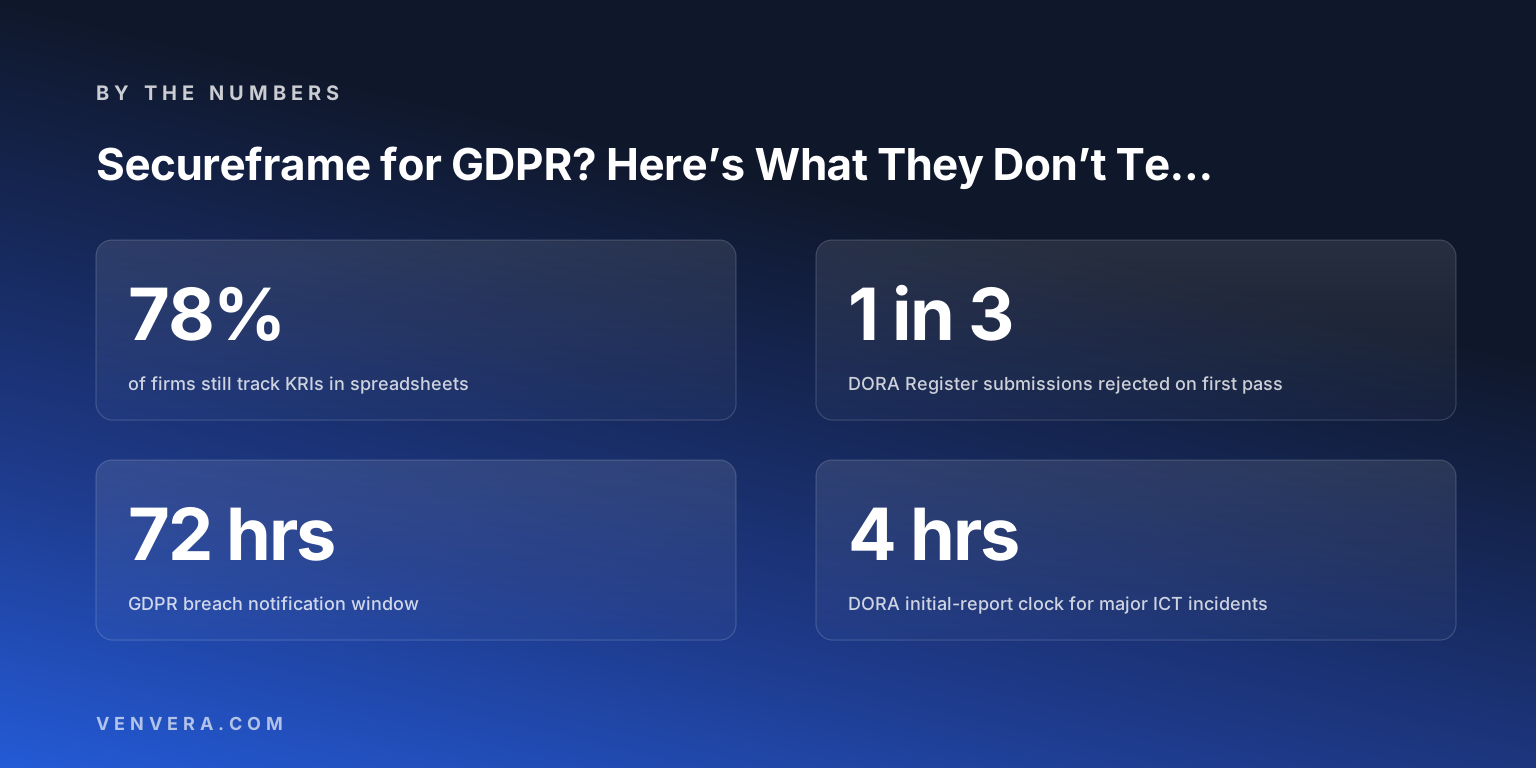
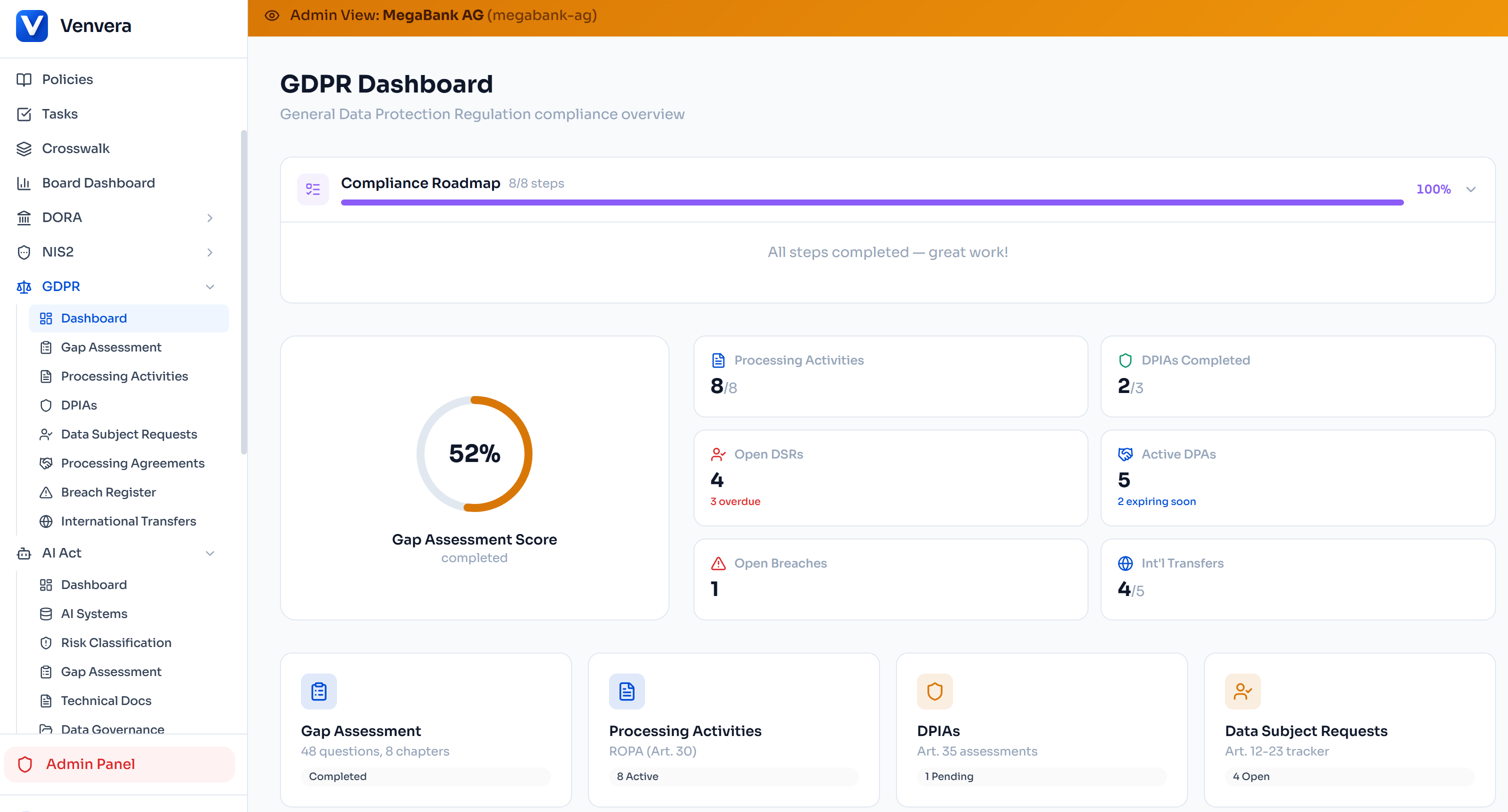
When I switched, the first thing I noticed was that GDPR wasn’t a checklist. It was a set of operational modules designed to handle what supervisors actually ask for:
- Processing Register: Full Article 30 RoPA. Every processing activity documented with purposes, legal basis, data categories, recipients, retention periods, transfers, and safeguards. Linked to your actual data flows.
- DPIA Workflow: Structured assessment with threshold screening, necessity/proportionality analysis, risk identification, mitigation planning, and DPO consultation tracking. Not a template - a workflow with statuses and audit trails.
- DPA Tracking: Every data processor agreement tracked: status, version, renewal dates, documented instructions. Linked to the relevant processing activities.
- Breach Management: 72-hour workflow: detection, risk assessment, supervisory notification, data subject communication. Every step timestamped and documented.
- Cross-Framework Mapping: Implementing an access control for GDPR Article 32? That same control maps to DORA, NIS2, ISO 27001, and SOC 2 automatically. Document once, comply everywhere.
🔗
CROSS-FRAMEWORK EFFICIENCY
GDPR + DORA + NIS2: The European Compliance Triple
If you’re doing GDPR in Europe, you almost certainly also need DORA (financial sector), NIS2 (essential/important entities), or both. These three regulations share massive amounts of overlapping requirements - incident response, security measures, governance, risk management.
✅ Real-world cross-mapping example:
A security-of-processing policy for GDPR Article 32 simultaneously maps to DORA Article 9 (protection & prevention), NIS2 Article 21 (cybersecurity measures), ISO 27001 Annex A, and SOC 2 CC6. One control. Five frameworks.
Teams report 40-50% reduction in compliance workload. That’s roughly 15 hours per week of duplicate work eliminated.
💰
PRICING COMPARISON
The Real Cost of GDPR Compliance
Secureframe’s GDPR “module” is essentially a checklist add-on. For operational GDPR compliance, you’d need a separate tool. Add DORA or NIS2 and you’re running three platforms with three invoices.
| Scenario | Secureframe + Others | Venvera | You Save |
|---|---|---|---|
| GDPR only | ~$15-25K/yr (checklist only) | €399/mo (€4,788/yr) | $8-18K/yr |
| GDPR + DORA + NIS2 | ~$30-50K/yr (multiple tools) | €899/mo (€10,788/yr) | $15-35K/yr |
| GDPR + ISO + SOC 2 + DORA | ~$40-75K/yr | €899/mo (€10,788/yr) | $25-60K/yr |
🇪🇺
DATA SOVEREIGNTY
The Irony of US-Hosted GDPR Compliance
There’s a certain irony in using a US-hosted platform to manage your GDPR compliance. Your processing register, your DPIAs, your breach records, your data subject request logs - all sitting on US servers, subject to US jurisdiction.
Post-Schrems II, with the EU-US Data Privacy Framework still facing legal challenges, this creates an uncomfortable question during any supervisory audit: “What’s your legal basis for transferring this compliance data to the US?”
🇪🇺 Venvera: Your GDPR data stays in the EU
Hosted in Amsterdam. AES-256-GCM encryption with per-tenant keys. No transatlantic data transfers. One less thing to explain when a DPA asks about your compliance infrastructure.
✅
DECISION GUIDE
Who Should Switch - And Who Should Stay
✅ Switch to Venvera if:
- You process EU personal data at scale and need operational GDPR compliance
- You need processing registers, DPIAs, breach management, and DPA tracking
- You also manage DORA, NIS2, or ISO 27001 compliance
- Cross-framework mapping would reduce your team’s duplicate documentation
- EU data hosting matters to your supervisors or clients
Stay with Secureframe if:
- You’re a US company that only needs to demonstrate GDPR awareness (policy checkboxes)
- GDPR operational compliance isn’t a supervisory audit risk for you
- SOC 2, ISO 27001, or HIPAA are your primary frameworks
- You value Secureframe’s onboarding experience and integration library above GDPR depth
Secureframe checks the GDPR box. Venvera runs the GDPR programme. The difference shows up the moment a DPA asks a hard question. We switched, and our GDPR programme went from green-checkmark theatre to actual operational compliance. That’s not a subtle distinction - it’s the gap between passing an audit and failing one.
GDPR Compliance That Goes Beyond Checkboxes
Processing registers, DPIAs, breach management, DPA tracking, and 12 more frameworks.
From €399/mo (1 framework) or €899/mo (3 frameworks). Hosted in Amsterdam.
Book a Demo →Last updated: March 2026. Based on publicly available information and hands-on usage. Contact vendors for current pricing and feature details.