
Best

I was on a call with a fintech expanding into Dubai last year. They asked their compliance consultant a simple question: “Which module in Secureframe covers UAE Information Assurance?” The silence was educational.
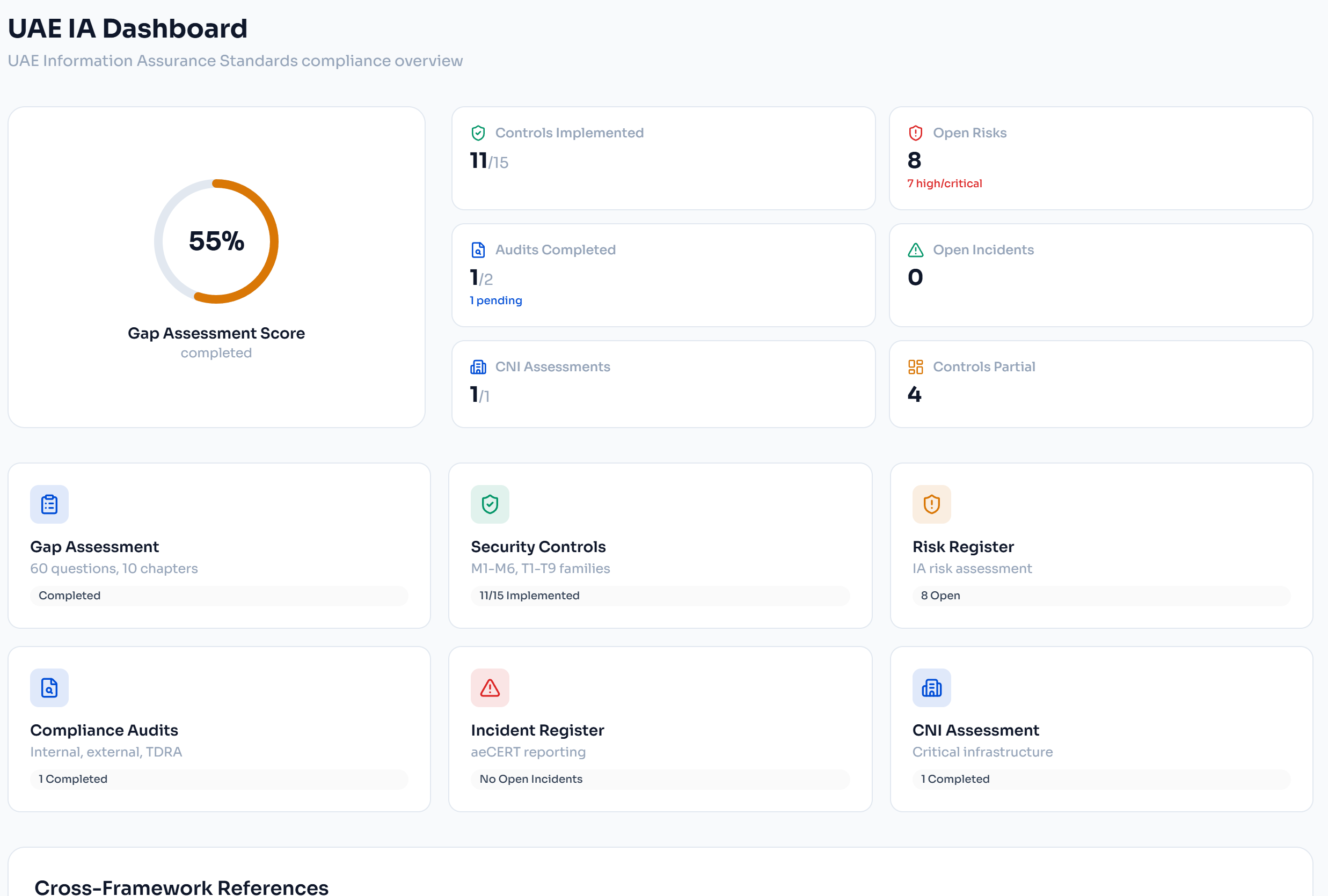
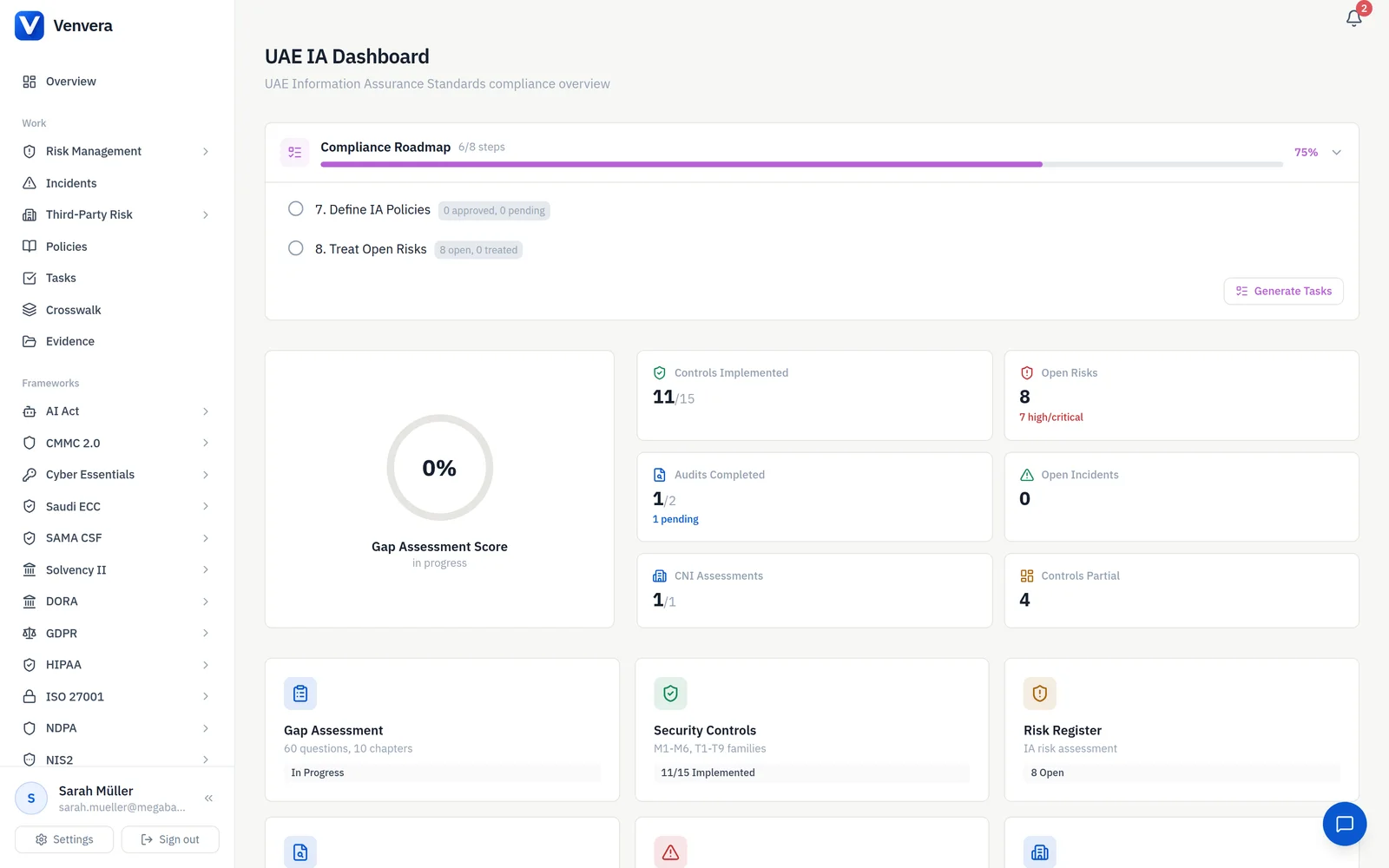
UAE Information Assurance (IA) standards, issued by the Telecommunications and Digital Government Regulatory Authority (TDRA, formerly TRA), are mandatory for UAE government entities, critical infrastructure operators, and increasingly for private sector companies handling government data or operating in regulated sectors. The IAS framework defines specific controls across governance, asset management, access control, cryptography, physical security, operations security, and incident management. It’s not ISO 27001, although it maps to it in places. It’s a UAE-specific standard that reflects the particular regulatory environment, threat landscape, and governance expectations of the Gulf region.
That’s not a dig at Secureframe specifically. They built a good product for US-centric compliance - SOC 2, ISO 27001, HIPAA, PCI DSS. Their onboarding is smooth, their HIPAA module is probably best-in-class, and their pricing (~$15-25K/year) is fair for the US market. But UAE IA is a different world. One they don’t serve. And no US-based compliance automation platform does.
⚠
THE PROBLEM
Understanding UAE IA Requirements
The UAE IA framework is more prescriptive than many Western standards. It incorporates considerations around national security that go beyond typical commercial compliance, and it requires structured compliance audits by authorised assessors with specific reporting formats.
⚠ Why generic compliance tools fail at UAE IA:
Classification tiers. Assets and systems are classified into tiers that determine the required control stringency. The classification methodology is specific to UAE’s risk context and doesn’t directly map to Western classifications.
National security dimension. UAE IA standards incorporate data sovereignty, in-country processing requirements, and specific encryption standards reflecting the UAE’s strategic priorities. These aren’t found in SOC 2 or ISO 27001.
TDRA audit requirements. Regular compliance audits by authorised assessors with specific reporting formats and submission requirements. This isn’t self-attestation - it’s a structured examination regime.
Integration with other UAE regulations. The IA framework intersects with NESA standards, UAE PDPL (data protection), and sector-specific regulations from CBUAE (banking) and SCA (securities). Multi-framework compliance in the UAE is just as real as it is in Europe.
🔍
GAP ANALYSIS
Where Secureframe Falls Short for UAE IA
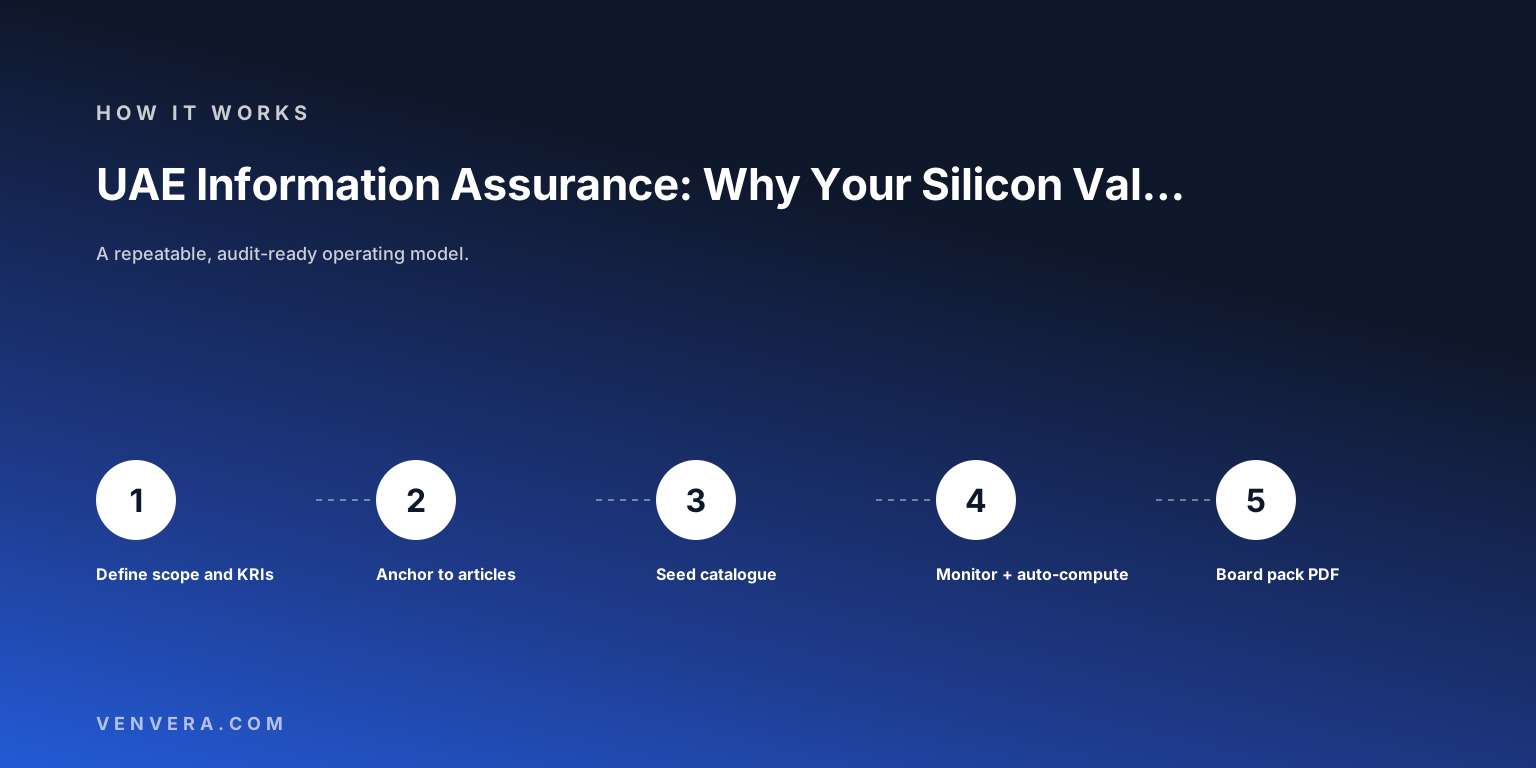
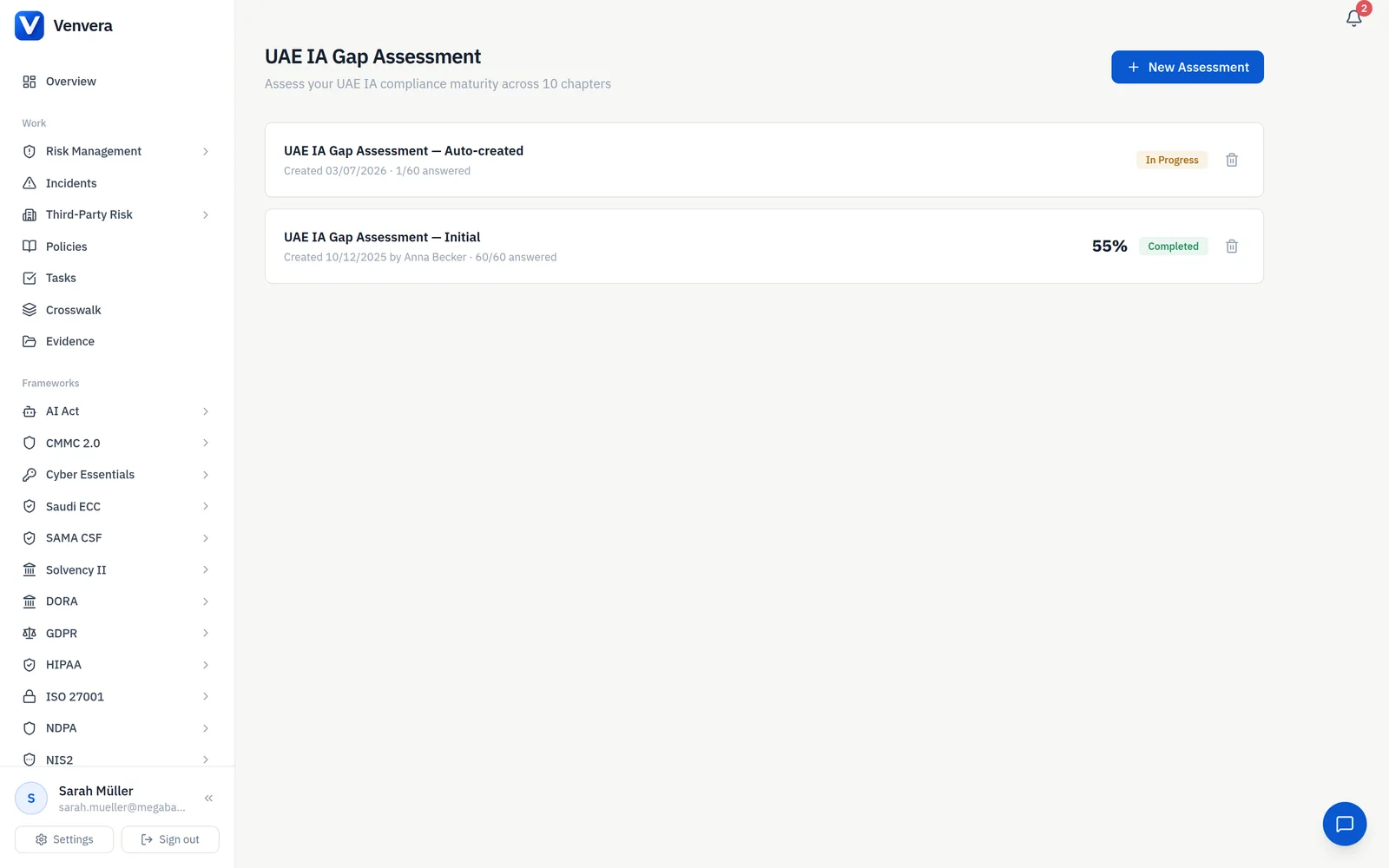
Companies operating in the UAE rarely need just one framework. The typical compliance stack for a UAE-based company with international operations includes UAE IA, ISO 27001, SOC 2, and often GDPR or DORA. Secureframe can handle maybe three of those six. Here are the gaps:
🗒
No UAE IA Module
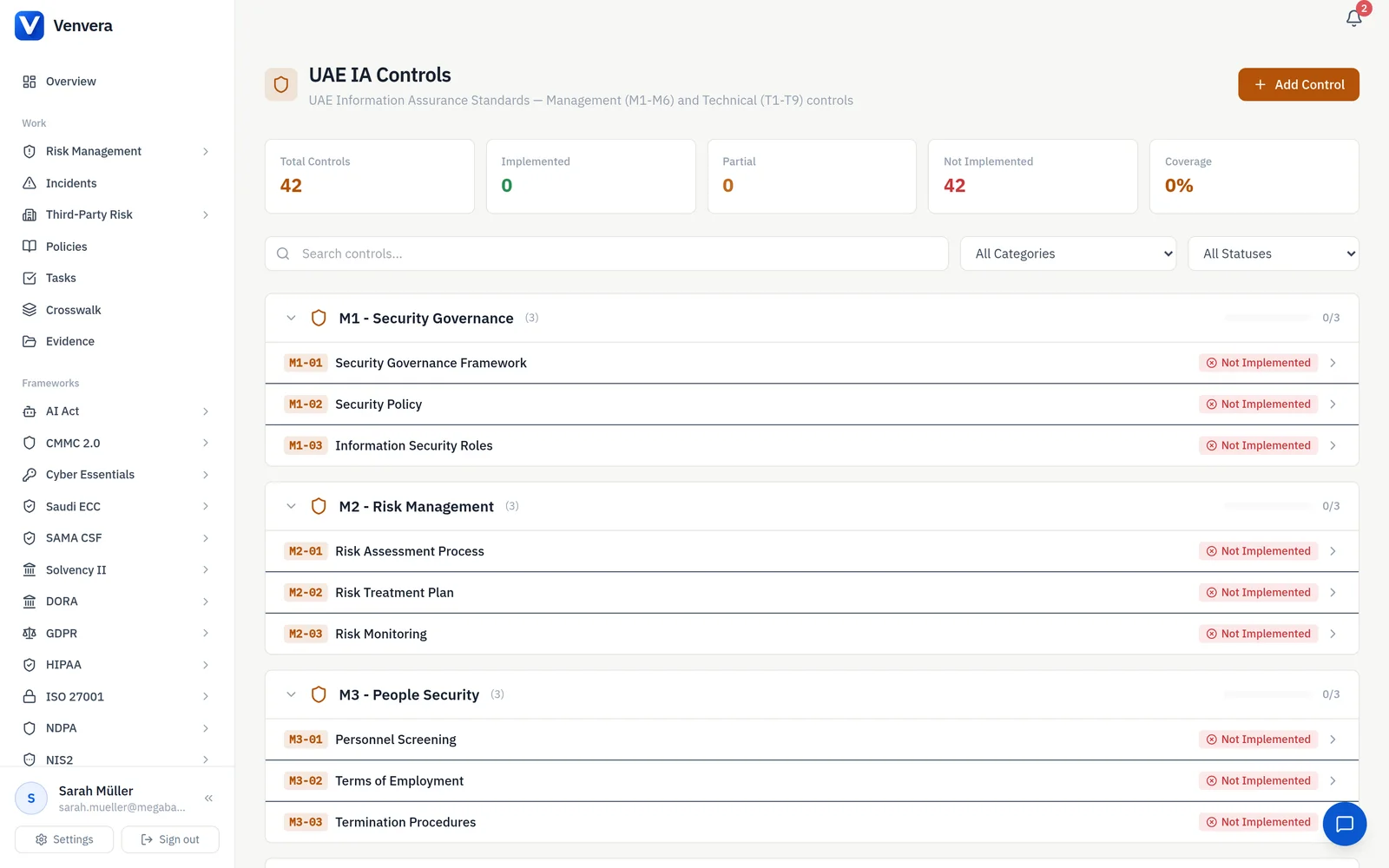
Zero support for TDRA Information Assurance standards. No classification tiers, no UAE-specific control sets, no TDRA reporting formats.
📊
No Gulf Regulatory Context
NESA standards, UAE PDPL, CBUAE banking regulations, SCA securities requirements - none of these exist in Secureframe’s framework library.
🌐
No GDPR Operations
Many UAE companies process EU data. Secureframe offers only a GDPR checklist - no RoPA, no DPIAs, no breach management workflow.
🚨
No DORA / NIS2
UAE entities serving EU financial institutions need DORA. Those in critical infrastructure may need NIS2. Secureframe has neither.
📄
No UAE-to-ISO Mapping
UAE IA shares substantial ground with ISO 27001. Without cross-mapping, you document access control, encryption, and incident management separately for each.
🔗
Limited Cross-Framework Scope
Secureframe maps SOC 2 to ISO 27001. That’s it. For companies managing 4-6 frameworks across the Gulf and Europe, that coverage is woefully narrow.
⚖
HEAD-TO-HEAD
Platform Comparison for UAE-Based Organisations
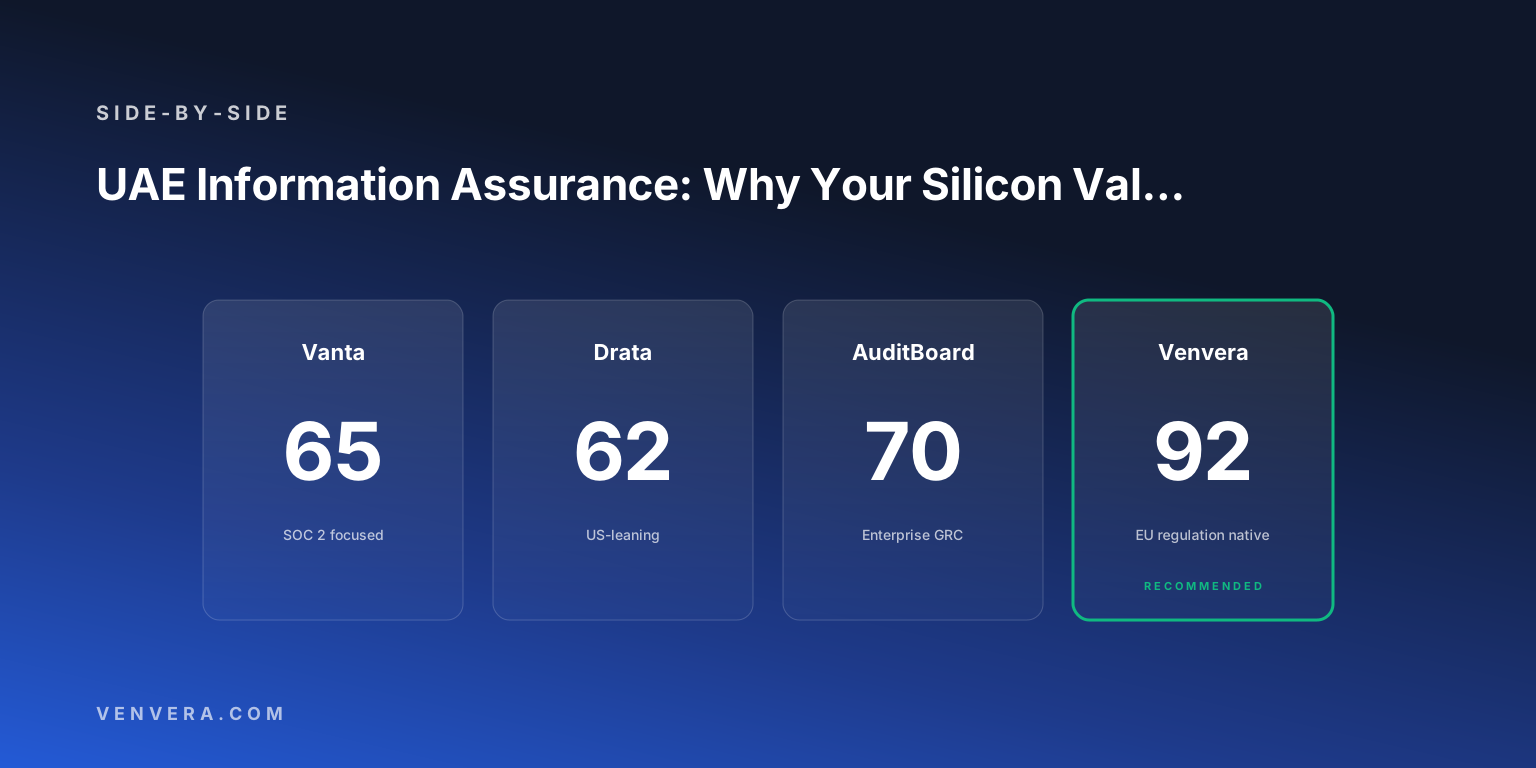
| Framework / Capability | Venvera | Secureframe |
|---|---|---|
| UAE IA standards | ✓ Full module | ✗ |
| Classification tier management | ✓ Built-in | ✗ |
| ISO 27001 | ✓ Full module | ✓ Strong |
| SOC 2 | ✓ Included | ✓ Excellent |
| GDPR operations (RoPA, DPIAs) | ✓ Full operations | ◯ Checklist only |
| DORA / NIS2 | ✓ Full modules | ✗ |
| NIST CSF | ✓ Included | ✓ Available |
| Cross-framework mapping | ✓ 16 frameworks | ◯ SOC 2 + ISO only |
| EU data hosting | ✓ Amsterdam | ✗ US-hosted |
| HIPAA | ✗ | ✓ Strong |
🔬
DEEP DIVE
Why Cross-Mapping Matters in the Gulf
UAE IA standards share significant ground with ISO 27001 and NIST CSF. Access control, encryption, incident management, business continuity - the concepts are universal even if the specific requirements vary. Without cross-framework mapping, your team documents the same control separately for each standard. That’s four documentation efforts for one control.
- Access control: An implementation that satisfies UAE IA also substantially addresses ISO 27001 A.8.2, SOC 2 CC6.1, and NIST CSF PR.AC. One control, four framework credits.
- Encryption standards: UAE IA prescribes specific cryptographic requirements. These overlap with ISO 27001 A.8.24, SOC 2 CC6.7, and NIST CSF PR.DS. Document once, demonstrate four times.
- Incident management: UAE IA incident response maps to ISO 27001 A.5.24-A.5.28, SOC 2 CC7.4, NIST CSF RS.RP, and DORA Article 17. One incident plan, five frameworks satisfied.
- Business continuity: UAE IA continuity requirements align with ISO 27001 A.5.29-A.5.30, SOC 2 A1.2, and NIST CSF RC.RP. Implement once, cross-map everywhere.
🔗
CROSS-FRAMEWORK EFFICIENCY
150+ Control Mappings Across 16 Frameworks
For companies managing three to six frameworks in the Gulf region, cross-mapping typically reduces total compliance effort by 35-50%. That’s not a marginal improvement. It’s the difference between needing five compliance analysts and needing three.
✅ The typical UAE compliance stack - simplified:
UAE IA for government and critical sector work + ISO 27001 for international clients + SOC 2 for US-facing business + GDPR for EU data processing + DORA for EU financial clients + NIST CSF as an internal baseline.
Secureframe handles three of those six. Venvera handles all of them - with cross-mapping that shows how a single control implementation addresses requirements across every applicable framework simultaneously.
Teams report 35-50% reduction in compliance effort when managing Gulf + European frameworks together.
💰
PRICING COMPARISON
The Money Conversation
Secureframe pricing runs roughly $15-25K per year. For SOC 2 and ISO 27001, that’s reasonable. But for UAE-based companies, Secureframe covers maybe half your framework needs. You’ll need separate UAE IA tooling, GDPR operations tools, and possibly DORA coverage. Those costs compound fast.
| Scenario | Secureframe + Others | Venvera | You Save |
|---|---|---|---|
| UAE IA only | N/A (no UAE IA) | €399/mo (€4,788/yr) | - |
| UAE IA + ISO + SOC 2 | ~$30-50K/yr (Secureframe + UAE IA tool) | €899/mo (€10,788/yr) | $15-35K/yr |
| UAE IA + ISO + SOC 2 + GDPR + DORA | ~$45-80K/yr (Secureframe + UAE IA + GDPR + DORA tools) | €899/mo (€10,788/yr) | $30-65K/yr |
🇪🇺
DATA SOVEREIGNTY
Data Hosting and Sovereignty Considerations
UAE IA standards incorporate data sovereignty considerations. While Secureframe’s US hosting may not directly violate UAE IA requirements, it creates an uncomfortable conversation with TDRA assessors about where your compliance evidence lives and what jurisdiction governs it.
For companies managing both UAE IA and GDPR, the hosting question is even more pointed. Your compliance data includes processing registers, risk assessments, and potentially sensitive details about your security posture. Having that data subject to US jurisdiction complicates both frameworks.
🇪🇺 Venvera: European hosting, global reach
Hosted in Amsterdam. AES-256-GCM encryption with per-tenant keys. No US jurisdiction complications. Simplifies your data sovereignty narrative for both UAE and European regulators.
✅
DECISION GUIDE
Who Should Switch - And Who Should Stay
✅ Switch to Venvera if:
- You need UAE Information Assurance compliance for government or critical sector work
- You manage ISO 27001, SOC 2, or GDPR alongside UAE IA
- You serve EU financial clients and need DORA or NIS2 coverage
- Cross-framework mapping across Gulf and European standards would save your team significant effort
- Data sovereignty and hosting location matter to your regulators
Stay with Secureframe if:
- You have no UAE operations or TDRA compliance obligations
- You only need SOC 2, ISO 27001, or HIPAA
- Gulf-region and European compliance frameworks are not relevant to your business
- You value Secureframe’s US-centric integration library and automated evidence collection
Secureframe is a capable platform for its core market. SOC 2, ISO 27001, HIPAA - all well-executed. The onboarding is smooth, the UI is clean, and for US-focused companies it delivers genuine value. But if you need UAE IA compliance - and increasingly, if you operate in the UAE, you do - Secureframe can’t help. You need a platform that understands regional standards alongside the international frameworks.
UAE IA Plus Every Framework You Need
UAE Information Assurance, ISO 27001, SOC 2, GDPR, DORA, and 8 more frameworks - cross-mapped.
From €399/mo (1 framework) or €899/mo (3 frameworks). Hosted in Amsterdam.
Book a Demo →Last updated: March 2026. Based on publicly available information. Contact vendors for current pricing and framework availability.