
Best

The UAE's information assurance landscape is unique. It's not a copy of any Western framework, though it draws from ISO 27001, NIST, and other international standards. The TDRA has defined specific requirements that reflect the UAE's particular risk landscape, governance structures, and digital transformation ambitions.
Drata, being a platform built for US SaaS companies pursuing SOC 2 and ISO 27001, doesn't have a native UAE IA module. What they offer is their standard approach: map existing controls to the framework and call it coverage. For a framework as context-specific as UAE IA, this approach misses most of what matters.
I'll be direct: Drata wasn't built with the UAE market in mind. Their core customers are US-based technology companies. Their framework library prioritises US and international standards. Regional frameworks like UAE IA are an afterthought at best. Let me walk through why, and what the alternative looks like.
⚠
THE PROBLEM
UAE IA Is Not ISO 27001 With Arabic Translations
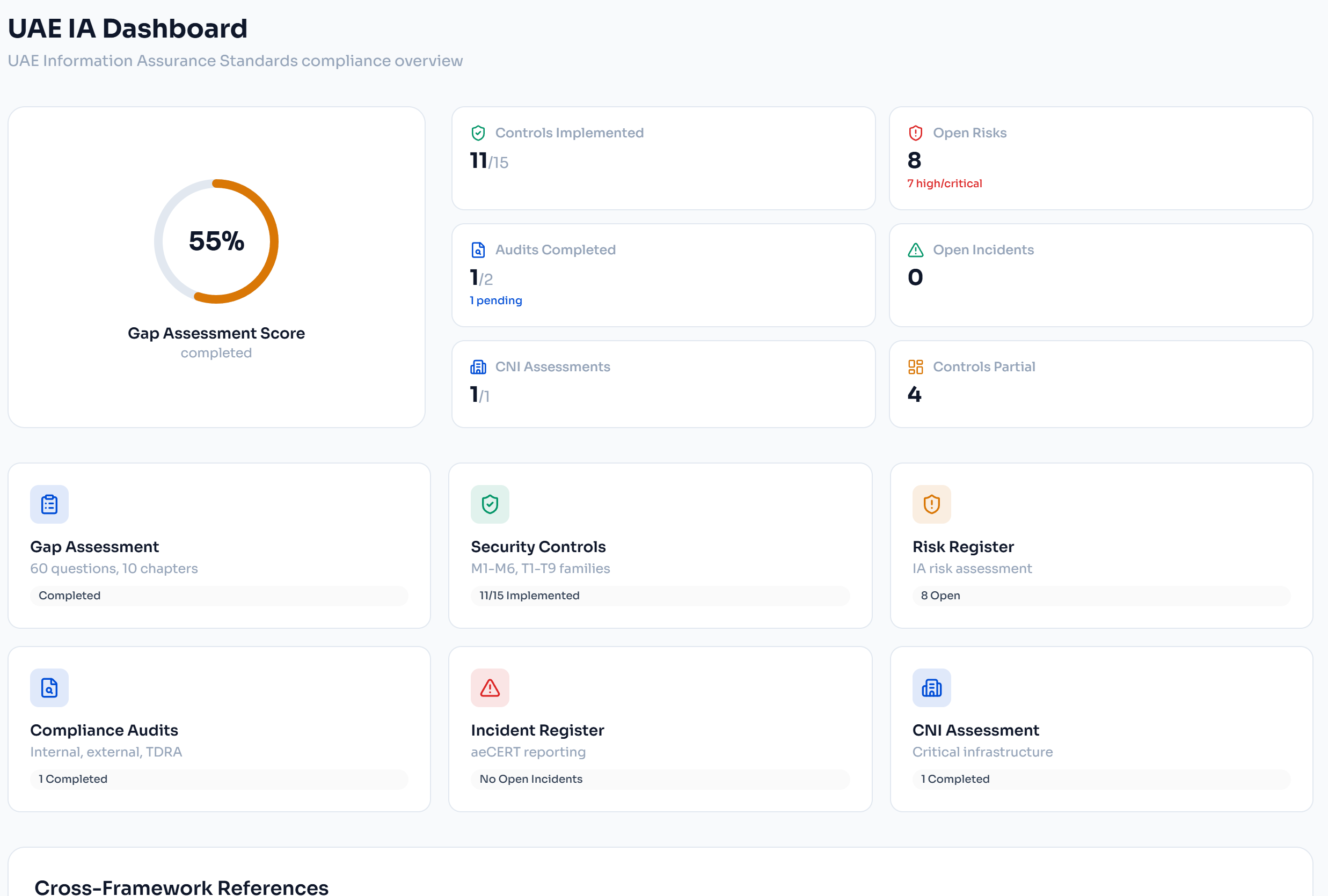
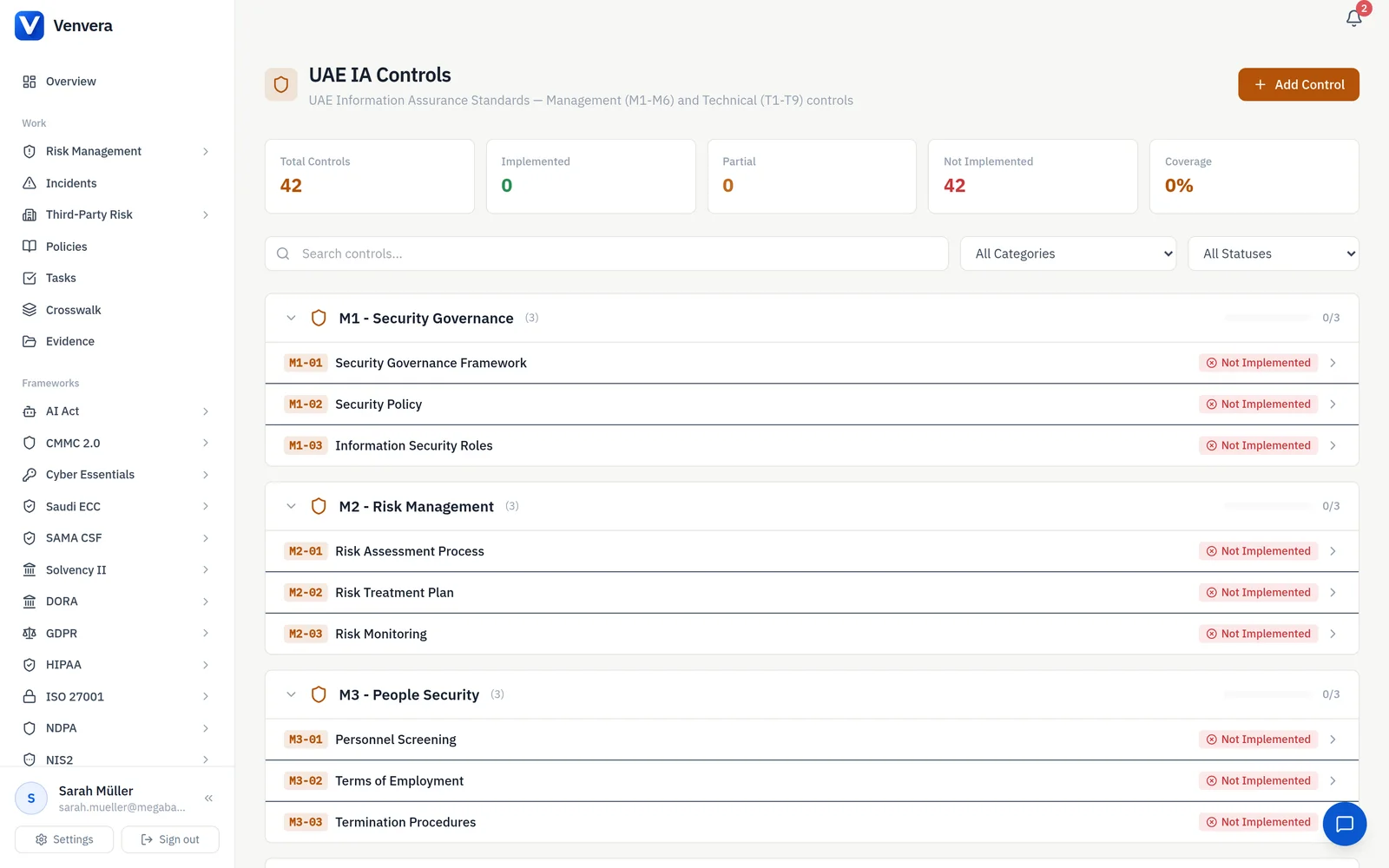
The UAE IA framework, issued by the TDRA, establishes information security standards for UAE government entities and organisations that interact with government systems. It's organised into domains, objectives, and controls - structurally similar to ISO 27001 but with UAE-specific additions that reflect national security priorities and the digital government agenda.
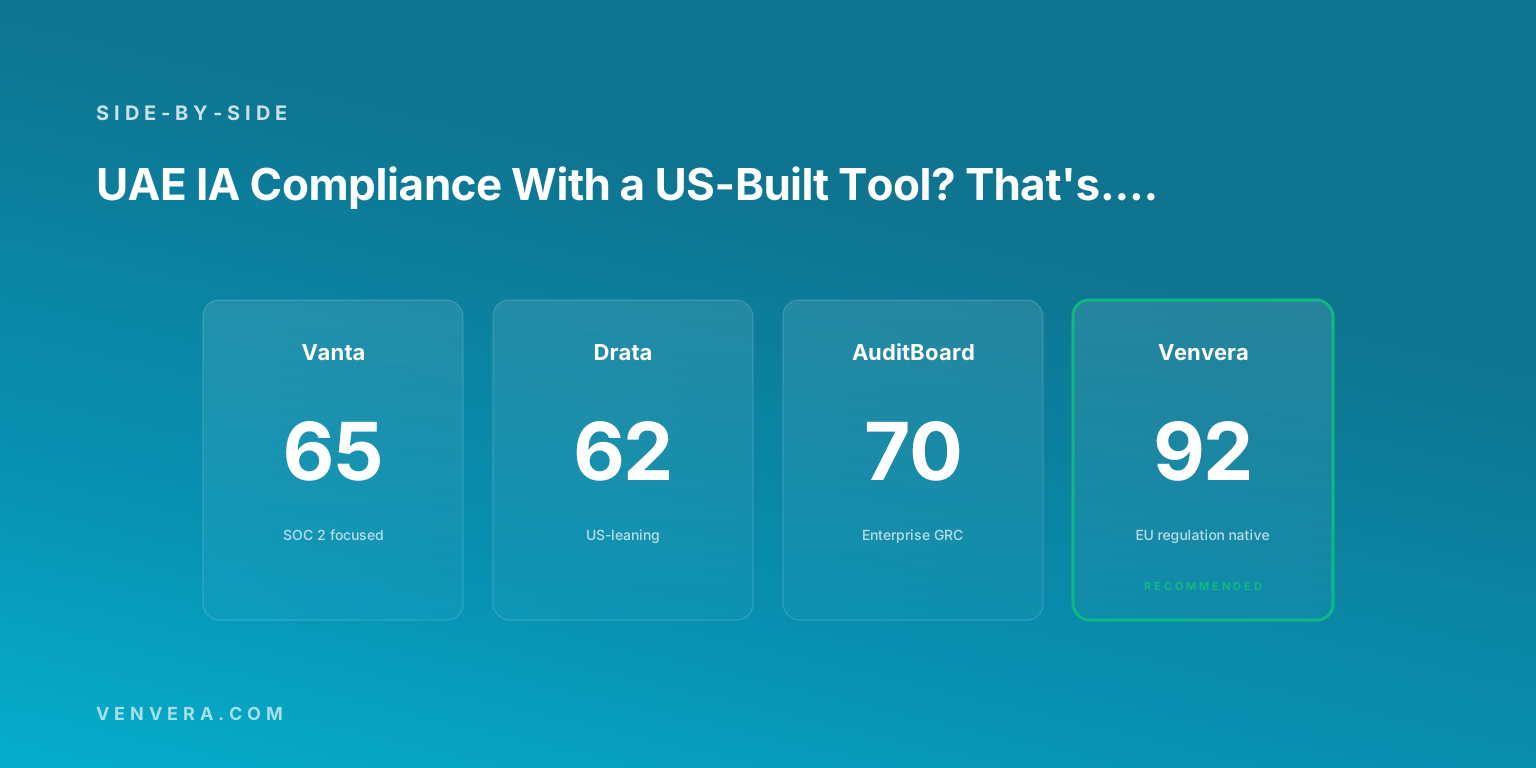
Trying to manage UAE IA compliance through a US-built SOC 2 tool is like trying to navigate Abu Dhabi with a San Francisco map. Some of the road names might look familiar, but you'll end up in the wrong place every time.
⚠ The fundamental mismatch:
UAE IA compliance isn't just about security controls - it's about alignment with the UAE's national digital strategy, TDRA governance expectations, data classification schemes, and sector-specific regulatory overlays. Drata's controls-based approach covers maybe 30% of what the TDRA actually evaluates.
🔍
WHERE DRATA FALLS SHORT
Six UAE IA Requirements Drata Can't Address
These are specific to the UAE IA framework and simply don't exist in Drata's architecture.
🏷
Classification System
UAE IA uses a specific classification scheme for information and systems that determines security control levels. The criteria are defined by UAE regulation, not international standards.
🇪🇦
National Data Residency
UAE regulations increasingly emphasise data localisation and sovereignty. Compliance data itself may need to remain within specific jurisdictions. US hosting is inherently problematic.
🏢
Sector-Specific Overlays
Financial services (CBUAE), healthcare (DOH), energy, and telecoms each have additional regulatory requirements. UAE IA doesn't exist in isolation from sector regulators.
📋
TDRA Domain Structure
The framework's domain structure, objectives, and control implementations are TDRA-specific. Drata's controls mapping doesn't reflect this structure.
📈
Digital Strategy Alignment
UAE IA is part of the broader UAE digital transformation agenda. It's about enabling trusted digital government, not just checking technical controls.
📊
Regulatory Reporting
Interactions with TDRA, sector regulators, and national compliance requirements aren't modelled in Drata. You're managing a UAE programme in a tool that doesn't know the UAE exists.
⚖
FEATURE COMPARISON
Side by Side: UAE IA Compliance
| UAE IA Capability | Drata | Venvera |
|---|---|---|
| UAE IA Assessment Framework | ✗ Generic controls mapping | ✓ Purpose-built module |
| Information Classification (UAE-specific) | ✗ Not available | ✓ Classification management |
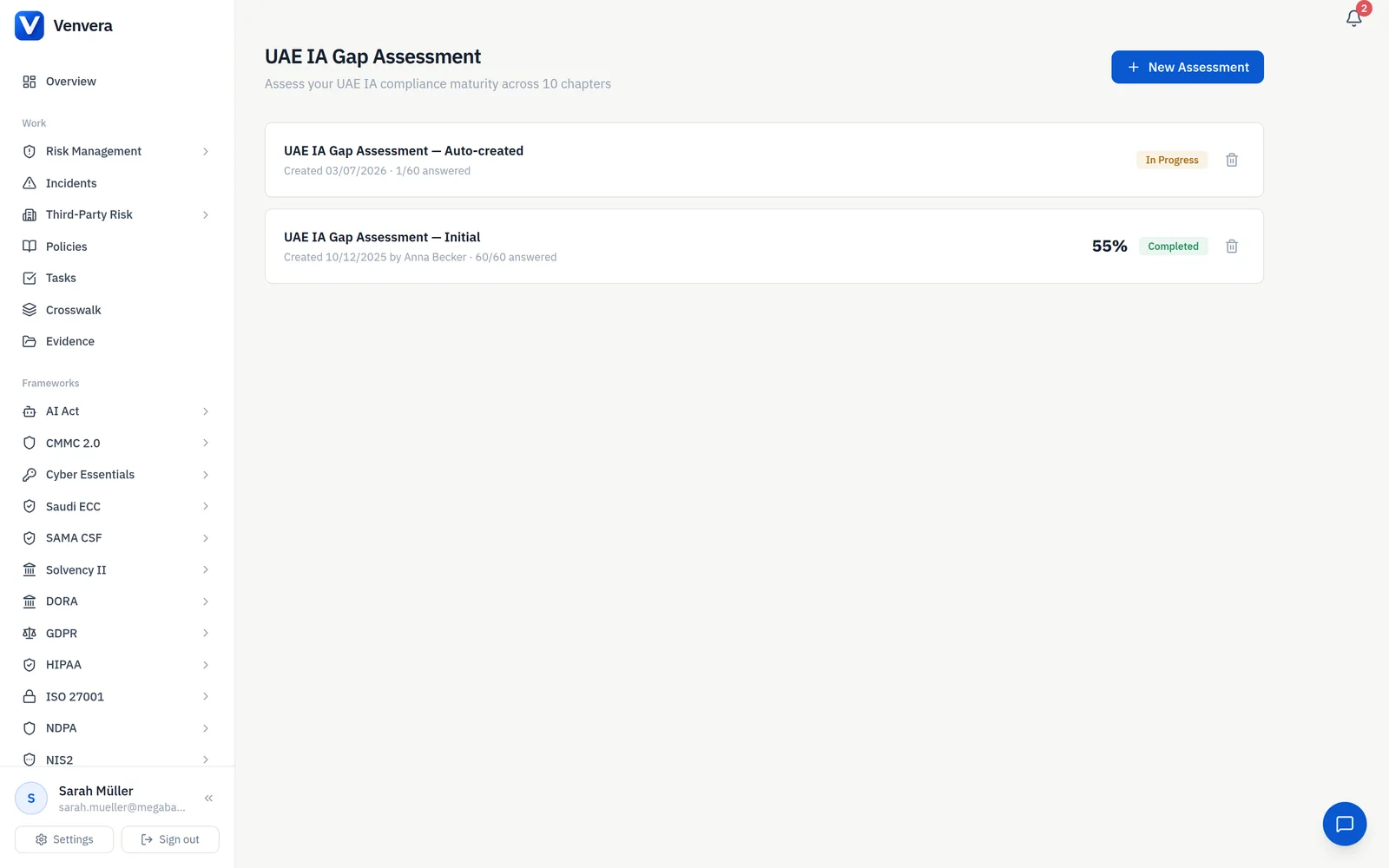
| Gap Assessment | ✗ Not purpose-built | ✓ Structured gap analysis |
| Risk Assessment | ◯ Basic | ✓ Full assessment framework |
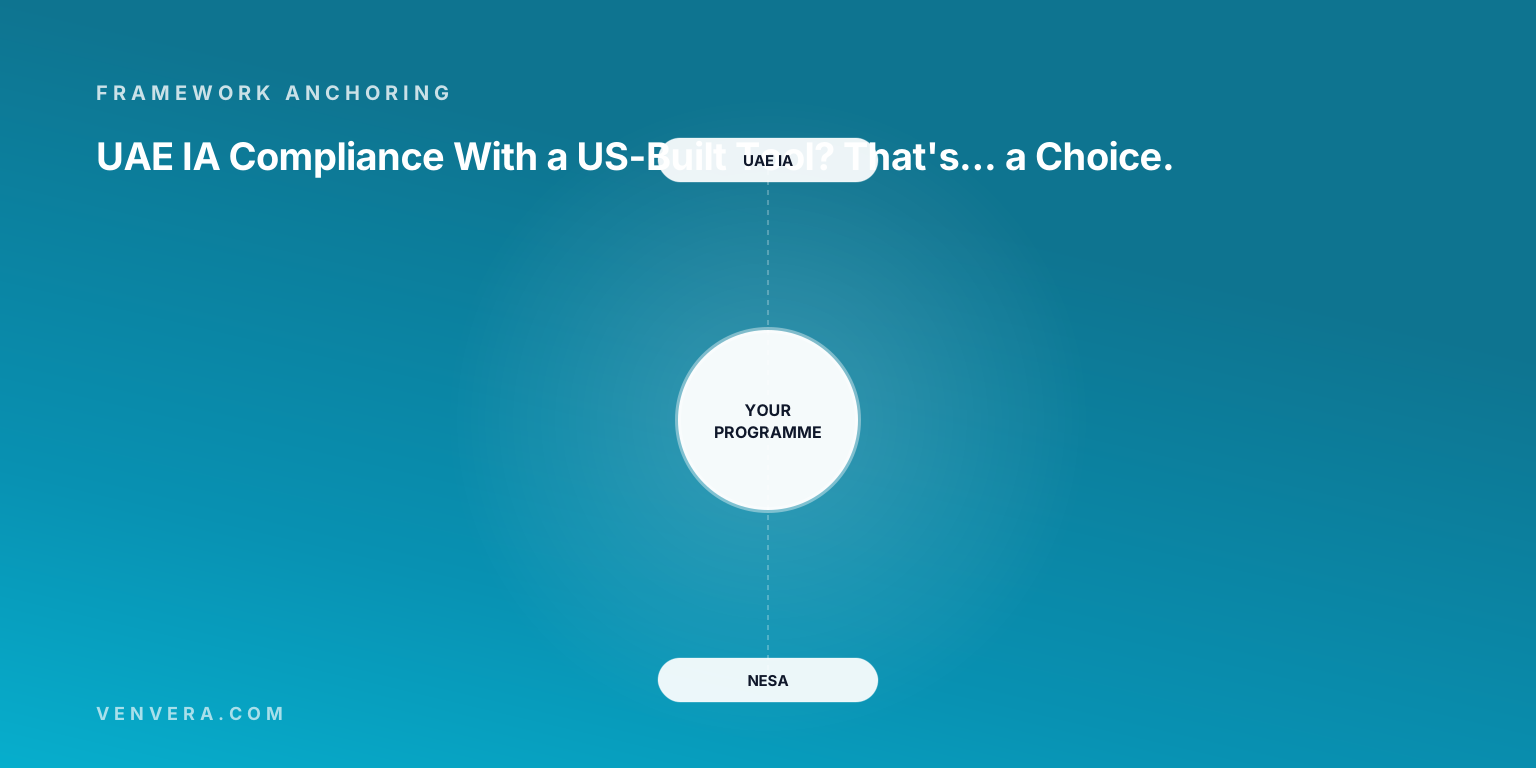
| Cross-Mapping to ISO 27001 / NIST CSF | ◯ Separate silos | ✓ 150+ mappings |
| Regulatory Context (TDRA/CBUAE/DOH) | ✗ Not modelled | ✓ UAE context |
| Infrastructure Monitoring | ✓ 100+ integrations | ◯ Growing |
| Data Hosting | ✗ US default | ✓ Amsterdam, EU (AES-256-GCM) |
| Starting Price | ~$25-30K+/yr | €399/mo (€4,788/yr) |
🔬
DEEP DIVE
UAE IA + International Standards: The Whole Picture
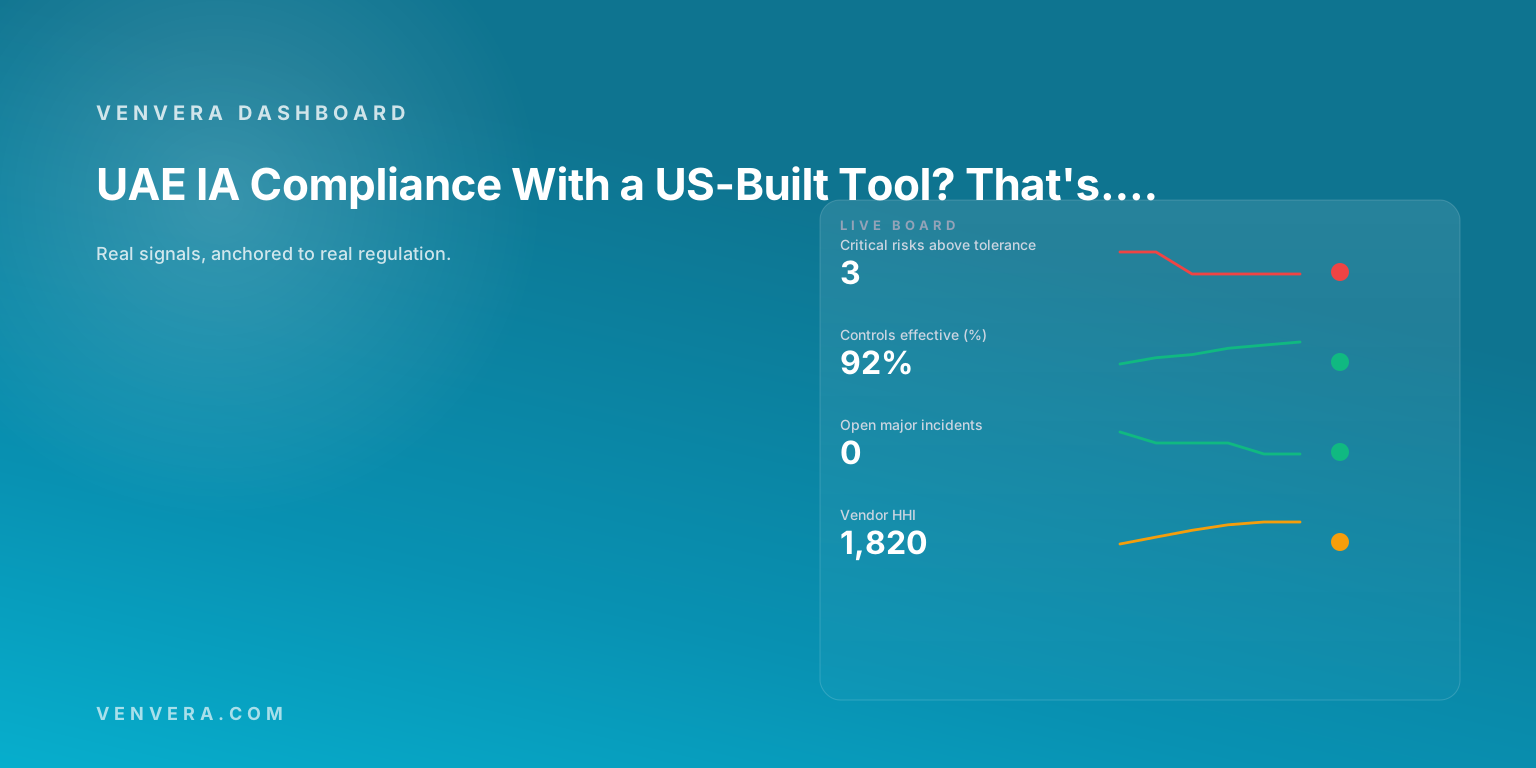
Organisations operating in the UAE rarely need only UAE IA compliance. Most also maintain ISO 27001 certification - often required by commercial partners and government procurement. Many need SOC 2 for international clients. Financial institutions need additional CBUAE regulatory compliance. And organisations with EU operations or clients add GDPR to the mix.
The overlap between UAE IA and ISO 27001 is particularly significant - the UAE IA framework explicitly references ISO 27001 controls. Implementing these frameworks together, with mapped relationships, saves substantial effort.
What Venvera's cross-mapping delivers:
- UAE IA controls that reference ISO 27001 are automatically linked. Implement an access control measure for UAE IA and the corresponding ISO 27001 Annex A and NIST CSF requirements are flagged as addressed.
- Risk assessment findings map across frameworks - identify a vulnerability once, track remediation across all applicable standards.
- Evidence collected for one framework automatically satisfies overlapping requirements in others.
- Gap assessments show your position against all applicable frameworks simultaneously, not one at a time.
🔗
CROSS-FRAMEWORK MAPPING
UAE IA References ISO 27001. Your Tool Should Too.
With Drata, you'd pay separately for UAE IA and ISO 27001, implement the same controls twice, and maintain parallel evidence sets. For three frameworks (add NIST CSF), that's $75K+ per year with no cross-mapping between them.
✓ Cross-framework impact:
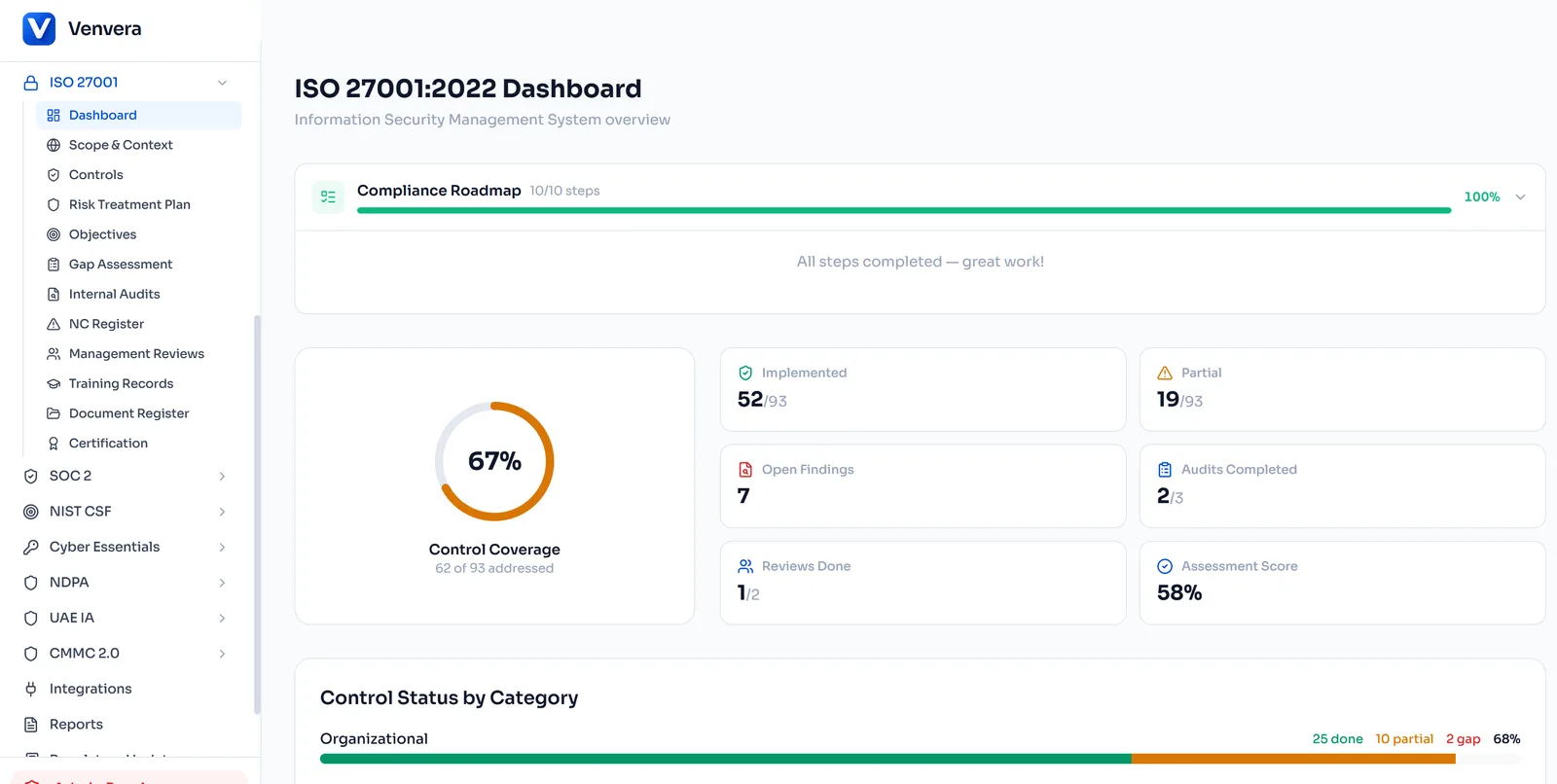
- 150+ pre-built mappings across UAE IA, ISO 27001, NIST CSF, and 10 more frameworks
- ~55% work reduction when implementing UAE IA alongside ISO 27001
- Single evidence base - implement once, satisfy TDRA and ISO certification body
- With Drata, each framework is siloed. Same access control documented three times, paid for three times.
💰
PRICING COMPARISON
The Cost of UAE Compliance
Most UAE organisations need UAE IA + ISO 27001. Many add SOC 2 for international clients. The cost difference is staggering.
| Scenario | Drata | Venvera | You Save |
|---|---|---|---|
| UAE IA only | ~$25-30K/yr | €4,788/yr | ~$20K/yr |
| UAE IA + ISO 27001 + NIST CSF | ~$75-90K/yr | €10,788/yr | ~$65-80K/yr |
| 3-year total (3 frameworks) | ~$225-270K | €32,364 | $190-240K |
For three frameworks, Venvera costs €899/month versus $75K+ with Drata. The savings fund a senior compliance analyst with money to spare. And for UAE IA specifically, the more expensive option doesn't even give you a purpose-built module - just remapped ISO 27001 controls.
🇪🇺
DATA SOVEREIGNTY
Data Residency: The Elephant in the Server Room
For a framework that emphasises data sovereignty and national security, storing compliance data on US servers is deeply problematic. Your UAE IA compliance records contain your classification schemes, risk assessments, gap analyses, and control implementation details - essentially a roadmap of your security posture. Putting that on servers subject to US FISA 702 jurisdiction is a tension that's hard to explain to the TDRA.
Drata offers EU hosting as an option, but not GCC hosting. Venvera is hosted in Amsterdam with AES-256-GCM encryption. While neither platform offers UAE-based hosting, EU hosting with strong privacy protections is a significantly better position than US default hosting for organisations subject to UAE data sovereignty requirements.
✅
WHO SHOULD SWITCH
Is the Switch Right for You?
Switch to Venvera if:
- ☑ UAE IA is a core compliance requirement for your organisation
- ☑ You need UAE-specific classification and assessment frameworks
- ☑ You're managing UAE IA alongside ISO 27001, NIST CSF, or other international standards
- ☑ You interact with TDRA, CBUAE, or other UAE sector regulators
- ☑ Data sovereignty concerns make US-hosted platforms problematic
- ☑ You'd rather spend $65K/year on security improvements than on platform licensing
Stay with Drata if SOC 2 is your primary framework and UAE IA is a secondary concern. Drata's genuine strengths - infrastructure monitoring, automated evidence collection, clean UI - are real but tangential to UAE IA compliance. They help with the technical control portion but don't address the framework's governance, classification, and regulatory reporting requirements.
UAE IA Compliance That Understands the UAE Context
Purpose-built UAE IA module. Classification management. Gap assessment.
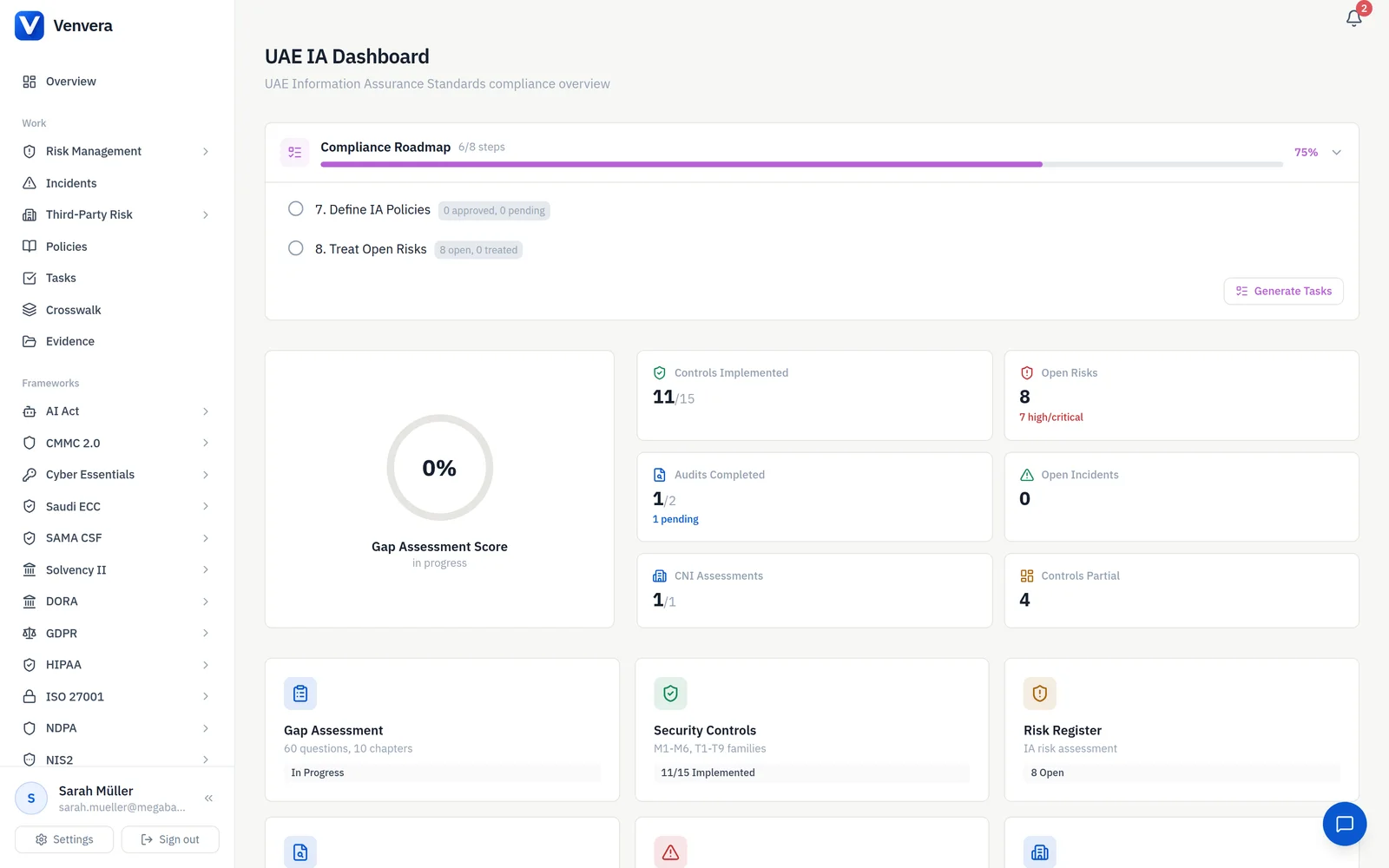
Cross-mapped to ISO 27001, NIST CSF, and 10 more frameworks. AES-256-GCM encryption. From €399/month.
Book a Demo →Last updated: March 2026. Pricing and features based on publicly available data. UAE regulatory requirements evolve - contact vendors for current capabilities.