
Best

The stakes here are unusually high. If you're a defense contractor - or a subcontractor, or a supplier anywhere in the defense industrial base - CMMC certification isn't a nice-to-have. It's a contractual prerequisite. Without it, you don't bid. Without it, you don't win. Without it, you're out of the defense supply chain entirely.
CMMC 2.0 (Cybersecurity Maturity Model Certification) requires organisations handling Controlled Unclassified Information (CUI) to meet specific cybersecurity practices derived from NIST SP 800-171. The DoD is rolling CMMC requirements into contracts across the Defense Federal Acquisition Regulation Supplement (DFARS). This is happening now. Not "on the roadmap." Now.
So when our compliance team looked at StrikeGraph to see if it could help with CMMC, the silence was deafening. No CMMC module. No NIST 800-171 mapping. No CUI handling workflows. No SSP templates. Nothing. Here's what CMMC actually demands, why SOC 2 platforms can't do it, and what we found when we went looking for something that could.
⚠
THE CORE PROBLEM
SOC 2 Is Not CMMC. Not Even in the Same Universe.
CMMC 2.0 simplified the original five-level model into three tiers. Most defense contractors will need Level 2: 110 security practices across 14 control families derived from NIST SP 800-171, plus a System Security Plan (SSP) documenting every practice, a Plan of Action and Milestones (POA&M) for any gaps, and - for critical programs - a third-party assessment by a C3PAO.
None of this maps to SOC 2. SOC 2's Trust Services Criteria overlap with some NIST 800-171 controls, but SOC 2 doesn't cover CUI handling, doesn't generate SSPs, doesn't track POA&Ms in the required format, and doesn't align with the specific CMMC practice statements. Using StrikeGraph for CMMC is like using your passport to pass a driving test - it proves you're a person, but it doesn't prove you can drive.
🚨 Defense contracts are at stake
StrikeGraph covers SOC 2, ISO 27001, HIPAA, and PCI DSS. It has zero CMMC capability - no NIST 800-171 mapping, no SSP generation, no POA&M tracking, no CUI handling workflows, no C3PAO assessment preparation. The platform was built for SaaS companies, not the defense industrial base.
🔍
GAP ANALYSIS
Where StrikeGraph Falls Short for CMMC
These are the specific CMMC requirements that StrikeGraph cannot address. Every one is mandatory for Level 2 certification.
📋
NIST 800-171 Practice Mapping
CMMC Level 2 is literally NIST SP 800-171 Rev 2. All 110 security requirements need tracking, evidence, and implementation status. StrikeGraph doesn't support NIST 800-171.
📄
System Security Plan (SSP)
A comprehensive SSP describing system boundaries, security controls, implementation details, and responsibilities. This is a structured NIST document, not a generic policy. StrikeGraph can't generate it.
📈
POA&M Tracking
Plan of Action and Milestones for every gap: what's missing, the remediation plan, timeline, and resource allocation. StrikeGraph doesn't track POA&Ms in any format.
🔒
CUI Handling & Marking
CMMC exists to protect Controlled Unclassified Information. CUI categories, marking requirements, and handling procedures are central. SOC 2 has no concept of CUI.
🔎
C3PAO Assessment Readiness
Level 2 requires third-party assessment by a CMMC Third-Party Assessment Organisation. Your platform needs evidence preparation and assessment tracking. StrikeGraph's workflow is built for SOC 2 auditors.
🔗
Cross-Framework Mapping to NIST CSF
NIST 800-171 derives from NIST 800-53, which maps to NIST CSF and ISO 27001. Cross-mapping accelerates implementation enormously. StrikeGraph can't map across frameworks.
📊
HEAD TO HEAD
Feature Comparison: StrikeGraph vs. Venvera for CMMC
| What You Need for CMMC | StrikeGraph | Venvera |
|---|---|---|
| CMMC module | ✗ | ✓ Full module |
| NIST 800-171 practice mapping (110) | ✗ | ✓ All 110 practices |
| SSP generation | ✗ | ✓ Structured templates |
| POA&M tracking | ✗ | ✓ Full tracking |
| CUI handling workflows | ✗ | ✓ Built-in |
| NIST CSF cross-mapping | ✗ | ✓ 150+ mappings |
| ISO 27001 overlap mapping | ✗ No cross-mapping | ✓ Automatic |
| DORA, GDPR, NIS2 support | ✗ | ✓ Full modules |
| Frameworks supported | ◯ 4 (SOC 2, ISO, HIPAA, PCI) | ✓ 13 frameworks |
| Data hosting | ✗ US-based | ✓ Amsterdam, NL |
| Starting price | ~$8-12K/yr (SOC 2) | €399/mo (1 fw) |
🔬
DEEP DIVE
The CMMC-NIST CSF-ISO 27001 Triangle
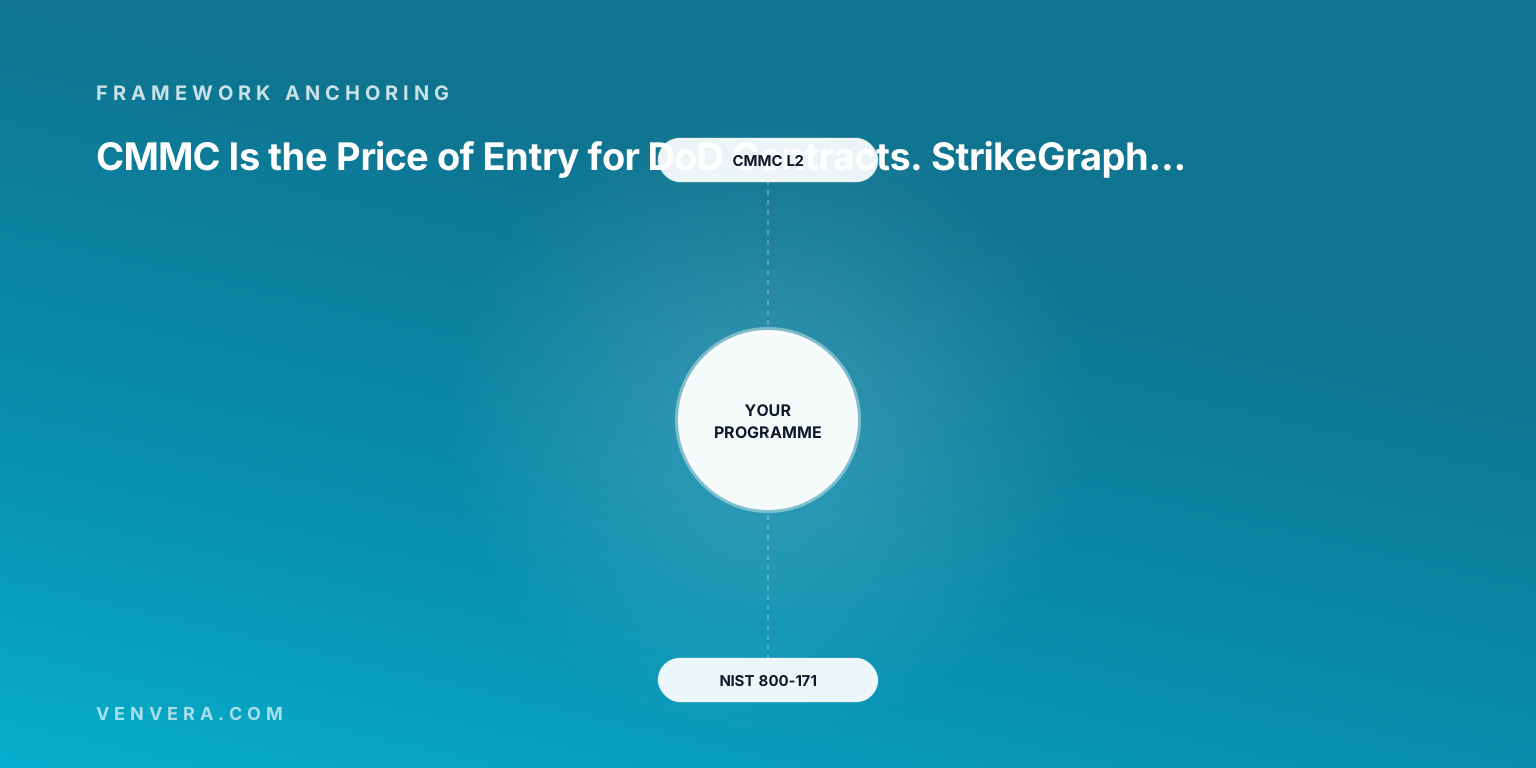
Here's why cross-framework mapping matters so much for CMMC. NIST 800-171 (the basis for CMMC Level 2) was derived from NIST SP 800-53, which is the control set that NIST CSF references. ISO 27001's Annex A controls overlap significantly with NIST 800-171 requirements. And SOC 2's Trust Services Criteria map to portions of all three.
What this means in practice: if you've already implemented ISO 27001, roughly 65-70% of NIST 800-171 requirements are partially addressed by your existing controls. If you've also done NIST CSF, that number climbs to 80%. The remaining gap is CUI-specific controls that don't have equivalents in non-defense frameworks.
What actually surprised us:
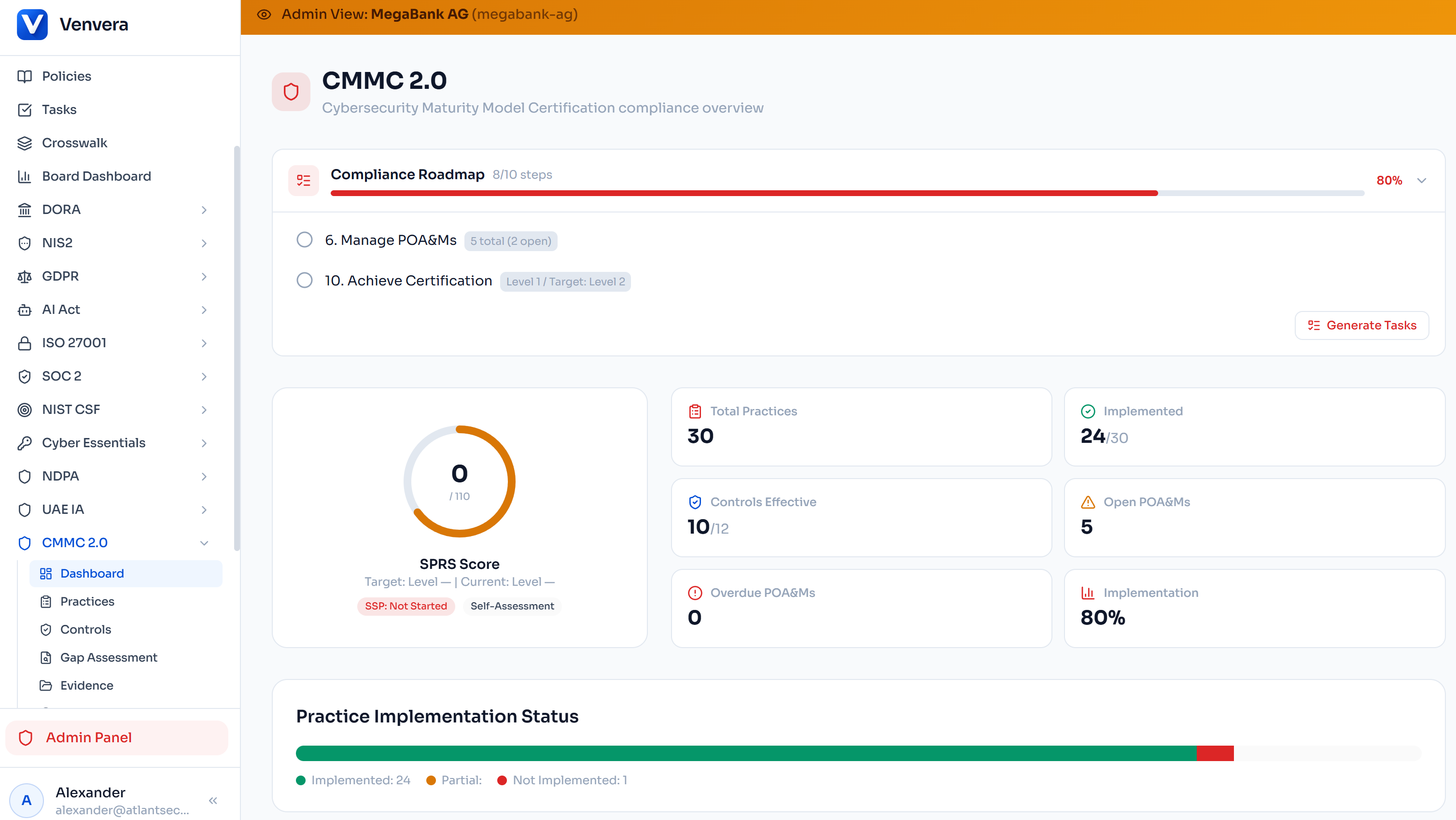
- When we enabled the CMMC module after having ISO 27001 and NIST CSF already in place, 73 of the 110 Level 2 practices showed up as partially addressed.
- Each of those 73 still needed verification against NIST 800-171's specific language - but we didn't have to build them from scratch.
- The SSP template was structured to match the actual NIST SP 800-171 reporting format, not a generic security document.
- POA&M tracking linked directly to practice gaps, with timelines and resource allocation - exactly what a C3PAO expects to see.
The time savings were significant. We went from "CMMC is going to take a year" to "we're assessment-ready in four months" - mostly because we didn't have to re-document every control that already existed in our ISO 27001 and NIST CSF implementations.
🔗
EFFICIENCY MULTIPLIER
Defense Contractors Don't Have Single-Framework Luxury
Defense contractors don't just need CMMC. They need NIST CSF (expected by most procurement). ISO 27001 (often contractually required by prime contractors). And if they have international operations: GDPR, DORA, and other frameworks layer on top. Single-framework thinking is a luxury the defense industrial base can't afford.
On StrikeGraph, you get SOC 2 and ISO 27001. No CMMC, no NIST CSF, no DORA. For a defense contractor with international operations, that's coverage for maybe 20% of your compliance obligations.
✓ One control, multiple frameworks satisfied
Your NIST 800-171 access controls map to ISO 27001 (A.9), NIST CSF (PR.AC), SOC 2 (CC6.1), and DORA (Article 9). Your incident response procedures satisfy CMMC, NIST CSF (RS), ISO 27001, NIS2, and DORA simultaneously.
Thirteen frameworks total: DORA, GDPR, NIS2, ISO 27001, EU AI Act, SOC 2, NIST CSF, Cyber Essentials, NDPA, UAE IA, CMMC, HIPAA, PCI-DSS. 150+ pre-built control mappings across all of them.
💰
PRICING REALITY CHECK
CMMC Compliance Costs: The Surprising Comparison
Most CMMC-specific platforms charge $50,000+ per year. StrikeGraph charges $8-12K for SOC 2 but can't do CMMC at any price. The pricing math might surprise you.
| Scenario | StrikeGraph + Workarounds | Venvera |
|---|---|---|
| SOC 2 only | ~$10K/yr | €4,788/yr (€399/mo) |
| CMMC + ISO 27001 | $10K + CMMC tool (~$60-70K total) | €10,788/yr (€899/mo for 3) |
| CMMC + ISO + NIST CSF | $10K + CMMC tool + manual (~$75-85K) | €10,788/yr (€899/mo for 3) |
| Annual savings with Venvera | - | Save $50-75K/yr + cross-framework mapping |
The pricing might seem unusual for a defense compliance tool - most CMMC platforms charge $50,000+ per year. But Venvera's model is the same regardless of which framework you're using: €399/month for one, €899/month for three. And because the CMMC module includes NIST 800-171 mapping, SSP templates, and POA&M tracking, it's not a watered-down version of the real thing.
🇪🇺
DATA SOVEREIGNTY
A Note on Data Hosting for Defense Contractors
Venvera is hosted in Amsterdam, which is relevant context for defense contractors. For companies that also have European compliance obligations (GDPR, DORA, NIS2), this is a significant advantage. For CUI-handling operations where US data residency might be preferred, this is worth discussing with Venvera directly - the compliance data (your control documentation, evidence, SSPs) is distinct from the CUI itself.
Venvera: EU-native hosting
Hosted entirely in Amsterdam. AES-256-GCM encryption with per-tenant keys. For defense contractors with both US and European operations, the European hosting handles GDPR/DORA obligations while CMMC compliance documentation (not CUI itself) is managed in a well-regulated jurisdiction.
✅
DECISION GUIDE
Who Should Actually Switch (And Who Should Stay)
StrikeGraph's risk-based SOC 2 approach is genuinely good for commercial SaaS companies. If you're not in the defense supply chain and never will be, CMMC is irrelevant to you. But if you are...
✓ Switch to Venvera if:
- You need CMMC Level 2 certification for DoD contracts
- You need NIST 800-171 practice mapping, SSPs, and POA&Ms
- You want ISO 27001-CMMC cross-mapping to accelerate certification
- You have international operations requiring GDPR, DORA, or NIS2
- You want to avoid $50K+/yr CMMC-specific platform costs
◯ Stay on StrikeGraph if:
- You're a commercial SaaS company with no defense contracts
- SOC 2 is your only compliance need
- You don't handle CUI and never will
- You like their risk-based SOC 2 scoping approach
Venvera earns its place for defense contractors not by being the flashiest platform, but by being the one that actually covers the regulatory landscape the defense industrial base faces in 2026 - CMMC, NIST CSF, ISO 27001, and beyond - at a fraction of what dedicated CMMC tools charge.
Defense Contracts Demand CMMC. Get Certified.
Venvera covers CMMC with NIST 800-171 mapping, SSP templates, and POA&M tracking - plus ISO 27001, NIST CSF, SOC 2, and 9 more frameworks.
All hosted in Amsterdam. Starting at €399/month (1 framework) or €899/month (3 frameworks).
Book a Demo →Last updated: March 2026. Feature and pricing details based on publicly available information and direct platform evaluation.