
Best

Let me start with what’s at stake: your ability to win and keep defence contracts.
The Cybersecurity Maturity Model Certification (CMMC) 2.0 is no longer a future requirement. The Department of Defense finalised the rule in late 2024, and CMMC requirements are being written into new contracts. If you’re in the Defence Industrial Base (DIB) - or you want to be - CMMC certification is becoming a prerequisite for doing business. No certification, no contract. That simple.
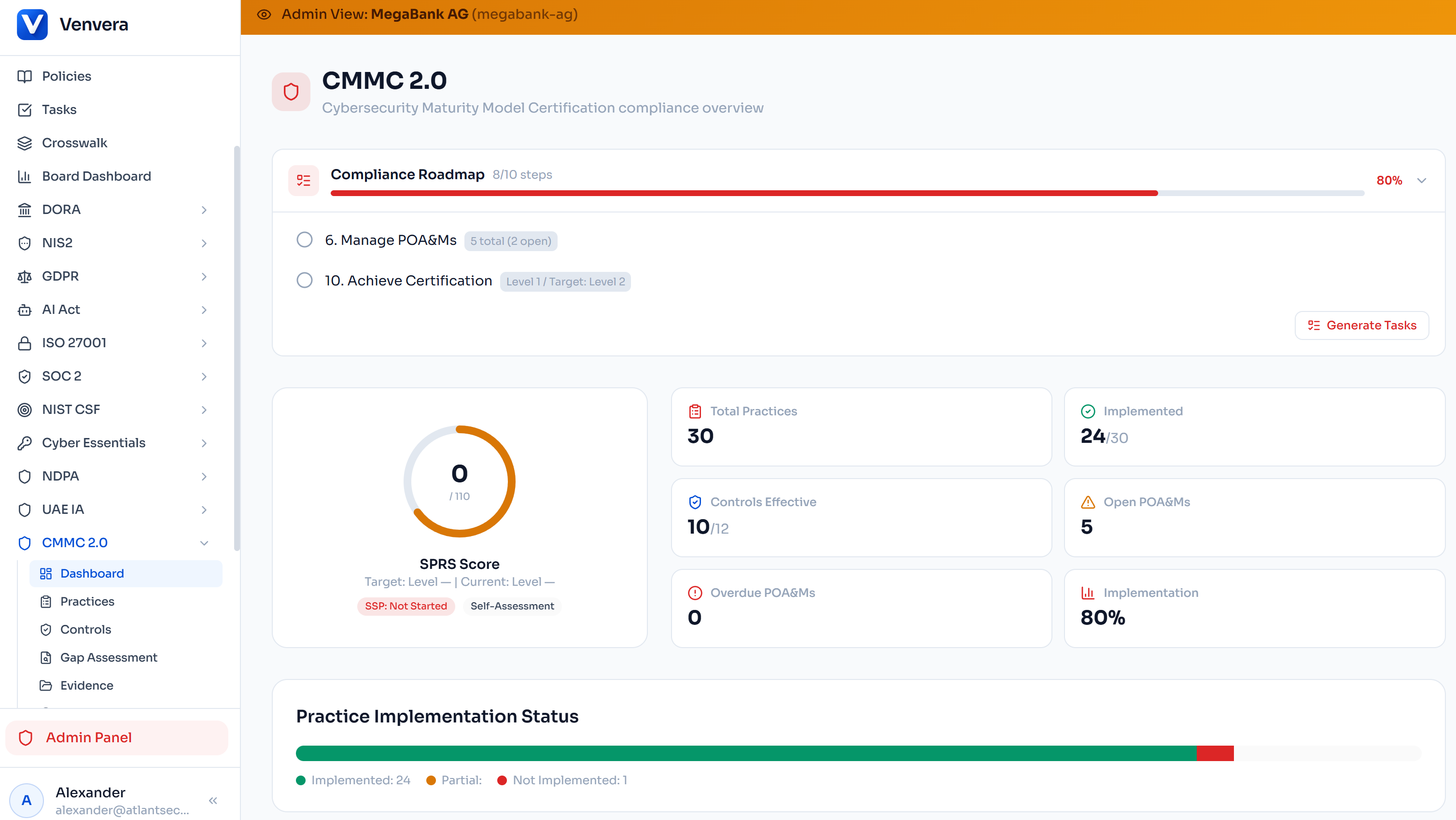
CMMC 2.0 has three levels. Level 1 (Foundational) covers 17 basic practices from FAR 52.204-21 - honestly, if you can’t pass Level 1, you probably shouldn’t be handling government data at all. Level 2 (Advanced) is where it gets real: all 110 controls from NIST SP 800-171, requiring a third-party assessment by a C3PAO. Level 3 (Expert) adds additional controls from NIST SP 800-172 with government-led assessments. Secureframe doesn’t have a CMMC module for any of them.
⚠
THE PROBLEM
What CMMC Level 2 Actually Requires
CMMC isn’t just “another framework.” It’s tied to NIST 800-171 controls, requires specific documentation artifacts, and involves assessments by authorised third parties. Generic compliance tooling doesn’t cut it.
⚠ Why SOC 2 tooling can’t handle CMMC:
110 NIST SP 800-171 controls. These aren’t generic security controls. They’re specific practices across 14 families: access control, audit and accountability, awareness and training, configuration management, identification and authentication, incident response, maintenance, media protection, personnel security, physical protection, risk assessment, security assessment, system and communications protection, and system and information integrity.
System Security Plan (SSP). A comprehensive document describing how your organisation implements each of the 110 controls within your system boundary. This isn’t a policy document - it’s a technical implementation description specific to your CUI-handling systems.
Plan of Action & Milestones (POA&M). For any controls not fully implemented, you need a documented plan with specific milestones, responsible parties, and completion dates. The POA&M isn’t a wishlist - it’s a commitment with timelines that assessors review.
C3PAO assessment. You can’t self-certify at Level 2. A CMMC Third Party Assessment Organization conducts the assessment, reviews your evidence, and determines your certification status. Your compliance platform needs to produce evidence that survives that scrutiny.
🔍
GAP ANALYSIS
Secureframe: Strong Platform, Wrong Fight
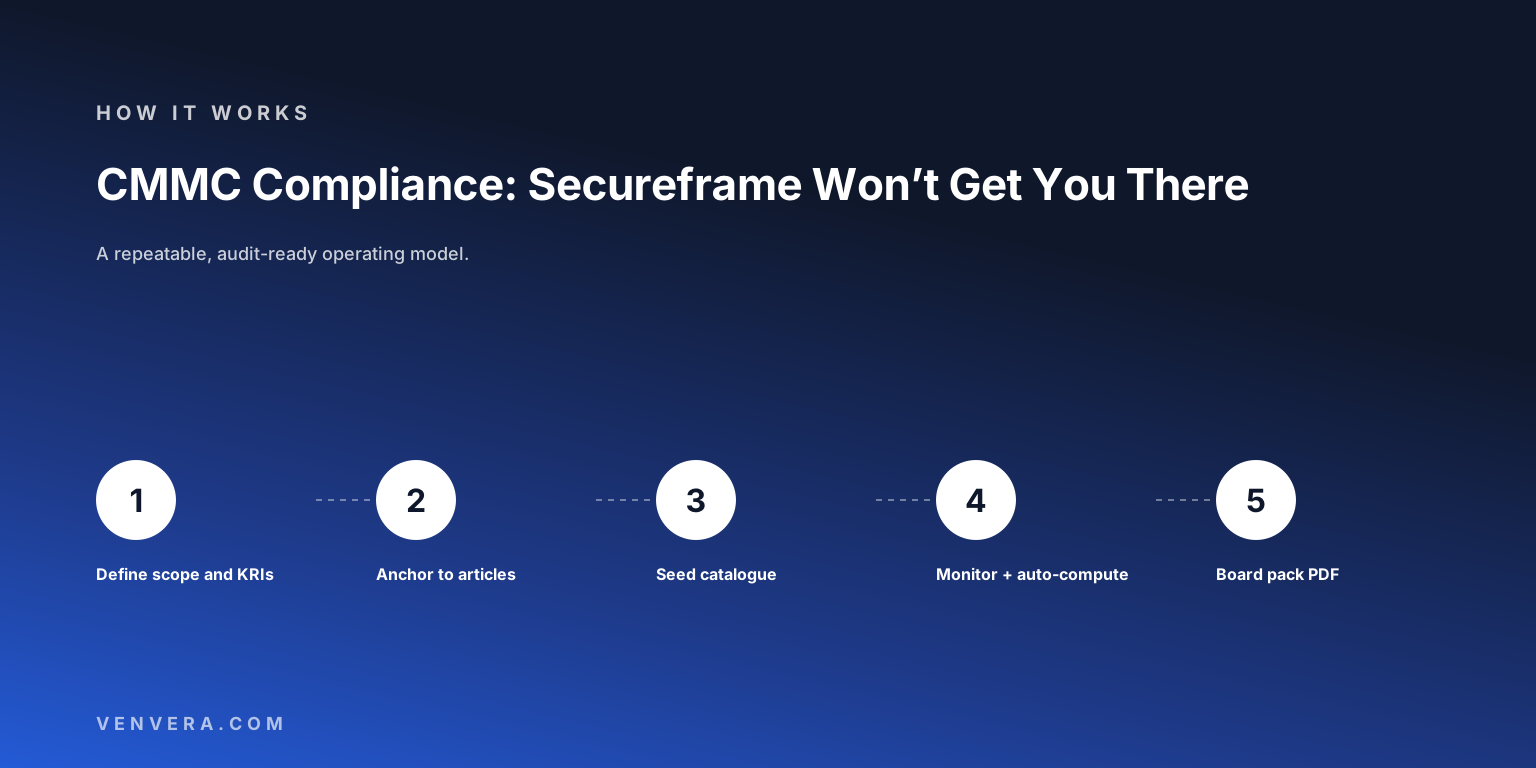
Secureframe is a good product. Their SOC 2 module is excellent - automated evidence collection, auditor network, clean UI. HIPAA is best-in-class. ISO 27001 is solid. But CMMC is a fundamentally different challenge from SOC 2, and here are the six gaps that matter:
🗒
No CMMC Module
Zero support for CMMC 2.0 at any level. No NIST 800-171 control tracking, no maturity model assessment, no C3PAO preparation workflows.
📊
No SSP Generation
System Security Plans are mandatory for CMMC Level 2. Secureframe has no concept of SSP documentation or CUI system boundary scoping.
🌐
No POA&M Tracking
Plans of Action & Milestones need structured tracking with deadlines, responsible parties, and status updates. Generic task lists don’t satisfy assessors.
🚨
European defence contractors need CMMC for US DoD work alongside DORA, NIS2, or GDPR for European obligations. Secureframe has none of these.
📄
No CMMC-NIST CSF Mapping
NIST 800-171 maps extensively to NIST CSF and ISO 27001. Without cross-mapping, you document the same controls separately for each framework.
🔗
Prescriptive vs. Flexible Mismatch
SOC 2 is principle-based. CMMC is prescriptive with specific controls and technical configurations. A platform built for flexibility isn’t equipped for prescription.
⚖
HEAD-TO-HEAD
Side by Side: CMMC Readiness
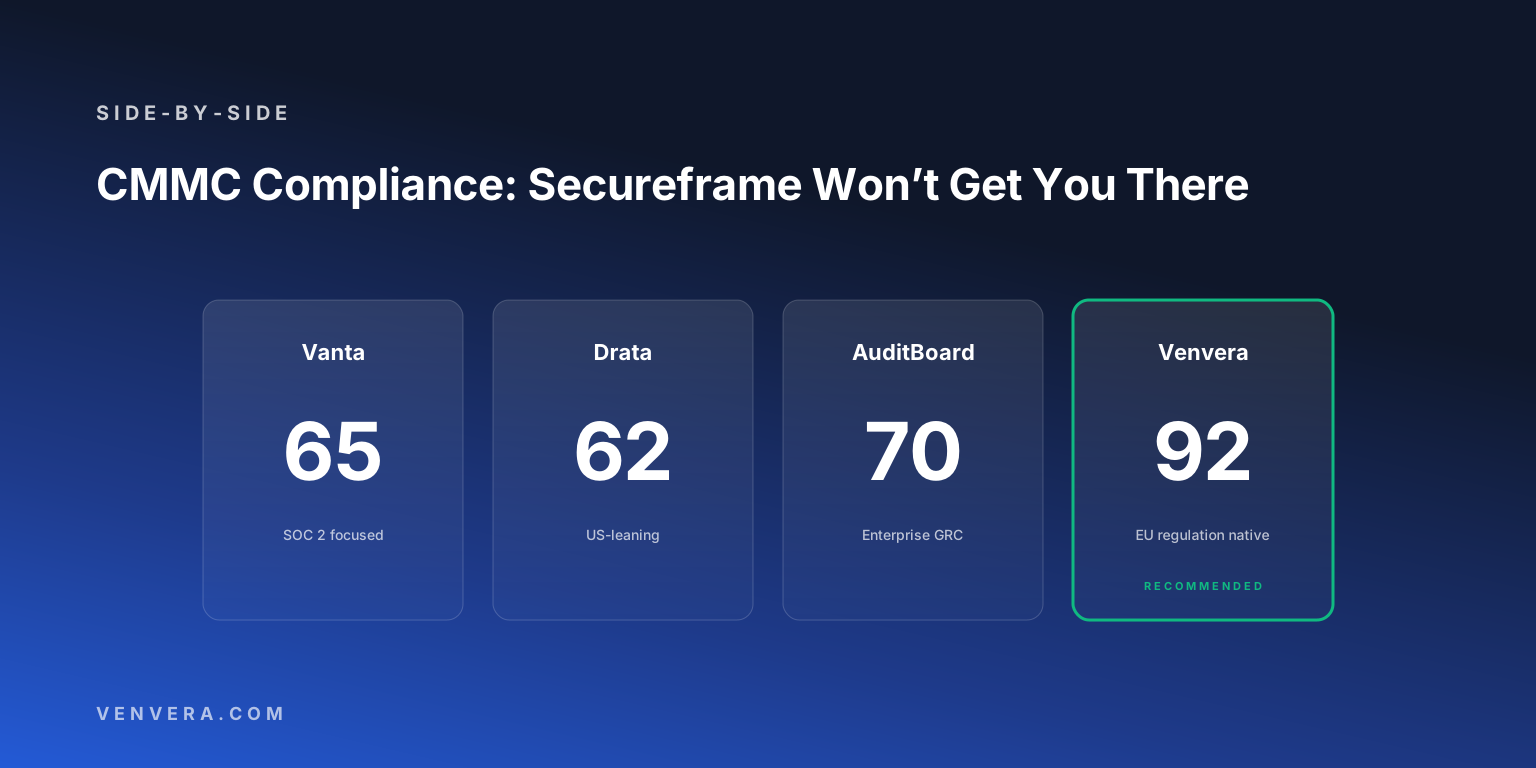
| Requirement | Venvera | Secureframe |
|---|---|---|
| CMMC 2.0 module | ✓ Full module | ✗ |
| NIST 800-171 control tracking (110 controls) | ✓ All 110 | ✗ |
| SSP documentation support | ✓ Built-in | ✗ |
| POA&M tracking | ✓ Structured | ✗ |
| Cross-maps to NIST CSF | ✓ Native mapping | ✗ No CMMC to map |
| Cross-maps to ISO 27001 | ✓ Native mapping | ✗ No CMMC to map |
| SOC 2 | ✓ Included | ✓ Excellent |
| DORA / NIS2 / GDPR | ✓ All included | ✗ |
| Total frameworks | ✓ 13 | ◯ ~6 |
| EU data hosting | ✓ Amsterdam | ✗ US-hosted |
| HIPAA | ✗ | ✓ Strong |
🔬
DEEP DIVE
The CMMC + NIST CSF + ISO 27001 Trifecta
Here’s the efficiency play that defence contractors are starting to figure out: CMMC’s 110 controls from NIST 800-171 map extensively to both NIST CSF and ISO 27001. A huge percentage of the work overlaps. If you also serve European clients, add DORA and NIS2 mappings. What looks like a five-framework compliance burden becomes roughly two frameworks worth of unique work.
- Access control (800-171 family 3.1): Maps to NIST CSF PR.AC and ISO 27001 A.8.2-A.8.5. Implement it once, document it once, get credit three times.
- Audit and accountability (800-171 family 3.3): Maps to NIST CSF DE.AE and ISO 27001 A.8.15. Same logging and monitoring controls, three framework credits.
- Incident response (800-171 family 3.6): Maps to NIST CSF RS.RP, ISO 27001 A.5.24-A.5.28, and DORA Article 17. One incident response plan, four frameworks satisfied.
- Configuration management (800-171 family 3.4): Maps to NIST CSF PR.IP, ISO 27001 A.8.9, and SOC 2 CC8.1. One configuration baseline, four framework credits.
🔗
CROSS-FRAMEWORK EFFICIENCY
150+ Control Mappings Across 13 Frameworks
Secureframe can’t do this mapping because CMMC doesn’t exist in their platform. Every NIST 800-171 control you implement is a standalone effort with no connection to your other frameworks. That’s duplication you don’t have to accept.
✅ Who benefits most from cross-mapping:
Defence primes and subcontractors: CMMC is your primary concern, but you also need ISO 27001 or SOC 2 for commercial clients. Cross-mapping means your 800-171 implementation work counts toward all of them.
Dual-use companies: Serving both commercial and defence clients means SOC 2/ISO for commercial and CMMC for defence. Running these in separate tools doubles your workload.
International defence companies: European defence contractors need CMMC for US DoD work alongside DORA, NIS2, or ISO 27001 for European obligations. That’s 4-5 frameworks.
Teams report 40-55% reduction in total compliance effort when cross-mapping CMMC with NIST CSF and ISO 27001.
💰
PRICING COMPARISON
The Money Conversation
Secureframe pricing runs roughly $15-25K per year. For SOC 2 alone, that’s fair. But since Secureframe can’t do CMMC, you need a separate CMMC-specific tool. If you also need DORA or GDPR for European clients, add more tools. Defence compliance gets expensive fast when you’re running multiple platforms.
| Scenario | Secureframe + Others | Venvera | You Save |
|---|---|---|---|
| CMMC only | N/A (no CMMC) | €399/mo (€4,788/yr) | - |
| CMMC + NIST CSF + ISO 27001 | ~$30-55K/yr (Secureframe + CMMC tool) | €899/mo (€10,788/yr) | $15-40K/yr |
| CMMC + SOC 2 + ISO + DORA + NIST CSF | ~$45-85K/yr (Secureframe + CMMC tool + DORA tool) | €899/mo (€10,788/yr) | $30-70K/yr |
🇪🇺
DATA SOVEREIGNTY
Hosting and Data Sovereignty for Defence
For US-only defence contractors, Secureframe’s US hosting isn’t a problem. But for international defence companies - especially European contractors pursuing US DoD work while maintaining DORA or NIS2 compliance - hosting location matters. Your compliance data for European frameworks needs to stay in Europe.
Running CMMC compliance on a US platform and DORA compliance on a European platform means two systems, two workflows, and zero cross-mapping between them. That defeats the purpose of compliance automation.
🇪🇺 Venvera: European hosting, defence-grade security
Hosted in Amsterdam. AES-256-GCM encryption with per-tenant keys. One platform for both your US defence compliance (CMMC) and European regulatory obligations (DORA, NIS2, GDPR). No jurisdictional compromises.
✅
DECISION GUIDE
Who Should Switch - And Who Should Stay
✅ Switch to Venvera if:
- You’re in the Defence Industrial Base and need CMMC Level 2 certification
- You need NIST 800-171 control tracking with SSP and POA&M documentation
- You also manage ISO 27001, NIST CSF, or SOC 2 for commercial clients
- You serve European clients and need DORA, NIS2, or GDPR alongside CMMC
- Cross-framework mapping between defence and commercial frameworks would eliminate duplicate work
Stay with Secureframe if:
- You have no defence contracts and CMMC is not on your roadmap
- You only need SOC 2, ISO 27001, or HIPAA
- Defence and European regulatory frameworks are not relevant to your business
- You value Secureframe’s automated evidence collection and auditor network for commercial compliance
Secureframe doesn’t do CMMC. If you need CMMC, that’s the end of the conversation for that particular need. Their SOC 2 and HIPAA modules are strong - genuinely - but they can’t help with defence compliance. Venvera covers CMMC alongside 12 other frameworks, with cross-mapping that connects your NIST 800-171 controls to NIST CSF, ISO 27001, SOC 2, and European regulations. If you’re in the defence industrial base and need to demonstrate compliance across multiple frameworks, it’s the platform that handles all of them without making you do the same work five times.
CMMC Compliance Without the Duplication
110 NIST 800-171 controls cross-mapped to NIST CSF, ISO 27001, SOC 2, and more.
From €399/mo (1 framework) or €899/mo (3 frameworks). Hosted in Amsterdam.
Book a Demo →Last updated: March 2026. Based on publicly available information. Contact vendors for current pricing and framework availability.