

Best

Your risk register tells you what could go wrong. Your KRIs tell you whether the wrong thing is getting more likely right now.
If you've ever sat across from an auditor and been asked "How would you know if your ICT risk environment changed materially since your last assessment?" - and you didn't have a quantitative answer - you needed KRIs. This guide is the working-document version of that answer. It explains what a Key Risk Indicator is, how it differs from a Key Performance Indicator (KPI), why every modern compliance framework expects you to have them, and what concrete KRIs to seed on day one for ISO 27001, NIS2, DORA, NIST CSF and the EU AI Act.
Whether you're searching for "what are KRIs", "KRI examples for risk management", "DORA KRI metrics", "key risk indicators ISO 27001" or "KRI vs KPI" - this is your one-stop reference. By the end you'll have a 14-KRI starter pack, the regulatory citations for each, and the threshold logic to drive a board-ready traffic-light dashboard.
What is a Key Risk Indicator?
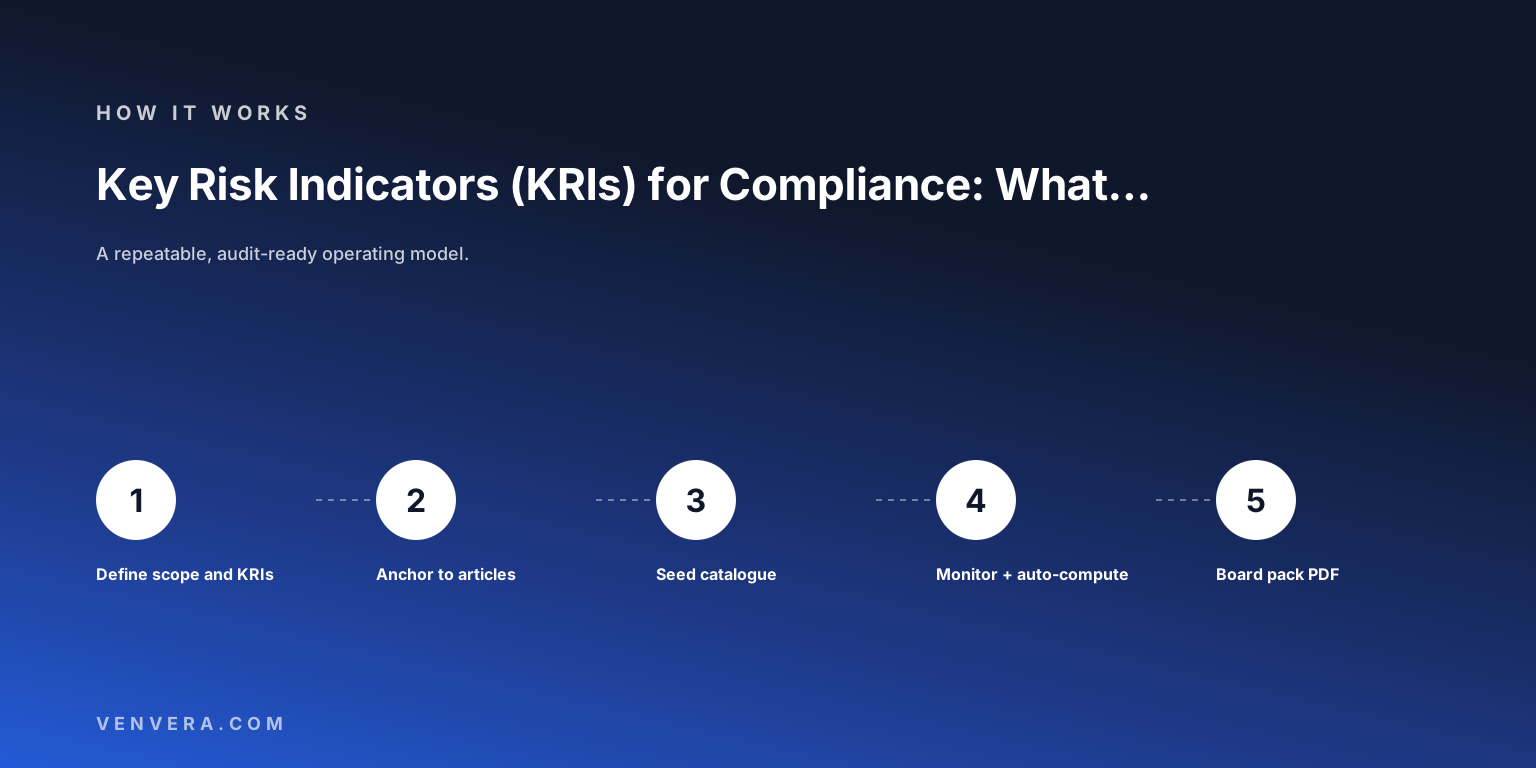
A Key Risk Indicator is a quantitative metric chosen to forecast or detect changes in a defined risk's likelihood, impact or velocity. Unlike a Key Performance Indicator (KPI), which measures whether you're achieving a goal, a KRI measures whether a risk you've already identified is becoming more or less acute.
KPI vs KRI - the practical distinction:
- KPI: Percentage of releases shipped on time. Answers "are we hitting our delivery target?"
- KRI: Percentage of releases that triggered a security incident within 7 days of deployment. Answers "is our change-management process degrading our risk posture?"
Same numerator can serve as either, depending on whether you're managing performance or watching risk.
A good KRI has six properties:
- Quantitative. Counts, percentages, days, currency. Not "high / medium / low" - that's the register.
- Predictive or contemporaneous, not lagging. "Number of breaches in the last quarter" is a lagging KPI. "Number of high-severity vulnerabilities open more than 30 days" is a leading KRI.
- Tied to a specific risk in the register. An unanchored metric is just a vanity number.
- Direction-explicit. Lower-is-better (e.g. # open critical incidents) or higher-is-better (e.g. % MFA coverage). The threshold logic depends on it.
- Threshold-bound. A green/amber/red band the value falls into. Without thresholds you have data, not signal.
- Owned. A named accountable role (CISO, CRO, DPO, Compliance Lead).
Why every modern compliance framework requires KRIs
The word "KRI" is not always written into the regulation, but the obligation is. Regulators want evidence that you are continuously monitoring risk levels and that there is a mechanism to escalate when they drift out of tolerance. Quantitative indicators with thresholds are the universal answer.
| Framework | Article / clause | What it requires |
|---|---|---|
| DORA (EU 2022/2554) | Art. 6, Art. 16 | ICT risk-management framework with documented strategy, policies, procedures and protocols, including continuous identification, assessment and monitoring of all ICT risks. Article 29 adds entity-level ICT concentration-risk monitoring. |
| NIS2 (EU 2022/2555) | Art. 21(2)(f) | "Policies and procedures to assess the effectiveness of cybersecurity risk-management measures." The only credible way to assess effectiveness is to measure it. |
| ISO 27001:2022 | Clause 6.1.3, 9.1 | Risk treatment plan with monitoring of effectiveness. Clause 9.1 explicitly requires the organisation to determine what needs to be monitored and measured, when, and by whom. |
| NIST CSF 2.0 | GV.RM-02, ID.IM-03 | Risk appetite and tolerance statements include criteria and measurements. Continuous monitoring informs improvement. |
| EU AI Act (EU 2024/1689) | Art. 9, Art. 72 | Risk-management system across the AI system lifecycle. Article 72 introduces post-market monitoring of high-risk AI systems with metrics on performance and incidents. |
In plain language: every supervisory regime that has emerged in the last five years has converged on the same supervisory expectation - show your metrics, show your thresholds, show the trend. KRIs are the answer to all three. One caveat on that table, because it flatters the regulators slightly. Not one of these instruments tells you what to measure, and that gap is yours to fill with your own judgement. The upside is that no auditor can reject your KRI set for being the wrong set. They can only reject it for being unanchored, unmeasured, or ignored when it goes red, and that is what a weak KRI programme actually looks like.
The 14 KRIs every risk manager should track in 2026
Below is a working starter pack grouped by risk domain. Each entry includes the direction, an illustrative threshold band, and the framework clauses the KRI helps evidence. A word on effort before you copy the list. Roughly half of these read straight out of systems you already run, and standing them up is configuration work you can finish in a week. The third-party group is the expensive one, because vendor spend concentration and single-provider dependency both need a clean vendor inventory underneath them, and building that inventory is the real project. If your vendor data is messy, start there and leave those indicators amber until it is fixed.
About the thresholds below. The green/amber/red bands are illustrative starting defaults we chose for a typical mid-market financial-services or B2B SaaS organisation. They are not regulatory requirements and not industry benchmarks. Set your own thresholds to your declared risk appetite; the numbers here are only a place to start.
Regulatory & compliance
1. % of policies past review date
Direction: lower is better · Green: ≤ 5% · Amber: ≤ 15% · Red: > 15% · Frequency: monthly
Maps to: ISO 27001 A.5.1, A.5.5 · DORA Art. 9 · NIS2 Art. 21(2)(a)
2. Regulatory updates unacknowledged > 30 days
Direction: lower is better · Green: 0 · Amber: ≤ 3 · Red: > 3 · Frequency: weekly
Maps to: ISO 27001 4.2 · DORA Art. 13
Operational
3. Critical risks above tolerance
Direction: lower is better · Green: 0 · Amber: ≤ 2 · Red: > 2 · Frequency: monthly
Maps to: DORA Art. 6, Art. 16 · ISO 27001 6.1.2, 6.1.3 · NIS2 Art. 21(2)(a)
4. Risks with overdue review
Direction: lower is better · Green: ≤ 2 · Amber: ≤ 10 · Red: > 10 · Frequency: monthly
Maps to: ISO 27001 6.1.3, 9.1 · DORA Art. 6
5. Average control effectiveness
Direction: higher is better · Green: ≥ 85% · Amber: ≥ 70% · Red: < 70% · Frequency: quarterly
Maps to: ISO 27001 6.1.3, 8.1 · DORA Art. 9
Cyber & ICT
6. Open major incidents
Direction: lower is better · Green: 0 · Amber: ≤ 2 · Red: > 2 · Frequency: daily
Maps to: DORA Art. 17, Art. 19 · NIS2 Art. 23 · ISO 27001 A.5.24
7. Incidents with missed regulator deadline (last 90 days)
Direction: lower is better · Green: 0 · Amber: ≤ 1 · Red: > 1 · Frequency: monthly
Maps to: DORA Art. 19 (initial 4h, intermediate 72h, final 1 month) · NIS2 Art. 23 (24h/72h/1 month) · GDPR Art. 33 (72h)
8. Open vulnerabilities > 30 days (high / critical)
Direction: lower is better · Green: ≤ 5 · Amber: ≤ 20 · Red: > 20 · Frequency: weekly
Maps to: ISO 27001 A.8.8 · DORA Art. 9 · NIS2 Art. 21(2)(e)
9. Mean time to remediate (MTTR) - critical risks
Direction: lower is better · Green: ≤ 45 d · Amber: ≤ 90 d · Red: > 90 d · Frequency: quarterly
Maps to: ISO 27001 8.1, 10.1 · DORA Art. 6, Art. 9
Third-party
10. % of critical vendors with overdue assessments
Direction: lower is better · Green: ≤ 5% · Amber: ≤ 15% · Red: > 15% · Frequency: monthly
Maps to: DORA Art. 28, Art. 29 · ISO 27001 A.5.19, A.5.20 · NIS2 Art. 21(2)(d)
11. Vendor spend Herfindahl-Hirschman Index (HHI)
Direction: lower is better · Green: < 1,500 · Amber: < 2,500 · Red: ≥ 2,500 · Frequency: quarterly
Maps to: DORA Art. 29 (entity-level ICT concentration risk)
The 1,500 / 2,500 bands are an illustrative default borrowed from the US DOJ/FTC 2010 Horizontal Merger Guidelines. DORA Art. 29 requires you to assess concentration risk; it does not prescribe an HHI number.
12. Critical functions on a single provider
Direction: lower is better · Green: ≤ 1 · Amber: ≤ 3 · Red: > 3 · Frequency: quarterly
Maps to: DORA Art. 29
People & awareness
13. % of staff completed annual security training
Direction: higher is better · Green: ≥ 95% · Amber: ≥ 80% · Red: < 80% · Frequency: quarterly
Maps to: NIS2 Art. 21(2)(g) · ISO 27001 A.6.3 · DORA Art. 13
14. Phishing simulation click-rate
Direction: lower is better · Green: ≤ 10% · Amber: ≤ 20% · Red: > 20% · Frequency: quarterly
Maps to: ISO 27001 A.6.3 · NIS2 Art. 21(2)(g)
Treat this as the weakest indicator on the list. Click-rate moves with how hard the simulation was written, so it measures your simulation vendor about as much as it measures your staff. It stays on the list because reporting rate and time to report come off the same exercise for free, and those two are what actually predict whether a real campaign gets caught early.
How to actually run a KRI programme - five practical steps
The fastest way to fail at KRIs is to design a beautiful catalogue and then never collect a measurement. The fastest way to succeed is to wire as many KRIs as possible to system data your platform already has, then commit one human owner per remaining manual KRI to a single page where they enter a number once a month. The second-fastest way to fail is to keep collecting long after the numbers stop saying anything. An indicator that has been green every month since the day it was created is either watching a risk you do not have or watching it in a way that cannot move. Retire it, and record why you retired it. A short list somebody reads beats a long one everybody scrolls past.
- Anchor every KRI to a risk and a regulation. "Unattached" KRIs become orphans no one updates. Tag the framework articles or controls the metric satisfies - when a regulator asks why you track it, the answer is on the screen.
- Set thresholds before you measure. Otherwise the first reading becomes the new "normal" and you lose objectivity. Where a defensible external reference exists, borrow it as a starting default and label it as such. The 1,500 / 2,500 HHI concentration bands come from the US DOJ/FTC 2010 Horizontal Merger Guidelines, not from DORA (Art. 29 requires concentration-risk assessment but sets no number); a 30-day patch SLA is one common internal PCI DSS-style convention. Expect this step to be the political one. Every band you set is an implicit statement about what the organisation will tolerate, and the manager who owns the underlying process will read a red threshold as a verdict on their team. Get the bands signed off alongside risk appetite, in one sitting, before anybody sees a live number attached to their name.
- Automate every KRI you can. If the data lives in your platform (risk register, controls library, vendor inventory, incidents table, integration findings) it should be a one-click auto-compute. Automation is the default; manual is the exception.
- Show the trend alongside today's number. A green KRI that has been worsening every month for the last quarter is more important than a red one that just flipped. Sparkline plus a regression-alerting rule (three consecutive measurements moving in the bad direction) catches both.
- Couple breach to escalation. When a KRI crosses red, something has to happen automatically - at minimum a notification with a named owner. For regulated entities, the breach should also start the statutory clock (DORA Art. 19: an initial notification within 4 hours of classifying the incident as major; NIS2 Art. 23: a 24-hour early warning). KRIs without escalation are decoration.
How Venvera implements KRIs
Venvera ships a KRI module as part of the standard risk-management workspace. A catalogue of 22 KRIs comes pre-seeded, spanning nine enterprise risk domains, each anchored to specific DORA, NIS2, ISO 27001 and NIST CSF articles or controls. Fourteen are auto-computed from the risk register, controls library, incidents table and TPRM vendor data - no manual collection required. The remaining eight are manual: a named owner records the value on a single page and adds context.
What Venvera layers on top of a static KRI list:
- Regulatory-clock-coupled breach. Toggle "auto-create regulatory incident on breach" on any KRI; when it crosses red, Venvera opens an incident with the right statutory clock (DORA Art. 19: 4h initial, 72h intermediate, 1-month final; or NIS2 Art. 23: 24h, 72h, 1 month), notifies the right people, and the incident-clock worker re-checks due-dates every five minutes.
- Snapshot-based regression alerts. The dashboard surfaces KRIs whose trajectory is worsening across the last three snapshots - even when the current status is still green. This is the early-warning signal regulators expect you to monitor.
- Composite domain-health scores. Each of the ten enterprise risk domains gets a 0-100 health score, weighted by regulatory anchoring (KRIs tagged to more articles weigh more). Surfaces straight onto board packs.
- Control-failure propagation. Link any KRI to the controls whose effectiveness materially affects it. When a control fails, the KRI is flagged as at-risk before the next measurement is even recorded.
- Board-pack PDF export. One click produces a board-ready PDF combining overall health, per-domain composites, regression alerts, open breaches with clock status, and regulatory-readiness scores per framework - anchored to article-level citations.
Try it in your tenant
Open Risk Management → KRIs and click Seed catalogue. Twenty-two KRIs with the full framework anchoring appear in under a second. Click Auto-compute and the dashboard populates from your live data.
Frequently asked questions about Key Risk Indicators
What is the difference between a KRI and a KPI?
A KPI measures whether you are achieving a performance goal. A KRI measures whether a risk you have identified is increasing or decreasing. The same raw number can serve as either - what matters is the framing. "Time to deploy" is a KPI; "Time to patch a critical vulnerability after disclosure" is a KRI. The threshold logic and ownership chain differ accordingly.
How many KRIs should an organisation track?
For mid-market financial-services, B2B SaaS and healthcare entities operating under ISO 27001, NIS2, DORA and adjacent regimes, 15-30 active KRIs is a healthy range. Below 15 you are almost certainly missing critical signals; above 40 the cost of monthly collection starts to outweigh the marginal insight. Venvera's seed catalogue lands at 22, which most regulated mid-market entities can run with little adjustment.
Do small organisations need KRIs to be NIS2 or DORA compliant?
NIS2 Art. 21(2)(f) requires "policies and procedures to assess the effectiveness of cybersecurity risk-management measures." Without quantitative indicators the assessment becomes subjective and impossible to defend in a competent-authority inspection. DORA is more explicit - Art. 6 requires a documented framework with continuous monitoring of all ICT risks. Small entities can get away with fewer KRIs, but the obligation to have them does not depend on size.
What is the relationship between KRIs and risk appetite?
Risk appetite is the qualitative statement of the level of risk an organisation is willing to accept. KRIs are the quantitative instruments that tell the board whether the organisation is operating within appetite. A KRI threshold (the green/amber boundary) is the operationalisation of the appetite. When a KRI moves into red, the organisation is operating outside its declared appetite and escalation is required.
Should KRIs be reported to the board?
Yes - and most modern board packs include a single-page KRI dashboard with a green/amber/red status, a sparkline showing the trend, and a flag for any KRI breaches that occurred in the period. DORA Art. 5 in particular places the management body in personal accountability for the ICT risk-management framework, including monitoring. A KRI dashboard is the primary evidence that the board is exercising that oversight.
Where can I find KRI templates I can adapt?
Venvera ships a reference catalogue of 22 KRIs - covering ISO 27001, NIS2, DORA, NIST CSF and the EU AI Act - that you can seed into any tenant in one click. Documentation here. If you would rather build your own, the 14-KRI starter pack in this article gives you a defensible base to adapt to your own risk appetite.
Primary sources
Every regulatory citation in this guide traces to a primary source. The article numbers point to the obligation; the KRI thresholds are our own illustrative defaults, not requirements.
- DORA - Regulation (EU) 2022/2554: Art. 5 (governance), 6/16 (ICT risk-management framework), 9 (protection and prevention), 13 (learning and training), 17 (incident management), 19 (major-incident reporting), 28/29 (ICT third-party and entity-level concentration risk). EUR-Lex.
- DORA incident deadlines - Commission Delegated Regulation (EU) 2025/301 sets the reporting time limits: initial notification within 4 hours of classifying an incident as major (no later than 24 hours from awareness), intermediate report within 72 hours, final report within one month. EUR-Lex.
- NIS2 - Directive (EU) 2022/2555: Art. 21(2) (risk-management measures, incl. point (f) on assessing effectiveness), Art. 23 (24h early warning, 72h notification, 1-month final report). EUR-Lex.
- ISO/IEC 27001:2022 - clauses 6.1.3 and 9.1 and the Annex A controls cited. Standard text is available from iso.org.
- NIST CSF 2.0 - GV.RM-02 (risk appetite and tolerance) and ID.IM-03 (continuous monitoring informs improvement). nist.gov.
- GDPR - Regulation (EU) 2016/679, Art. 33: breach notification "not later than 72 hours". EUR-Lex.
- EU AI Act - Regulation (EU) 2024/1689, Art. 9 (risk-management system) and Art. 72 (post-market monitoring of high-risk AI systems). EUR-Lex.
- HHI concentration bands (1,500 / 2,500) - US Department of Justice and Federal Trade Commission, Horizontal Merger Guidelines (2010). Used here only as an illustrative default.
Ready to move from spreadsheet to programme?
Spin up a Venvera tenant, seed the 20-KRI catalogue, and run auto-compute. In under five minutes you'll have a board-ready dashboard with the regulatory citations already attached. Start a free trial →