

Learn

CorrectionCorrected on 14 July 2026. An earlier version of this article carried citations that did not match the official texts: a chapter-to-RTS mapping whose article ranges did not correspond to the structure of Delegated Regulation (EU) 2024/1774, an incident notification deadline stated as a single four-hour window, and several management-body duties attributed to the wrong subpoints of Article 5(2). Every citation below has been re-checked against the Official Journal text. Claims about supervisory behaviour that could not be traced to a published source have been removed rather than softened.
DORA Chapter II, Articles 5 to 16, requires every financial entity in scope to have an ICT risk management framework. Article 6(1) is the operative sentence: it must be a “sound, comprehensive and well-documented ICT risk management framework as part of their overall risk management system”. The regulation has applied since 17 January 2025.
The regulation sets the obligations. The detail sits one level below it, in Commission Delegated Regulation (EU) 2024/1774, the regulatory technical standards “specifying ICT risk management tools, methods, processes, and policies and the simplified ICT risk management framework”, adopted under Article 15 and Article 16(3) of DORA. Its Articles 2 to 27 apply to the full framework. Its Articles 28 to 41 set the simplified framework for the entities listed in DORA Article 16(1).
A framework document that cites only the Level 1 text is missing the level at which the requirements are actually specified. This two-level structure is the most under-appreciated thing about DORA. The regulation reads as though a good policy set answers it. The RTS is where the work actually is, and it is written at a level of detail that forces changes to how you run ICT rather than to how you describe it. This guide walks the structure chapter by chapter and gives, for each one, the article it has to answer to. It does not tell you what supervisors are thinking, because that is not something we can source.
📜
Section 1
What the Framework Must Cover
Chapter II runs from Article 5 to Article 16. Articles 5 and 6 set the governance and the framework itself. Articles 7 to 14 set the substantive obligations. Article 15 is the mandate for the technical standards, and Article 16 carves out a simplified framework for the smaller entities it lists. The document needs a home for each of the following.
Article 5 - Governance and organisation
The management body must “define, approve, oversee and be responsible for the implementation of all arrangements related to the ICT risk management framework referred to in Article 6(1)”. Article 5(2) then lists nine specific duties, points (a) to (i).
Article 6 - ICT risk management framework
A sound, comprehensive and well-documented framework. Entities other than microenterprises must assign ICT risk to an independent control function (6(4)). The framework is reviewed at least yearly and after major incidents (6(5)), audited internally (6(6)), and must contain a digital operational resilience strategy (6(8)).
Article 7 - ICT systems, protocols and tools
Systems must be appropriate to the magnitude of operations, reliable, sufficient in capacity to handle peak volumes, and technologically resilient under stressed market conditions.
Article 8 - Identification
Identify, classify and document all ICT-supported business functions, information assets and ICT assets, and their dependencies. Map critical assets and interdependencies (8(4)), identify processes dependent on ICT third parties (8(5)), maintain inventories (8(6)), and run a yearly risk assessment on legacy ICT systems (8(7)).
Article 9 - Protection and prevention
Article 9(4) sets six framework obligations, points (a) to (f): an information security policy (a), network and infrastructure management (b), access limitation policies (c), strong authentication and cryptographic key protection (d), documented ICT change management (e), and comprehensive patch and update policies (f).
Article 10 - Detection
Mechanisms to promptly detect anomalous activities, ICT network performance issues and incidents, and to identify potential material single points of failure. Detection mechanisms must enable multiple layers of control and define alert thresholds (10(2)), and must themselves be regularly tested.
Article 11 - Response and recovery
An ICT business continuity policy, response and recovery plans subject to independent internal audit review (11(3)), a business impact analysis (11(5)), and testing of the plans at least yearly and on substantive changes (11(6)(a)). Entities other than microenterprises need a crisis management function (11(7)).
Article 12 - Backup, restoration and recovery
Documented backup policies specifying scope and minimum frequency, restore systems physically and logically segregated from the source (12(3)), redundant ICT capacity for entities other than microenterprises (12(4)), and recovery time and recovery point objectives set per function (12(6)).
Article 13 - Learning and evolving
Capabilities to gather threat and vulnerability information, post-incident reviews after major incidents (13(2)), incorporation of testing and incident lessons into the ICT risk assessment process (13(3)), yearly reporting by senior ICT staff to the management body (13(5)), and compulsory ICT security awareness and resilience training modules (13(6)).
Article 14 - Communication
Crisis communication plans for responsible disclosure of major incidents and vulnerabilities, separate communication policies for internal staff and for external stakeholders, and at least one named person tasked with the public and media function.
“Financial entities shall have in place an internal governance and control framework that ensures an effective and prudent management of ICT risk, in accordance with Article 6(4), in order to achieve a high level of digital operational resilience.”
DORA Article 5(1). Note the cross-reference to Article 6(4), the requirement for an independent ICT risk control function. It is routinely dropped when this sentence is quoted, and it is the part that has organisational consequences.
These are not independent chapters. Article 8 identification drives the Article 9 protections. Article 10 detection feeds the Article 11 response. Article 13(3) closes the loop by requiring the lessons from testing and from real incidents to be incorporated into the risk assessment process on a continuous basis, and to form the basis for reviews of the framework itself. A document that cannot show that circuit is a stack of policies rather than a framework. Writing a document that covers Articles 5 to 16 is a few weeks of drafting. Being able to walk somebody through the circuit with dated artefacts at each step is a year of operating discipline. Plan for both, and be clear with the board about which of the two you are asking them to approve.
⚖️
Section 2
What the RTS Adds Beyond DORA Itself
Delegated Regulation (EU) 2024/1774 has 42 articles. Article 1 is the proportionality provision. Articles 2 to 27 specify the full ICT risk management framework. Articles 28 to 41 specify the simplified framework. The table below maps the substantive block, Articles 2 to 27, to what it requires and to the DORA article it supplements.
| RTS 2024/1774 | Domain | What the framework must address | DORA anchor |
|---|---|---|---|
| Art. 2 | General elements of ICT security policies, procedures, protocols and tools | The ICT security policy must be embedded in the framework, aligned to the information security objectives in the resilience strategy, and must indicate the date of its formal approval by the management body. | DORA Art. 9(2) |
| Art. 3 | ICT risk management | The risk management procedure itself: risk tolerance, criteria for assessing impact, the methodology, and acceptance of residual ICT risk by an accountable role. | DORA Art. 6(1) |
| Arts. 4-5 | ICT asset management policy and procedure | The policy (Art. 4) and the operating procedure (Art. 5): asset criticality classification, links and interdependencies, and the handling of assets approaching end of support. | DORA Art. 8(1), 8(4), 8(6) |
| Arts. 6-7 | Encryption and cryptographic controls; cryptographic key management | A cryptographic policy covering data at rest, in transit and in use, and a key management lifecycle covering generation, renewal, storage, revocation and destruction. | DORA Art. 9(4)(d) |
| Arts. 8-12 | ICT operations: policies and procedures, capacity and performance, vulnerability and patch management, data and system security, logging | This is where the operational detail lives: patch deadlines by criticality, vulnerability scanning, capacity planning, and log retention and tamper protection. | DORA Art. 9(1), 9(4)(f) |
| Arts. 13-14 | Network security management; securing information in transit | Network segmentation, review of network connections and firewall rules, secure remote access, and protection of information in transit. | DORA Art. 9(4)(b) |
| Arts. 15-17 | ICT project management; systems acquisition, development and maintenance; ICT change management | Project governance and security requirements, separation of development, testing and production environments, and a documented change procedure with approval, testing, rollback and emergency-change handling. | DORA Art. 9(4)(e) |
| Art. 18 | Physical and environmental security | Physical access controls to premises, data centres and sensitive designated areas, environmental protection, and secure disposal of media. | DORA Art. 9(4)(c) |
| Arts. 19-21 | Human resources policy; identity management; access control | Security responsibilities in employment, unique identities, and an access control policy covering least privilege, need-to-know, privileged access, remote access, and periodic review of access rights. | DORA Art. 9(4)(c) |
| Arts. 22-23 | ICT-related incident management policy; anomalous activities detection | Detection criteria and triggers, escalation, and the incident management process that connects detection to the reporting obligations in Chapter III of DORA. | DORA Art. 10, Art. 17 |
| Arts. 24-26 | ICT business continuity policy; testing of the continuity plans; response and recovery plans | The components of the continuity policy, the testing regime for the plans, and the content of the response and recovery plans including recovery objectives. | DORA Art. 11, Art. 12 |
| Art. 27 | Format and content of the report on the review of the ICT risk management framework | The report required by DORA Article 6(5) must be submitted in a searchable electronic format and must carry the sections listed in Article 27(2). | DORA Art. 6(5) |
Why the RTS numbering matters
The cross-reference table is usually the cheapest thing in a framework document to spot-check, and it reveals whether the drafting was done from the text or from a summary of the text. A mapping that sends Chapter 4 to “RTS Articles 8 to 17” when the protection controls actually run across Articles 6 to 21 is a self-inflicted finding. Build the table from the Official Journal text, and keep it current, because these standards are amended.
📋
Section 3
Framework Document Structure
This ten-chapter structure gives every requirement in DORA Chapter II, and every article of the RTS, a place to live. It is a structural blueprint. Adapt the sub-sections to your size, complexity and risk profile, and record that adaptation as your proportionality assessment.
Chapter 1
Governance and Responsibilities
Maps to: DORA Art. 5, Art. 6(1)-(7) | RTS (EU) 2024/1774 Art. 2, Art. 3
- Management body duties, mapped one by one to Article 5(2), points (a) to (i)
- The ICT risk control function and its independence (Art. 6(4))
- The ICT risk tolerance level, set as part of the resilience strategy (Art. 6(8)(b))
- Budget allocation (Art. 5(2)(g)) and the framework review cycle (Art. 6(5))
- The date of formal approval by the management body, which RTS Art. 2(2)(b) requires the security policy to state
Chapter 2
ICT Asset Management and Classification
Maps to: DORA Art. 8(1), 8(4), 8(6) | RTS (EU) 2024/1774 Arts. 4-5
- The ICT asset and information asset inventory
- The classification scheme and criticality mapping
- Links and interdependencies between assets, which Art. 8(4) requires you to map
- Inventory update triggers, including on each major change (Art. 8(3), 8(6))
Chapter 3
Risk Identification and Assessment Methodology
Maps to: DORA Art. 8(2), 8(3), 8(7) | RTS (EU) 2024/1774 Art. 3
- Continuous identification of ICT risk sources, with risk scenarios reviewed at least yearly (Art. 8(2))
- A risk assessment on each major change to infrastructure, processes or procedures (Art. 8(3))
- A yearly specific ICT risk assessment on all legacy ICT systems (Art. 8(7))
- Residual risk acceptance, recorded against a named accountable role
Chapter 4
Protection and Prevention Controls
Maps to: DORA Art. 9 | RTS (EU) 2024/1774 Arts. 6-21
- Information security policy (Art. 9(4)(a))
- Network and infrastructure management, including the ability to sever or segment connections instantaneously (Art. 9(4)(b); RTS Arts. 13-14)
- Limitation of physical and logical access (Art. 9(4)(c); RTS Arts. 18-21)
- Strong authentication and protection of cryptographic keys (Art. 9(4)(d); RTS Arts. 6-7)
- ICT change management, approved by appropriate lines of management (Art. 9(4)(e); RTS Arts. 15-17)
- Patch and update policies (Art. 9(4)(f); RTS Art. 10)
Chapter 5
Detection and Monitoring
Maps to: DORA Art. 10 | RTS (EU) 2024/1774 Art. 12, Art. 23
- Anomaly detection with multiple layers of control and defined alert thresholds (Art. 10(2))
- Logging: what is logged, how long it is kept, and how it is protected from tampering (RTS Art. 12)
- Identification of potential material single points of failure (Art. 10(1))
- Regular testing of the detection mechanisms themselves (Art. 10(1), second subparagraph)
Chapter 6
Response and Recovery
Maps to: DORA Art. 11, Art. 12 | RTS (EU) 2024/1774 Art. 22, Arts. 24-26
- The ICT business continuity policy and the response and recovery plans (Art. 11(1), 11(3))
- A business impact analysis using quantitative and qualitative criteria (Art. 11(5))
- Recovery time and recovery point objectives determined per function (Art. 12(6))
- A crisis management function (Art. 11(7)) and records of activity during disruption (Art. 11(8))
- Yearly testing, including cyber-attack scenarios and switchover to redundant capacity (Art. 11(6))
Chapter 7
Testing Programme
Maps to: DORA Arts. 24-27 | RTS on TLPT (EU) 2025/1190
- The resilience testing programme as an integral part of the framework (Art. 24(1))
- Yearly testing of all ICT systems and applications supporting critical or important functions (Art. 24(6))
- The test types listed in Art. 25(1), from vulnerability scans to end-to-end and penetration testing
- Threat-led penetration testing for the entities identified under Art. 26, governed by Delegated Regulation (EU) 2025/1190
- Procedures to prioritise, classify and remedy every issue the tests reveal, plus internal validation that they are fully addressed (Art. 24(5))
Chapter 8
Third-Party Risk Integration
Maps to: DORA Arts. 28-30 | RTS (EU) 2024/1773, RTS (EU) 2025/532, ITS (EU) 2024/2956
- The strategy on ICT third-party risk, including the policy on ICT services supporting critical or important functions (Art. 28(2); RTS (EU) 2024/1773)
- The pre-contractual assessment and due diligence in Art. 28(4)
- The preliminary assessment of ICT concentration risk (Art. 29)
- Subcontracting of services supporting critical or important functions (Art. 30(2)(a); RTS (EU) 2025/532)
- Exit strategies and transition plans (Art. 28(8))
- The register of information (Art. 28(3); ITS (EU) 2024/2956)
Chapter 9
Reporting and Communication
Maps to: DORA Art. 14, Arts. 17-19 | RTS (EU) 2024/1772, RTS (EU) 2025/301
- Crisis communication plans and the named person for the public and media function (Art. 14(1), 14(3))
- Incident classification against the criteria and materiality thresholds in Delegated Regulation (EU) 2024/1772 (Art. 18)
- The notification deadlines in Delegated Regulation (EU) 2025/301, Article 5, set out in Section 4 below
- Management body reporting: at minimum the yearly report from senior ICT staff (Art. 13(5)) and the reporting channels required by Art. 5(2)(i)
Chapter 10
Review and Continuous Improvement
Maps to: DORA Art. 6(5), Art. 13 | RTS (EU) 2024/1774 Art. 27
- The four review triggers in Art. 6(5): at least yearly, on major ICT-related incidents, following supervisory instructions, and on conclusions from resilience testing or audit
- Post-incident reviews, and the four effectiveness questions in Art. 13(2), points (a) to (d)
- Feeding testing and incident lessons back into the risk assessment process (Art. 13(3))
- Key performance indicators and key risk metrics, which Art. 6(8)(c) requires the resilience strategy to set out
- The format and content of the framework review report (RTS Art. 27)
The proportionality principle, in the words of the regulation
“Financial entities shall implement the rules laid down in Chapter II in accordance with the principle of proportionality, taking into account their size and overall risk profile, and the nature, scale and complexity of their services, activities and operations.”
DORA Article 4(1). Proportionality calibrates depth. It does not delete chapters. Article 4(3) adds that competent authorities “shall consider the application of the proportionality principle by financial entities when reviewing the consistency of the ICT risk management framework” on the basis of the reports submitted under Article 6(5). The rationale is itself reviewable, so write it down. Proportionality is the most misused word in DORA conversations. The relief is real, and it works on how deep each control goes while every chapter still needs an answer. Writing the rationale takes an afternoon and removes an easy finding.
🔍
Section 4
Six Linkages the Text Requires You to Evidence
We are not going to tell you which question a supervisor asks first, because we have no sourced basis for that claim. What we can do is point at the places where the text asks for a demonstrable link between two things rather than for a policy statement. These are the parts of a framework that are hardest to retrofit after the fact.
1. The board accountability chain
Article 5(2) does not say “the board approves the framework” and stop. It lists nine duties, points (a) to (i), and each one is an evidence question. Point (f) is the ICT internal audit plan. Point (g) is budget. Point (i) is a set of corporate-level reporting channels covering third-party arrangements, planned material changes to them, and at least major ICT-related incidents. If the management body appears in your framework only once, in an approval block, the document does not cover Article 5(2).
2. Inventory completeness
Article 8(4) requires you to identify all information and ICT assets “including those on remote sites, network resources and hardware equipment”, map those considered critical, and map “the links and interdependencies between the different information assets and ICT assets”. An asset list without the dependency map does not satisfy the article, and the dependency map is the part that takes time to build.
3. The risk, control, test, risk loop
Article 13(3) requires that lessons from resilience testing, from real incidents, and from the activation of continuity plans “shall be duly incorporated on a continuous basis into the ICT risk assessment process”, and that those findings “shall form the basis for appropriate reviews of relevant components of the ICT risk management framework”. A framework that describes risks in one chapter and controls in another, with no documented path between them, cannot evidence this.
4. Continuity testing that actually happened
Article 11(6)(a) requires the continuity plans and the response and recovery plans to be tested “at least yearly, as well as in the event of any substantive changes to ICT systems supporting critical or important functions”. For entities other than microenterprises, the testing plans must include scenarios of cyber-attacks and switchovers between the primary infrastructure and the redundant capacity.
5. The notification clock
The reporting deadlines are not in DORA Article 19, which defers them to the technical standards. They are in Article 5 of Delegated Regulation (EU) 2025/301, and the initial deadline has two limbs rather than one. If the framework prints the wrong clock, the incident response runbook underneath it will inherit the error.
6. Concentration risk, before you sign
Article 29(1) requires that when you perform the risk identification under Article 28(4)(c), you also take into account whether the envisaged contract would lead to the situations Article 29 lists. That makes it a pre-contractual gate in the procurement process, not a yearly reporting exercise, and the framework has to place it there.
The notification clock, stated correctly
DORA Article 19(4) requires an initial notification, an intermediate report and a final report, but it does not set the deadlines. It defers them to the technical standards. They are in Article 5(1) of Delegated Regulation (EU) 2025/301:
- Initial notification: “as early as possible, but in any case, within four hours from the classification of the ICT-related incident as a major ICT-related incident and no later than 24 hours from the moment the financial entity has become aware of the ICT-related incident”. Two limbs. The four-hour clock starts at classification. The 24-hour clock starts at awareness.
- Intermediate report: “at the latest within 72 hours from the submission of the initial notification”, and it is due even where the status or handling of the incident has not changed.
- Final report: “no later than one month after either the submission of the intermediate report, or, where applicable, after the latest updated intermediate report”. The month runs from the intermediate report, not from the incident.
Article 5(4) allows a deadline that falls on a weekend or a bank holiday to move to noon of the next working day, and Article 5(5) withdraws that relief for the initial notification and the intermediate report from credit institutions, central counterparties, operators of trading venues, and entities identified as essential or important under Directive (EU) 2022/2555. A framework that prints “4h / 72h / 1 month” and stops is wrong in three separate places. The two-limb initial deadline is well designed. It stops the clock being stretched by slow classification while still leaving room to work out what you are looking at. What it asks of you is a classification decision that can be made quickly and evidenced, which is a process problem rather than a drafting one.
⚠️
Section 5
A Quality Checklist Before Board Approval
Every row below ties to a specific requirement in the text. Use it as a pre-approval check on your own document. If you fix only two rows, fix the citations and the proportionality rationale. Both are cheap, both can be checked by somebody who has never met your firm, and both colour how the rest of the document gets read. We make no claim about how common any of these gaps are, because we have no published data on that.
| Gap | What it looks like | What the text requires instead |
|---|---|---|
| Regulation parroting | The framework restates the article and stops. It reads as a summary of DORA rather than as a governance instrument. | For each requirement, state who is responsible, what the process is, how often it runs, and what artefact it produces. |
| Missing RTS detail | The framework addresses the DORA articles but not the articles of Delegated Regulation (EU) 2024/1774, which is where the tools, methods, processes and policies are actually specified. | Cross-reference the framework against Articles 2 to 27 of the RTS. Every one of those articles should land in a named chapter. |
| Citations that point at the wrong provision | Article references that look precise and are wrong. Encryption cited to Art. 9(4)(b) rather than 9(4)(d). The budget duty cited to Art. 5(2)(b) rather than 5(2)(g). An RTS mapping table with tidy ranges that do not match the RTS. | Check every citation against the Official Journal text. A mis-cited framework invites the reader to assume the analysis underneath it was done to the same standard. |
| No proportionality rationale | The entity relies on proportionality to scale controls down, but records no reasoning. | Article 4(1) permits proportionality “taking into account their size and overall risk profile, and the nature, scale and complexity of their services, activities and operations”. Document the assessment against those factors. Article 4(3) says competent authorities will consider how you applied it. |
| Governance vacuum | Responsibilities assigned to “the organisation” or to “IT” rather than to named roles, committees and escalation paths. | Article 5(2)(c) requires the management body to “set clear roles and responsibilities for all ICT-related functions”. Use a RACI, and name the management body wherever DORA does. |
| Third-party risk bolted on | ICT third-party risk sits in its own policy with no route back into the framework. | Article 28(1) requires entities to manage ICT third-party risk “as an integral component of ICT risk within their ICT risk management framework”. Cross-reference the risk register, the protection controls and the continuity plans. |
| Static document | No version history, no evidence of review, no trigger-based update mechanism. | Article 6(5) sets four review triggers: at least yearly, on major ICT-related incidents, following supervisory instructions, and on conclusions derived from resilience testing or audit. Put all four in the version control table. |
| No testing feedback loop | A testing programme is described, but nothing connects its findings back to the risk assessment. | Article 24(5) requires procedures to prioritise, classify and remedy all issues revealed by the tests, and internal validation methodologies to ascertain they are fully addressed. Article 13(3) requires the lessons to enter the risk assessment process. |
| Undefined risk metrics | The framework mentions monitoring but defines no indicators, thresholds or escalation triggers. | Article 6(8)(c) requires the resilience strategy to set out “clear information security objectives, including key performance indicators and key risk metrics”. Define the metrics, the thresholds, and who is told when a threshold breaks. |
The test to apply to every sentence
For every policy statement in the framework, ask what artefact proves it is happening. If the answer is nothing, there are two honest options: change the statement to describe what you actually do, or build the process before the document goes to the board. A framework describing an organisation you do not have is worse than a thinner one describing the organisation you do, because Article 6(3) obliges you to provide complete and updated information on the framework to the competent authority upon request.
🏛️
Section 6
Board Approval and Governance
Article 5(2) opens by making the management body responsible for defining, approving, overseeing and implementing all arrangements related to the framework. It then lists nine specific duties. Most framework documents quote the opening sentence and skip the list. Here is the full set, with the correct subpoint against each one.
| Management body duty | Source |
|---|---|
| Bear the ultimate responsibility for managing the financial entity’s ICT risk | Art. 5(2)(a) |
| Put in place policies to maintain high standards of availability, authenticity, integrity and confidentiality of data | Art. 5(2)(b) |
| Set clear roles and responsibilities for all ICT-related functions | Art. 5(2)(c) |
| Set and approve the digital operational resilience strategy, including the ICT risk tolerance level | Art. 5(2)(d), citing Art. 6(8) and 6(8)(b) |
| Approve, oversee and periodically review the ICT business continuity policy and the ICT response and recovery plans | Art. 5(2)(e), citing Art. 11(1) and 11(3) |
| Approve and periodically review the ICT internal audit plans, ICT audits and material modifications to them | Art. 5(2)(f) |
| Allocate and periodically review the budget for digital operational resilience needs, including awareness programmes and training | Art. 5(2)(g), citing Art. 13(6) |
| Approve and periodically review the policy on arrangements for the use of ICT services provided by ICT third-party service providers | Art. 5(2)(h) |
| Put in place corporate-level reporting channels on third-party arrangements, planned material changes to them, and at least major ICT-related incidents | Art. 5(2)(i), points (i) to (iii) |
| Establish a role, or designate a member of senior management, to monitor arrangements with ICT third-party service providers (entities other than microenterprises) | Art. 5(3) |
| Actively keep up to date with sufficient knowledge and skills to understand and assess ICT risk, including by following specific training on a regular basis | Art. 5(4) |
| Ensure the framework is reviewed at least once a year, and on major incidents, supervisory instructions, or conclusions from testing or audit | Art. 6(5) |
| Receive reporting from senior ICT staff, at least yearly, on the findings referred to in Art. 13(3), with recommendations | Art. 13(5) |
Article 5(4) deserves its own line in the framework. Members of the management body “shall actively keep up to date with sufficient knowledge and skills to understand and assess ICT risk and its impact on the operations of the financial entity, including by following specific training on a regular basis, commensurate to the ICT risk being managed”. That is an obligation on individuals, and it produces an artefact: a training record. It is also the duty most likely to be quietly skipped, and one of the cheapest to satisfy. A short annual session for the board, minuted, with the material retained, costs somebody a morning. Skipping it leaves a gap a reviewer can find without leaving their desk.
A board governance calendar earns its place
These duties are periodic, and the regulation says so. The phrase “approve and periodically review” recurs through Article 5(2). The framework review carries the four triggers in Article 6(5). Senior ICT staff report at least yearly under Article 13(5). An appendix that turns each of these into a dated board deliverable with a named owner converts an abstract obligation into something a company secretary can track, and into a minute that evidences it happened.
Put a formal approval block on the front page: version, approval date, approving body, next review date. RTS Article 2(2)(b) requires the ICT security policies to indicate the date of their formal approval by the management body, so the same discipline is expected in the layer directly below the framework.
🔗
Section 7
Connecting the Framework to Operational Reality
The framework is the apex document. It sets the what and the why. Everything below it sets the how. Article 6(2) describes the framework as including “strategies, policies, procedures, ICT protocols and tools”, which is a document hierarchy compressed into a single sentence.
Recommended document hierarchy
Level 1, the ICT Risk Management Framework. Board-approved, strategic, reviewed on the Article 6(5) triggers.
Level 2, policies. Information security, ICT business continuity, access control, ICT third-party risk.
Level 3, standards. Cryptography, patching, logging, network segmentation.
Level 4, procedures. Incident response runbook, recovery switchover procedure, access certification, vulnerability scanning.
Add a framework mapping matrix as an appendix: each chapter, the subordinate documents that implement it, the owner, and the review cycle. It demonstrates completeness in one page, and it is the artefact you reach for when Article 6(3) is invoked and the competent authority asks for complete and updated information on the framework.
⚡
Section 8
Where Venvera Fits
Venvera is a compliance platform covering frameworks across Europe, the Middle East, Africa and North America. DORA is one of them, and it is handled the same way as the others: obligations are modelled, evidence lives against them, and a control that answers to more than one framework is reused rather than rebuilt. The capabilities below are the ones that bear on an ICT risk management framework, and each exists in the product today.
An ICT risk management framework template
A framework policy template mapped to DORA Articles 5 to 16, alongside ten further DORA policy templates covering incident management, resilience testing, third-party risk, business continuity, asset management, access control, change management, encryption and information sharing.
DORA gap assessment
A structured gap assessment against DORA, scored per assessment, feeding a remediation roadmap generated from the answers.
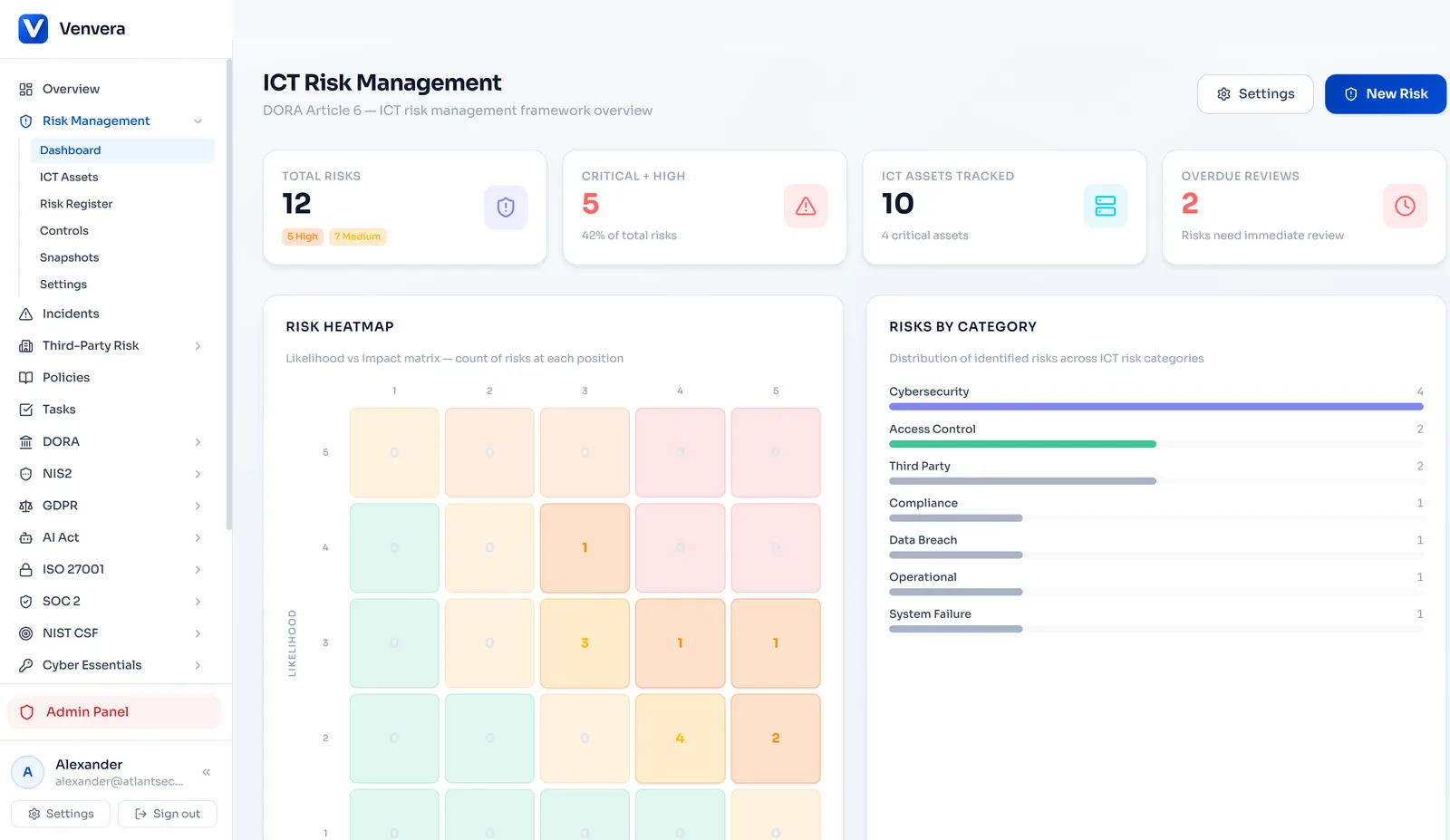
Risk-to-control linkage
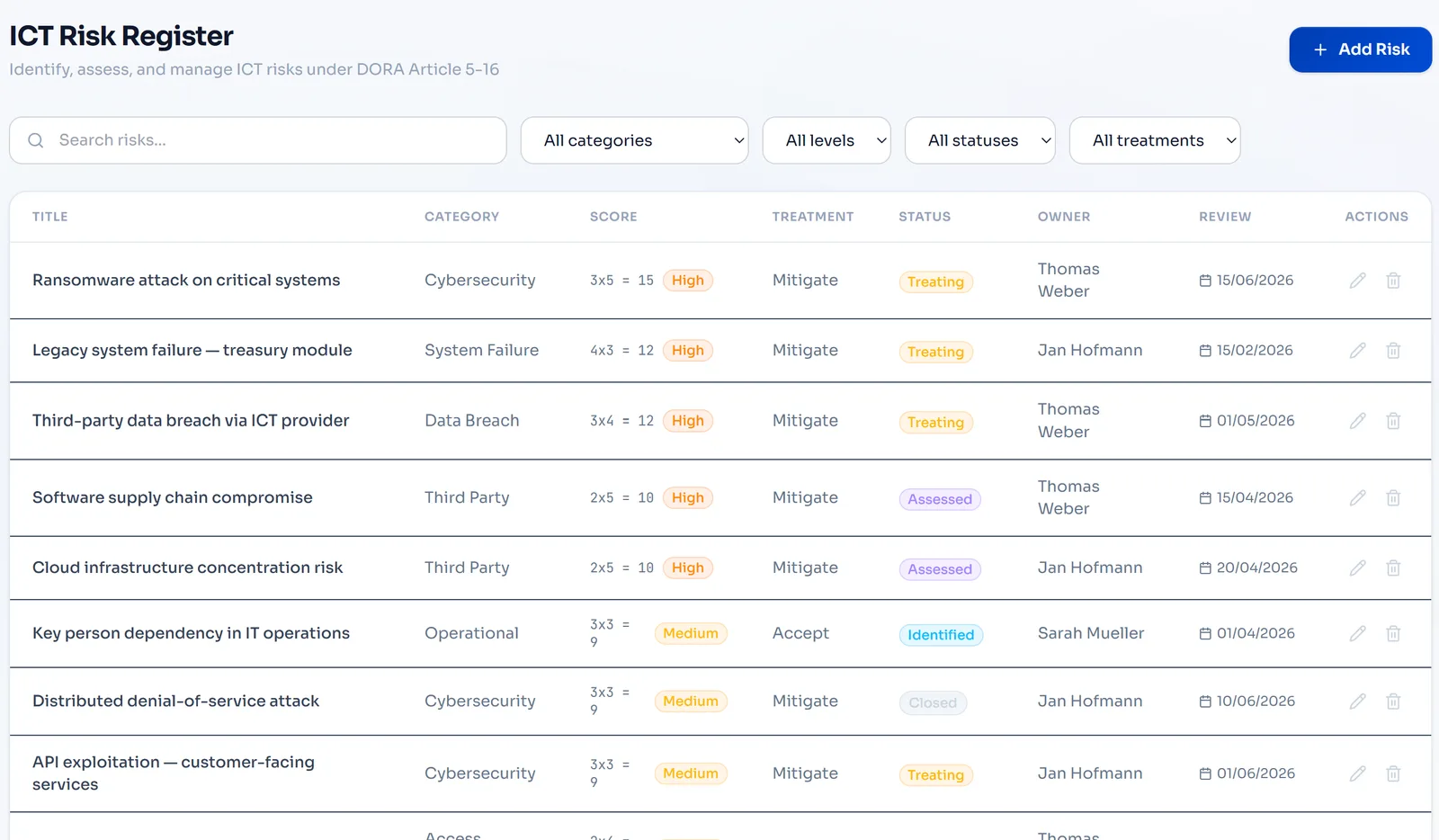
Risks and controls are joined records rather than two spreadsheets. Each risk carries its linked controls, likelihood and impact scores, an owner, a treatment and a review date, which is the traceability Article 13(3) expects you to be able to show.
Register of Information
The Article 28(3) register, built on the 15 official templates from B_01.01 to B_99.01, with a completeness score, pre-export validation, and an xBRL-CSV export package built to the table structure of ITS (EU) 2024/2956.
Incident deadline tracking
Incidents classified as major carry their notification deadlines as dated, tickable steps, and NIS2-significant incidents carry their own separate clock.
Resilience testing register
Scheduling, individual tests and findings, so the testing programme required by Article 24(1) has a record rather than a calendar reminder.
Board dashboard and KRI board pack
A board view carrying framework scores, open incidents, policies and tasks, plus a downloadable KRI board pack for the management body reporting cadence.
Cross-framework control reuse
An ICT risk management framework does not sit alone. Where one control satisfies a requirement in more than one framework you hold, the crosswalk carries it across rather than making you evidence the same thing twice.
None of this writes the framework for you. The document has to describe your organisation, your risk tolerance and the controls you actually operate. What a platform changes is what happens after approval: whether the risks, controls, tests, incidents and third-party arrangements the document describes are live records with owners and dates, or a binder that starts going stale the week the board signs it.
Write the framework once, then keep it alive.
Venvera holds the ICT risk register, the controls, the resilience tests, the incidents and the register of information as connected records, so the framework you approve is the framework you can evidence.
Book a demo →Primary sources
- Regulation (EU) 2022/2554 (DORA). Article 4, proportionality. Chapter II, Articles 5 to 16, ICT risk management. Articles 17 to 23, incident management and reporting. Articles 24 to 27, resilience testing. Articles 28 to 30, ICT third-party risk. Applies from 17 January 2025.
- Commission Delegated Regulation (EU) 2024/1774. RTS specifying ICT risk management tools, methods, processes and policies, and the simplified ICT risk management framework. Articles 2 to 27, full framework. Articles 28 to 41, simplified framework.
- Commission Delegated Regulation (EU) 2024/1772. RTS on the criteria for classifying ICT-related incidents and cyber threats, the materiality thresholds, and the details of major incident reports.
- Commission Delegated Regulation (EU) 2025/301. RTS on the content of the reports and the time limits for the initial notification and the intermediate and final reports. Article 5 sets the deadlines quoted above.
- Commission Delegated Regulation (EU) 2024/1773. RTS on the policy on the use of ICT services supporting critical or important functions, under DORA Article 28(10).
- Commission Delegated Regulation (EU) 2025/532. RTS on subcontracting of ICT services supporting critical or important functions, under DORA Article 30(5).
- Commission Delegated Regulation (EU) 2025/1190. RTS on threat-led penetration testing, under DORA Article 26(11).
- Commission Implementing Regulation (EU) 2024/2956. ITS on the standard templates for the register of information, under DORA Article 28(9). See our guide to the 15 official templates.
This article is for information only and is not legal or regulatory advice. Article citations were checked against the Official Journal texts on 14 July 2026. Technical standards are amended over time, so confirm the version in force before relying on any deadline or requirement stated here.