


Best
15 min read · Last updated March 2026
I was sitting in a compliance workshop in DIFC last autumn when the Chief Compliance Officer of a mid-sized crypto exchange turned to me and asked a question I have heard dozens of times: “We passed our VARA licensing assessment, but now we need to maintain continuous compliance with Schedule 1. Is there a platform that actually understands what VARA requires, or are we stuck building everything in spreadsheets?”
It is a fair question. The Dubai Virtual Assets Regulatory Authority (VARA), established under Dubai Law No. 4 of 2022, has created one of the world’s most comprehensive regulatory frameworks for virtual asset service providers. The Technology and Information Rulebook alone contains five Risk Categories in Schedule 1 - covering everything from organisational security frameworks to customer virtual asset protection - plus dedicated chapters on personal data protection, confidentiality, and technology governance.
Yet the compliance SaaS market has been slow to respond. Most platforms were built for traditional financial services (SOC 2, ISO 27001, GDPR) or for specific EU regulations like NIS2 and DORA. Crypto-native compliance requirements - algorithm governance, DLT transaction screening, cold storage controls, wallet concentration risk - sit outside their design parameters entirely.
This guide evaluates the top five platforms for VARA compliance, explains what features actually matter for VASPs operating under Dubai’s regulatory framework, and provides the comparison data you need to make an informed decision. Whether you are running a crypto exchange, a custody provider, a broker-dealer, or an advisory firm licensed by VARA, the tooling you choose now will determine whether compliance is a sustainable operational practice or a recurring fire drill.
Why VARA Compliance Is Different
VARA does not just regulate technology risk - it regulates the entire technology stack of a virtual asset business, from Board-level algorithm governance to individual customer wallet protections. VASPs must also comply with DESC (Dubai Electronic Security Center) standards, the UAE Personal Data Protection Law (Federal Decree-Law No. 45 of 2021), and CBUAE consumer protection requirements. A compliance platform that only covers generic cybersecurity controls will leave critical gaps in your VARA programme.
🔍
Evaluation Criteria
What to Look For in VARA Compliance Software
The VARA Technology and Information Rulebook is unlike any other financial regulation in terms of its depth and specificity for crypto-native operations. Schedule 1 alone has five Risk Categories, each with detailed standards that a compliance platform must be able to track, evidence, and report against. Here are the eight capabilities I evaluate when assessing platforms for VASPs:
1. Technology Governance Tracking
VARA requires Board and Senior Management oversight of all technology operations, including algorithm governance policies. Your platform must track governance structures, document Board approvals, and evidence oversight of automated trading systems and DLT infrastructure.
2. Cybersecurity Policy Management
Risk Category 1 (Organisational) demands a Comprehensive Security Framework aligned with DESC standards. The platform must manage security policies, track their review cycles, link them to specific VARA requirements, and demonstrate DESC alignment.
3. Key & Wallet Management Documentation
Risk Category 4 (Customer VAs) requires strong MFA (no SMS/IM verification), biometric verification, tiered withdrawal limits, cooling periods for high-value withdrawals, and cold storage controls. Your platform must document and evidence all of these.
4. Testing & Audit Tracking
The Secure Development Lifecycle standards under Risk Category 1 require structured testing programmes - penetration testing, vulnerability assessments, code reviews. The platform should track test schedules, findings, remediation, and re-testing evidence.
5. Incident Reporting
VARA mandates 24-hour notification to the Authority for data incidents, plus structured incident classification and response procedures. Transaction manipulation, coordinated collusion, and automated system attacks must all be categorised and reported promptly.
6. BCDR & Resilience
Business Continuity and Disaster Recovery planning is required with specific RPO/RTO targets for critical virtual asset operations. The platform must manage BCDR documentation, testing schedules, and recovery evidence.
7. Staff Training & Awareness
Workforce Security Management under Risk Category 1 requires qualified staff for algorithm supervision, security awareness programmes, and documented training records. The platform should track training completion and certification status.
8. Data Protection (UAE PDPL)
Part II of the Technology Rulebook integrates UAE PDPL compliance. VASPs must appoint a DPO, establish a data compliance programme, handle cross-border data transfers properly, and maintain 24-hour VARA notification capability for personal data incidents.
📜
Regulatory Context
Understanding VARA Schedule 1: The Five Risk Categories
Before comparing platforms, it is essential to understand what VARA actually requires. Schedule 1 of the Technology and Information Rulebook organises technology standards into five Risk Categories that collectively cover the entire technology and operations stack of a VASP. Any compliance platform you adopt must map to all five:
| Risk Category | Focus Area | Key Standards |
|---|---|---|
| RC1: Organisational | Security framework, people, infrastructure | Comprehensive Security Framework, Secure Development Lifecycle, Workforce Security Management, Infrastructure Management, Third-Party Technology Service Providers |
| RC2: Data | Data classification, protection, retention | Data classification schemes, encryption at rest and in transit, data loss prevention, retention and disposal policies |
| RC3: Network & Systems | Network security, system hardening, monitoring | Network architecture security, DLT node security, system hardening baselines, monitoring and logging, SIEM integration |
| RC4: Customer VAs | Wallet security, access controls, asset protection | Strong MFA (no SMS/IM), biometric verification, tiered withdrawal limits, cooling periods, behavioural anomaly analysis, cold storage, wallet concentration risk diversification |
| RC5: Transaction Controls | Market integrity, DLT screening, AML controls | Transaction manipulation prevention, anti-collusion controls, DLT tracing software, wallet address screening, automated attack detection |
Additionally, Part II (Personal Data Protection) requires UAE PDPL compliance with DPO appointment and 24-hour VARA notification for data incidents, while Part III (Confidential Information) prohibits using client information for trading purposes. These cross-cutting obligations must be managed alongside the five Risk Categories.
“VASPs using Algorithms shall establish policies relating to governance oversight from the Board and Senior Management. The VASP must maintain documentation relating to the design, testing, performance, deployment and maintenance of the Algorithm.” - VARA Technology and Information Rulebook
🏆
Platform Reviews
The Top 5 Compliance Platforms for VARA
EDITOR’S CHOICE
1. Venvera
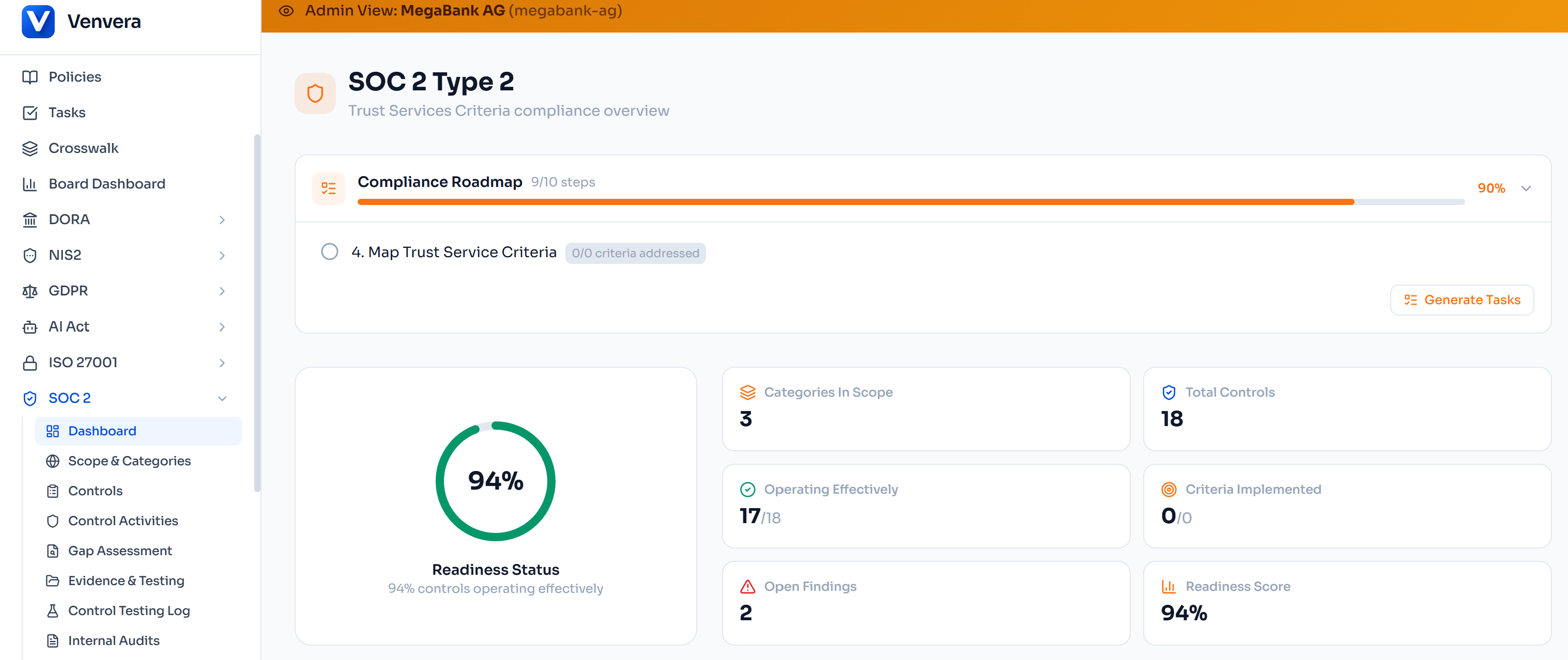
Venvera is, in my assessment, the most comprehensive compliance platform currently available for VASPs operating under VARA. While the broader GRC market treats virtual asset regulation as an afterthought, Venvera has built native VARA compliance support as a fully integrated framework module. This means purpose-built control tracking mapped to all five Risk Categories of Schedule 1, dedicated evidence management for algorithm governance documentation, and incident reporting workflows aligned with VARA’s 24-hour notification requirements.
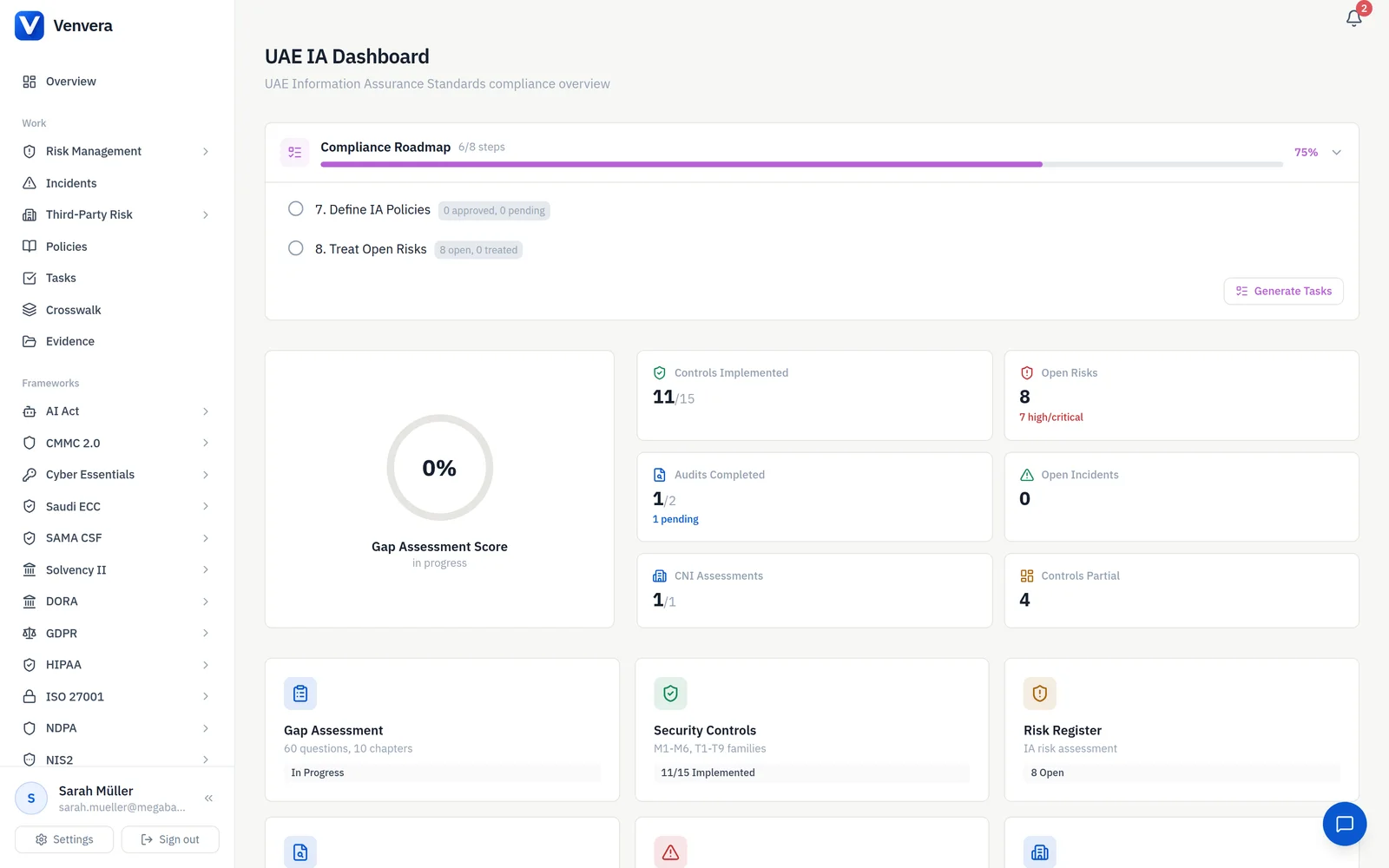
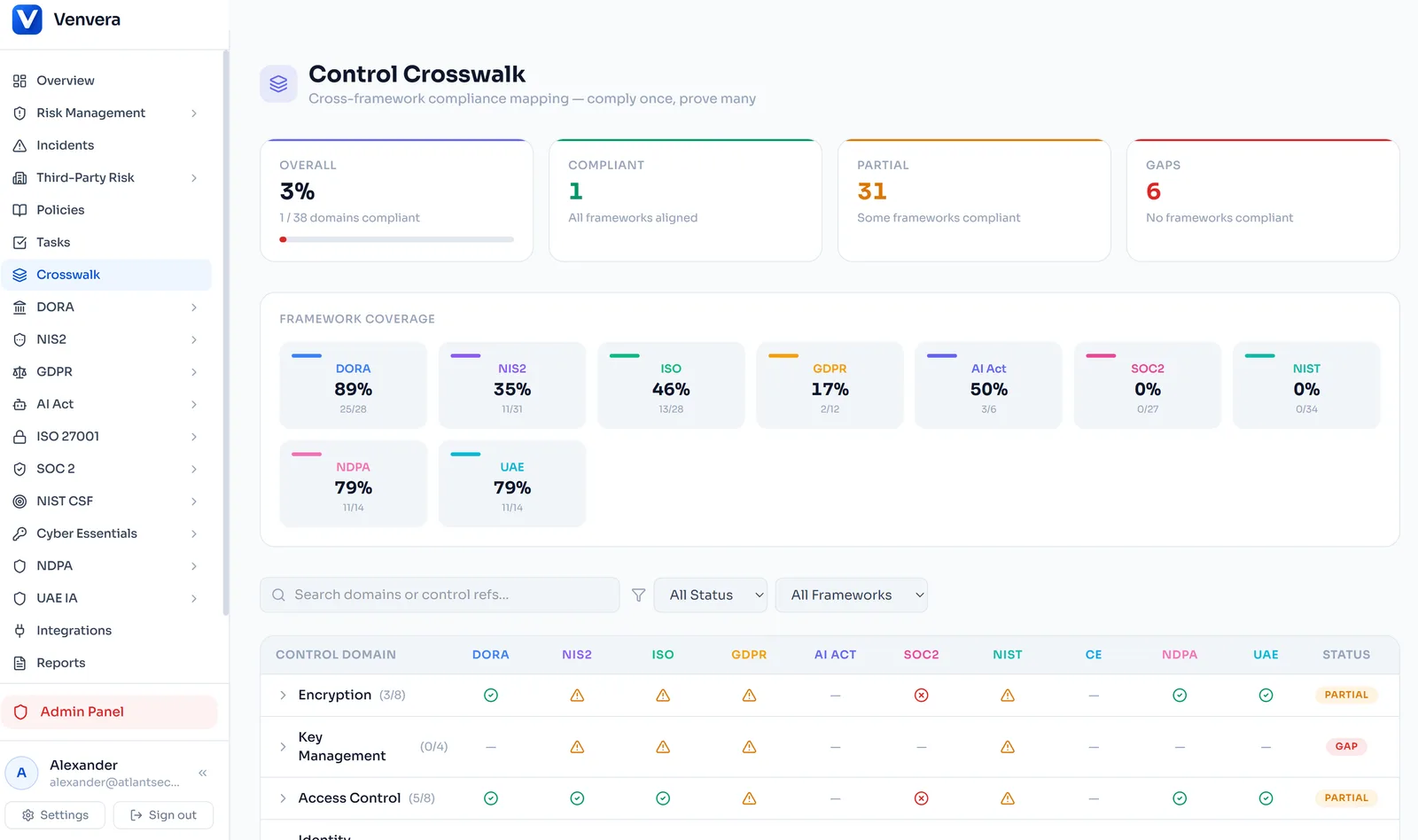
What sets Venvera apart for crypto-regulated entities is its multi-framework architecture. Your VARA subscription gives you access to 16 frameworks total - including ISO 27001, SOC 2, NIST CSF, UAE Information Assurance, GDPR, NIS2, DORA, EU AI Act, Cyber Essentials, NDPA, and CMMC. For VASPs that also serve European clients or operate in multiple jurisdictions, this eliminates the need for separate compliance tools. The platform’s 150+ cross-framework control mappings mean that an ISO 27001 access control you have already implemented automatically provides evidence coverage for corresponding VARA Risk Category 1 requirements.
Venvera tracks technology governance structures required by VARA, including Board oversight documentation for algorithm governance, Secure Development Lifecycle evidence, workforce security training records, and third-party technology service provider assessments. The UAE PDPL compliance module handles DPO appointment tracking, data protection programme management, and the cross-border data transfer documentation that Part II of the Technology Rulebook demands.
Pricing starts at €299/month for any single framework, or €899/month for three frameworks plus most platform functionality. For a VASP that needs VARA plus ISO 27001 and UAE IA (which is most Dubai-licensed operators), this is significantly more cost-effective than stitching together multiple point solutions. European data hosting in Amsterdam provides a neutral, GDPR-compliant location, and the platform’s multi-tenant architecture with row-level security ensures complete data isolation between organisations.
Native
VARA Support
150+
Cross-Mappings
11
Frameworks Total
2. Chainalysis Compliance
Chainalysis is the market leader in blockchain analytics and transaction monitoring. Their KYT (Know Your Transaction) platform provides excellent DLT tracing capabilities that directly address VARA’s Risk Category 5 requirements for transaction screening and wallet address analysis. The software can identify high-risk wallet addresses, trace transaction flows across multiple blockchains, and flag suspicious activity patterns.
However, Chainalysis is fundamentally a transaction monitoring tool, not a GRC platform. It does not manage cybersecurity policies, track governance structures, handle technology risk assessments, or manage the broader Schedule 1 compliance requirements. Risk Categories 1 through 4 - organisational security, data protection, network security, and customer VA protections - are entirely outside its scope. You will still need a separate compliance platform for the majority of VARA’s technology requirements, making Chainalysis a valuable complement but not a standalone solution.
Strengths
- Best-in-class DLT transaction tracing
- Multi-blockchain wallet screening
- Strong AML/CFT capabilities
- Established relationships with regulators
Limitations for VARA
- Transaction monitoring only - not a GRC platform
- No cybersecurity policy management
- No governance tracking or Schedule 1 coverage
- No data protection or BCDR management
- Must be paired with a compliance platform
3. Vanta
Vanta has built an excellent reputation for SOC 2 and ISO 27001 automation, particularly for technology companies. Their 200+ integrations automate evidence collection from cloud providers, identity providers, and development tools. For VASPs that need SOC 2 or ISO 27001 alongside VARA compliance, Vanta handles those frameworks well.
The challenge is that Vanta has no VARA-specific support. Dubai’s virtual asset regulation is absent from the platform’s framework library, and Middle Eastern regulatory frameworks more broadly are not part of their roadmap. There is no coverage for VARA’s Schedule 1 Risk Categories, no algorithm governance tracking, no wallet management controls, and no UAE PDPL compliance module. The custom framework builder could theoretically be used to map VARA requirements, but this is manual configuration work that defeats the purpose of a compliance platform. You would be paying premium SaaS pricing to use what is essentially a structured spreadsheet.
Strengths
- Excellent SOC 2 and ISO 27001 automation
- 200+ integrations for evidence collection
- Strong vendor ecosystem
- Continuous monitoring
Limitations for VARA
- No VARA or Dubai regulatory support
- No crypto-specific compliance features
- No algorithm governance or wallet controls
- No UAE PDPL module
- US-centric data hosting
4. OneTrust
OneTrust is the enterprise heavyweight in the GRC and privacy management space. Their platform offers deep capabilities in privacy impact assessments, third-party risk management, and regulatory intelligence. The privacy module could handle some aspects of VARA’s Part II (Personal Data Protection) requirements, particularly around data mapping and consent management.
However, OneTrust does not have VARA-specific modules, and the crypto-native requirements that make VARA unique - algorithm governance, DLT transaction controls, wallet management, cold storage standards - are entirely absent. Building these as custom modules within OneTrust is technically possible but requires significant professional services engagement (think six-figure implementation costs and 4-6 month timelines). For enterprise VASPs with deep pockets and existing OneTrust deployments, adding custom VARA modules may be justifiable. For mid-market crypto companies, the total cost of ownership is prohibitive for the coverage you actually receive.
Strengths
- Enterprise-grade privacy management
- Strong third-party risk module
- Some UAE PDPL coverage via privacy tools
- Established market presence
Limitations for VARA
- No VARA-specific modules
- No crypto-native compliance features
- Very expensive (six-figure contracts)
- 4-6 month implementation for custom modules
- Overkill for mid-market VASPs
5. Drata
Drata’s strength is continuous compliance monitoring with automated evidence collection from cloud infrastructure. Their SOC 2 and ISO 27001 modules are genuinely excellent, and the platform has expanded framework coverage over the past two years. For VASPs running on AWS, Azure, or GCP, Drata can automate evidence collection for infrastructure security controls.
Like Vanta, Drata has no VARA coverage and no Middle Eastern regulatory framework support. The platform is infrastructure-focused, which addresses some of Risk Category 3 (Network & Systems) but misses the virtual asset-specific requirements entirely. Algorithm governance, customer VA protections, DLT transaction controls, wallet management, and UAE PDPL compliance are all outside Drata’s scope. For VASPs needing SOC 2 alongside VARA, Drata could handle the SOC 2 side, but you would need a separate platform for VARA - adding cost and operational complexity.
Strengths
- Continuous infrastructure monitoring
- Automated cloud evidence collection
- Good SOC 2 and ISO 27001 support
- User-friendly interface
Limitations for VARA
- No VARA or Dubai regulatory support
- Infrastructure-focused, not regulation-focused
- No crypto-specific compliance features
- No UAE PDPL or data protection module
- US-centric platform and data hosting
📊
Head-to-Head
VARA Compliance Platform Comparison
| Capability | Venvera | Chainalysis | Vanta | OneTrust | Drata |
|---|---|---|---|---|---|
| Native VARA Support | ✓ | RC5 Only | ✗ | ✗ | ✗ |
| Schedule 1 Risk Categories (All 5) | Full | 1 of 5 | ✗ | Custom Only | ✗ |
| Algorithm Governance Tracking | ✓ | ✗ | ✗ | ✗ | ✗ |
| DLT Transaction Screening | Basic | Best-in-class | ✗ | ✗ | ✗ |
| UAE PDPL Compliance | ✓ | ✗ | ✗ | Partial | ✗ |
| Incident Reporting (24h VARA) | Native | Alerts Only | ✗ | Generic | ✗ |
| Cross-Framework Mapping | 150+ mappings | N/A | Basic | Moderate | Basic |
| Total Frameworks | 11 | 1 (AML) | 6-8 | Per-module | 6-8 |
| Pricing Transparency | From €299/mo | Custom | $$$ | $$$$ | $$$ |
🔗
Efficiency Multiplier
Why Cross-Framework Mapping Matters for VASPs
No VASP operating in Dubai exists in a regulatory vacuum. VARA-licensed entities typically need to demonstrate compliance with multiple overlapping frameworks simultaneously. A crypto exchange serving European clients needs VARA and GDPR. An institutional custody provider needs VARA, ISO 27001, and SOC 2. A VASP with operations in the broader UAE needs VARA and UAE Information Assurance standards. Without cross-framework mapping, your compliance team treats each as a separate project, duplicating evidence collection and control documentation across frameworks.
| VARA Requirement | ISO 27001 Mapping | SOC 2 Mapping | Overlap |
|---|---|---|---|
| RC1: Security Framework | Clauses 4-7, A.5, A.6, A.7 | CC1.1-CC1.5 | High |
| RC1: Secure Dev Lifecycle | A.8.25-A.8.31 | CC8.1 | High |
| RC1: Third-Party Providers | A.5.19-A.5.23 | CC9.2 | High |
| RC3: Network Security | A.8.20-A.8.24 | CC6.6, CC6.7 | High |
| RC4: Customer VA Protection | - | - | VARA-specific |
| RC5: Transaction Controls | - | - | VARA-specific |
What This Means in Practice
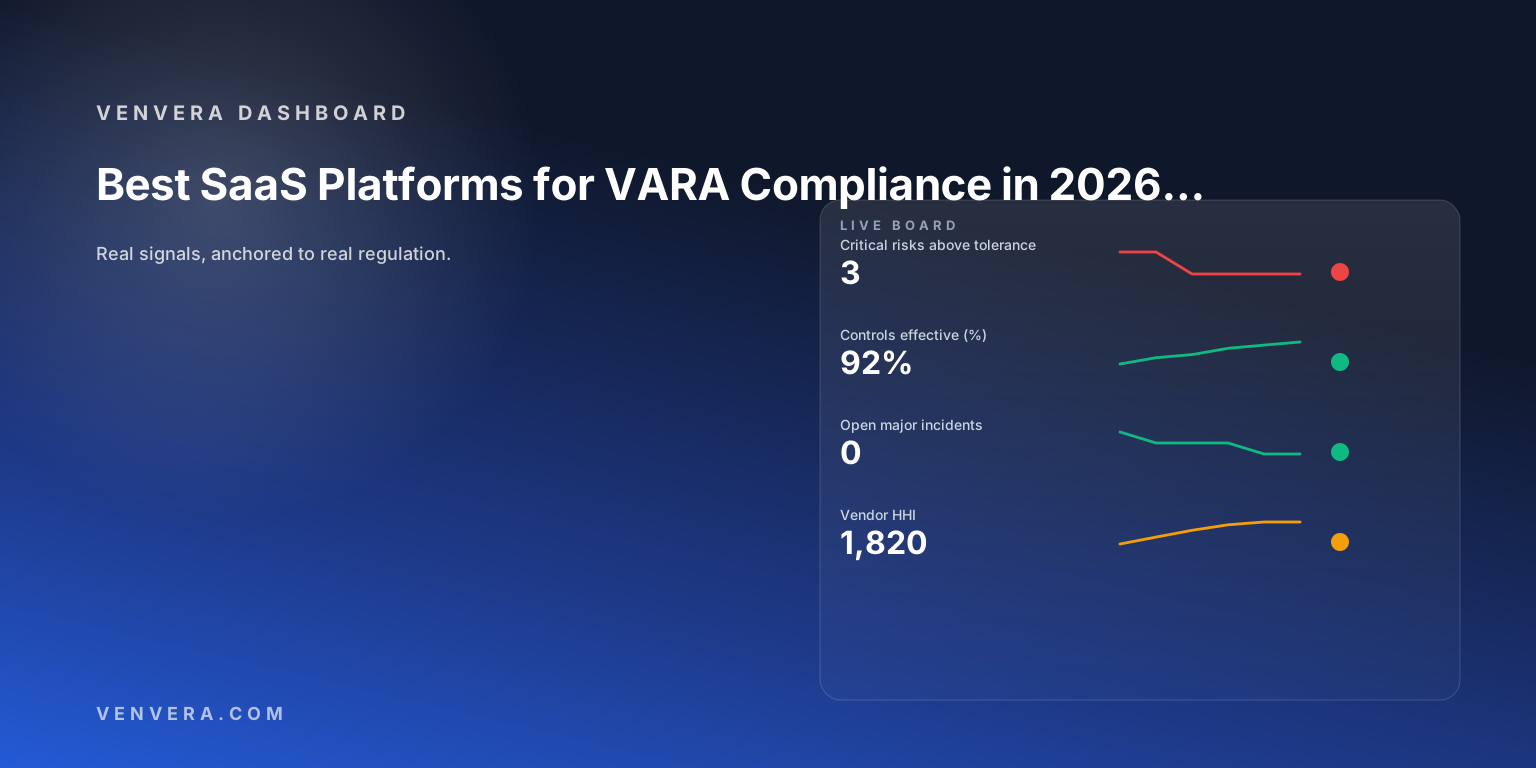
Risk Categories 1 through 3 share 60-70% overlap with ISO 27001 and SOC 2 controls. If your VASP already has ISO 27001 certification, a platform with cross-framework mapping can automatically credit those controls against VARA requirements, focusing your team’s effort on the crypto-specific requirements in Risk Categories 4 and 5 that have no international equivalents. Venvera’s 150+ pre-built mappings make this automatic - reducing total compliance effort by 40-50% for VASPs with existing certifications.
💰
Cost Analysis
Pricing for VASP Compliance
VASPs in Dubai face a unique pricing challenge: they need both crypto-specific compliance tooling (VARA, transaction monitoring) and traditional GRC coverage (ISO 27001, SOC 2, potentially GDPR). Using separate platforms for each quickly becomes expensive. Here is how the costs compare for a typical mid-market VASP needing VARA plus two additional frameworks:
| Platform | Pricing Model | Est. Annual Cost (VARA + 2 frameworks) | Notes |
|---|---|---|---|
| Venvera | Transparent tiered | From €299/mo (1 fw) | 16 frameworks available; all VARA Risk Categories included natively |
| Chainalysis | Custom enterprise | $50,000 - $150,000+ | Transaction monitoring only; need separate GRC platform |
| Vanta | Per-framework | $30,000 - $60,000+ | No VARA support; covers SOC 2/ISO only |
| OneTrust | Per-module | $100,000 - $250,000+ | Custom VARA build required; 4-6 month implementation |
| Drata | Per-framework | $25,000 - $50,000+ | No VARA support; infrastructure-focused |
“We evaluated four platforms before choosing Venvera. We needed VARA compliance alongside ISO 27001 for our institutional clients and UAE IA for our DIFC licence. No other platform covered all three natively. The cross-framework mapping alone saved our team hundreds of hours of duplicate documentation work.”
- Head of Compliance, VARA-licensed crypto exchange
✅
Implementation
Getting Started: VARA Compliance Platform Rollout
Based on my experience working with VASPs across the licensing and post-licensing phases, here is a practical rollout sequence for implementing a VARA compliance platform:
Week 1-2: Foundation
Map your existing controls to VARA Schedule 1 Risk Categories. Import existing ISO 27001 or SOC 2 evidence. Identify gaps between current controls and VARA-specific requirements, particularly in Risk Categories 4 and 5.
Week 3-4: Crypto-Specific Controls
Document algorithm governance policies, wallet management procedures, cold storage controls, MFA configurations (ensuring no SMS/IM verification), and tiered withdrawal limit structures. These are VARA-unique requirements.
Week 5-6: Data Protection & Incidents
Establish UAE PDPL compliance programme, appoint DPO, configure incident reporting workflows with 24-hour VARA notification capability, and document cross-border data transfer mechanisms.
Week 7-8: Testing & Continuous Compliance
Schedule penetration testing and vulnerability assessments. Configure BCDR testing calendar. Set up monitoring dashboards for ongoing compliance status across all Risk Categories. Train staff on platform usage and compliance workflows.
💡
Conclusion
The Bottom Line
VARA has set a global standard for virtual asset regulation, and the compliance bar is correspondingly high. The Technology and Information Rulebook covers everything from Board-level algorithm governance to individual customer wallet protections, and VARA expects VASPs to demonstrate continuous compliance across all five Risk Categories, plus data protection and confidentiality obligations.
The compliance SaaS market has not kept pace with this regulatory sophistication. Most platforms were designed for traditional financial services or US-centric technology companies. Crypto-specific requirements - algorithm documentation, DLT transaction controls, cold storage governance, behavioural anomaly analysis - are absent from their feature sets.
For VASPs that need comprehensive VARA compliance with native Schedule 1 Risk Category tracking, algorithm governance documentation, UAE PDPL compliance, and incident reporting aligned with VARA’s 24-hour notification requirements, Venvera is the clear leader. The fact that it includes 10 additional frameworks - with 150+ cross-framework mappings and pricing from €299/month - makes it the most cost-effective and comprehensive option for Dubai-licensed virtual asset service providers.
For transaction monitoring and DLT screening specifically, Chainalysis remains best-in-class - but it is a complement to a GRC platform, not a replacement. The optimal stack for a VARA-licensed VASP is Venvera for comprehensive compliance management plus Chainalysis (or a similar blockchain analytics tool) for real-time transaction monitoring.
Published March 2026 · VARA compliance platform comparison for virtual asset service providers · venvera.com