

Best
GDPR Compliance
A comparison of five compliance tools for processing registers, DPIAs, breach notifications and data subject rights, with European data residency front and centre.

Eight years after it took effect, GDPR compliance is less about scrambling to meet a deadline and more about operational routine: maintaining living registers, running DPIAs as standard practice, and responding to data subject requests within the statutory window without a fire drill each time.
Quick answer
Which GDPR tool fits depends on whether privacy is your only concern or one of several regimes. OneTrust is well suited to organisations that want the deepest dedicated privacy management, including cookie consent, and have enterprise budget. Sprinto is a good fit for startups that need baseline GDPR affordably. Vanta and Drata suit technology teams that mainly need GDPR mapped to their technical security controls. Venvera, the platform behind this guide, is well suited to EU financial entities running GDPR alongside DORA, NIS2 and ISO 27001, with those security controls mapped across frameworks and data hosted in the EU. The comparison below covers all five.
A pattern worth noting is that treating GDPR as an isolated privacy exercise tends to create duplicated work. Organisations that embed privacy into their broader compliance framework, connecting GDPR requirements with their security controls, risk management and regulatory reporting, tend to keep it more manageable. That is why the platform you choose matters.
This guide compares five SaaS platforms for GDPR compliance, sets out the criteria that matter, and helps you avoid overpaying for features you do not need while missing ones you do.
Worth saying at the outset which parts of this earn their keep. The processing register and DPA tracking are administrative work that software makes tidier and faster. Breach handling and data subject requests are the two processes that buckle under time pressure, so those are the ones to push hardest in a demo. Ask to run a live request end to end rather than watching a slide about it.
🔍
Selection Criteria
What to Look for in GDPR Compliance Software
Six capabilities separate productive privacy teams from those perpetually chasing their tail. These are the ones worth prioritising when you evaluate a tool.
1. Processing Activities Register
Article 30 requires a record of processing activities. Your platform must capture data categories, legal bases, retention periods, recipients, transfer mechanisms and purposes, and make it easy to keep the register current as your operations evolve. Building the first register is a couple of weeks of interviews. Keeping it true after a year of product changes is the part nobody budgets for, so weigh how easily a business owner can update their own entry without going through you.
2. DPIA Management
Data Protection Impact Assessments are required for high-risk processing. The tool should provide structured DPIA workflows with risk scoring, mitigation tracking, DPO sign-off and a searchable archive of completed assessments.
3. Breach Notification Management
The 72-hour notification window to the supervisory authority leaves no room for ad-hoc processes. You need structured breach recording, impact assessment, notification templates and deadline tracking, with a clear audit trail showing you acted promptly. The window sounds generous until you count the steps inside it: triage, a legal read on whether the threshold is met, an executive sign-off and a drafted notification, quite possibly over a weekend. Plan as though you have far less time than the clock suggests.
4. DPA Management
Data Processing Agreements with your processors are required under Article 28. Tracking DPA status, expiry dates, sub-processor chains and Standard Contractual Clauses is essential.
5. Data Subject Request Handling
Access, rectification, erasure and portability requests increase every year. The platform should track requests, manage deadlines, document responses and handle identity verification workflows.
6. European Data Hosting
Storing your GDPR compliance data outside the EU is an awkward look for regulators. European hosting addresses Schrems II concerns for the compliance platform itself and demonstrates genuine commitment to data sovereignty. Be honest about the weight of this one. It rarely decides whether you are compliant, and it frequently decides how long your own procurement and security review takes, which is a real cost paid in weeks.
🏆
Platform Reviews
Five GDPR Compliance Platforms Compared
Our platform
Venvera
Best for: EU financial entities running GDPR alongside DORA, NIS2 and ISO 27001, that want security controls mapped across frameworks and data hosted in the EU.
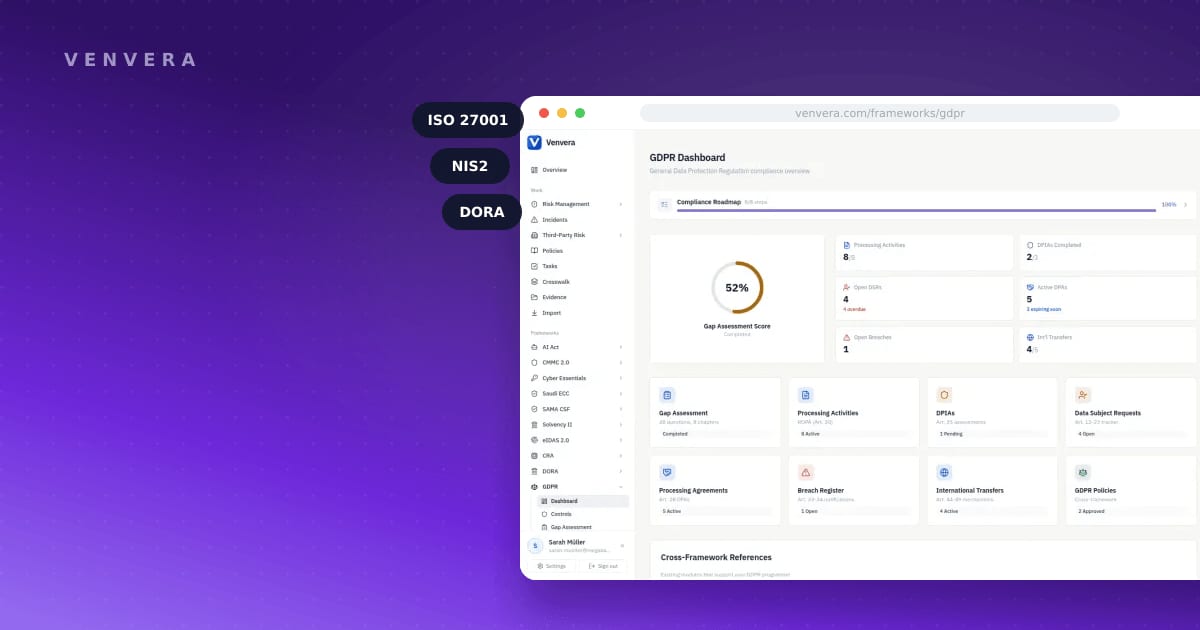
Venvera delivers GDPR capabilities within a broader multi-framework compliance platform. For EU entities navigating DORA, NIS2, ISO 27001 and the AI Act alongside GDPR, that integration lets one security control serve several regimes.
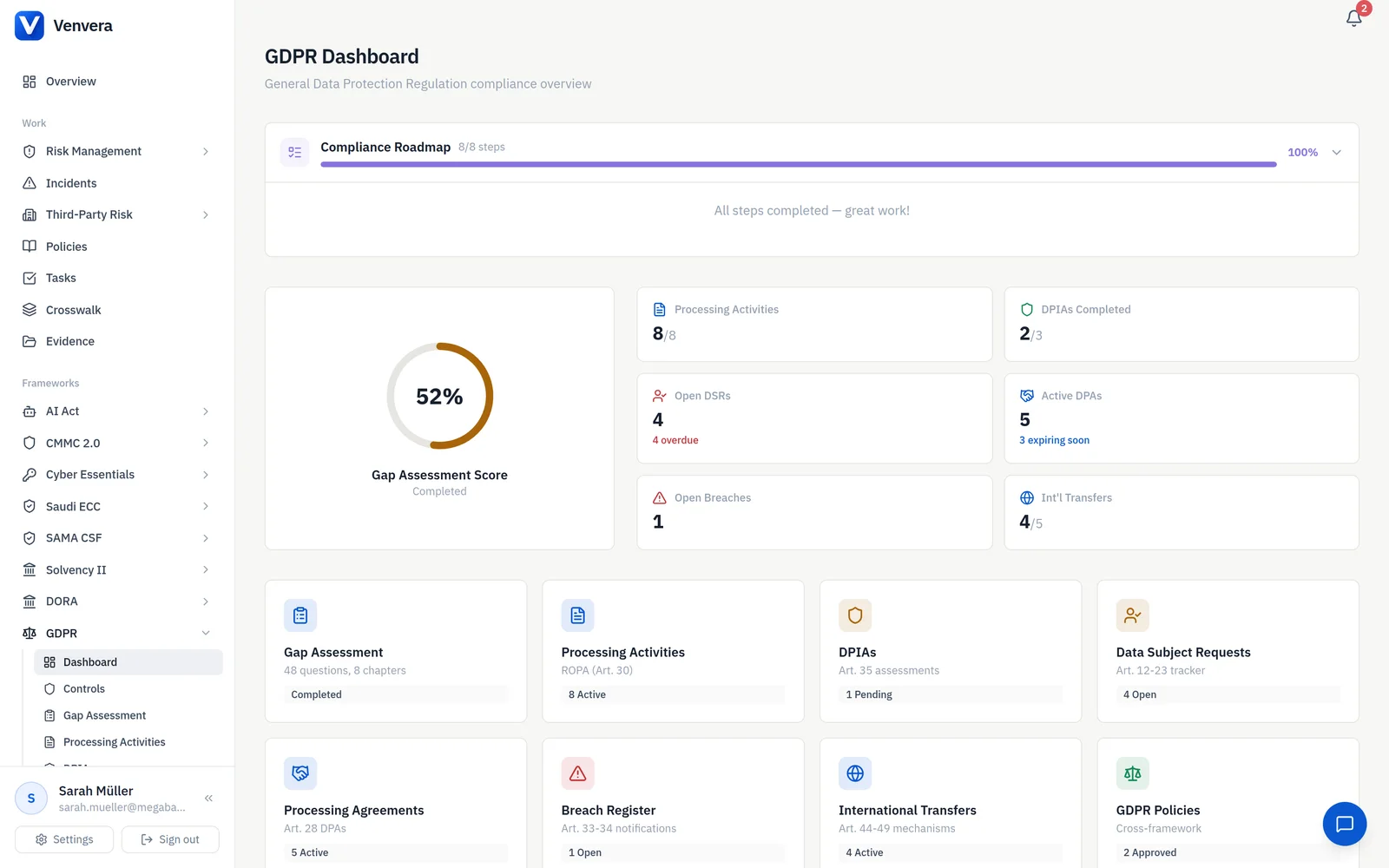
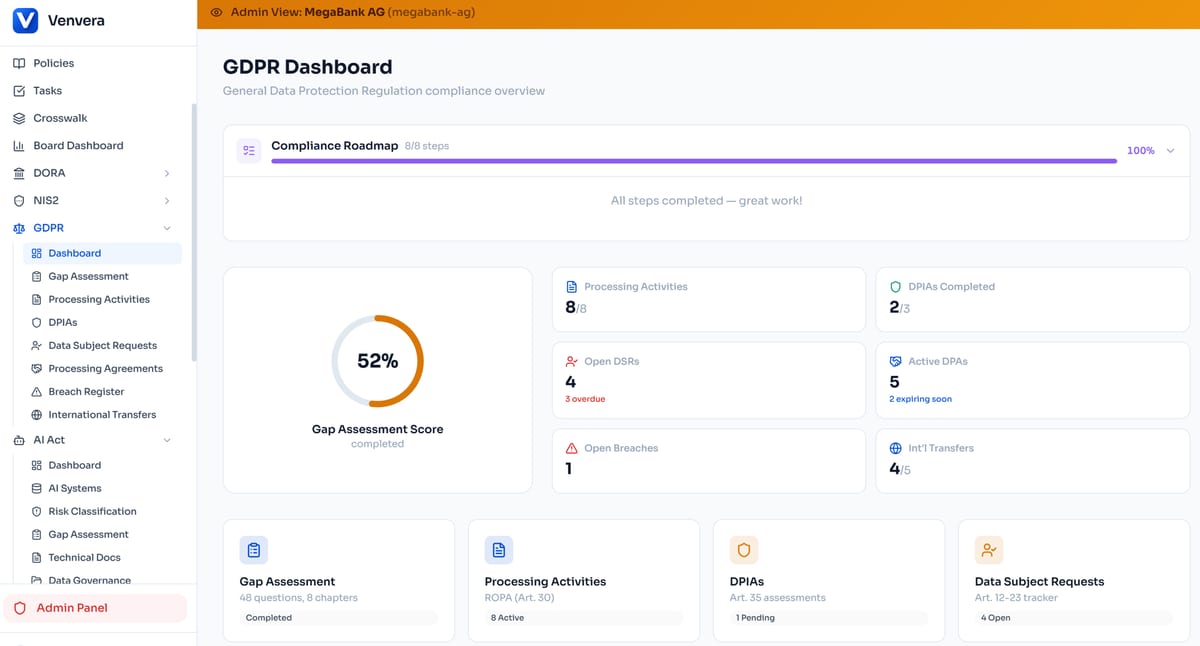
The GDPR module includes a structured processing activities register with the Article 30 fields, DPIA management with risk scoring and mitigation workflows, breach notification tracking with 72-hour deadline alerts, and DPA management for your processor relationships. Each processing activity can be linked to the underlying technical controls, which are themselves mapped to ISO 27001, NIS2 and DORA requirements through pre-built cross-framework mappings.
Data hosting is in Amsterdam by default, not "EU region on request". For entities where data residency is a board-level concern, that removes a layer of risk from the compliance tool itself. Because several frameworks sit in the same subscription, adding GDPR alongside DORA does not require a separate product.
Gap assessment lets you benchmark your GDPR posture, identify deficiencies and track remediation with an audit trail. Policy templates for privacy notices, data protection policies and breach response procedures give you a documentation starting point.
Strengths
- Full processing activities register
- DPIA management with risk scoring
- Breach notification with 72h tracking
- DPA management
- Multiple frameworks in one subscription
- EU hosting (Amsterdam)
- Cross-framework control mapping
Considerations
- No cookie consent management
- No built-in consent preference centre
- Newer platform building market presence
OneTrust
Best for: enterprises that want the deepest dedicated privacy management, including cookie consent, and have the budget for it.
OneTrust is the established leader in privacy management software. Its public documentation describes deep GDPR capabilities: data mapping, automated data discovery, DPIA automation, cookie consent management, DSR automation with identity verification, and a vendor risk module for processor oversight. If GDPR is your primary concern and you have enterprise budget, it is a strong contender.
The considerations are cost and complexity. OneTrust uses a modular pricing model (privacy management, vendor risk, cookie consent and GRC as separate modules), and enterprise deployments typically involve professional services and a multi-month implementation. Exact pricing is not published; confirm scope and cost with OneTrust. If you also need NIS2, DORA or ISO 27001, those are separate modules, so the cross-framework reuse is looser than a purpose-built multi-framework platform.
Strengths (per public docs)
- Deep privacy management
- Automated data discovery
- Cookie consent management
- DSR automation
- Mature DPIA workflows
Verify with vendor
- Total cost of a full deployment
- Modular pricing scope
- Implementation timeline
- Cost of non-privacy frameworks
- Learning curve for your team
Vanta
Best for: technology teams that mainly need GDPR mapped to their technical security controls, often alongside SOC 2.
Vanta has expanded beyond its SOC 2 roots to include GDPR. Its approach uses automated evidence collection from your infrastructure to populate compliance requirements, which is genuinely useful for cloud-native technology companies looking to reduce manual documentation.
Based on the public documentation reviewed in July 2026, Vanta's GDPR support centres on mapping technical controls to GDPR requirements rather than deep privacy operations. The depth of the processing register, DPIA management, breach notification workflow and DPA management is not confirmed from that documentation; if you need those operational privacy processes, confirm coverage with Vanta or plan for supplementary tooling.
Strengths (per public docs)
- Automated evidence collection
- Technical control mapping
- Pairs with SOC 2
- Large integration catalogue
Verify with vendor
- Depth of processing register
- DPIA capabilities
- Breach notification workflow
- DPA management
- Data residency options
Sprinto
Best for: startups and early-stage companies that need baseline GDPR affordably.
Sprinto positions itself as the budget-friendly compliance automation platform, and for startups it delivers value. Its public materials describe a GDPR module covering processing activities documentation, policy management and compliance monitoring, at pricing below enterprise alternatives, which makes baseline compliance accessible for smaller teams.
The depth of DPIA workflows, breach notification management and DPA tracking that regulated financial entities need is not confirmed from the public documentation reviewed in July 2026, and framework breadth beyond the essentials is limited. If you need NIS2, DORA or the AI Act alongside GDPR, confirm fit with Sprinto; it may serve better as a starting point than a long-term platform for expanding obligations.
Strengths (per public docs)
- Budget-friendly pricing
- Quick to set up
- Suited to startups
- Clean user interface
Verify with vendor
- Depth of GDPR coverage
- DPIA management
- Breach notification workflow
- Framework breadth
- Fit for financial services
Drata
Best for: teams whose GDPR need is mainly about demonstrating technical security controls (Article 32).
Drata offers GDPR alongside SOC 2, ISO 27001 and other frameworks. Its continuous monitoring approach means technical controls supporting GDPR, such as encryption, access management and logging, are checked against your infrastructure automatically, with a real-time compliance dashboard.
As with Vanta, the public documentation reviewed in July 2026 points to an infrastructure-focused GDPR approach. It is strong on demonstrating that your technical environment meets GDPR security requirements (Article 32); the depth of operational privacy processes such as the processing register, integrated DPIAs and breach notification is not confirmed from that documentation, so confirm those with Drata if you need full privacy lifecycle management.
Strengths (per public docs)
- Continuous infrastructure monitoring
- Article 32 technical coverage
- Automated evidence collection
- Clean compliance dashboard
Verify with vendor
- Depth of privacy processes
- Processing register detail
- Breach notification workflow
- DPIA management
- EU-specific privacy coverage
📊
Head-to-Head
Feature Comparison Table
Venvera entries reflect its own product. Competitor entries reflect the public documentation reviewed in July 2026: "Confirmed" means the capability is described there, and "Verify with vendor" means it was not confirmed and should be checked directly, not that it is unsupported.
| Feature | Venvera | OneTrust | Vanta | Sprinto | Drata |
|---|---|---|---|---|---|
| Processing Activities Register | Full (Art. 30) | Confirmed | Verify with vendor | Verify with vendor | Verify with vendor |
| DPIA Management | Full | Confirmed | Verify with vendor | Verify with vendor | Verify with vendor |
| Breach Notification (72h) | Full | Confirmed | Verify with vendor | Verify with vendor | Verify with vendor |
| DPA Management | Full | Confirmed | Verify with vendor | Verify with vendor | Verify with vendor |
| Data Subject Requests | Tracked | Confirmed (automated) | Verify with vendor | Verify with vendor | Verify with vendor |
| Cookie Consent Management | No | Confirmed | Verify with vendor | Verify with vendor | Verify with vendor |
| Cross-Framework Mapping | Pre-built | Verify with vendor | Verify with vendor | Verify with vendor | Verify with vendor |
| EU Data Hosting | Amsterdam | Verify with vendor | Verify with vendor | Verify with vendor | Verify with vendor |
| Framework breadth | Multi-framework | Per-module (verify) | Per-framework (verify) | Verify with vendor | Per-framework (verify) |
🔗
Efficiency Multiplier
Why Cross-Framework Control Mapping Matters for GDPR
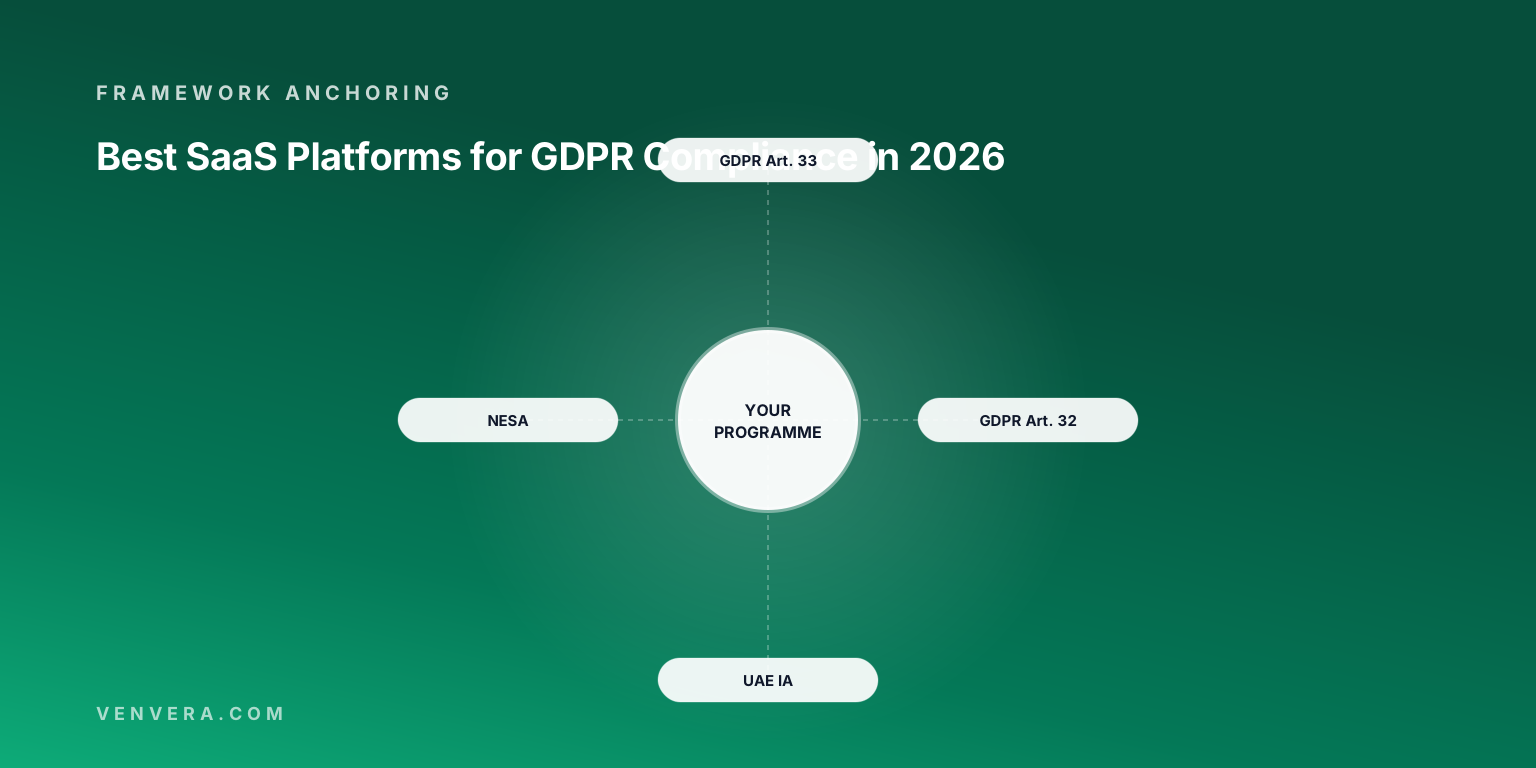
GDPR does not exist in isolation. A financial institution in the EU is also subject to DORA; an operator of essential services falls under NIS2; ISO 27001 certification shares many security controls. Leveraging that overlap, rather than fighting it, is what keeps a multi-framework programme manageable.
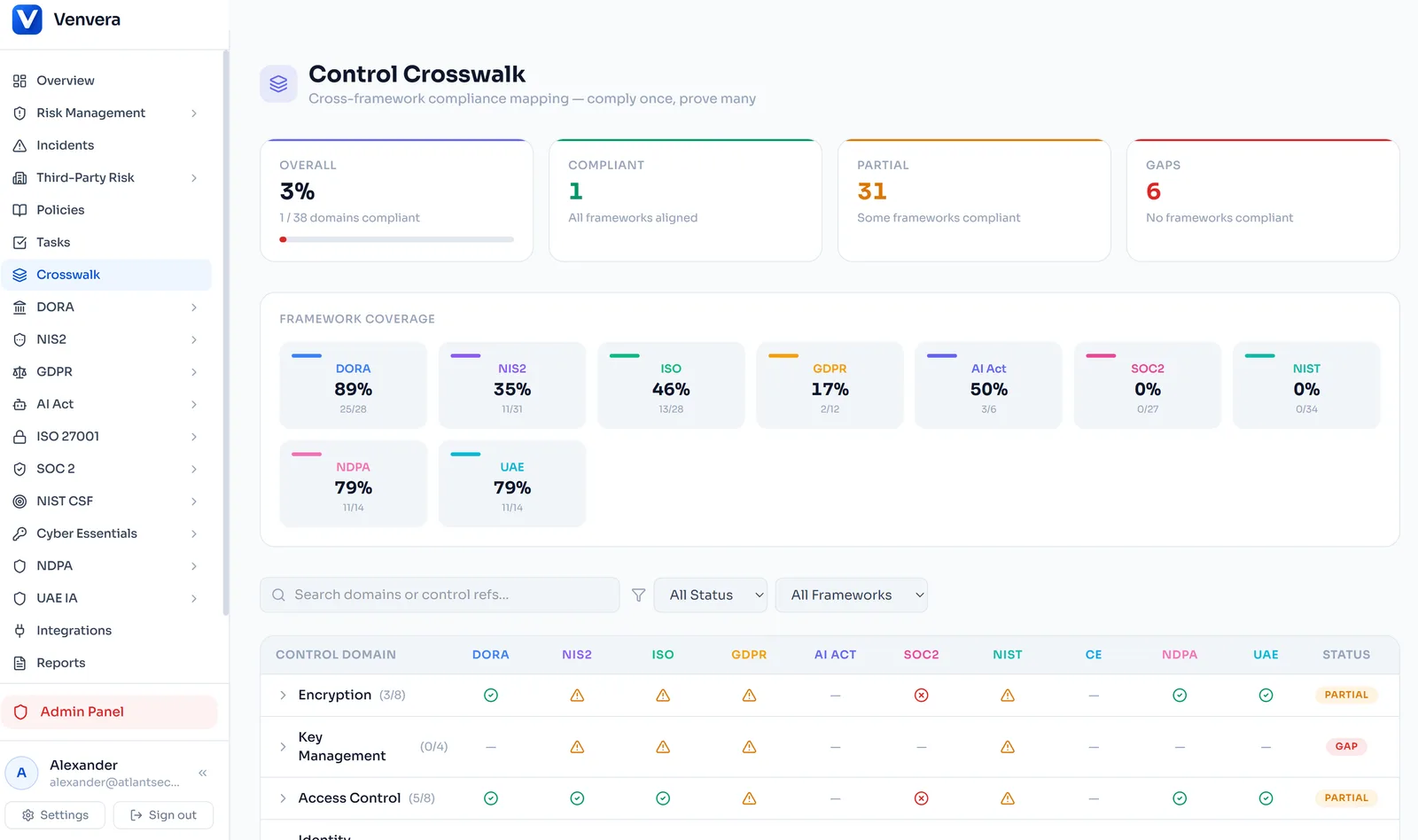
Illustrative example: encryption requirements
Implementing encryption at rest and in transit is relevant to several requirements at once:
- GDPR Art. 32(1)(a) - Encryption of personal data
- DORA Art. 9 - Protection of data at rest, in use and in transit
- ISO 27001 A.8.24 - Use of cryptography
- NIS2 Art. 21(2)(h) - Cryptography and encryption policies
- SOC 2 CC6.7 - Data transmission protection
One encryption implementation, several requirements addressed. Without mapping, each team documents it separately and nobody connects the dots. The article references above are illustrative; confirm the current mapping for your scope in the platform.
Set expectations about where the overlap actually is. Encryption, access control and logging travel well between frameworks, so the security half of GDPR genuinely gets cheaper when you run several regimes together. Lawful basis, retention and data subject rights have no counterpart in ISO 27001 or SOC 2. Mapping shortens the security work and leaves the privacy work exactly where it was.
Venvera's pre-built cross-framework mappings make this connection for you: document a GDPR security control and the platform links it to the related ISO 27001, NIS2, SOC 2 and DORA requirements. That turns multiplicative effort into additive work as your obligations grow.
💰
Cost Analysis
Pricing Comparison
GDPR tooling ranges from bootstrapper-friendly to enterprise-scale. The useful question is not just what GDPR costs, but what GDPR plus the other frameworks you need costs. Most vendors here do not publish detailed pricing, so the table describes the pricing model rather than exact figures.
| Platform | Pricing Model | Adding more frameworks |
|---|---|---|
| Venvera | Published, from €399/mo | Multiple frameworks available in the same subscription |
| OneTrust | Not publicly published; per-module (verify with vendor) | Privacy and GRC modules priced separately |
| Vanta | Not publicly published; per-framework (verify with vendor) | Confirm per-framework cost with vendor |
| Sprinto | Not publicly published; positioned as budget-friendly (verify with vendor) | Confirm framework coverage and cost with vendor |
| Drata | Not publicly published; per-framework (verify with vendor) | Confirm per-framework cost with vendor |
How per-framework pricing adds up
An EU financial services firm typically needs GDPR, NIS2, ISO 27001 and DORA. With a per-framework or per-module model, each of those is a separate line item, so ask each vendor for a written quote covering all of them to compare full programme cost. A platform that includes several frameworks in one subscription gives a more predictable total. Confirm current numbers with each vendor.
✅
Conclusion
Which of the five fits you
Choosing a GDPR platform in 2026 is as much about how privacy fits your wider regulatory landscape as about privacy features alone. If GDPR is genuinely your only concern and you want the deepest dedicated privacy tooling including cookie consent, OneTrust is the strongest fit, at a premium. If budget is the main constraint and you are a startup, Sprinto gets you started affordably. If your GDPR need is chiefly technical security controls, Vanta and Drata map those well.
For EU financial institutions running GDPR alongside ISO 27001, NIS2 and DORA, which is the reality for most regulated entities, Venvera is designed for that case: solid privacy operations, cross-framework mapping so security controls count across regimes, EU data residency, and published pricing. You get GDPR without paying separately for every other regulation you are subject to.
The compliance landscape keeps getting more complex. The right platform for you is the one that fits your mix of obligations. Whichever you choose, confirm current capabilities and pricing with each vendor before you decide.
Run GDPR alongside your other EU frameworks
Venvera handles GDPR processing activities, DPIAs and breach notifications alongside ISO 27001, NIS2 and DORA, cross-mapped and hosted in Europe. Book a demo to see it with your own scope.
Book a Demo →Last reviewed: July 2026. Comparison produced from public vendor documentation and the Venvera product. Confirm current pricing and features with each vendor.