
Best
ISO 27001 Compliance
Nearly every GRC tool claims ISO 27001 support, so the real question is how well a platform operationalises the standard and whether the controls you implement carry over to the other frameworks you have to meet. This guide compares five platforms on those terms.

A common pattern for European organisations is that ISO 27001 certification is quickly followed by adjacent obligations: DORA for financial entities, NIS2 for essential and important entities, and a periodic GDPR refresh. Many of the controls behind these regimes overlap heavily with ISO 27001 Annex A, yet teams often re-document the same access control, incident management and cryptography measures once per regulation.
Quick answer
Which ISO 27001 software fits depends on how far beyond certification you need to go. Vanta and Drata are well suited to cloud-native technology companies that want automated evidence collection from infrastructure. Sprinto is a good fit for first-time certifications on a startup budget. OneTrust suits large enterprises already invested in its GRC suite. Venvera, the platform behind this guide, is well suited to teams that treat ISO 27001 as the anchor for a wider EU programme and want Annex A controls to map to related NIS2, SOC 2, DORA and GDPR requirements through pre-built cross-framework mappings, with EU data residency. The comparisons below cover strengths, trade-offs and how each is priced.
The point is not that any one tool re-does the same work three times, but that the same policy and evidence can serve several frameworks if the platform maps the relationships. That is the trap the right platform helps you avoid.
ISO 27001 is one of the most competitive spaces in compliance software. Nearly every GRC platform offers it, so the differentiator is rarely whether a tool supports ISO 27001. It is what the tool does with those controls once you have implemented them. This guide compares five platforms and explains why cross-framework reuse should weigh heavily in the decision for EU-facing teams.
A word on the standard itself, because it shapes the tooling: ISO 27001:2022 is well drafted. The clauses tell you to run a management system and leave the detail of how to you, which is why it travels across industries and company sizes without needing a rewrite. The price of that flexibility is that the standard will never tell you when you have done enough. Your Statement of Applicability and your risk assessment carry that argument on your behalf, and they are the two documents a certification auditor reads hardest.
🔍
Selection Criteria
What to Look for in ISO 27001 Compliance Software
Because ISO 27001 is so widely supported, the buying criteria shift from "does it cover the standard?" to "how efficiently does it operationalise the standard?" Here are six criteria that separate good platforms from great ones:
Weight them unevenly. Cross-framework reuse is the only one on the list that changes what your programme costs in two years, so it deserves the argument in the procurement meeting. The others are closer to table stakes: if a platform cannot track a nonconformity through to verified closure, it should not have made your shortlist in the first place.
1. Annex A Control Management
ISO 27001:2022 has 93 controls across four themes. Your platform should map every control, track implementation status, link evidence, and flag gaps. The ability to mark controls as applicable or not applicable (with justification) is essential for your Statement of Applicability.
2. Internal Audit Management
Clause 9.2 requires internal audits at planned intervals. The platform should manage audit planning, execution, findings, nonconformities, and corrective actions - creating a trail that your certification auditor can follow without confusion.
3. Risk Assessment Workflows
Clause 6.1.2 requires a risk assessment process. The tool should support risk identification, analysis (likelihood x impact), treatment plans, risk acceptance, and ongoing monitoring. Pre-built risk libraries accelerate the process significantly.
4. Evidence Collection and Management
Auditors want evidence, and lots of it. Your platform should make it easy to link evidence artefacts to specific controls, version them, and present them in a format that auditors can navigate without a guided tour.
5. Cross-Framework Reuse
ISO 27001 controls overlap with NIS2, DORA, SOC 2 and NIST CSF. A platform that maps these relationships lets one implemented control provide readiness evidence towards several frameworks, so a single certification effort supports wider coverage.
6. Nonconformity and CAPA Tracking
Identifying nonconformities is only half the job. Tracking corrective and preventive actions (CAPA) to closure is what demonstrates ISMS maturity. The platform should manage the full lifecycle with deadlines, ownership, and verification.
🏆
Platform Reviews
Five ISO 27001 Compliance Platforms Compared
Our platform
Venvera
Best for: EU-facing teams that want ISO 27001 to double as readiness evidence for NIS2, SOC 2, DORA and GDPR, with data hosted in the EU.
Venvera is a multi-framework compliance platform in which the ISO 27001 controls you implement are mapped to corresponding requirements in frameworks such as NIS2, SOC 2, NIST CSF, DORA and GDPR. Pricing starts from €399/month.
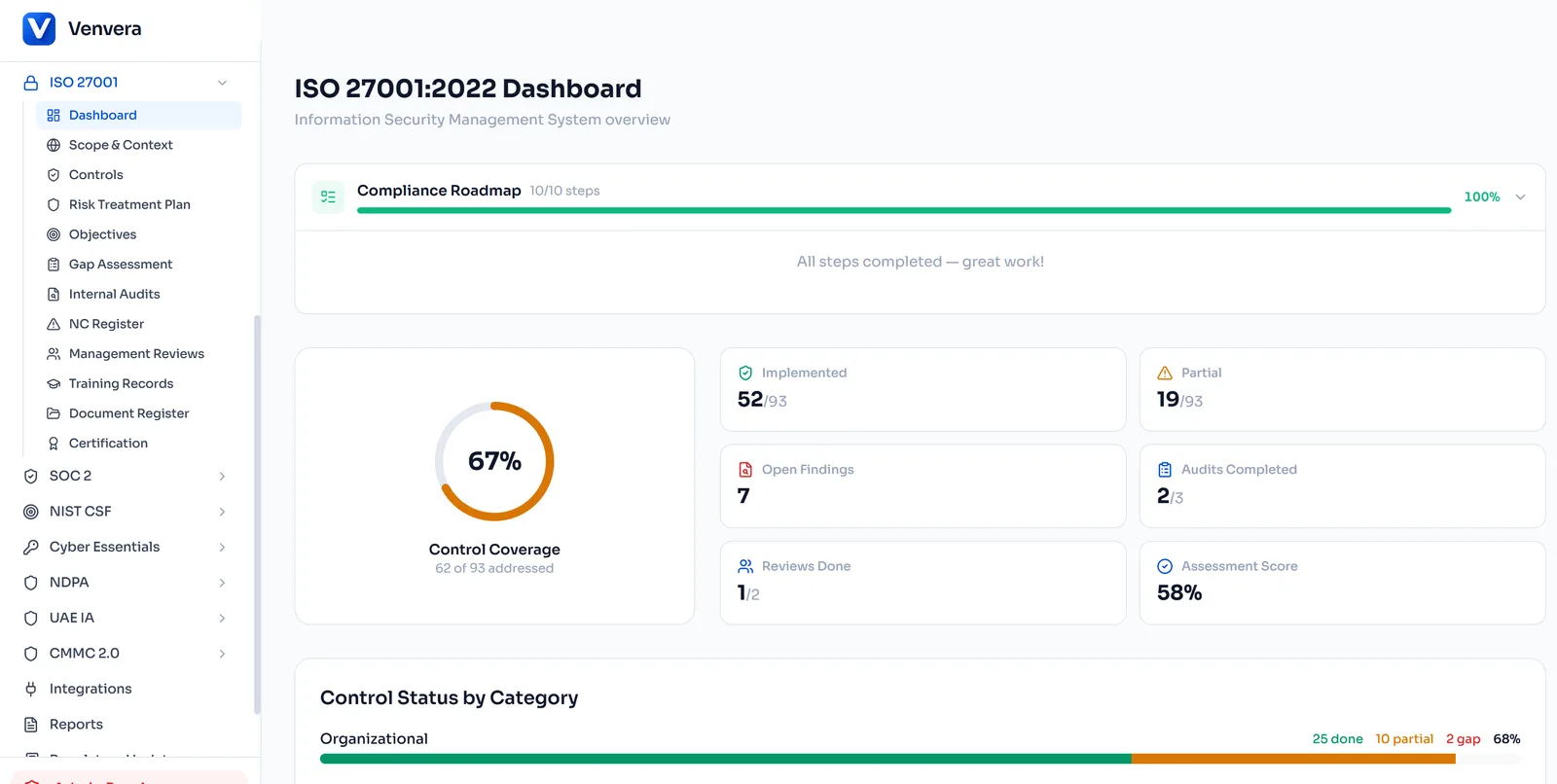
The ISO 27001 module covers the full standard: Annex A control management with all 93 controls mapped, gap assessments to identify where you stand, internal audit management with finding tracking, nonconformity management with corrective action workflows, and risk assessment with treatment planning. Evidence can be linked to controls, and the audit trail provides the documentation your certification body expects.
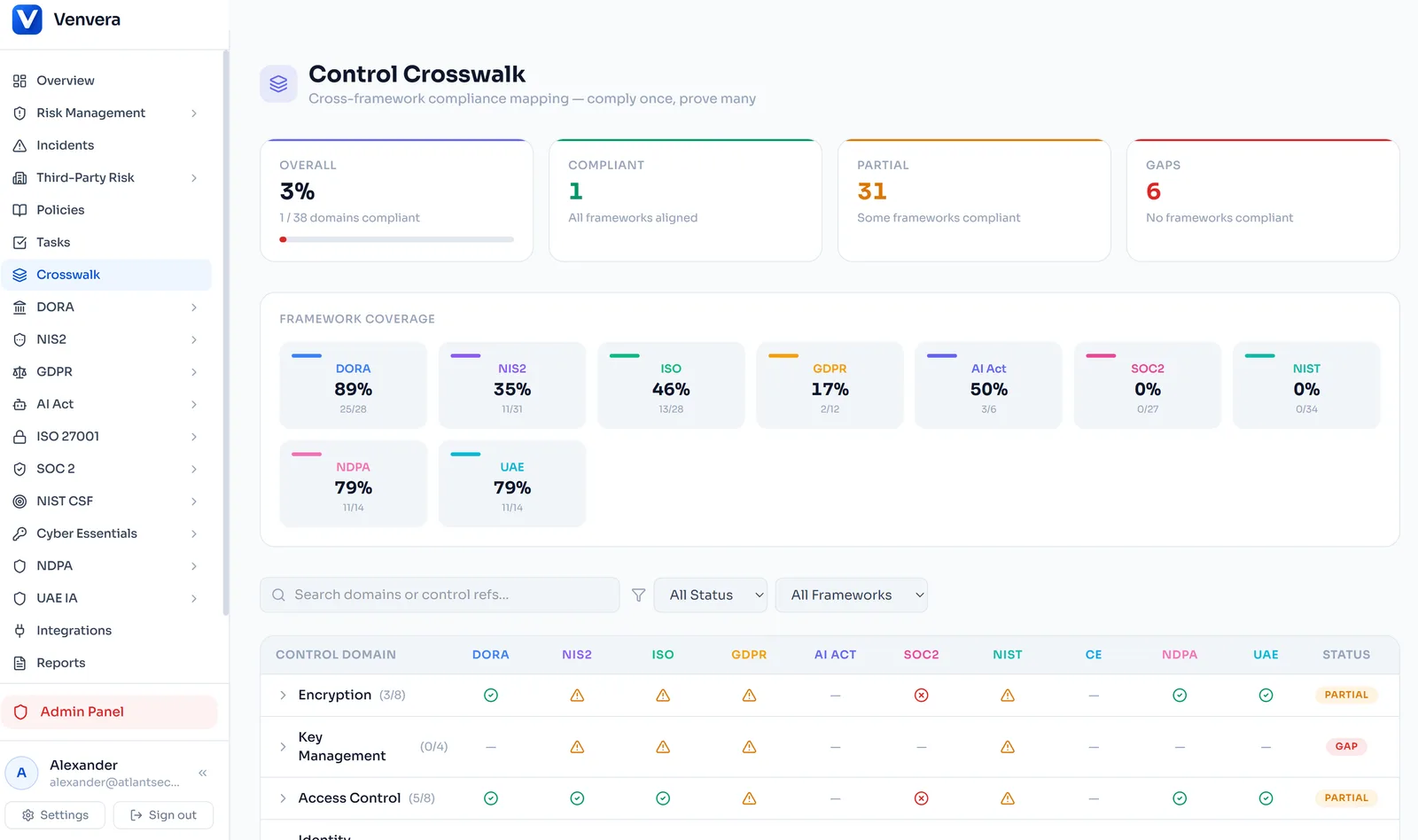
The distinguishing feature is cross-framework reuse. With pre-built cross-framework control mappings, an ISO 27001 control does not sit in a silo. Implement access control for ISO A.8.3 and the platform links it to the related DORA, NIS2, SOC 2 and NIST CSF requirements, so the same evidence supports readiness across each. For organisations subject to several EU regimes at once, that reuse reduces duplicated documentation.
Data is hosted in Amsterdam, giving EU data residency. Because the additional frameworks sit in the same platform, ISO 27001 can act as the starting point of a wider programme rather than a standalone project.
Strengths
- Full Annex A control management
- Pre-built cross-framework control mappings
- Multiple EU and international frameworks in one platform
- Gap assessment and risk management
- Internal audit and nonconformity tracking
- EU hosting (Amsterdam)
- Published pricing from €399/mo
Considerations
- Fewer automated infrastructure integrations than the automation-led tools
- Newer platform still building its ecosystem
- EU-focused rather than US-centric
Vanta
Best for: cloud-native technology companies that want heavy automation of evidence collection for an ISO 27001 certification.
Vanta's public documentation describes automated evidence collection from cloud infrastructure (AWS, Azure, GCP), identity providers, HR systems and development tools, along with a large integration catalogue, so many controls can be monitored continuously rather than checked periodically. For a technology company pursuing ISO 27001, that automation is a genuine strength.
The consideration for EU-facing buyers is coverage of EU-specific regimes. Depth of NIS2, DORA and EU AI Act support, data residency options and the price of adding frameworks are not fully clear from the public documentation reviewed in July 2026, so confirm these directly with Vanta if your roadmap includes them.
Strengths (per public docs)
- Strong automation for cloud-native teams
- Large infrastructure integration catalogue
- Continuous control monitoring
- Established auditor workflow
Verify with vendor
- Cost of adding further frameworks
- Depth of EU-specific regulatory coverage
- Data residency options
- Depth of cross-framework mapping
Drata
Best for: cloud-native teams that value continuous control monitoring and a polished interface for their ISO 27001 programme.
Drata's public materials describe continuous monitoring with automated tests against your infrastructure, a compliance dashboard for readiness at a glance, and a clean interface that supports team adoption. Like Vanta, it is positioned strongly for technology companies pursuing ISO 27001, handling evidence collection, control testing and auditor collaboration.
As with the other automation-led tools, the depth of EU-specific framework coverage (NIS2, DORA, EU AI Act) and the pricing for additional frameworks are not fully confirmed from the public documentation reviewed in July 2026. If multi-framework EU compliance is on your roadmap, confirm this with Drata before committing.
Strengths (per public docs)
- Continuous monitoring
- Clean, intuitive interface
- Automated control testing
- Auditor collaboration features
Verify with vendor
- Pricing for additional frameworks
- Depth of NIS2, DORA and AI Act coverage
- Breadth beyond infrastructure controls
- Depth of cross-framework mapping
Sprinto
Best for: startups and smaller teams pursuing a first ISO 27001 certification on a limited budget.
Sprinto is positioned as a budget-friendly compliance platform for startups and growing companies. Its public materials describe an ISO 27001 module with guided workflows, policy templates and automated evidence collection, which helps teams without dedicated compliance staff work through a first certification.
For buyers, the questions to confirm are scope and depth for more complex environments, and coverage of EU-specific frameworks such as NIS2, DORA and the AI Act, which are not confirmed from the public documentation reviewed in July 2026. If those regimes are on your horizon, check with Sprinto whether the platform is intended to grow with you or serve as a first step.
Strengths (per public docs)
- Positioned as an affordable option
- Guided certification workflows
- Aimed at first-time certification
- Quick setup
Verify with vendor
- Breadth of framework coverage
- Suitability for complex environments
- NIS2, AI Act and DORA support
- Fit as your obligations expand
OneTrust
Best for: large enterprises that already run OneTrust and want ISO 27001 inside an existing GRC deployment.
OneTrust's GRC module includes ISO 27001 support with enterprise risk assessment, policy management and control tracking. For large organisations already using OneTrust (common for privacy management), adding ISO 27001 builds on a platform the team already knows, and the risk assessment capabilities are mature.
The considerations are cost and implementation effort. OneTrust's ISO 27001 capabilities sit in its GRC module, priced separately from its privacy modules, and enterprise deployments typically involve professional services and a multi-month timeline. Exact pricing is not published; confirm scope and cost directly with OneTrust.
Strengths (per public docs)
- Enterprise-grade risk management
- Mature policy management
- Integrates with existing OneTrust
- Strong audit capabilities
Verify with vendor
- Per-module pricing
- Implementation timeline
- Professional-services requirement
- Fit for mid-market budgets
📊
Head-to-Head
Feature Comparison Table
Venvera entries reflect its own product. Competitor entries reflect the public documentation reviewed in July 2026: "Confirmed" means the capability is described in that documentation, and "Verify with vendor" means it was not confirmed there and should be checked directly, not that it is unsupported.
| Feature | Venvera | Vanta | Drata | Sprinto | OneTrust |
|---|---|---|---|---|---|
| Annex A Control Management | Full (93 controls) | Confirmed | Confirmed | Confirmed | Confirmed |
| Internal Audit Management | Full | Verify with vendor | Verify with vendor | Verify with vendor | Confirmed |
| Risk Assessment | Full | Confirmed | Confirmed | Verify with vendor | Confirmed |
| Nonconformity and CAPA | Full | Verify with vendor | Verify with vendor | Verify with vendor | Confirmed |
| Automated Evidence Collection | Manual and upload | Confirmed (large catalogue) | Confirmed | Confirmed | Verify with vendor |
| Cross-Framework Mapping | Pre-built (multi-framework) | Verify with vendor | Verify with vendor | Verify with vendor | Verify with vendor |
| DORA Support | Native | Verify with vendor | Verify with vendor | Verify with vendor | Verify with vendor |
| NIS2 Support | Native | Verify with vendor | Verify with vendor | Verify with vendor | Verify with vendor |
| EU Data Hosting | Amsterdam | Verify with vendor | Verify with vendor | Verify with vendor | Verify with vendor |
🔗
The ISO 27001 Multiplier
Your ISO 27001 Controls Overlap With Other Frameworks
ISO 27001 is often the first information security certification an organisation pursues. The controls implemented for it overlap with regulatory requirements teams face next. Without cross-framework mapping, that overlap has to be re-established by hand for each regime.
Illustrative: ISO 27001 controls that overlap across frameworks
| ISO 27001 Control | DORA | NIS2 | SOC 2 |
|---|---|---|---|
| A.5.1 Info Security Policy | Art. 6 | Art. 21(2)(a) | CC1.1 |
| A.8.3 Access Restriction | Art. 9 | Art. 21(2)(i) | CC6.1 |
| A.5.24 Incident Mgmt | Art. 17 | Art. 23 | CC7.3 |
| A.8.24 Cryptography | Art. 9 | Art. 21(2)(h) | CC6.7 |
| A.5.29 Business Continuity | Art. 11 | Art. 21(2)(c) | A1.2 |
In Venvera these mappings are pre-built, so an implemented ISO control is linked to the related NIS2, SOC 2 and DORA requirements without manual cross-referencing. The article references above are illustrative; confirm the current mapping for your scope in the platform.
Be realistic about what mapping buys you. It removes the re-documentation, and it leaves the judgement where it was: a NIS2 supervisor and a certification auditor can look at the same access control and want different wording wrapped around it. What you save is the second inventory, the second evidence hunt and the second round of chasing owners for screenshots, which is where the calendar time actually goes.
This is the core argument for a platform with deep cross-framework mapping: an ISO 27001 certification effort can serve as readiness evidence across the other regulations you face. Without mapping, each regulation is a separate project. With mapping, later frameworks become incremental work on a shared foundation.
💰
Cost Analysis
Pricing Comparison
ISO 27001 software ranges from affordable SaaS to enterprise-scale deployments. Most vendors on this list do not publish detailed pricing, so the figures below describe the pricing model rather than exact costs. A useful question when comparing is how the total changes when you add NIS2, DORA or GDPR.
Keep the subscription in proportion. The certification body, the internal audit effort and the hours your engineers spend producing evidence often add up to more than the platform does, so squeezing hard on licence cost while ignoring how much manual chasing a tool removes is the wrong trade to optimise.
| Platform | Pricing Model | Adding more frameworks |
|---|---|---|
| Venvera | Published, from €399/mo | Multiple frameworks available in the same platform |
| Vanta | Not publicly published; per-framework (verify with vendor) | Confirm per-framework cost with vendor |
| Drata | Not publicly published; per-framework (verify with vendor) | Confirm per-framework cost with vendor |
| Sprinto | Not publicly published; per-framework (verify with vendor) | Confirm framework coverage and cost with vendor |
| OneTrust | Not publicly published; per-module (verify with vendor) | Additional modules and implementation typically extra |
How to model the cost over time
Many organisations start with ISO 27001 and add other frameworks within a couple of years. When comparing, ask each vendor for a written quote covering every framework you expect to need, so you compare full programme cost rather than the single-framework entry price. With a per-framework or per-module model the total rises with each addition; with a platform that includes several frameworks it is more predictable. Confirm the current numbers with each vendor.
✅
Conclusion
Which of the five fits you
If you are starting from nothing, settle scope and run the risk assessment before you buy anything. Scope is the decision that shapes every other cost in the programme, it is cheap to change on a whiteboard, and it is painful to change once controls, evidence and an auditor are attached to it. Tool selection can wait; a badly drawn scope follows you through every surveillance audit afterwards.
All five platforms can support an ISO 27001 programme. The right choice depends on what comes next. If ISO 27001 is your main requirement and you are a cloud-native technology company, Vanta and Drata offer strong automation. If you are budget-constrained and pursuing a first certification, Sprinto is worth a look. If you already run OneTrust across the enterprise, adding ISO 27001 there keeps things in one place.
For EU-facing organisations where ISO 27001 sits alongside NIS2, DORA and GDPR, Venvera is designed for that case: implemented Annex A controls are mapped to related requirements in other frameworks, data is hosted in the EU, and pricing is published from €399/mo. That makes ISO 27001 a foundation for a wider programme rather than a standalone project.
Whichever you choose, treat these notes as a starting point and confirm current capabilities, coverage and pricing with each vendor before you decide. A tool supports your readiness for certification; the certification decision rests with your auditor.
See how ISO 27001 controls carry across frameworks
Venvera maps your ISO 27001 Annex A controls to related NIS2, SOC 2, DORA and GDPR requirements, with EU data hosting. Book a demo to see the crosswalk with your own scope.
Book a Demo →Last reviewed: July 2026. Comparison produced from public vendor documentation and the Venvera product. Confirm current pricing and features with each vendor.