
Learn
You are not alone if the DORA ICT Register of Information (RoI) feels like a slow grind.

It is not just “a spreadsheet”.
It is a structured dataset that forces your business, procurement, IT, risk, and legal teams to agree on one version of the truth.
Then you must ship it in a machine-readable reporting format. xBRL-CSV.
Supervisors run rules on it. They bounce it back when it breaks.
If you do this in email threads and Excel tabs, it will hurt.
If you build a clean data model and a repeatable workflow, it becomes boring. The good kind of boring.
This article explains where the pain comes from, what breaks most often, and how to get to a clean xBRL-CSV export fast.
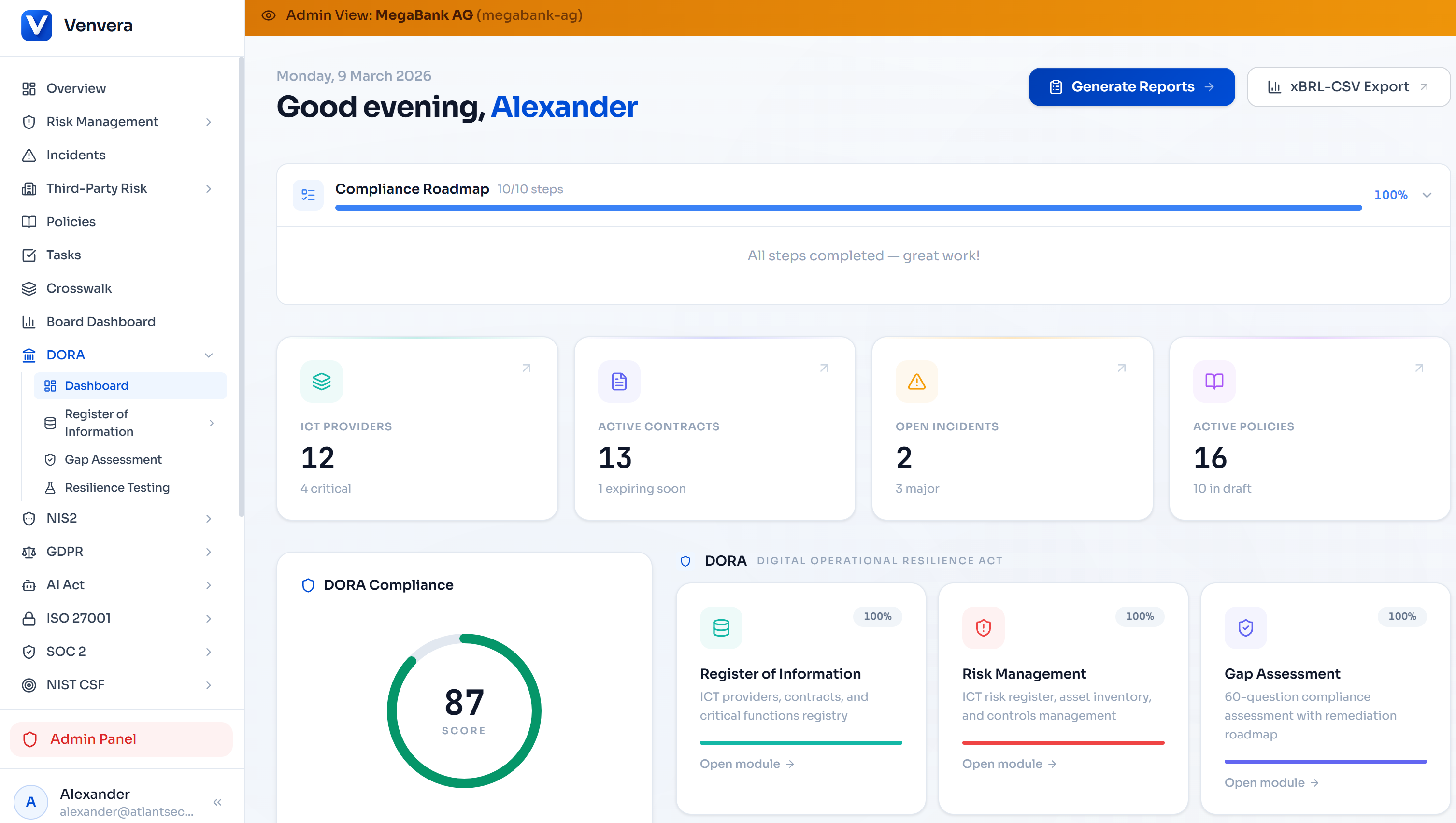
Venvera exists for exactly that: you fill the info once, keep it clean, and export xBRL-CSV without hand-building files.
What the RoI really is
DORA requires financial entities to maintain a register of all contractual arrangements for ICT services provided by ICT third-party service providers.
Not once.
Continuously.
And at multiple levels if you are in a group.
The EBA describes the goal in plain terms:
- You need a comprehensive register of ICT third-party contractual arrangements
- At entity, sub-consolidated, and consolidated levels
- So entities can monitor ICT third-party risk
- So competent authorities can supervise it
- So the ESAs can identify critical ICT third-party providers (CTPPs)
That last part matters.
Your RoI data feeds the EU-level oversight regime for providers that may become “critical”.
So the RoI is not “paperwork”.
It is a supervisory dataset.
Why it hurts: the RoI forces cross-team truth
Most compliance work fails in one place.
Ownership.
The RoI cuts across:
- Procurement and vendor management
- Legal and contract owners
- IT service owners
- Security and risk
- Business owners for functions and processes
- Group governance (for consolidated reporting)
DORA does not care how you split responsibilities inside the firm.
The file you submit is your problem.
Dutch Central Bank (DNB) says it directly: accuracy and completeness remain your responsibility.
So the RoI hurts because it exposes gaps you already had:
- No single vendor inventory
- No single contract inventory
- No clean “service to system to function” mapping
- No agreed view on “critical or important functions”
- No consistent provider identifiers (LEI, EUID, group structure)
- No clean view of subcontracting chains
The real trigger: reporting is structured, validated, and time-bound
A RoI is not “free text”.
It is:
- Templates
- Data types
- Controlled value lists
- Referential integrity between tables
- Validation rules
- Filing rules for xBRL-CSV packaging
The EBA publishing stack makes this explicit:
- Data model
- Technical package
- Validation rules
- Data Point Model dictionary
- Sample files
- Filing rules
- Data quality feedback packs
Supervisors also run automated checks and expect resubmissions when errors appear.
So the RoI hurts because it behaves like regulatory reporting, not like a policy document.
What you actually have to report
The templates come from Implementing Technical Standards (ITS) that are adopted and published in the Official Journal.
In practice, firms experience the RoI as a set of linked tables.
You can see the structure in the illustrative Excel templates published by the EBA.
The RoI typically captures:
- Who is reporting (entity and group context)
- Which ICT providers you use
- Which contracts exist
- Which services are delivered
- Which functions and business lines those services support
- Where data and service delivery happen
- Whether subcontractors are involved
- Whether the service supports critical or important functions
- Key contractual attributes needed for third-party risk oversight
And you submit it annually to your national supervisor, who then shares it with the ESAs.
Deadlines vary by supervisor.
Examples from supervisors:
- DNB required submission by 23 April 2025 and specified xBRL-CSV format
- Malta MFSA sets an annual reporting period and says the submission counts only once it is “Accepted”, with regulatory action as a stated consequence for failure
So you are not only building data.
You are meeting a reporting gate.
Pain map: where teams lose weeks
Here is where the RoI usually destroys timelines.
| Pain point | What it looks like inside the firm | Why it blocks submission | What fixes it |
|---|---|---|---|
| Vendor sprawl | 300 to 2,000 “vendors”, no ICT filter | You cannot decide what belongs in scope | Set an ICT service definition and tag vendors to it |
| Contract sprawl | Multiple contracts per provider, unclear owners | You cannot populate contract-level fields | Build a contract inventory with owners and reference IDs |
| Service mapping | People name “Zoom” and “Teams” but not services | Templates want services, not product names | Create a service catalog per provider |
| Function mapping | Nobody owns “critical or important” mapping | Mandatory flags and dependencies stay blank | Define functions, owners, and criteria once |
| Subcontracting | Provider says “we use partners” | Templates ask about supply chain | Add supplier declarations to onboarding and renewals |
| Identifiers | No LEIs, inconsistent legal names | Validation fails on identifiers | Standardize legal entities and identifiers early |
| Group reporting | Local entities act alone | Consolidated view is missing | Build group entity model and roll-up logic |
| xBRL-CSV export | Teams try to hand-build files | Packaging and rules break | Use a tool that exports valid xBRL-CSV from the data model |
Many firms burn time in the last row.
They finish “the spreadsheet”.
Then they discover the real job starts: producing a valid xBRL-CSV package.
Why xBRL-CSV makes it feel worse than it should
xBRL-CSV is not “a CSV”.
It is a set of CSV tables plus metadata and taxonomy references that make the data machine-readable.
Supervisors then run:
- Technical checks
- Business checks
- Data quality checks
They also check identifiers like LEIs and EUIDs.
If you build the package by hand, you face predictable failure modes:
- Wrong table layout or naming
- Missing required columns
- Wrong value codes
- Broken relationships between tables
- Wrong date formats
- Wrong entity identifiers
- Wrong taxonomy references
- Missing package pieces
Some supervisors offered an Excel fallback for early cycles and convert it for you, but they still place responsibility on you.
Others are direct: you must submit in the required “plain-csv” format and they will not provide extensive technical help.
So the pain spikes because teams try to turn a governance deliverable into a reporting deliverable at the last moment.
The hidden killer: the RoI is a graph, not a list
Most teams treat the RoI like a list of vendors.
That fails.
A RoI is closer to a graph:
- Entity
- Provider
- Contract
- ICT service
- Supported function
- Data location
- Subcontractor chain
- ICT service
- Contract
- Provider
If your data model cannot express those links cleanly, you get:
- Duplicate providers
- Duplicate contracts
- Conflicting service names
- Missing dependencies
- Impossible roll-ups for group reporting
The EBA references a RoI data model and a Data Point Model (DPM) to make this structured.
That is your clue.
Treat this like a data product.
Not a spreadsheet.
The top reasons validation fails
Supervisors do not reject your RoI because your wording is ugly.
They reject it because your data breaks rules.
Based on the EBA’s validation-centric reporting stack and supervisors’ process descriptions, these are common failure drivers:
- Entity identity issues
- Incorrect legal entity identifiers
- Inconsistent naming across tables
- Provider identity issues
- Missing LEIs where expected
- Wrong country codes
- Legal name mismatches
- Broken table relationships
- Contract references a provider ID that does not exist
- Service references a contract ID that does not exist
- Invalid controlled values
- Wrong code lists for dropdown fields
- Free text where codes are required
- Date logic errors
- End date before start date
- Missing mandatory dates
- Critical function flags without justification structure
- Marked as supporting critical functions but missing linked details
- Subcontractor chain fields left blank
- Often because the provider never gave you data
- xBRL-CSV packaging mistakes
- Missing files
- Wrong folder structure
- Wrong metadata
DNB describes an automated validation feedback loop and resubmission requests after errors.
MFSA describes “Accepted” versus “Rejected” status and expects you to fix feedback and resubmit.
So your workflow must assume resubmission.
Your job is to reduce the number of cycles.
Why subcontracting data is a special kind of pain
Subcontracting fields turn the RoI into supply chain reporting.
That is where firms lose control.
Reasons:
- Your contract might not force disclosure of subcontractors
- Your provider’s subcontractor list changes often
- The provider may define “sub-processor” differently than you define “subcontractor”
- Global providers have layered group structures
- Local teams do not know which group entity signs the contract
If you want this to stop hurting, change onboarding and renewals:
- Add a structured vendor questionnaire for RoI fields
- Add a clause that requires updates on subcontracting changes
- Require named legal entities for the provider and key subcontractors
- Require data location and service delivery location data, in a structured format
Then your RoI becomes a byproduct of vendor governance, not a fire drill.
Group reporting: the pain multiplies
AFM explains the RoI must be provided at the right consolidation level, based on whether you are part of a group and where the parent sits.
This triggers predictable problems:
- The group wants one approach
- Local entities already use their own vendor tools
- Shared services create duplicates and inconsistencies
- Intra-group ICT services get missed or misclassified
- Contracts signed by parent entities get lost from local inventories
Fix pattern:
- Define one group entity model
- Define one provider master record policy
- Define one contract reference ID scheme
- Define one service catalog naming scheme
- Roll up from entity-level RoIs into consolidated RoIs through rules, not manual merges
If you merge spreadsheets, you will create errors faster than you can fix them.
What supervisors are signaling with this dataset
Ask yourself a blunt question.
Why does DORA demand a RoI at this depth?
Because supervisors want to see concentration and dependency.
Across:
- Providers
- Services
- Functions
- Sectors
- Countries
- Group structures
The EBA states that registers help competent authorities supervise ICT and third-party risk, and help the ESAs designate critical third-party providers.
So the RoI is also a market-level risk lens.
That means sloppy data is not a small issue.
It creates blind spots in systemic oversight.
That is why you see automated checks, data quality feedback, and strict submission states.
The simplest way to stop the pain: build the RoI like a product
You need five moves.
1) Build a single source of truth
One dataset for:
- Entities
- Providers
- Contracts
- Services
- Functions
- Subcontractors
Not five spreadsheets.
Not email threads.
2) Assign owners per object
Ownership by object beats ownership by “the RoI”.
Example:
- Provider owner: vendor management
- Contract owner: legal or procurement
- Service owner: IT service owner
- Function owner: business owner
- Criticality owner: risk and compliance
3) Capture data in the format you will report
If a field is a controlled list, capture it as a controlled list.
If a field expects a code, store the code.
If you store free text, you will rework everything at export time.
The EBA publishes lists of values and the technical package to support this.
4) Validate early, not at the deadline
Run checks weekly during build.
Not once at the end.
Supervisors run automated validations anyway.
You want the first time you see an error to be inside your process, not inside the supervisor portal.
5) Export xBRL-CSV from the data model
Do not “construct the file”.
Generate it.
From clean tables.
That is the switch from pain to boring.
A practical workflow you can run in 30 days
If you have nothing clean today, this pattern works.
Day 1 to 5
- Freeze scope rules
- What counts as ICT service in your firm
- Which vendor types are out
- Build entity list for reporting levels
- Decide on IDs for providers, contracts, services
Day 6 to 15
- Import vendor and contract sources
- Procurement system
- AP spend
- Contract repository
- CMDB or service tools
- De-duplicate providers
- Map contracts to providers
- Tag which contracts include ICT services
Day 16 to 23
- Build service catalog per provider
- Map services to functions
- Flag critical or important function support
- Collect subcontracting data from providers
Day 24 to 27
- Run validation rules internally
- Fix referential breaks
- Fix controlled value issues
- Fill missing identifiers
Day 28 to 30
- Export xBRL-CSV
- Pre-check packaging
- Submit
- Plan for feedback and resubmission cycle
This is also the moment you decide if you want to do this again next year the same way.
Or if you want a platform that keeps it clean all year.
Where Venvera fits
Venvera is built for the part that hurts most:
Turning messy cross-team inputs into a clean RoI dataset, then exporting valid xBRL-CSV.
What that means in practice:
- You structure data around the RoI objects
- entities, providers, contracts, services, functions, subcontractors
- You keep relationships intact
- no broken references between tables
- You keep controlled values controlled
- fewer “invalid code” failures at validation time
- You export xBRL-CSV automatically
- no manual package building
That last step is the difference between:
- “We finished the spreadsheet”
- “We submitted a valid report”
If you want your RoI to stop being a yearly trauma, you need the work to shift left.
Capture clean data during onboarding, renewals, and change management.
Venvera makes that workflow realistic for small teams.
Questions you should ask your team today
- Do you have one list of ICT providers that everyone trusts?
- Can you answer “which functions depend on provider X” in 60 seconds?
- Can you identify which contracts support critical or important functions without debate?
- Can you list subcontractors for your top 20 providers with evidence?
- Can you produce xBRL-CSV without hand edits?
If any answer is “no”, your next RoI cycle will hurt again.
Unless you change the system.
Quotes you can use in internal buy-in decks
“Financial entities … will need to have a comprehensive register of their contractual arrangements with ICT third-party service providers available at entity, sub-consolidated and consolidated levels.”
“You must report the information register as an xBRL-CSV file with a table-oriented layout for the data.”
“A RoI submission is only considered DORA compliant once it attains the status of ‘Accepted’ … Failure to submit … may result in regulatory action …”
Sources
EBA preparations and technical package hub:
https://www.eba.europa.eu/activities/direct-supervision-and-oversight/digital-operational-resilience-act/preparation-dora-application

EBA ITS page for RoI templates:
https://www.eba.europa.eu/activities/single-rulebook/regulatory-activities/operational-resilience/implementing-technical-standards-establish-templates-register-information

DNB reporting guidance (example supervisor deadlines and format):
https://www.dnb.nl/en/sector-news/supervision-2025/dora-reporting-dora-registers-of-information-in-april-2025/

AFM RoI page (annual sharing and consolidation level concept):
https://www.afm.nl/en/sector/themas/belangrijke-europese-wet-en-regelgeving/dora/informatieregister

MFSA circular (reporting timelines and “Accepted” status):
https://www.mfsa.mt/images/uploads/2025/11/Regulation-EU-20222554-on-Digital-Operational-Resilience-for-the-Financial-Sector-%E2%80%93-Register-of-Information-Reporting-Timelines-for-the-Year-2026-and-Onwards.pdf

EBA illustrative RoI templates (Excel):
https://www.eba.europa.eu/sites/default/files/2024-01/e9e1b5e2-dc1f-45fa-a03b-2c1cfaecf84f/RegisterInformationTemplatesIllustration%20%281%29.xlsx

Central Bank of Ireland RoI reporting page (recent supervisor guidance example):
https://www.centralbank.ie/regulation/digital-operational-resilience-act-dora/reporting-registers-of-information
Call to action
If you want to stop building the RoI in spreadsheets and stop fighting xBRL-CSV packaging, set up Venvera and run one pilot export with your top 20 ICT providers this week.
Go to Venvera and test a full RoI flow end-to-end:
- capture
- validate
- export xBRL-CSV
When you see a clean export, you will not want to go back.